Behind every plastered wall sits a network of cables, pipes and vents that most homeowners only think about when something fails. In 2026, that network still commands a serious slice of any renovation budget: an EICR costs £150–£350, a consumer unit upgrade runs £400–£900, and a full rewire on a typical semi is £3,500–£10,000 before a single socket goes back on the wall.
This guide brings our electrics, heating, plumbing, ventilation and smart home library together in one place, organised by the job you’re actually trying to do, whether that’s adding an outdoor socket, choosing a towel radiator, or working out if a security light needs a registered competent person. Every section links through to a dedicated guide with full 2026 UK pricing and the regulations that apply.
Electrics & Safety
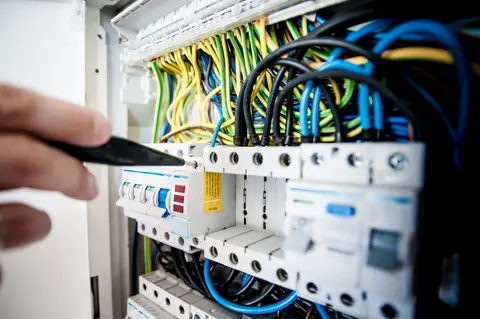
A consumer unit upgrade costs £400–£900 and is worth pairing with an EICR at £150–£350. Homeowners are advised to have an EICR at least every 10 years, and landlords in England must have the electrics checked at least every 5 years.12 Check cable types and sizes match the circuit before trusting old wiring, and learn the signs you need a rewire: a full one runs £3,500–£10,000. Powering a detached space means wiring a garage’s electrics with its own consumer unit, typically £800–£2,500.
Sockets, Switches & Lighting
Adding a socket to a room costs £80–£200 depending on cable run; an outdoor socket needs RCD protection and a cable run protected against damage, usually armoured cable, at £180–£400; and USB or smart sockets swap in for £60–£100. Match dimmer switches to your bulbs, leading- vs trailing-edge, or expect flicker. Choose ceiling lights with downlights rated for contact with insulation wherever it sits above them, and fire-rated downlights where the ceiling has to resist fire, ideally following a proper home lighting design rather than one central pendant. LED strip lighting runs £3–£30/m for stairs and cabinets, and smart lighting adds app control from around £200 for a room.
Heating & Hot Water Controls
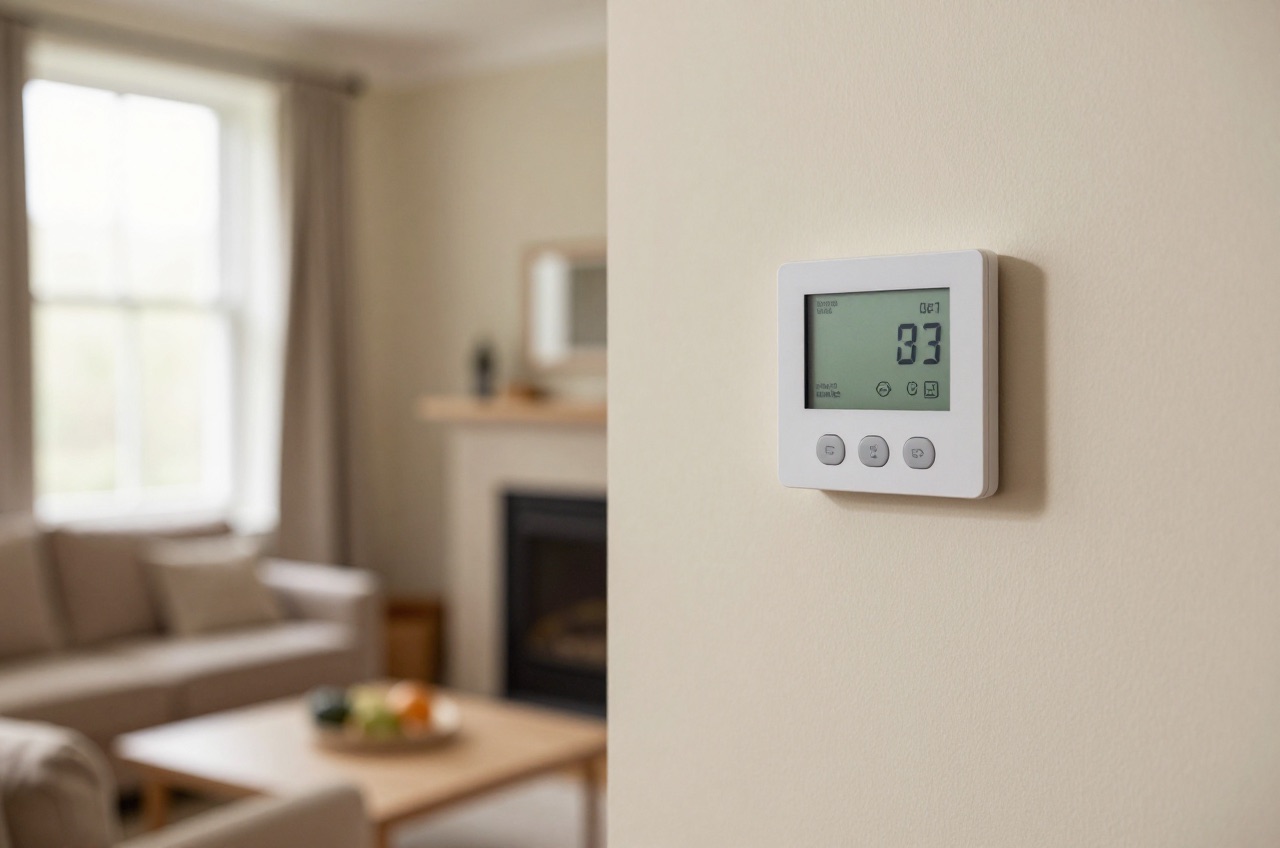
Radiator sizing starts from each room’s heat loss, often estimated with a BTU-per-m³ rule of thumb, and radiators span £30–£800+ per unit. When a boiler is replaced in an existing home, Part L expects each room to be given thermostatic room controls, which usually means fitting thermostatic radiator valves.3 Weighing radiators against underfloor heating? Budget £150–£400 per room versus £60–£120/m² for wet UFH, plus £300–£900 for underfloor heating manifolds and zone controls. In the bathroom, a towel radiator needs 1,000–2,500 BTU and costs £60–£400, and a smart room thermostat to tie the system together costs £100–£300.45
Plumbing, Drainage & Ventilation
Soil and waste pipes follow Part H: a stack serving a standard WC should be at least 100 mm in internal diameter (110 mm plastic pipe in practice), with 32–50 mm branches for basins, baths and showers.6 Guttering and downpipes cost £400–£900 in uPVC or up to £2,500 in cast iron. Indoors, bathroom ventilation and extractor rules set a minimum 15 l/s extract rate for an intermittent bathroom fan, and choosing the right extractor fan, humidity-sensing or basic, changes the £80–£150 installed cost.7 For whole-house airtight retrofits, MVHR ventilation costs £2,500–£6,000 and recovers most of the heat from the stale air it extracts.
Security, Smart Home & Networking
Upgrade to BS 3621 door locks and key-locking window locks for £150–£350, the best-value single security fix, or add keyless convenience with a smart lock from £80–£400. Outside, home CCTV spans a £100 DIY kit to a £2,200 installed system, and a video doorbell is £80–£300 wired or battery. PIR security lighting costs £100–£200 fitted, and wiring it is notifiable under Part P only if it needs a new circuit.8 A monitored home alarm system costs £600–£1,500 plus £15–£40 a month and may earn a discount on home insurance, while valuables belong in a home safe rated to EN 1143-1. A smart home hub tying Zigbee or Matter devices together starts around £30–£120, and home network data points cost £80–£200 each, cheaper to run while walls are open. Outdoors, an electric fence for a garden boundary costs £300–£900 installed.
Costs & Day Rates
Electricians in this cluster typically charge £40–£80 an hour, with day rates scaling from there depending on region and whether the job is notifiable. The table below pulls together headline 2026 figures from across this guide, so you can see where a modest job sits against a major one.
| Job | Typical 2026 Cost |
|---|---|
| EICR (electrical safety check) | £150–£350 |
| Consumer unit upgrade | £400–£900 |
| Full house rewire | £3,500–£10,000 |
| Adding a socket | £80–£200 |
| Bathroom extractor fan, installed | £80–£150 |
| MVHR system, 3-bed house | £2,500–£6,000 |
| Wet underfloor heating | £60–£120/m² |
| Monitored alarm system | £600–£1,500 + £15–£40/month |
Most of these prices assume straightforward access and an existing circuit or supply to extend from. Long cable runs, solid floors, or a consumer unit that also needs upgrading will push any of them toward the top of the range.
Book the EICR Before
First Fix, Not After An EICR before any work starts is the cheapest way to find out whether your consumer unit, cabling or earthing needs upgrading. Finding out once walls are replastered costs far more in disruption than sorting it up front.
When You Need a Certified Trade vs DIY
Under Part P of the Building Regulations, three kinds of electrical work are notifiable: a new circuit, a replacement consumer unit, and any addition or alteration to circuits in a special location, meaning the space around a bath or shower or a room with a swimming pool or sauna.8 Notifiable work must either be carried out by a registered competent person who self-certifies it, or be notified to Building Control before it starts. Gas follows similar logic: anyone working on a boiler, gas fire or gas pipework as an employer or self-employed person must by law be a member of the class approved by the Health and Safety Executive, which is the Gas Safe Register.9 A plumber registered with a competent person scheme can self-certify a new bathroom or other sanitary installation that does not involve work on shared or underground drainage; new or altered underground drains fall under Part H and normally need a building control application.10
Genuinely low-risk DIY territory is narrower than people assume: replacing a like-for-like light fitting or socket on an existing circuit, fitting a TRV or smart thermostat head, or swapping a shower head. Anything involving a new circuit, a consumer unit, or a gas or drainage connection is a job for a certified trade, the cost of getting it wrong, from invalidated insurance to an unsellable house, dwarfs the saving.
Where to Start
If you don’t know where your home’s systems currently stand, start with an EICR, a £150–£350 report that flags anything unsafe before you spend on anything else. If it flags the fuse board, consumer unit types and upgrade costs explains what a compliant replacement involves, and if it flags the wiring itself, the signs you need a rewire will tell you whether you’re looking at a partial fix or a full £3,500–£10,000 rewire.
References (10)
Figures in this note were checked against the sources below on 30 September 2026. Superscript numbers in the text point to them. Every source the site cites, by topic.
- 1technicalvery strongMinistry of Housing, Communities and Local Government, guidance.RN-M6FECMGovernment guidance on the Electrical Safety Standards Regulations in England, which require landlords to have installations inspected and tested at least every five years.
- 2technicalstrongNICEIC, guidance.RN-2WKL0UNICEIC's householder guide to EICRs: no legal duty for owner-occupiers, but an inspection at least every 10 years is recommended, and what the report involves.
- 3technicalvery strongMinistry of Housing, Communities and Local Government.RN-L0FCJXThe in-force U-value tables a DIY insulation or door note must quote, with the exact numbers. Table 4.2, limiting U-values for new fabric elements in existing dwellings, sets roof 0.15, wall 0.18, floor 0.18, swimming pool basin 0.25, window 1.4 or Window Energy Rating Band B minimum, rooflight 2.2, doors with more than 60 per cent of the internal face glazed 1.4 or Doorset Energy Rating Band C minimum, and other doors 1.4 or Doorset Energy Rating Band B minimum. Table 4.3, for existing elements, gives a roof threshold of 0.35 and an improved value of 0.16, which is the figure a loft insulation note needs: paragraph 4.12 says a retained element whose U-value is higher than the column (a) threshold, for example through a loft or garage conversion, should be upgraded to the column (b) value. Paragraph 4.13 allows a lesser upgrade only where the improved value is not technically or functionally feasible or would not achieve a simple payback of 15 years or less. Paragraph 4.8 requires a replacement element to be no worse than the one it replaces as well as meeting Table 4.2. Paragraph 4.10 gives the heritage exception: where character must be maintained, a centre pane U-value of no more than 1.2 or low-emissivity secondary glazing. Note 9 records that the timber window concession of 1.6 or Band C ended on 14 June 2023. The 2021 edition came into force on 15 June 2022; a 2026 edition exists at https://assets.publishing.service.gov.uk/media/69c122a6cfa346b9d4704a55/ADL1_2026.pdf.
- 4costsupplier figureScrewfix.RN-PPB6ITA price, true at 2026-09. the retail price Screwfix publishes for jg underfloor jgstat4bl wired programmable thermostat black 240v, which is the supply figure the cost book records for this item
- 5costsupplier figureToolstation.RN-GQWUKXA price, true at 2026-09. the retail price Toolstation publishes for the Hive V4 Smart Thermostat Hubless - Combi Boiler & Multizone OpenTherm, which is the supply figure the cost book records for this item
- 6technicalvery strongMinistry of Housing, Communities and Local Government.RN-SM6TRWThe statutory source for soakaway design and the discharge hierarchy every garden drainage note should state. Requirement H3(3) lists the order of priority for rainwater discharge: (a) an adequate soakaway or other adequate infiltration system, or where not reasonably practicable (b) a watercourse, or where not reasonably practicable (c) a sewer. Paragraph 3.25 bars infiltration devices within 5 metres of a building or road, in ground where the water table reaches the bottom of the device at any time of year, too close to other drainage fields or soakaways, or where contamination could pollute groundwater. Paragraph 3.26: soakaways serving less than 100 square metres are generally square or circular pits filled with rubble or lined with dry-jointed masonry or perforated ring units. Paragraph 3.27: design to a return period of once in ten years, and for small soakaways serving 25 square metres or less a design rainfall of 10mm in 5 minutes may be assumed as the worst case. Paragraph 3.28 requires percolation tests to derive the infiltration rate, and paragraph 3.30 sends larger soakaways to BS EN 752-4 or BRE Digest 365 Soakaway design. Paragraphs 2.10 to 2.12 cover pervious paving over a granular storage reservoir and warn against its use where sediment or oil spillage would block the pores. For foul drainage, paragraph 2.33 sets a minimum 75mm internal diameter, or 100mm for a WC, and Table 6 gives minimum gradients of 1 in 40 for 75mm and 100mm at peak flows under 1 litre per second.
- 7technicalvery strongMinistry of Housing, Communities and Local Government.RN-QD1SFFTable 1.1 sets minimum intermittent extract rates: kitchen with a cooker hood extracting outside 30 l/s, kitchen without one 60 l/s, utility room 30 l/s, bathroom 15 l/s, sanitary accommodation 6 l/s. Extract terminals and fans other than cooker hoods should be as high as practicable and no more than 400mm below the ceiling; a cooker hood should sit between 650mm and 750mm above the hob if the manufacturer gives no figure. Table 1.7 requires background ventilators of at least 8000mm2 equivalent area in habitable rooms and kitchens for a dwelling, 10,000mm2 for a single-storey dwelling. Background ventilators should be at least 1700mm above floor level and at least 500mm from a fan in the same room. On replacement windows, paragraph 3.14 says new windows must carry background ventilators no smaller than the originals, and paragraph 3.15 gives the fallback minimums where the old size is unknown: 8000mm2 habitable rooms, 8000mm2 kitchen, 4000mm2 bathroom. Paragraph 3.32 confirms that replacing an extractor fan or cooker hood on existing cabling is not notifiable.
- 8technicalvery strongMinistry of Housing, Communities and Local Government.RN-JYJ3I5The document that decides what electrical work a homeowner may legally do themselves, and the exact list of notifiable jobs. Regulation 12(6A), reproduced at paragraph 2.5, makes only three things notifiable: the installation of a new circuit, the replacement of a consumer unit, and any addition or alteration to existing circuits in a special location. Regulation 12(9) defines special location as, in a room containing a bath or shower, the zone extending vertically from finished floor level to 2.25 metres (or the shower head position if higher) and horizontally 600mm from the edge of the bath tub or shower tray. Paragraph 2.7 states that all other electrical installation work is not notifiable, namely additions and alterations to existing installations outside special locations, and replacements, repairs and maintenance anywhere. Paragraph 2.8 gives worked examples: a built-in cooker is not notifiable unless a new cooker circuit is needed, and connecting an electric gate or garage door to an existing isolator is not notifiable but running a new circuit from the consumer unit to that isolator is. Paragraph 2.2 confirms Part P reaches outdoor work including fixed garden lighting, pond pumps and outbuildings such as sheds, detached garages and domestic greenhouses. Notifiable work must be certified by self-certification by a registered competent person, third-party certification, or a building control body (paragraph 3.1), with the compliance certificate issued within 30 days (paragraph 3.4). Note that Approved Document P is a source of guidance rather than a ban: non-notifiable work still has to comply with BS 7671.
- 9technicalvery strongThe National Archives (legislation.gov.uk), legislation.RN-UFY1XPRegulation 3(1) makes it unlawful for any person to carry out work in relation to a gas fitting or gas storage vessel unless he is competent to do so, and 3(2) places the duty to ensure that on the employer, on every other employer or self-employed person with any control over the work, and on anyone who required the work to be done at a place of work under their control. Regulation 3(3) goes further: no employer may let an employee, and no self-employed person may themselves, carry out work on a gas fitting or service pipework unless that employer or self-employed person is a member of a class of persons approved by the Health and Safety Executive, which in practice is registration with the Gas Safe Register. Regulation 3(4) exempts only replacing a hose or regulator on a portable or mobile space heater and replacing the hose connecting a re-fillable cylinder to installation pipework. Regulation 3(7) makes it an offence to falsely pretend to be a member of an approved class. This is the legal basis for saying a boiler must be fitted by a Gas Safe registered engineer.
- 10technicalvery strongThe National Archives (legislation.gov.uk), guidance.RN-BP3IWGSchedule 3 item 12 lets registered installers (APHC, BESCA, Certsure, HETAS, NAPIT) self-certify sanitary installations in a dwelling that involve no shared or underground drainage.
-
Guide for landlords: electrical safety standards in the private rented sector, Ministry of Housing, Communities and Local Government, accessed 30 September 2026. gov.uk
-
Electrical Installation Condition Reports (EICRs), NICEIC, accessed 30 September 2026. niceic.com
-
Approved Document L, Conservation of fuel and power, Volume 1: Dwellings, 2021 edition incorporating 2023 amendments, Ministry of Housing, Communities and Local Government, accessed 14 September 2026. assets.publishing.service.gov.uk
-
jg underfloor jgstat4bl wired programmable thermostat black 240v, Screwfix, accessed 30 September 2026. Priced at 2026-09, so no calibration is needed. screwfix.com
-
Hive V4 Smart Thermostat Hubless - Combi Boiler & Multizone OpenTherm, Toolstation, accessed 30 September 2026. Priced at 2026-09, so no calibration is needed. toolstation.com
-
Approved Document H, Drainage and waste disposal, 2002 edition incorporating 2010 and 2015 amendments, Ministry of Housing, Communities and Local Government, accessed 14 September 2026. assets.publishing.service.gov.uk
-
Approved Document F, Ventilation, Volume 1: Dwellings, 2021 edition, Ministry of Housing, Communities and Local Government, accessed 30 September 2026. assets.publishing.service.gov.uk
-
Approved Document P, Electrical safety: Dwellings, 2013 edition incorporating 2010 and 2013 amendments, Ministry of Housing, Communities and Local Government, accessed 14 September 2026. assets.publishing.service.gov.uk
-
The Gas Safety (Installation and Use) Regulations 1998, regulation 3: Qualification and supervision, legislation.gov.uk, accessed 30 September 2026. legislation.gov.uk
-
The Building Regulations 2010, Schedule 3: Self-certification schemes and exemptions from requirement to give building notice or deposit full plans, legislation.gov.uk, accessed 30 September 2026. legislation.gov.uk