Upgrading to smart heating is one of the most cost-effective energy improvements available to UK homeowners, no scaffolding, no disruption, and the savings usually pay back the investment within a few years. But “smart heating” covers a wide range, from a single connected thermostat replacing your existing programmer to a full multi-room zoning system. Understanding the difference helps you choose the right level of investment.
What Is a Smart Thermostat?
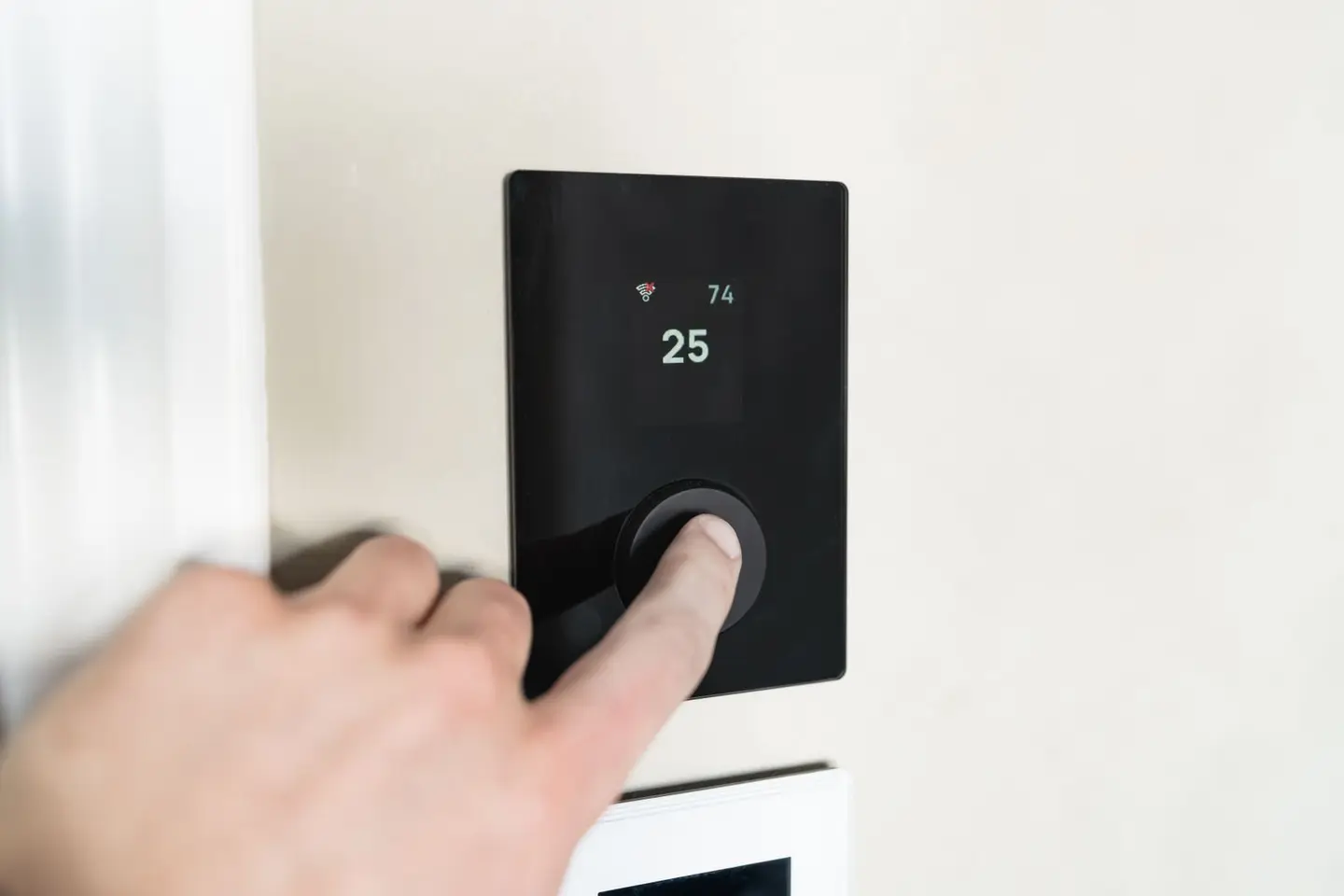
A smart thermostat replaces your existing room thermostat and/or programmer. It connects to your home’s Wi-Fi (and usually to a bridge or hub), allowing you to control your heating remotely via a smartphone app. Most also learn your schedule, adjust for the weather, and provide energy usage reports.
At minimum, a smart thermostat gives you:
- Remote on/off and temperature control from any location
- Schedule setting from a phone rather than a physical timer
- Usage data showing how many hours your heating ran
More advanced models add weather compensation (adjusting target temperature based on the outdoor forecast), geofencing (turning heating off when the app detects you’ve left home), and occupancy detection.
Smart Thermostats: Cost and Options
| System | Components | Supply & Fit Cost | Compatible Boilers |
|---|---|---|---|
| Hive Active Heating | Thermostat + hub + receiver | £150–£250 | Most UK gas boilers |
| Google Nest Learning Thermostat | Thermostat + Heat Link | £180–£300 | Most; check Heat Link compatibility |
| tado° Starter Kit | Thermostat + internet bridge | £160–£280 | Most UK gas/oil boilers |
| Drayton Wiser | Thermostat + hub | £130–£220 | Most conventional systems |
| Honeywell Home T6R | Wireless room thermostat | £80–£150 | Conventional systems |
Supply-only costs are typically £80–£200; professional installation adds £60–£150. In the UK every Nest thermostat comes with a Heat Link, a receiver wired in near the boiler.1 Work inside the boiler casing should be left to a Gas Safe registered engineer, because the Gas Safety (Installation and Use) Regulations 1998 allow only a competent person to work on a gas fitting; an electrician can handle thermostat wiring on the room side.2
Heating Zones: What They Are and Why They Matter
A single-thermostat setup heats the whole house based on one location, typically the hallway or living room. Rooms that are unused, face south (and gain solar heat), or have different occupancy patterns are either overheated or underheated.
Zoning divides the house into areas that can be independently controlled:
- Zone 1 (Living areas): Heated to 21°C during the day
- Zone 2 (Bedrooms): Heated only in the morning and evening; cooler overnight (17–18°C)
- Zone 3 (Utility/spare rooms): Frost protection only (8–10°C) when unoccupied
This can be achieved at different levels of complexity and cost:
Level 1: Smart TRVs (Thermostatic Radiator Valves)
Smart TRVs replace the manual TRV on each radiator. They are individually programmable via an app and allow room-by-room temperature control without additional pipework. Approved Document L now expects thermostatic control in each room whenever a boiler is replaced in an existing home, so TRVs of some kind usually go in with a new boiler anyway.3
Cost: £30–£80 per valve (supply); fitting is usually DIY-possible (no gas qualification needed). A whole-house fit for 8–10 radiators: £250–£800 in smart TRVs. Compatible hubs are often required (e.g., tado° or Drayton Wiser hubs: £50–£100).
Limitation: Smart TRVs control each radiator independently but cannot switch the boiler on or off by themselves. Unless the system includes a boiler relay or other “call for heat” link, the boiler can keep firing after every valve has closed. Approved Document L expects heating controls to be wired so that the boiler and pump switch off when there is no demand for heat.3
Level 2: Two-Zone Heating (Upstairs/Downstairs)
Adding a second zone valve and thermostat splits the system into two independently controlled areas. This is a common upgrade for family homes and requires a qualified plumber. For new homes of 150 m² or more with wet heating, Approved Document L already expects at least two independently controlled heating circuits.3
Cost: £300–£700 for a second zone valve, room thermostat, and wiring, fitted by a plumber and/or electrician. Can be combined with a smart thermostat on each zone.
Level 3: Full Multi-Zone or Underfloor Heating Manifold
Underfloor heating (UFH) systems and newer installations often include manifolds with individual loop valves, allowing truly room-by-room control. Smart systems from companies like Heatmiser, SALUS, or Danfoss connect each zone to a central hub.
Cost: £600–£2,000+ for a hub and wiring harness controlling 6–12 zones; typically quoted as part of a wider heating project.
Typical Energy Savings
Published evidence on smart-control savings is limited, so treat the figures below, worked out on a gas spend of £800–£1,200 a year, as indicative estimates rather than measured results. For comparison, the Energy Saving Trust puts the saving from installing and using a full set of heating controls (programmer, room thermostat and TRVs) at around £100 a year.4
| Control Upgrade | Indicative Annual Saving |
|---|---|
| Smart thermostat (single zone) | 8–15% of heating bill (~£65–£180) |
| Smart TRVs on most radiators | 5–12% additional saving (~£40–£145) |
| Two-zone system (up/downstairs) | 10–20% of heating bill (~£80–£240) |
| Full multi-zone smart system | 15–25% of heating bill (~£120–£300) |
Savings vary widely depending on your existing controls, occupancy patterns, and how well you currently manage your heating. Homes with no programmable control at all and electric storage heaters see the biggest gains; homes already on a good schedule with modern TRVs may see smaller improvements.
For reference, gas under the price cap from 1 October 2026 costs 7.97p per kWh.5 A semi-detached home using 10,000–15,000 kWh of gas a year therefore spends roughly £800–£1,200 on gas before the standing charge, so a 15% saving is worth about £120–£180 a year.
Is Your System Compatible?
Most UK gas and oil boilers can accept a smart thermostat. Check:
- Wiring type, most UK systems use 230 V switching; some older systems use millivolt controls (rare) which may need an adapter
- OpenTherm compatibility, a communication protocol that allows the thermostat to modulate the boiler (rather than just switch it on/off). OpenTherm can improve efficiency, but not every thermostat supports it. Google lists the Nest Thermostat E and the 3rd generation Nest Learning Thermostat as OpenTherm devices, so check both the thermostat’s and your boiler’s spec sheets.6
- Combi vs system boiler, combis have no hot water cylinder, so smart control only covers heating; system boilers can have the hot water cylinder schedule managed separately via the same app on compatible systems
- Heat pump compatibility, if you have or plan a heat pump, ensure the smart system supports lower-temperature operation and the modulating control protocols used by heat pumps (not all thermostats are suitable)
Installation: DIY or Professional?
The thermostat unit itself can often be swapped by a competent homeowner, manufacturers provide wiring diagrams and the task is typically a like-for-like swap on the room thermostat terminals. However:
- If wiring the boiler receiver/relay, this is 230 V mains wiring and should be done by a qualified electrician or Gas Safe engineer
- If adding zone valves, a qualified plumber is required
- Smart TRVs on radiators, usually DIY-friendly: the smart head replaces the old TRV head on the existing valve body, using an adaptor where needed, so the system does not need draining. Hive, for example, supplies adaptors for M30, M28 and Danfoss RA valve bodies.7
Most smart thermostat manufacturers offer a professional installation service, usually within the £60–£150 range above, which includes a compatibility check, fitting, and an app setup walk-through.
What to Watch Out For
- Dead zones, placing the thermostat sensor in a hallway that heats up quickly can cause the thermostat to cut the boiler before the living room reaches target temperature
- Smart TRV battery life, expect to change batteries about once a year on some models, and follow the maker’s advice on battery type: Hive, for example, says to avoid lithium or rechargeable batteries in its radiator valves.7
- App dependency, if the smart system relies on a cloud service, manufacturer withdrawal of support can render the system unusable; check the company’s longevity and whether local control is possible
- Boiler short-cycling, some smart systems allow temperature setback to very low levels overnight; if the setback is too aggressive, the boiler fires up multiple times before the home warms, reducing efficiency gains
Smart heating is a genuinely worthwhile upgrade for the majority of UK homes. Start with a quality smart thermostat (tado°, Nest, or Hive) and add smart TRVs where budget allows. For family homes with distinct usage patterns across floors, a two-zone system offers the best balance of cost and savings.
References (7)
Figures in this note were checked against the sources below on 30 September 2026. Superscript numbers in the text point to them. Every source the site cites, by topic.
- 1technicalsupplier figureGoogle Nest Help, guidance.RN-RK4M51Google's help page for the Nest Heat Link. It says every Nest thermostat sold in Europe comes with a Heat Link that connects to the heating system, so a hub-free install is not possible.
- 2technicalvery strongThe National Archives (legislation.gov.uk), legislation.RN-UFY1XPRegulation 3(1) makes it unlawful for any person to carry out work in relation to a gas fitting or gas storage vessel unless he is competent to do so, and 3(2) places the duty to ensure that on the employer, on every other employer or self-employed person with any control over the work, and on anyone who required the work to be done at a place of work under their control. Regulation 3(3) goes further: no employer may let an employee, and no self-employed person may themselves, carry out work on a gas fitting or service pipework unless that employer or self-employed person is a member of a class of persons approved by the Health and Safety Executive, which in practice is registration with the Gas Safe Register. Regulation 3(4) exempts only replacing a hose or regulator on a portable or mobile space heater and replacing the hose connecting a re-fillable cylinder to installation pipework. Regulation 3(7) makes it an offence to falsely pretend to be a member of an approved class. This is the legal basis for saying a boiler must be fitted by a Gas Safe registered engineer.
- 3technicalvery strongMinistry of Housing, Communities and Local Government.RN-L0FCJXThe in-force U-value tables a DIY insulation or door note must quote, with the exact numbers. Table 4.2, limiting U-values for new fabric elements in existing dwellings, sets roof 0.15, wall 0.18, floor 0.18, swimming pool basin 0.25, window 1.4 or Window Energy Rating Band B minimum, rooflight 2.2, doors with more than 60 per cent of the internal face glazed 1.4 or Doorset Energy Rating Band C minimum, and other doors 1.4 or Doorset Energy Rating Band B minimum. Table 4.3, for existing elements, gives a roof threshold of 0.35 and an improved value of 0.16, which is the figure a loft insulation note needs: paragraph 4.12 says a retained element whose U-value is higher than the column (a) threshold, for example through a loft or garage conversion, should be upgraded to the column (b) value. Paragraph 4.13 allows a lesser upgrade only where the improved value is not technically or functionally feasible or would not achieve a simple payback of 15 years or less. Paragraph 4.8 requires a replacement element to be no worse than the one it replaces as well as meeting Table 4.2. Paragraph 4.10 gives the heritage exception: where character must be maintained, a centre pane U-value of no more than 1.2 or low-emissivity secondary glazing. Note 9 records that the timber window concession of 1.6 or Band C ended on 14 June 2023. The 2021 edition came into force on 15 June 2022; a 2026 edition exists at https://assets.publishing.service.gov.uk/media/69c122a6cfa346b9d4704a55/ADL1_2026.pdf.
- 4technicalfairEnergy Saving Trust, guidance.RN-1B36CGEnergy Saving Trust's consumer advice on thermostats and heating controls: room thermostats, programmers, thermostatic radiator valves and zoning, with indicative savings. Useful as the plain-English explanation of what each control does; the compliance requirement for controls on a new or replacement system sits in Approved Document L, not here. The page blocks automated fetching, so it is described from its title and publisher.
- 5costvery strongOfgem.RN-YYE8U2A price, true at 2026-09. The live source for any running-cost sum in a heating note. For 1 October to 31 December 2026 the direct debit cap is 26.32p per kWh for electricity with a 54.83p daily standing charge, and 7.97p per kWh for gas with a 29.68p daily standing charge, giving a typical annual dual fuel bill of £1,723, a 4% rise on the previous period. Ofgem states these are the average unit rate and standing charge for direct debit customers in England, Scotland and Wales; gas prices include 5% VAT while electricity carried no VAT in this period. The cap is reset every three months, so any note quoting a pence-per-kWh figure should be dated against this page.
- 6technicalsupplier figureGoogle Nest Help, guidance.RN-U6GVKLGoogle's help page on OpenTherm. It names the Nest thermostat models that support OpenTherm modulating control of a boiler.
- 7technicalsupplier figureHive, guidance.RN-2U4I1CHive's product page for its smart radiator valve. It says the valve fits a compatible TRV valve body and ships with M30, M28 and Danfoss RA adaptors, so the valve body stays in place.
-
Learn about Heat Link for Nest thermostats in Europe, Google Nest Help, accessed 30 September 2026. support.google.com
-
The Gas Safety (Installation and Use) Regulations 1998, regulation 3: Qualification and supervision, The National Archives, accessed 30 September 2026. legislation.gov.uk
-
Approved Document L, Conservation of fuel and power, Volume 1: Dwellings, 2021 edition incorporating 2023 amendments, Ministry of Housing, Communities and Local Government, accessed 30 September 2026. assets.publishing.service.gov.uk
-
Heating controls, Energy Saving Trust, accessed 30 September 2026. energysavingtrust.org.uk
-
Energy price cap unit rates and standing charges, Ofgem, accessed 30 September 2026. Priced at 2026-09 and left there. ofgem.gov.uk
-
OpenTherm and what Nest thermostats can do with it, Google Nest Help, accessed 30 September 2026. support.google.com
-
Hive Radiator Valve, Hive, accessed 30 September 2026. hivehome.com