Heating water accounts for roughly a fifth of a typical home’s energy use (government estimates put it at about 18%), second only to space heating.1 With energy costs remaining high and a growing range of technology options in 2026, choosing the right hot water system is worth doing carefully. The best option depends on your property size, existing heating system, number of occupants, and long-term plans.
This guide covers every mainstream option available to UK homeowners, with realistic costs and honest trade-offs.
System Types at a Glance
| System | Best For | Capital Cost (installed) | Running Cost (annual estimate, 3-bed) |
|---|---|---|---|
| Combi boiler | 1–3 bed, low demand, no storage space | £1,900–£3,600 | £150–£310 (gas) |
| System boiler + vented cylinder | Older properties, gravity systems | £2,000–£4,000 | £150–£310 (gas), plus cylinder losses |
| System boiler + unvented cylinder | 3–5 bed, high demand, mains pressure | £2,500–£5,000 | £150–£310 (gas), plus cylinder losses |
| ASHP + hot water cylinder | Heat pump homes, off-gas | £11,200–£15,600 (before grant; Boiler Upgrade Scheme grant: £7,500, or £9,000 for an oil or LPG heated home that qualifies) | £140–£365 (electricity) |
| Heat pump water heater (standalone) | Single-room/flat, supplement | £2,000–£4,000 (no Boiler Upgrade Scheme grant) | £100–£250 (electricity) |
| Solar thermal | Supplement for existing system | About £5,300 | Saves about £75–£155/yr against gas |
| Direct electric cylinder | Back-up / off-peak / temporary | £600–£1,500 | £500–£910 (standard rate); less on Economy 7 |
| Electric shower (instant) | Single user, no storage space | £200–£500 | Per shower: low |
Running costs in this table are for hot water only. They are worked from government monitoring of connected gas boilers, which found median hot water energy use of about 1,900 kWh to 3,500 kWh a year depending on boiler size, priced at the October 2026 cap rates of 7.97p/kWh for gas and 26.32p/kWh for electricity, with a 90% efficient boiler and a heat pump coefficient of performance of 2.5–3.5.1 For scale, the government’s business case for the Boiler Upgrade Scheme puts the median installed cost of an air source heat pump at about £12,500 in 2024/25 (before grant; Boiler Upgrade Scheme grant: £7,500).2
Combi Boiler
A combination (combi) boiler provides both central heating and instantaneous hot water from a single unit, with no separate storage cylinder. Water is heated directly as it’s drawn off.
Pros:
- No cylinder or storage tank, space-saving
- Instant hot water (no waiting for a tank to heat)
- Only heats water as needed (no standing losses)
Cons:
- Flow rate limited by boiler output, typically 10–18 litres/min; multi-outlet use (bath running + shower) can result in pressure drops
- Not suited to large families with high simultaneous demand
- Boiler works harder and may have a shorter service life than a system boiler
A new condensing combi boiler costs £900–£1,800 for the unit; installation adds £1,000–£1,800, totalling £1,900–£3,600 all-in. For new homes in England, the Future Homes and Buildings Standards apply from 24 March 2027 and are designed to ensure they are built with low carbon heating.3
Unvented (Mains-Pressure) Hot Water Cylinder
An unvented cylinder is fed directly from the mains, providing hot water at mains pressure throughout the house. It’s the premium option for high-demand households.
Pros:
- Mains-pressure hot water to every outlet, powerful showers without a pump
- Works with any heat source: gas, heat pump, solar, immersion
- No cold water storage tank is needed in the loft, which frees space and makes siting the cylinder more flexible
Cons:
- Needs an annual service, which manufacturers usually make a condition of the warranty
- Installation is notifiable building work: use an installer registered with a competent person scheme for hot water systems, who can self-certify it, or notify building control before work starts4
- Higher capital cost than vented systems
Cylinder sizes: 120–250 litres for a typical 3–4 bed house. Larger families or properties with multiple bathrooms should specify 180–300 litres.
Cost to install: £2,500–£5,000 including cylinder, programmer, and all associated works.
Air Source Heat Pump Hot Water
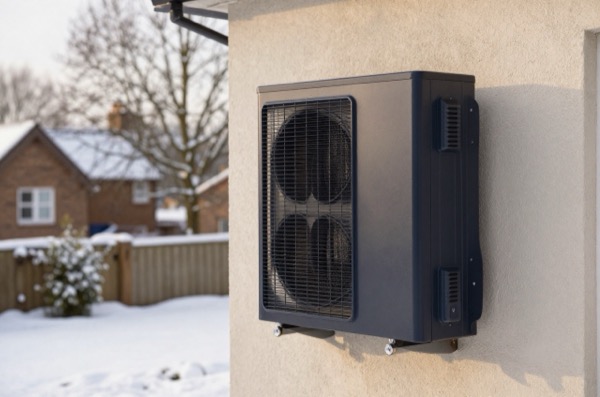
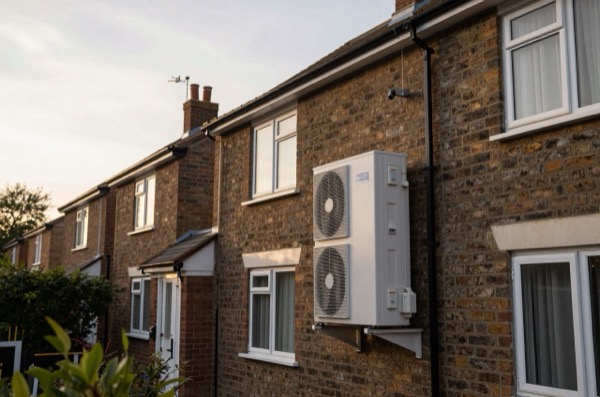
An air source heat pump (ASHP) can provide both space heating and domestic hot water via a thermal store or hot water cylinder. This is the dominant direction for UK homes moving off gas.
Alternatively, a standalone heat pump water heater (sometimes called a monobloc DHW heat pump or hot water heat pump cylinder) is a self-contained unit that sits where a regular cylinder would, it extracts heat from room air to heat the water. These are increasingly available from major manufacturers and cost £2,000–£4,000 including installation (no Boiler Upgrade Scheme grant, for the reason given below).
- CoP (coefficient of performance): 2.5–3.5, meaning 1 kWh of electricity produces 2.5–3.5 kWh of heat
- At the price cap electricity rate of 26.32p/kWh from 1 October 2026, effective heat cost ≈ 7.5–10.5p/kWh, against about 8.9p for each unit of heat from a 90% efficient gas boiler at the 7.97p/kWh gas cap5
- Over 5–7 years, the running cost advantage over electric immersion is significant
The Boiler Upgrade Scheme (BUS) provides a £7,500 grant toward an ASHP installation in England and Wales, plus an extra £1,500 until March 2027 where the home is heated by oil or LPG and has no mains gas connection.6 Standalone DHW heat pumps do not qualify, because a BUS-funded heat pump must be able to meet all of the home’s space heating demand.7
Solar Thermal
Solar thermal collectors on the roof heat water in a coil inside a specially designed cylinder. In the UK a solar thermal system normally provides roughly half of a home’s hot water over the year, nearly all of it in summer but much less in winter, with a backup immersion heater or boiler coil making up the difference.8
- Typical system (2 flat-plate or evacuated tube collectors, 200-litre twin-coil cylinder): around £5,300 installed, the Energy Saving Trust’s figure for a typical system8
- Annual saving: roughly half the hot water bill, so about £75–£155 a year against gas, or £250–£455 against an electric immersion, on the running costs in the table above
- Payback period: long, at roughly 12–21 years against an electric immersion and several decades against gas
- Maintenance is modest but not nil: the system has a pump and a fluid circuit, and the Energy Saving Trust advises a thorough check every five years to flush it and replace the fluid8
- Best suited to households that already need to replace an old cylinder and have a south-facing roof with good aspect
Solar thermal combines very well with heat pump systems, the ASHP handles space heating and shoulders DHW in cold weather; solar thermal handles DHW in spring/summer/autumn.
Direct Electric Cylinder
The simplest hot water system: a cylinder with one or two immersion heaters running off mains electricity. No boiler needed.
- Unit cost: £400–£900 plus installation £200–£600
- Running cost at the price cap rate of 26.32p/kWh: £500–£910/year on the same hot water use as the table5
- On Economy 7, heating the cylinder overnight at the off-peak rate costs considerably less; how much depends on your tariff’s night rate
For properties without gas, a direct cylinder on Economy 7 is a simple, low-capital fallback. For long-term use, a heat pump water heater is almost always the better investment.
Water Regulations and Compliance
Hot water systems in the UK are governed by:
- Water Supply (Water Fittings) Regulations 1999: all water fittings must comply, and some installations, such as a bath holding more than 230 litres or a pump or booster drawing more than 12 litres a minute from the supply pipe, must be notified to the water supplier before work starts9
- Part G of the Building Regulations: hot water supply, sanitation and water efficiency; installing an unvented cylinder is notifiable building work10
- Part L (Conservation of Fuel and Power): new boiler and heat pump installations must meet efficiency standards11
When selling a property, building regulations compliance certificates for any notifiable water or heating work can be requested by a buyer’s solicitor. Keep all certificates.
Choosing the Right System
- New-build or recently extended home, off-gas: ASHP with unvented cylinder is the right long-term answer; BUS grant makes it financially comparable to gas.
- Victorian or Edwardian terrace, gas connected, 2 bathrooms: unvented cylinder with modern system boiler; good pressure throughout, easy to add solar thermal later.
- Small flat, one bathroom: combi boiler remains convenient and economical.
- Rural off-gas home, limited budget: direct cylinder on Economy 7 in the short term; budget for heat pump upgrade within 5 years.
- Home with south-facing roof, existing system boiler: adding a solar thermal panel with twin-coil cylinder is a low-disruption upgrade worth costing.
References (11)
Figures in this note were checked against the sources below on 2 October 2026. Superscript numbers in the text point to them. Every source the site cites, by topic.
- 1technicalvery strongDepartment for Energy Security and Net Zero, guidance.RN-K8QIZLDESNZ research report on domestic hot water use (March 2024). It gives the government estimate that hot water is about 18% of domestic energy consumption.
- 2costvery strongDepartment for Energy Security and Net Zero.RN-AC5XPIA price, true at 2025-03. The summary business case for the Boiler Upgrade Scheme 2026 to 2030. Sets out the grant amounts, the budget, expected installation volumes and the department's reasoning for continuing the scheme. This is where the scheme's own numbers come from, as opposed to the application page, which tells a householder what to do but not what it is expected to cost the state or how long the money lasts.
- 3technicalvery strongMinistry of Housing, Communities and Local Government, guidance.RN-WMRZGFThe government's circular letter to building control bodies announcing the Future Homes and Buildings Standards: the Building Regulations etc. (Amendment) (England) Regulations 2026 and the 2026 editions of Approved Documents L and F. It gives the purpose (new buildings built with low carbon heating and high energy efficiency), the in-force date of 24 March 2027 (24 September 2027 for higher-risk building work), and the transitional arrangements, under which work notified before 24 March 2027 and started before 24 March 2028 stays under the previous rules.
- 4technicalvery strongThe National Archives (legislation.gov.uk), guidance.RN-BP3IWGSchedule 3 item 12 lets registered installers (APHC, BESCA, Certsure, HETAS, NAPIT) self-certify sanitary installations in a dwelling that involve no shared or underground drainage.
- 5technicalvery strongOfgem.RN-YYE8U2The live source for any running-cost sum in a heating note. For 1 October to 31 December 2026 the direct debit cap is 26.32p per kWh for electricity with a 54.83p daily standing charge, and 7.97p per kWh for gas with a 29.68p daily standing charge, giving a typical annual dual fuel bill of £1,723, a 4% rise on the previous period. Ofgem states these are the average unit rate and standing charge for direct debit customers in England, Scotland and Wales; gas prices include 5% VAT while electricity carried no VAT in this period. The cap is reset every three months, so any note quoting a pence-per-kWh figure should be dated against this page.
- 6technicalvery strongGOV.UK.RN-9EFNVZThe grant values: £7,500 towards an air source heat pump, £7,500 towards a ground source heat pump including water source heat pumps and those on shared ground loops, and £5,000 towards a biomass boiler. A further £1,500 is available until March 2027 where the property is heated by oil or LPG and has no mains gas connection. Only one grant is available per property. Capacity limits are 45kWth for an individual system, 70kWth for multiple heat pumps and 300kWth for shared ground loops. Hybrid systems pairing a gas boiler with a heat pump are not eligible, and an existing low carbon heating system cannot be replaced under the scheme.
- 7technicalvery strongOfgem, guidance.RN-FAJTUKOfgem's scheme guidance for Boiler Upgrade Scheme installers, version 5.1. It settles that from 28 April 2026 a valid EPC is no longer needed, though an existing EPC's number must be supplied.
- 8technicalfairEnergy Saving Trust, guidance.RN-00VIDGSolar thermal performance and cost. Hot water accounts for around 11% of the average energy bill. A typical installed system costs around £5,300. Output is seasonal: roughly 90% of hot water demand in summer falling to around 25% in winter, averaging about half of annual hot water needs, so the system is always paired with a conventional boiler or immersion heater. Installation by an MCS certified contractor brings both workmanship and product warranties, typically several years on workmanship and longer on the collectors themselves. Maintenance requires a thorough check every five years to flush the system and replace the fluid mix. Last updated 20 May 2026.
- 9technicalvery strongThe National Archives (legislation.gov.uk), guidance.RN-29CES1Regulation 5 of the Water Supply (Water Fittings) Regulations 1999: the work that must be notified to the water undertaker, and consented, before it begins, including large baths, pumps drawing over 12 litres a minute from a supply pipe, reverse osmosis and water treatment units, automatic garden watering systems and deep or shallow external pipework.
- 10technicalvery strongMinistry of Housing, Communities and Local Government.RN-YAW64MRequirement G3(4) states the hot water supply to any fixed bath must be designed so the water delivered to that bath cannot exceed 48 degrees C; paragraph 3.65 says this is achieved with an in-line blending valve or other temperature control device with a maximum temperature stop, and 3.66 accepts valves to BS EN 1111:1999 or BS EN 1287:1999 that fail safe. G3(3) requires unvented storage vessels to prevent stored water exceeding 100 degrees C and to convey safety discharge somewhere visible and safe. Regulation 36 and Requirement G2 cap potential consumption in a new dwelling at 125 litres per person per day, or the optional 110 litres per person per day where a planning condition specifies it; G2 applies only to dwellings erected or formed by material change of use. Sections G4 sanitary conveniences, G5 bathrooms and G6 food preparation areas set scale of provision.
- 11technicalvery strongMinistry of Housing, Communities and Local Government.RN-L0FCJXThe in-force U-value tables a DIY insulation or door note must quote, with the exact numbers. Table 4.2, limiting U-values for new fabric elements in existing dwellings, sets roof 0.15, wall 0.18, floor 0.18, swimming pool basin 0.25, window 1.4 or Window Energy Rating Band B minimum, rooflight 2.2, doors with more than 60 per cent of the internal face glazed 1.4 or Doorset Energy Rating Band C minimum, and other doors 1.4 or Doorset Energy Rating Band B minimum. Table 4.3, for existing elements, gives a roof threshold of 0.35 and an improved value of 0.16, which is the figure a loft insulation note needs: paragraph 4.12 says a retained element whose U-value is higher than the column (a) threshold, for example through a loft or garage conversion, should be upgraded to the column (b) value. Paragraph 4.13 allows a lesser upgrade only where the improved value is not technically or functionally feasible or would not achieve a simple payback of 15 years or less. Paragraph 4.8 requires a replacement element to be no worse than the one it replaces as well as meeting Table 4.2. Paragraph 4.10 gives the heritage exception: where character must be maintained, a centre pane U-value of no more than 1.2 or low-emissivity secondary glazing. Note 9 records that the timber window concession of 1.6 or Band C ended on 14 June 2023. The 2021 edition came into force on 15 June 2022; a 2026 edition exists at https://assets.publishing.service.gov.uk/media/69c122a6cfa346b9d4704a55/ADL1_2026.pdf.
-
Domestic hot-water use: observations on hot-water use from connected devices, Department for Energy Security and Net Zero, accessed 30 September 2026. assets.publishing.service.gov.uk
-
Boiler Upgrade Scheme 2026-2030: Summary business case, Department for Energy Security and Net Zero, accessed 2 October 2026. Priced at 2025-03 and left there. assets.publishing.service.gov.uk
-
The Future Homes and Buildings Standards: Building Circular 01/2026, Ministry of Housing, Communities and Local Government, accessed 29 September 2026. gov.uk
-
The Building Regulations 2010, Schedule 3: Self-certification schemes and exemptions from requirement to give building notice or deposit full plans, legislation.gov.uk, accessed 30 September 2026. legislation.gov.uk
-
Energy price cap unit rates and standing charges, Ofgem, accessed 29 September 2026. ofgem.gov.uk
-
Apply for the Boiler Upgrade Scheme: What you can get, GOV.UK (Department for Energy Security and Net Zero), accessed 15 September 2026. gov.uk
-
Boiler Upgrade Scheme: Installer Guidance V5.1, Ofgem, accessed 30 September 2026. ofgem.gov.uk
-
Solar water heating, Energy Saving Trust, accessed 2 October 2026. energysavingtrust.org.uk
-
The Water Supply (Water Fittings) Regulations 1999, regulation 5: Notification, legislation.gov.uk, accessed 30 September 2026. legislation.gov.uk
-
Approved Document G, Sanitation, hot water safety and water efficiency, 2015 edition incorporating 2016 and 2024 amendments, Ministry of Housing, Communities and Local Government, accessed 2 October 2026. assets.publishing.service.gov.uk
-
Approved Document L, Conservation of fuel and power, Volume 1: Dwellings, 2021 edition incorporating 2023 amendments, Ministry of Housing, Communities and Local Government, accessed 14 September 2026. assets.publishing.service.gov.uk