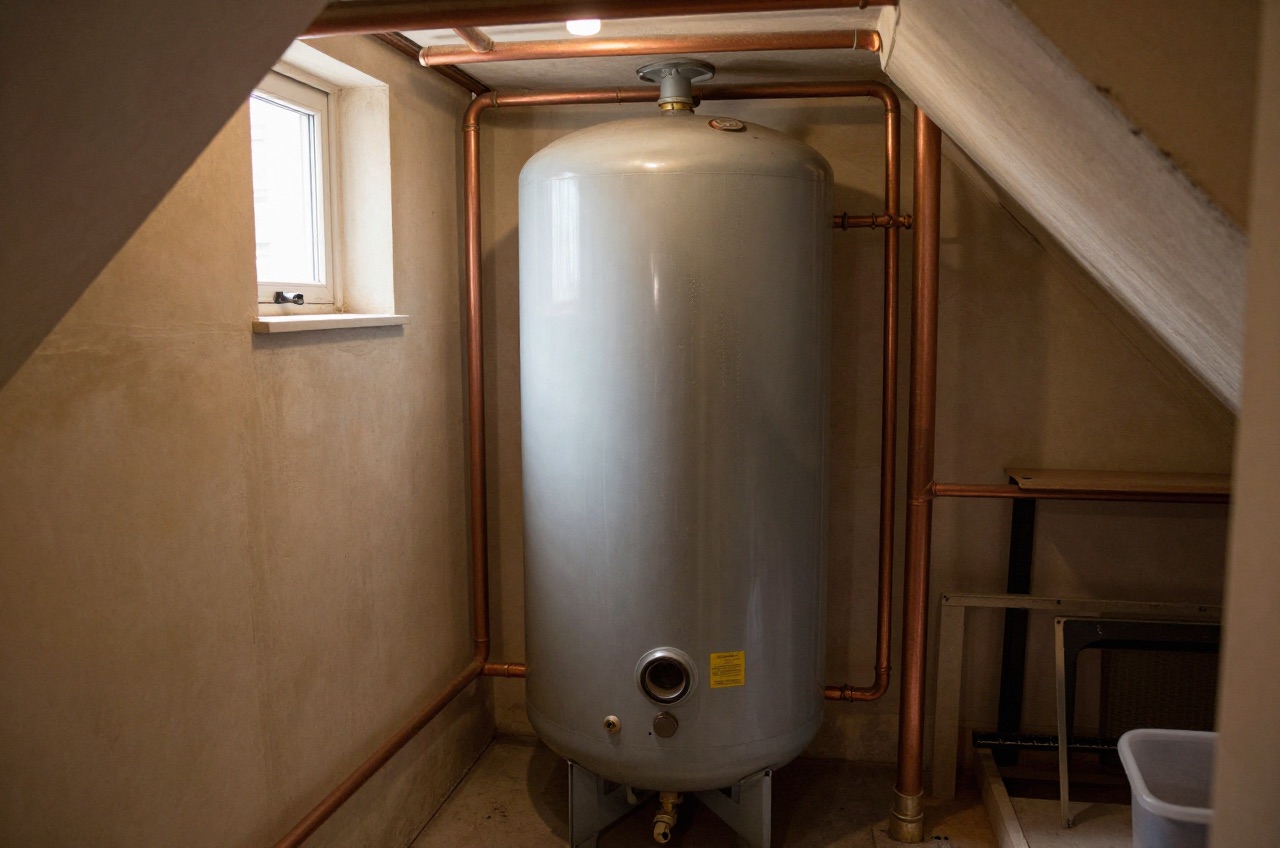
If your home has a system or regular boiler, it stores hot water in a cylinder. The type of cylinder, vented or unvented, determines the water pressure at your showers and taps, the space the system occupies, and the complexity of installation. Unvented cylinders are now the usual choice where a new cylinder is fitted; many older properties still have a vented (gravity-fed) setup that is increasingly worth upgrading.
Vented (Open) Cylinders
A vented cylinder is fed by a cold water storage tank, usually in the loft. The tank is open to atmosphere at the top, hence “vented” or “open-vented”. Hot water flows from the cylinder by gravity, so the pressure depends on the height of the tank above the outlet: roughly 0.1 bar for every metre, which usually means well under 1 bar at a first-floor shower.
How it works: Cold water from the loft tank fills the cylinder. The boiler heats the water via a coil (indirect) or by immersion heater (direct). Hot water rises to the top of the cylinder and is drawn off as needed; cold replaces it from the loft tank.
Advantages:
- Simple, low-cost to install and maintain
- No risk of dangerous over-pressure (the open vent pipe is the safety device)
- Works at low mains pressures, the system is independent of incoming pressure
Disadvantages:
- Low water pressure at taps and showers, gravity-only
- Requires a cold water tank in the loft (frost risk; takes up space)
- Poor shower performance without a pump
- Loft tank must be cleaned periodically; open systems can be contaminated
Typical cost (2026): £400–£1,050 supplied and fitted for a standard indirect vented cylinder (150–210 litres)
Unvented (Pressurised) Cylinders
An unvented cylinder connects directly to the mains cold water supply. Water is stored under pressure, typically limited to about 3 bar by a pressure-reducing valve on the inlet, so hot water is delivered at close to the pressure of your cold mains, enough for a good power shower without a pump.1
How it works: Mains-pressure cold water enters the cylinder through an inlet group (containing a pressure reducing valve, expansion valve, check valve, and expansion vessel or bubble-top air gap). The boiler heats water via a coil; an immersion heater provides backup. Safety is provided by a factory-fitted temperature and pressure relief valve (T&P valve) and a thermal cut-out, while an expansion vessel or internal air gap takes up the thermal expansion of the water.1
Advantages:
- Mains-pressure hot water, powerful showers, good flow at multiple outlets simultaneously
- No loft tank required, frees up loft space and eliminates frost risk
- Better for modern homes with multiple bathrooms
- Works with solar thermal or heat pump pre-heat coils
Disadvantages:
- More complex installation, requires a G3 Building Regulations notification (see below)
- Higher initial cost
- Requires periodic maintenance: annual check of the T&P valve and expansion vessel
- Needs a good mains supply: Heatrae Sadia, for example, recommends at least 1.5 bar and 20 litres per minute for its Megaflo Eco1
Typical cost (2026): £850–£2,400 supplied and fitted for a 150–210 litre cylinder, plus any new boiler or new pipework
Cost Comparison
| Item | Vented Cylinder | Unvented Cylinder |
|---|---|---|
| 150-litre cylinder supply | £200–£500 | £500–£1,200 |
| 210-litre cylinder supply | £280–£650 | £650–£1,800 |
| Installation labour | £200–£400 | £350–£600 |
| Building Regs notification (G3) | Not required | No council fee via a competent person scheme (see below) |
| Loft tank removal (if converting) | - | £100–£300 |
| Total fitted (150 L) | £400–£900 | £850–£1,800 |
| Total fitted (210 L) | £480–£1,050 | £1,000–£2,400 |
Totals are the cylinder plus installation labour, and exclude loft tank removal. Where the installer notifies the work through a competent person scheme, no council building control charge is payable.2 If you go through the council instead, expect a building notice charge: North Norfolk, for example, charges £273.60 including VAT for a hot water vessel.3 At Toolstation in September 2026, a 210-litre Joule Invacyl indirect unvented cylinder cost £649.99 including VAT.4 A 210-litre Heatrae Sadia Megaflo Eco indirect cost £1,758.99 at the same merchant.5
Building Regulations: The G3 Requirement
Unvented hot water storage systems are covered by requirement G3 of the Building Regulations, with guidance in Approved Document G, Section 3. Installing one is notifiable building work unless the storage vessel holds 15 litres or less.6 Requirement G3(3) calls for precautions that stop the stored water ever exceeding 100°C and carry any discharge from the safety devices safely away.7 This requirement exists because a pressurised cylinder that overheats and fails can release large quantities of scalding steam, potentially with explosive force if safety devices are absent or faulty.
To comply with G3, the work must be either:
- Carried out by a competent person registered with a scheme authorised by government for heating and hot water work (for example APHC, BESCA, Certsure, Gas Safe Register, HETAS, NAPIT or OFTEC) who can self-certify, or8
- Notified to the local building control authority before work begins, who will inspect and issue a completion certificate
An unregistered plumber cannot legally self-certify G3 work. Always ask your installer for evidence of their G3 competency registration before they start. Failure to comply can cause problems at the point of sale, a buyer’s solicitor will ask for the G3 certificate.
What Size Cylinder Do You Need?
Cylinder sizing is based on peak daily hot water demand. As a rough guide:
| Household Size | Recommended Cylinder Capacity |
|---|---|
| 1–2 people | 100–150 litres |
| 3–4 people | 150–210 litres |
| 5–6 people | 210–300 litres |
| 6+ people / 3+ bathrooms | 300–400 litres |
These assume a single reheat per day from the boiler. If you have solar thermal, size up by 50–100 litres to store the solar gain. If the cylinder is to be heated primarily by an immersion heater on an Economy 7 tariff, size generously, you need enough stored capacity for the full day without mid-day reheating at peak rate.
Vented or Unvented: Which Should You Choose?
Choose an unvented cylinder if:
- You want good shower pressure without a separate pump
- You have two or more bathrooms in regular simultaneous use
- You are removing the loft cold water tank as part of a wider upgrade
- Your incoming mains supply is reliably good (ideally at least 1.5 bar dynamic, the minimum some makers recommend)
Stick with vented if:
- Budget is limited and the existing gravity system is working well
- Your mains pressure or flow is consistently low (well under 1.5 bar dynamic), an unvented cylinder will underperform
- The property is a listed building, where removing tanks and re-routing pipework may itself need listed building consent9
- The installation is a straightforward like-for-like cylinder replacement with no other work planned
Maintenance
Vented cylinders need very little maintenance, check the loft tank annually for corrosion, debris, or signs of contamination.
Unvented cylinders require annual servicing: the T&P valve must be manually lifted and tested (it should release water freely and reseal cleanly), the expansion vessel pressure should be checked and re-charged if below specification (to the maker’s figure, commonly around 3 bar on the gas side), and the PRV setting should be verified. Servicing typically costs £60–£120 from a qualified engineer. Neglecting unvented cylinder maintenance is both a safety risk and a common cause of premature cylinder failure.
Leading manufacturers typically warrant the cylinder itself for 25 years or more, provided it is serviced every year. Gledhill, for example, gives a 25-year warranty on all its unvented cylinders, conditional on an annual service.10 Heatrae Sadia gives its Megaflo Eco a lifetime warranty for domestic installations, again subject to an annual service.11
The rules in this note are those that apply in England. Scotland, Wales and Northern Ireland have their own building standards and permitted development rights.
References (11)
Figures in this note were checked against the sources below on 30 September 2026. Superscript numbers in the text point to them. Every source the site cites, by topic.
- 1technicalsupplier figureHeatrae Sadia, a data sheet.RN-YHTQW5Manufacturer data for the Megaflo Eco indirect unvented cylinder. Nominal capacities are 70, 125, 145, 170, 210, 250 and 300 litres. Insulation is 60mm thick on every size. The immersion heater is 1 x 3 kW on all sizes. Empty weights are 25, 31, 35, 39, 43, 50 and 58 kg, but full weights are 125, 180, 204, 233, 253, 300 and 358 kg, which is the figure that decides whether a floor or an airing cupboard base can take it. Standing heat loss runs 332.15 kWh/year at 70 litres up to 616.85 kWh/year at 300 litres, so an oversized cylinder is a permanent standing cost. Maximum flow at 3 bar is 76 l/min across the range. The cylinder has an insulated temperature and pressure relief valve.
- 2coststrong locallyLondon Borough of Hillingdon.RN-XNWC03A price, true at 2026-09. Hillingdon's 2026-27 building control fee schedule lists a regularisation charge for each type of domestic work: £1,210 for an extension under 40 m² and £440 for minor works such as chimney breast removal or a simple structural opening.
- 3coststrong locallyNorth Norfolk District Council.RN-LHKHLQA price, true at 2026-09. North Norfolk's building control charges, Table C category 1 (individual minor works including hot water vessels): £228 plus £45.60 VAT, £273.60 in total, as a plan or building notice charge.
- 4costsupplier figureToolstation.RN-GQN5E1A price, true at 2026-09. Toolstation product page for a 210-litre indirect unvented hot water cylinder, priced at £649.99 including VAT, supply only.
- 5costsupplier figureToolstation.RN-O7ODEAA price, true at 2026-09. Toolstation's product page for a 210-litre Heatrae Sadia Megaflo Eco indirect unvented cylinder at £1,758.99 including VAT; it sets the top of the 210-litre supply range.
- 6technicalvery strongThe National Archives (legislation.gov.uk), guidance.RN-CC1O5HSchedule 4 lists building work that needs no building notice; item (g) covers a self-contained fixed service that is not a combustion appliance other than a fixed flueless gas cooker, so a flueless hob is exempt but flued appliances are not.
- 7technicalvery strongThe National Archives (legislation.gov.uk), legislation.RN-3PNB0TThe functional requirements themselves, as distinct from the Approved Documents that give one way of meeting them. Part H, drainage and waste disposal, is the operative part for external works. H1 requires an adequate system of drainage to carry foul water from appliances to a public sewer, private sewer, treatment system or cesspool, in that order of priority. H2 covers wastewater treatment systems and cesspools: siting and construction to avoid health hazards and water contamination, adequate access for emptying and maintenance, sufficient capacity, impermeability, ventilation and a durable notice to the owner about maintenance. H3 is the one that governs patios and driveways: adequate provision shall be made for rainwater to be carried from the roof of the building, and paved areas shall be adequately drained, with discharge to a soakaway or other infiltration system, then a watercourse, then a sewer, in that order of priority - the requirement biting on paved areas that provide access to the building or to waste storage. H4 prohibits building work over an existing sewer that would damage it or obstruct maintenance access. H5 requires surface water and foul drainage to be kept separate where reasonably practicable. H6 covers solid waste storage. Part K covers protection from falling, collision and impact; Part M covers access, with the three dwelling categories.
- 8technicalvery strongMinistry of Housing, Communities and Local Government.RN-SAMO3MThe official list of competent person schemes whose members can self-certify certain building work instead of getting building regulations approval, published 4 April 2013 and last updated 12 March 2018. Named schemes with contact numbers include ATTMA, APHC, Assure Certification, Blue Flame Certification, the British Board of Agrement, BESCA, Capita Gas Registration and Ancillary Services trading as Gas Safe Register, CIGA, Certass, Certsure LLP trading as NICEIC, the Elmhurst Airtightness Scheme, Fensa Limited, HETAS Limited, NAPIT Registration Limited, the National Federation of Roofing Contractors trading as CompetentRoofer, and OFTEC. Two footnotes matter: the Gas Safe Register is not technically a competent person scheme although in practice its installers carry the same building regulations responsibilities, and Benchmark Certification Limited ceased to operate as a competent person scheme on 10 February 2017, becoming part of NAPIT Registration Limited that day. Installers joining an electrical scheme are added to the single electrical competent person register.
- 9technicalvery strongThe National Archives (legislation.gov.uk), legislation.RN-XN22L9The provision that decides when listed building consent is actually needed, and the answer to the common overstatement that any alteration to a listed building requires consent. Section 7(1): 'no person shall execute or cause to be executed any works for the demolition of a listed building or for its alteration or extension in any manner which would affect its character as a building of special architectural or historic interest, unless the works are authorised under section 8.' The trigger is therefore effect on character as a building of special architectural or historic interest, not alteration as such, so work with no effect on that character falls outside the restriction. Section 7(2) makes subsection (1) subject to section 33(1) of the Planning Act 2008, which excludes the requirement for other consents where development consent is required. Authorisation itself comes from section 8.
- 10technicalsupplier figureGledhill, guidance.RN-9EZ4FXGledhill's homeowner advice page: all its unvented cylinders carry a 25-year manufacturer's warranty, and the cylinder must be serviced each year to keep the warranty valid.
- 11technicalsupplier figureHeatrae Sadia, guidance.RN-BCBKZGHeatrae Sadia's warranty page: Megaflo Eco unvented cylinders have a lifetime warranty for domestic installations, conditional on an annual service carried out to the installation instructions.
-
Megaflo Eco Indirect unvented cylinder data sheet, Heatrae Sadia, accessed 30 September 2026. heatraesadia.com
-
Building control fees 2026-27, London Borough of Hillingdon, accessed 30 September 2026. Priced at 2026-09 and left there. pre.hillingdon.gov.uk
-
Building control charges: dwellings, domestic extensions and alterations, North Norfolk District Council, accessed 30 September 2026. Priced at 2026-09 and left there. north-norfolk.gov.uk
-
Joule Invacyl Unvented Indirect Cylinder 210L, Toolstation, accessed 30 September 2026. Priced at 2026-09 and left there. toolstation.com
-
Heatrae Sadia Megaflo Eco Indirect Cylinder 210L, Toolstation, accessed 30 September 2026. Priced at 2026-09 and left there. toolstation.com
-
The Building Regulations 2010, Schedule 4: Descriptions of work where no building notice or deposit of full plans required, The National Archives (legislation.gov.uk), accessed 30 September 2026. legislation.gov.uk
-
The Building Regulations 2010, Schedule 1: Requirements, The National Archives (legislation.gov.uk), accessed 30 September 2026. legislation.gov.uk
-
Competent person scheme: current schemes and how schemes are authorised, Ministry of Housing, Communities and Local Government (GOV.UK), accessed 10 September 2026. gov.uk
-
Planning (Listed Buildings and Conservation Areas) Act 1990, section 7: Restriction on works affecting listed buildings, The National Archives (legislation.gov.uk), accessed 30 September 2026. legislation.gov.uk
-
Are you aware that your unvented cylinder requires an annual service?, Gledhill, accessed 30 September 2026. gledhill.net
-
Product warranty, Heatrae Sadia, accessed 30 September 2026. heatraesadia.com