A whole-house retrofit is a coordinated programme of energy efficiency improvements designed to significantly reduce a home’s carbon emissions and running costs. Unlike piecemeal upgrades, it considers the building as a system, insulation, airtightness, heating, ventilation, and renewables must work together or you risk problems such as condensation, overheating, or an undersized heat pump.
Done well, a whole-house retrofit can cut heating bills substantially and, in the right house, lift an EPC from E to B in a single programme of works. Done badly, insulation without ventilation, or a heat pump in a poorly insulated property, it can cause damp, discomfort, and wasted money.
The Retrofit First Principle
The established approach in the UK industry is “fabric first”: reduce heat loss through the walls, roof and floor before upgrading or replacing the heat source. This sequence matters because:
- A smaller heat load (after insulating) means a smaller, cheaper heat pump
- Moisture risk in walls changes when you insulate, heating upgrades must account for this
- Better airtightness requires mechanical ventilation or you create condensation problems
Typical Whole-House Retrofit Costs (Mid-Terraced, 3-Bed, EPC E→B)
| Measure | Typical Cost |
|---|---|
| Loft insulation (270 mm) | £300–£700 |
| Cavity wall insulation | £700–£1,400 |
| Solid wall insulation (external or internal) | £8,000–£18,000 |
| Floor insulation (suspended timber) | £2,000–£5,000 |
| Triple-glazed windows (whole house) | £8,000–£15,000 |
| Airtightness work (tapes, membranes, sealing) | £1,000–£3,000 |
| MVHR (mechanical ventilation with heat recovery) | £3,500–£8,000 |
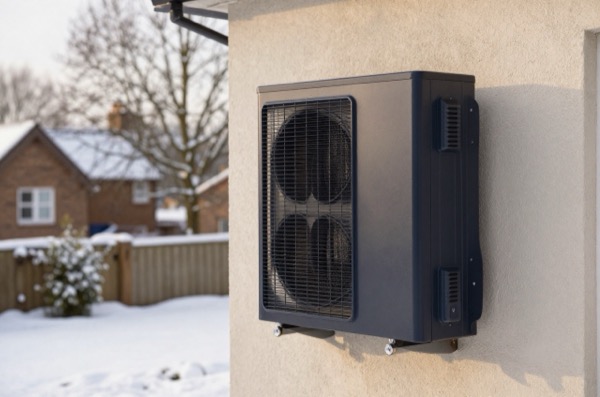
| Air source heat pump | £10,000–£18,000 (before grant; Boiler Upgrade Scheme grant: £7,500) |
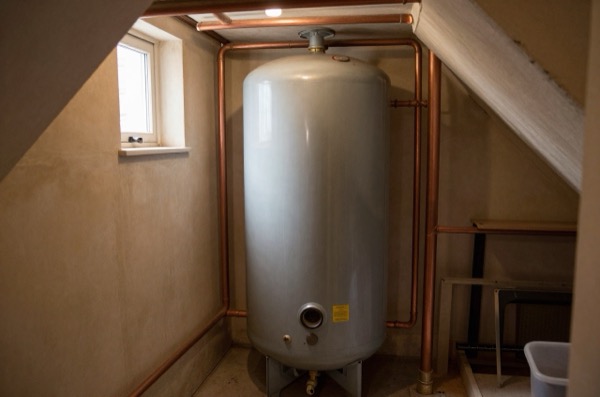
| Hot water cylinder upgrade | £800–£2,000 |
| Radiator upgrades | £1,000–£4,000 |
| Solar PV (4 kWp) | £6,000–£9,000 |
| Battery storage (10 kWh) | £3,500–£6,000 |
| Total (indicative) | £25,000–£70,000 (before grants) |
For comparison, the Energy Saving Trust puts professionally installed loft insulation to 270mm at about £750 from scratch, or £600 as a top-up from 120mm, in Great Britain.1 It puts cavity wall insulation at around £2,200 for a typical home, so expect a smaller mid-terrace to cost less and a larger house more.2
Not every home needs every measure. A solid-wall terrace with an existing gas boiler and single glazing will need more work than a 1980s cavity-wall semi already on double glazing. A good retrofit coordinator will prioritise measures by cost-effectiveness.
PAS 2035 and the Retrofit Coordinator
Publicly funded work, such as ECO4 and the Warm Homes: Local Grant that followed the Home Upgrade Grant, must follow PAS 2035: the publicly available specification for domestic energy-efficiency retrofit.3 Key requirements:
- A TrustMark-registered Retrofit Coordinator must oversee the project
- A Retrofit Assessor (or the coordinator) must survey the property and carry out a retrofit assessment of its construction, condition and energy use4
- Installers must be TrustMark-registered and certified under the latest version of the PAS installation standard (now PAS 2035/2030:2023), or by MCS, for the measures they fit3
- The Retrofit Coordinator must produce a medium-term improvement plan, showing the sequence and phasing of works4
For privately funded work, PAS 2035 is not legally required but is considered best practice. Many quality retrofit installers follow it voluntarily.
Finding a Retrofit Coordinator: the TrustMark website lists accredited coordinators. Expect to pay £800–£2,500 for the assessment, whole-house plan, and oversight of a typical three-bedroom project.
How to Phase a Retrofit if You Cannot Do Everything at Once
Whole-house retrofits rarely happen in a single burst of work. Most homeowners phase the work over 3–10 years. A sensible sequence:
Phase 1, Quick wins (Year 1)
- Loft insulation and cavity wall insulation (if applicable)
- Draught-proofing
- LED lighting
- Heating controls upgrade (smart thermostat, thermostatic radiator valves)
Phase 2, Heating (Year 1–3)
- Replace ageing boiler (condensing gas/oil as interim) or go straight to heat pump if fabric is adequate
- Hot water cylinder with solar thermal or heat pump ready coil
Phase 3, Fabric (Years 2–5)
- External or internal wall insulation (for solid walls)
- Floor insulation
- Window upgrades
Phase 4, Ventilation and renewables (Years 3–7)
- MVHR once property is sufficiently airtight
- Solar PV and battery
If you install a heat pump before solid wall insulation, it will normally be sized for the house as it is then, so it will be bigger and dearer than one sized after the walls are done: another reason to put the fabric first.
Common Retrofit Mistakes to Avoid
Insulating without ventilating. Filling cavity walls and adding loft insulation dramatically reduces background air infiltration. Without controlled ventilation, moisture from cooking and breathing accumulates. At minimum fit trickle vents. Approved Document F treats a home with a design air permeability below 5 m³/(h·m²) at 50 Pa as highly airtight and points such homes towards continuous mechanical ventilation, which MVHR provides efficiently.5
Interstitial condensation in walls. Internal wall insulation can push the dew point into the original wall structure, causing hidden condensation. Use vapour-control layers correctly and check the condensation risk analysis (to BS EN ISO 13788) before specifying the insulation type.6
Sizing the heat pump before the insulation is done. An MCS-compliant heat loss calculation (to BS EN 12831-1) is essential.7 A heat pump sized to the current, uninsulated heat loss will be larger than you need once you insulate, so where you can, finish the fabric work first and size the heat pump afterwards.
Ignoring thermal bridges. Junctions between walls, floors, and roofs can account for a significant share of total heat loss in an otherwise well-insulated building, and that share grows as the rest of the fabric improves. Detail thermal bridging at design stage; use insulated lintels, and extend insulation past window reveals.
Available Grants and Funding
| Scheme | Who It Helps | What It Funds | Value |
|---|---|---|---|
| Boiler Upgrade Scheme | Property owners, including landlords and second-home owners, replacing fossil fuel heating (England & Wales) | Heat pump | £7,500 (£9,000 for oil or LPG homes with no mains gas, until March 2027)8 |
| ECO4 (until 31 Dec 2026) | Low income / fuel poor | Insulation, heating, first-time CH | Up to full cost |
| Warm Homes: Local Grant (successor to HUG2) | Low income, EPC D–G, on or off the gas grid (England) | Insulation, solar PV + low-carbon heating | Up to full cost |
| Warmer Homes Scotland | Low income (Scotland) | Fabric + heating | Up to full cost |
| Warm Homes Nest | Low income (Wales) | Fabric + heating | Up to full cost |
The Great British Insulation Scheme closed on 31 March 2026.9 ECO4 will run until 31 December 2026, so check that a scheme is still open before planning around it.10 The Warm Homes: Local Grant, delivered through councils in England, covers homes rated EPC D–G for households on low incomes or certain means-tested benefits.3 Its guidance to councils caps spending at an average of £16,600 per home for energy performance upgrades and another £16,600 for low-carbon heating, and owner-occupiers are not expected to contribute.3 The Boiler Upgrade Scheme is not limited to owner-occupiers: any owner of the property, including a landlord or second-home owner, can apply when replacing fossil fuel heating, though social housing and most new builds are excluded.11 The grant is £7,500 towards an air source or ground source heat pump, with an extra £1,500 until March 2027 where the home is heated by oil or LPG and has no mains gas connection.8 Many households combine multiple schemes. For example, an owner-occupier on a modest income might use ECO4 for insulation and BUS for the heat pump. Always speak to an independent energy advisor (Home Energy Scotland, Warm Wales, or your local council’s energy team) before committing.
How Long Does a Whole-House Retrofit Take?
Phased as described above, a full programme can stretch over several years. Done as a single coordinated project, it typically takes 6–18 months from initial assessment to final air pressure test, and the physical works (all trades on site together) can take as little as 4–8 weeks for a typical semi-detached, but that needs detailed upfront planning and a coordinated contract.
Start With a Survey
Before spending a penny on measures, pay for a proper Retrofit Assessment (£400–£800 for a thorough one). It will identify your highest-priority measures, flag any structural or moisture risks, and give you a sequenced plan. Think of it as insurance against expensive mistakes.
Finding Tradespeople
Use TrustMark (trustmark.org.uk) for accredited retrofit installers and MCS (mcscertified.com) for heat pump and solar contractors. For solid wall insulation, check that installers are members of the Insulated Render and Cladding Association (INCA) or the National Insulation Association (NIA). Always get a minimum of three quotes and ask for references from similar retrofit projects.
References (11)
Figures in this note were checked against the sources below on 2 October 2026. Superscript numbers in the text point to them. Every source the site cites, by topic.
- 1costfairEnergy Saving Trust.RN-6X9H3BA price, true at 2026-09. The Energy Saving Trust's consumer guide to loft insulation. Its cost table gives about £750 to install 270mm from nothing and £600 to top up from 120mm in Great Britain.
- 2costfairEnergy Saving Trust.RN-3D6QMOA price, true at 2026-09. The Energy Saving Trust's consumer guide to cavity wall insulation, giving a typical installation cost of around £2,200 for a home in Great Britain.
- 3technicalvery strongDepartment for Energy Security and Net Zero (GOV.UK), guidance.RN-2DO0ZLThe Department for Energy Security and Net Zero policy guidance for local authorities delivering the Warm Homes: Local Grant, updated June 2026. Sets the eligibility rules the council must apply, including the deprivation and income routes, what measures the grant funds, and how it sits alongside the Warm Homes Plan. This is the rulebook a council follows, so it says what a household must satisfy rather than what the council's own page summarises.
- 4technicalstrongTrustMark, guidance.RN-NW5SO3TrustMark's scheme requirements for PAS 2035 Retrofit Coordinators, describing the retrofit assessment and the coordinator's responsibility for the improvement plan.
- 5technicalvery strongMinistry of Housing, Communities and Local Government.RN-QD1SFFTable 1.1 sets minimum intermittent extract rates: kitchen with a cooker hood extracting outside 30 l/s, kitchen without one 60 l/s, utility room 30 l/s, bathroom 15 l/s, sanitary accommodation 6 l/s. Extract terminals and fans other than cooker hoods should be as high as practicable and no more than 400mm below the ceiling; a cooker hood should sit between 650mm and 750mm above the hob if the manufacturer gives no figure. Table 1.7 requires background ventilators of at least 8000mm2 equivalent area in habitable rooms and kitchens for a dwelling, 10,000mm2 for a single-storey dwelling. Background ventilators should be at least 1700mm above floor level and at least 500mm from a fan in the same room. On replacement windows, paragraph 3.14 says new windows must carry background ventilators no smaller than the originals, and paragraph 3.15 gives the fallback minimums where the old size is unknown: 8000mm2 habitable rooms, 8000mm2 kitchen, 4000mm2 bathroom. Paragraph 3.32 confirms that replacing an extractor fan or cooker hood on existing cabling is not notifiable.
- 6technicalstrongBSI Knowledge, a standard.RN-V6N8P0BS EN ISO 13788:2012, the calculation methods for internal surface temperature to avoid critical surface humidity, and for interstitial condensation. This is the maths behind two separate problems: mould growing on a cold internal surface, and moisture condensing inside a wall or roof build-up where it cannot dry out. Cited where a note says internal insulation carries a condensation risk, because this is how that risk is actually assessed.
- 7technicalstrongMCS, guidance.RN-7E9GLPMCS's page on its Heat Load Calculator, confirming that MIS 3005-D requires a BS EN 12831-1:2017 compliant heat load calculation.
- 8costvery strongGOV.UK.RN-9EFNVZA price, true at 2026-09. The grant values: £7,500 towards an air source heat pump, £7,500 towards a ground source heat pump including water source heat pumps and those on shared ground loops, and £5,000 towards a biomass boiler. A further £1,500 is available until March 2027 where the property is heated by oil or LPG and has no mains gas connection. Only one grant is available per property. Capacity limits are 45kWth for an individual system, 70kWth for multiple heat pumps and 300kWth for shared ground loops. Hybrid systems pairing a gas boiler with a heat pump are not eligible, and an existing low carbon heating system cannot be replaced under the scheme.
- 9technicalvery strongOfgem.RN-RDOIJRThe scheme, formerly known as ECO+, ran from April 2023 to 31 March 2026 and is now closed. It obliged medium and large energy suppliers to deliver measures reducing energy use in the least energy-efficient homes in Great Britain. Eligibility was homes with an EPC rating of D to G in Council Tax bands A to D in England, or A to E in Scotland and Wales, plus low-income and vulnerable households. Unlike ECO4, which funds whole-house packages, GBIS mostly delivered a single insulation measure per home. This is the page to cite when a note has to say a grant route has closed rather than leave a reader chasing it.
- 10technicalvery strongOfgem.RN-FPPUSLECO4 is the fourth phase of the Energy Company Obligation across Great Britain. It applies to measures installed from 1 April 2022 and runs until 31 December 2026 following a nine-month extension; ECO3 closed on 31 March 2022 and ECO4 came into force in July 2022. The scheme places a Home Heating Cost Reduction Obligation on medium and large energy suppliers to promote measures that improve the ability of low-income, fuel-poor and vulnerable households to heat their homes, funding insulation and heating upgrades for both homeowners and tenants. Ofgem also lists the Great British Insulation Scheme as a separate obligation on this page.
- 11technicalvery strongGOV.UK.RN-ZAQ300You must own the property, which can be a business premises, second home or rental, and you must be replacing a fossil fuel heating system such as oil, gas, electric or LPG. Properties that have already had government funding for a heat pump or biomass boiler, social housing, and most new builds still under construction are excluded, though a finished new build with a fossil fuel boiler and an owner-built self build can qualify. A biomass boiler additionally requires the property to be off the gas grid, in a rural location as defined in Ofgem guidance, and the boiler to hold an emissions certificate. The installer must commission and install the heat pump within 120 days of applying for the grant or it will not be eligible, and the application is made through an MCS certified installer.
-
Roof and loft insulation, Energy Saving Trust, accessed 2 October 2026. Priced at 2026-09 and left there. energysavingtrust.org.uk
-
Cavity wall insulation, Energy Saving Trust, accessed 2 October 2026. Priced at 2026-09 and left there. energysavingtrust.org.uk
-
Warm Homes: Local Grant, Policy Guidance for Local Authorities, Department for Energy Security and Net Zero, accessed 30 September 2026. assets.publishing.service.gov.uk
-
PAS 2035 Retrofit Coordinator Scheme Requirements V1.3, TrustMark, accessed 30 September 2026. trustmark.org.uk
-
Approved Document F: Ventilation, Volume 1: Dwellings (2021 edition), Department for Levelling Up, Housing and Communities, accessed 30 September 2026. assets.publishing.service.gov.uk
-
BS EN ISO 13788:2012 Hygrothermal performance of building components and building elements, BSI, accessed 30 September 2026. knowledge.bsigroup.com
-
About the Heat Load Calculator, MCS, accessed 30 September 2026. mcscertified.com
-
Apply for the Boiler Upgrade Scheme: What you can get, GOV.UK (Department for Energy Security and Net Zero), accessed 15 September 2026. Priced at 2026-09, so no calibration is needed. gov.uk
-
Great British Insulation Scheme, Ofgem, accessed 30 September 2026. ofgem.gov.uk
-
Energy Company Obligation (ECO), Ofgem, accessed 30 September 2026. ofgem.gov.uk
-
Apply for the Boiler Upgrade Scheme: Check if you’re eligible, GOV.UK (Department for Energy Security and Net Zero), accessed 30 September 2026. gov.uk