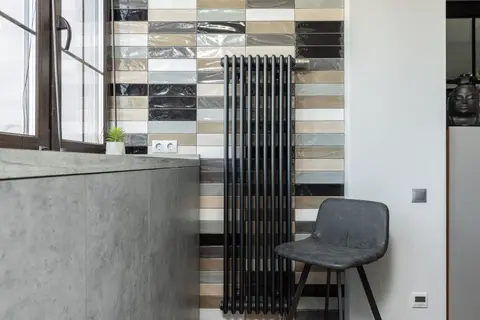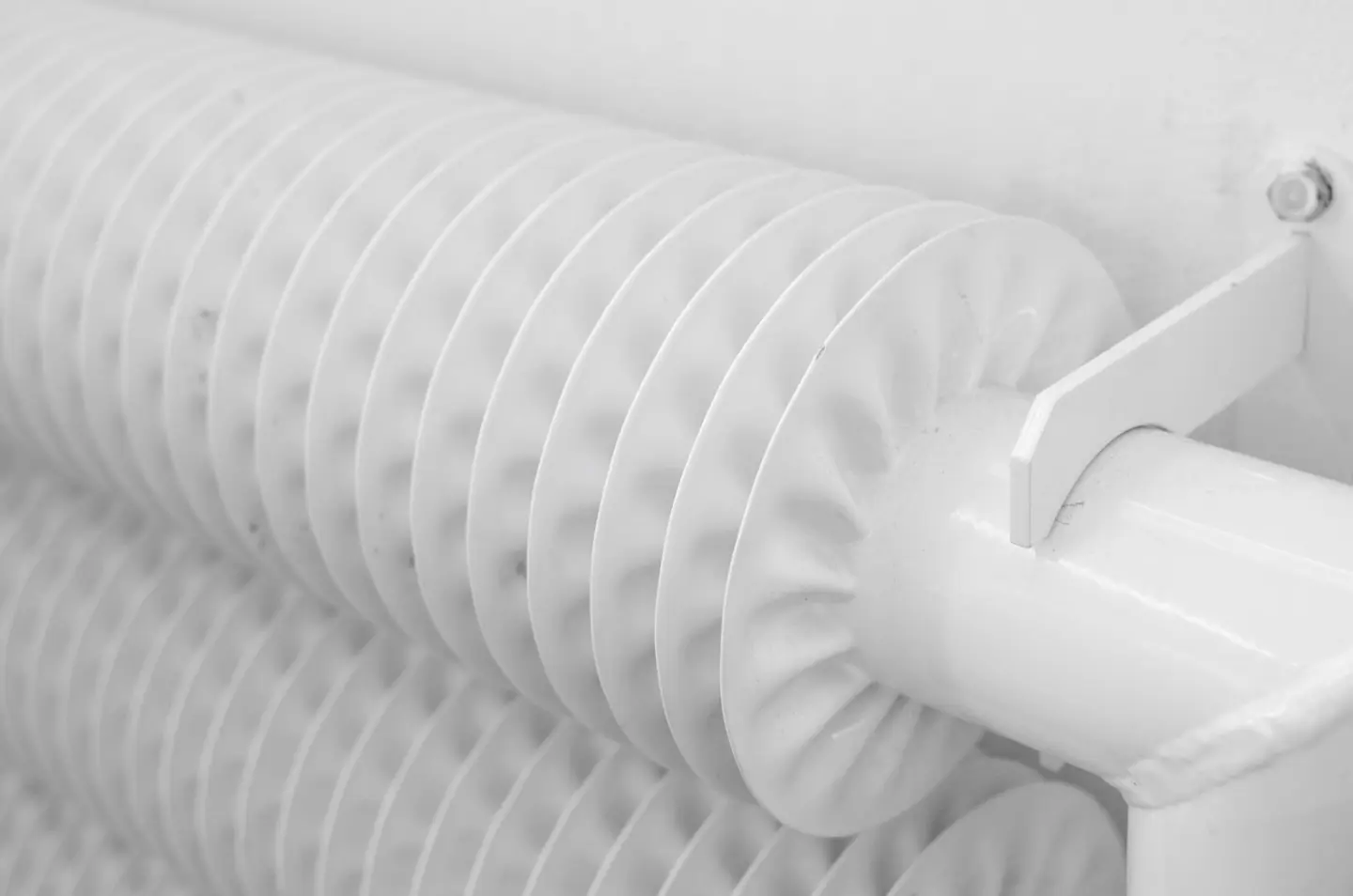
An old radiator that is cold at the top, stained, flaking, or weeping at the valve joints does not need replacing. Most steel panel radiators and virtually all cast iron column radiators can be restored to full working order for under £80 in materials and a weekend’s work.
The key is diagnosing the fault first. Cold at the top means air, bleed it. Cold at the bottom means sludge, flush it. Leaking at the valve means a new valve. Tatty paint means preparation and the right radiator paint. This guide covers all of it.
When to Restore vs When to Replace
Cast iron radiators are almost always worth restoring, they are expensive to buy new (£200–£800+ for a period-style column radiator) and respond well to proper refurbishment. Pressed steel panel radiators are more marginal: if a steel radiator is severely corroded internally, over 20–25 years old, or has a pinhole leak in the panel itself, replacement is usually cheaper.
Restore if you have:
- Cold patches at the top (air lock) or bottom (sludge)
- Flaking, yellowed, or discoloured paintwork
- Stiff or leaking valves
- Surface rust on a cast iron radiator
Replace if you have:
- Pinhole or seam leaks in a steel panel (not at the valve)
- Severe internal corrosion
- A radiator undersized for the room
Tools and Materials
| Item | What it’s for | Approximate 2026 cost |
|---|---|---|
| Radiator bleeding key | Releasing trapped air | £2–£5 |
| Adjustable spanner and grips | Valve removal and tightening | Already owned / £10–£25 |
| PTFE tape | Re-sealing valve threads | £1–£3 |
| Radiator flush / descaler | Flushing internal sludge | £8–£15 per bottle |
| Central heating inhibitor | Corrosion protection after flush | £10–£20 per litre |
| Leak sealer (e.g. liquid silicone type) | Sealing minor weeps | £8–£15 |
| Replacement thermostatic radiator valve (TRV) | Replacing faulty valve | £10–£451 |
| Fine wire wool (grade 0000) or wet-and-dry paper | Surface preparation | £3–£6 |
| Rust-inhibiting primer (spray or brush) | Adhesion on bare metal | £6–£12 |
| Specialist radiator paint (white or colour) | Final finish | £8–£15 per 750 ml |
| Radiator roller and small angled brush | Application on column rads | £4–£10 |
| Dust sheets | Protecting floor and walls | £3–£8 |
Total DIY materials estimate: £20–£80 depending on which steps are needed.
Step 1: Bleed the Radiator
Bleeding removes trapped air that pools at the top of a radiator and prevents hot water filling the full panel.
- Run the heating to full temperature, then turn it off and let the system cool for 20 minutes.
- Place a cloth or container under the bleed valve (the square-slot nipple at the top corner).
- Insert the bleeding key and turn anti-clockwise by half a turn, you will hear hissing air.
- As soon as water drips steadily, close the valve clockwise. Do not overtighten.
- Check the boiler pressure gauge, top up via the filling loop if it has dropped below 1 bar.
- Repeat for every radiator, working upstairs first.
Bleed every radiator at the start of each heating season
Air naturally accumulates over summer. A 10-minute bleed check each autumn prevents cold spots before you need the heating.
Step 2: Flush Out Sludge
If bleeding does not resolve cold patches at the bottom of a radiator, the problem is magnetite sludge, iron oxide deposits that settle at the lowest point and block flow. You can flush a single radiator or the whole system.
Single radiator flush (DIY):
- Close both valves (TRV and lockshield). Place towels and a bucket beneath the radiator.
- Undo the union nut on the lockshield side and drain, expect dark, rust-coloured water.
- Disconnect the TRV side and carry the radiator outside.
- Connect a garden hose to one port and flush until the water runs clear (5–10 minutes).
- Refit, reconnect the valves, and refill.
- Add a central heating inhibitor via the feed-and-expansion tank or a radiator port, follow the dosing instructions on the bottle.
Professional powerflush:
A powerflush machine forces water at high velocity through every radiator and the boiler heat exchanger, dislodging sludge more thoroughly than a manual flush and adding inhibitor in a single operation. Which? puts the cost at £300–£750 for a five-radiator system, with an average of £500, and bigger systems cost more.2 Prices also run higher in London and the South East. Approved Document L says that before a new heating appliance is installed, all central heating circuits should be thoroughly cleaned and flushed out and an inhibitor added.3 Boiler manufacturers often make a clean, treated system a condition of the warranty.
Step 3: Fix Valve Leaks
A weeping valve is the most common radiator fault and almost always fixable without draining the whole system.
Try tightening the gland nut first, the small nut just above the valve body. With the valve closed, tighten a quarter to half a turn. This stops many stem leaks immediately.
If the valve needs replacing:
- Close both valves and drain the radiator as described in Step 2.
- Unscrew the old valve at the union connection on the radiator and the pipe below.
- Clean the threads and wrap them with PTFE tape (5–6 turns, clockwise).
- Fit the new valve and tighten firmly, brass fittings crack if over-tightened.
- Refill, open both valves, and check for leaks.
Replacement TRVs cost £10–£45 for a standard 15 mm straight or angled pattern. Angled valves suit pipes rising from the floor; straight valves suit side-entry pipes.
For persistent minor weeps at a union, a central heating leak sealer added to the system water can seal hairline joints. Add it to the feed-and-expansion tank and circulate for 30 minutes. These products are a short-term measure, do not exceed the stated dose.
Step 4: Prepare the Surface for Painting
Never paint over rust or loose paint, the new coat will peel within months. Old radiators may carry layers of lead paint: HSE notes that lead pigments were widely used in household paints until the 1960s, so rub down wet rather than dry, never burn or heat-strip old paint, and keep children and pregnant women away from the work.4
- Turn the heating off and let the radiator cool completely before touching it.
- Rub down any flaking areas with fine wire wool (grade 0000) or 240-grit wet-and-dry paper to give the new paint a key.
- On cast iron with surface rust, apply a rust-inhibiting primer and allow it to dry fully (typically 2–4 hours) before topcoating.
- Wipe clean with a dry cloth to remove all dust.
Step 5: Paint the Radiator
Ordinary household emulsion or gloss will yellow and blister in contact with a hot radiator. Use a specialist radiator paint, which is formulated to give a heat-resistant finish that resists yellowing.5
- Apply a thin, even first coat with a small radiator roller (for flat panel fronts) and an angled brush for getting into the fins of column radiators or behind the panel.
- Allow the first coat to dry fully before recoating: Hammerite’s radiator paint, for example, is touch dry in 4–6 hours but should not be recoated for 16 hours.5
- Apply a second coat for solid coverage.
- Leave to cure for 24–48 hours before turning the heating back on. First heat-up may produce a faint smell as the paint fully cures, ensure the room is ventilated.
Radiator paint comes in white and a growing range of colours, anthracite and matt black are popular choices for period renovations. Coverage varies by product: Hammerite’s radiator paint is rated at 7 m² per litre, so a 750 ml tin covers roughly 5 m² per coat.5
DIY vs Professional: Cost Comparison
| Task | DIY cost (materials) | Professional cost (2026 UK) | When to choose professional |
|---|---|---|---|
| Bleeding radiators | £2–£5 (key only) | Included in service call (£80–£120/hr) | Never, this is always DIY |
| Single radiator flush | £10–£20 | £80–£150 per radiator | If sludge is severe or system has many radiators |
| Full system powerflush | Not feasible DIY | £300–£750 | Whole-system sludge; before new boiler install |
| Valve replacement | £11–£48 inc. PTFE | £80–£180 inc. parts and labour | If pipework is difficult to access |
| Repainting (exterior) | £20–£40 | £150–£300 for one radiator (specialist) | Cast iron radiators requiring professional sandblasting |
| Full replacement (mid-size steel panel rad) | £60–£150 for radiator alone | £150–£400 supply and fit | When restoration cost exceeds replacement cost |
Common Mistakes to Avoid
- Painting a warm radiator. Heat causes solvent-based paints to blister immediately. Paint cold and cure cold before switching the heating on.
- Skipping inhibitor after a flush. Refilling with plain tap water accelerates internal corrosion. Always dose the system after refilling.
- Over-tightening brass fittings. Brass threads strip easily, firm hand-tight plus a quarter turn with a spanner is enough.
- Using standard gloss paint. It will yellow and crack within one heating season. Use radiator-specific paint only.
- Forgetting to top up system pressure after bleeding. Each bleed drops pressure slightly on a sealed system; with the system cool, refill to between 1 and 1.5 bar via the filling loop.6
When to Call a Professional
Call a heating engineer if:
- The leak is at the boiler connection, not the radiator itself.
- The boiler is kettling or banging, which usually points to scale or sludge in the boiler’s heat exchanger rather than a radiator sludge problem.
- You need to move or re-pipe a radiator, which involves cutting into the central heating circuit.
- The system is sealed (pressurised) and you are unsure how to isolate sections safely.
Anyone employed to work on a gas boiler or other gas appliance in your home must be a Gas Safe registered engineer.7 A Gas Safe engineer can carry out a full system health check, inhibitor levels, magnetic filter, pump pressure, for around £80–£150 as part of an annual boiler service.
The rules in this note are those that apply in England. Scotland, Wales and Northern Ireland have their own building standards and permitted development rights.
References (7)
Figures in this note were checked against the sources below on 30 September 2026. Superscript numbers in the text point to them. Every source the site cites, by topic.
- 1costsupplier figureScrewfix.RN-5NZ1EQA price, true at 2026-09. the retail price Screwfix publishes for 1 2 x 15mm white chrome angled l s modern thermostatic radiator valve lockshield, which is the supply figure the cost book records for this item
- 2costfairWhich?.RN-4XIXAGA price, true at 2026-09. Which? guide to boiler and associated installation costs; it gives the cost range and average for a power flush of a five-radiator heating system.
- 3technicalvery strongMinistry of Housing, Communities and Local Government.RN-L0FCJXThe in-force U-value tables a DIY insulation or door note must quote, with the exact numbers. Table 4.2, limiting U-values for new fabric elements in existing dwellings, sets roof 0.15, wall 0.18, floor 0.18, swimming pool basin 0.25, window 1.4 or Window Energy Rating Band B minimum, rooflight 2.2, doors with more than 60 per cent of the internal face glazed 1.4 or Doorset Energy Rating Band C minimum, and other doors 1.4 or Doorset Energy Rating Band B minimum. Table 4.3, for existing elements, gives a roof threshold of 0.35 and an improved value of 0.16, which is the figure a loft insulation note needs: paragraph 4.12 says a retained element whose U-value is higher than the column (a) threshold, for example through a loft or garage conversion, should be upgraded to the column (b) value. Paragraph 4.13 allows a lesser upgrade only where the improved value is not technically or functionally feasible or would not achieve a simple payback of 15 years or less. Paragraph 4.8 requires a replacement element to be no worse than the one it replaces as well as meeting Table 4.2. Paragraph 4.10 gives the heritage exception: where character must be maintained, a centre pane U-value of no more than 1.2 or low-emissivity secondary glazing. Note 9 records that the timber window concession of 1.6 or Band C ended on 14 June 2023. The 2021 edition came into force on 15 June 2022; a 2026 edition exists at https://assets.publishing.service.gov.uk/media/69c122a6cfa346b9d4704a55/ADL1_2026.pdf.
- 4technicalvery strongHealth and Safety Executive, guidance.RN-DF6UI1HSE's construction lead page. It states lead pigments were commonly used in paints for buildings until the 1960s and that lead was not removed from all commonly used paint until the early 1980s, which is the date test any note about stripping paint in an older house needs. The highest-risk activities it names are stripping or preparing leaded paint from doors and windows, working with lead on roofs, hot cutting of lead or leaded paint in demolition, and blast removal of old leaded paint. Health effects include anaemia and kidney disease, with chronic exposure risking kidney, nerve and brain damage, and a link to a small number of occupational cancers. The governing law is the Control of Lead at Work Regulations 2002, which requires employers to protect employees from the risks from lead, applied through an Assess, Control and Review model with FFP3 respiratory protection at an assigned protection factor of 20, changed work methods, dust control, protective clothing, hygiene and medical surveillance.
- 5technicalsupplier figureAkzoNobel (Dulux Trade), guidance.RN-3MODC3Maker's product page for Hammerite radiator paint; it states the paint is formulated for a heat-resistant finish on domestic radiators and lists resistance to yellowing.
- 6technicalsupplier figureWorcester Bosch, guidance.RN-5VM491A boiler manufacturer's support page on system pressure. It gives 1 to 1.5 bar as the correct reading on a cool sealed heating system.
- 7technicalvery strongHealth and Safety Executive, guidance.RN-RJTAHSHSE's gas safety answers for homeowners and occupiers: what to do if an appliance is suspected unsafe, and the advice that all gas appliances, flues and pipework be installed, maintained and serviced annually by a Gas Safe registered installer. HSE is the enforcing authority for gas safety, so this is the regulator's own position.
-
1/2 inch x 15mm White/Chrome Angled & L/S Modern Thermostatic Radiator Valve & Lockshield, Screwfix, accessed 30 September 2026. Priced at 2026-09, so no calibration is needed. screwfix.com
-
How much does a new boiler cost?, Which?, accessed 30 September 2026. Priced at 2026-09 and left there. which.co.uk
-
Approved Document L, Conservation of fuel and power, Volume 1: Dwellings, 2021 edition incorporating 2023 amendments, Ministry of Housing, Communities and Local Government, accessed 14 September 2026. assets.publishing.service.gov.uk
-
Construction hazardous substances: Lead, Health and Safety Executive, accessed 30 September 2026. hse.gov.uk
-
Hammerite Radiator Paint Gloss, AkzoNobel (Dulux Trade), accessed 30 September 2026. duluxtradepaintexpert.co.uk
-
How often should I need to top up the pressure in the heating system?, Worcester Bosch, accessed 30 September 2026. worcester-bosch.co.uk
-
Gas safety - Home owners, Health and Safety Executive, accessed 30 September 2026. hse.gov.uk