Home air conditioning was once considered a luxury confined to commercial buildings and new-build flats in the UK. That has changed rapidly. Warmer summers, more people working from home, and the falling cost of inverter-driven split systems mean that domestic AC installation has become far more common in recent years.
The key question is what type of system suits your home, and what it will cost. A portable fan is not air conditioning; a fixed split system is. Understanding the difference, and the options in between, helps you spend your budget wisely.
Air Conditioning Cost Summary
| System type | Supply & install cost (inc. VAT) | Best for |
|---|---|---|
| Portable evaporative cooler | £100–£400 (no install) | Very limited cooling, rental |
| Portable refrigerant AC (window/floor) | £300–£800 (minimal install) | Single room, temporary |
| Single-split AC system | £1,200–£2,500 | One room, year-round use |
| Dual-split (2 indoor units, 1 outdoor) | £2,500–£4,500 | Two rooms |
| Multi-split (3–5 indoor, 1 outdoor) | £3,500–£9,000 | Whole-house |
| Ducted (concealed) system | £6,000–£15,000+ | New-build or major renovation |
| Air-to-air heat pump (combined heating/cooling) | £1,500–£3,000 per room (before grant; Boiler Upgrade Scheme grant: £2,500, only where it replaces the home’s fossil fuel heating) | Year-round heating and cooling |
The Energy Saving Trust puts a typical air-to-air heat pump, the heating-and-cooling form of a split system, at about £1,900 for one room and around £3,700 for a three-bedroom semi-detached home (both before grant; Boiler Upgrade Scheme grant: £2,500).1 In England and Wales, the Boiler Upgrade Scheme now offers a £2,500 grant towards an air-to-air heat pump.2 The grant is only paid where any existing fossil fuel heating system, such as a gas or oil boiler, is fully replaced, so a unit added to one room of a home that keeps its boiler does not qualify.3
Types of System Explained
Portable Air Conditioners
Portable refrigerant ACs are self-contained units that sit in the room, extract heat from the air, and exhaust it via a flexible hose vented through a window or small hole in the wall. They require no permanent installation (though a through-wall vent is neater than dangling a hose out of a window) and cost £300–£800 to buy.
Their key limitation is efficiency: because they draw in warm room air to cool the condenser, they partially counteract their own cooling effect. They are significantly less efficient than split systems (lower SEER/SCOP ratings) and considerably noisier. They are best treated as a stopgap rather than a permanent solution.
Split Systems (Most Popular)
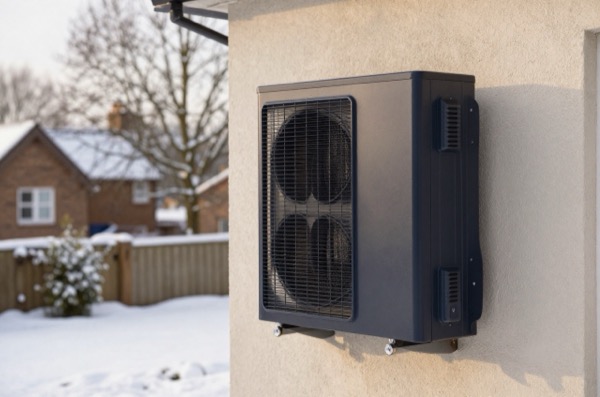
A split system consists of two units: an indoor air handler (wall-mounted, floor-standing, or ceiling cassette) and an outdoor compressor/condenser connected by refrigerant pipework run through a small hole in the external wall. They are quiet, efficient, and, on modern inverter-driven models, can also provide efficient heating in winter (functioning as an air-to-air heat pump).
Modern inverter split systems commonly have SEER (Seasonal Energy Efficiency Ratio) values of roughly 6–9, with some premium models rated higher. Portable units are rated on a different basis (EER) and are markedly less efficient.
Installation requires an engineer with a personal F-gas qualification, working for a company certified to work with F gas, under Regulation (EU) No 517/2014 as retained in Great Britain after Brexit. A category 2 F-gas certificate is the minimum for installing, servicing and recovering refrigerant from systems holding less than 3 kg of F gas, which covers typical domestic split units.4
Single-room split system installed costs in 2026:
| Room size | Capacity required | Installed cost (inc. VAT) |
|---|---|---|
| Small bedroom (up to 15 m²) | 2.0–2.5 kW | £1,200–£1,800 |
| Double bedroom / small lounge (15–25 m²) | 2.5–3.5 kW | £1,500–£2,200 |
| Large lounge / open-plan (25–45 m²) | 4.0–6.0 kW | £2,000–£3,000 |
| Very large open-plan (45–80 m²) | 6.0–9.0 kW | £2,800–£4,500 |
Capacity should be calculated by a qualified installer using a heat gain calculation, online rules of thumb can be misleading, particularly in south-facing rooms or properties with poor insulation.
Multi-Split Systems
A multi-split system uses a single outdoor unit connected to two to five indoor units in different rooms. The outdoor unit is larger (and more expensive) than a single-split outdoor unit, but the economy of sharing one compressor and one refrigerant circuit becomes apparent when covering three or more rooms.
Installed cost in 2026:
- 2 rooms, £2,500–£4,500
- 3 rooms, £3,500–£6,500
- 4–5 rooms, £5,500–£9,000
The brands most commonly installed by UK engineers include Daikin, Mitsubishi Electric, LG, Panasonic, and Samsung. These are not equivalent to budget-end brands sold via retail; quality and reliability differ significantly.
Ducted Systems
Concealed ducted air conditioning distributes conditioned air through a network of ducts in the ceiling or floor void. The indoor unit is hidden in a loft or ceiling space; only the grilles are visible. This is the most discreet option and suits whole-house conditioning, but it requires either a new-build shell or significant structural work to install ducts retrospectively.
Costs are high: £8,000–£15,000 for a three- to four-bedroom house, with additional costs for any structural work to accommodate the ducting.
Planning Permission
Permitted development rights in England (Schedule 2, Part 14, Class G of the GPDO) cover an air source heat pump on a house, including a reversible air-to-air system that heats as well as cools, but not a unit used solely for cooling, so a cooling-only air conditioner generally needs planning permission.5 The main limits for a house since 29 May 2025 are:
- The heat pump must not be used solely for cooling, and must comply with the MCS Planning Standards6
- No more than one air source heat pump on a house that is not detached, or two on a detached house6
- The outdoor compressor unit, including any housing, must not exceed 1.5 m³ on a house5
- Not on a pitched roof, not within 1 m of the edge of a flat roof, and not on a listed building or within its curtilage6
- In a conservation area or World Heritage Site, not on a wall or roof that fronts a highway; elsewhere, not on a highway-facing wall above ground-floor level6
Most reversible single-split and multi-split installations on houses fall within these limits. Always check with your local planning authority if the unit is cooling-only, the property is listed or in a conservation area, or permitted development rights have been removed.
Running Costs
A 3.5 kW split system running for 8 hours per day during a 3-month summer season costs approximately:
- At the Ofgem price cap rate of 26.32p per kWh for electricity from 1 October 2026, and about 100–150 kWh a month: roughly £26–£40 per month in cooling mode7
- In heat pump (heating) mode in winter, running costs are typically a third to a quarter of those of an electric resistive heater for the same heat output, owing to COP values of 3–4
Annual running cost for a well-specified single-room system used as both cooling and supplemental heating is roughly £200–£400 per year depending on usage pattern and electricity tariff.
Choosing an Installer
- The engineer must hold a personal F-gas qualification from an accredited body such as City & Guilds, BESA or LCL Awards, and the firm should hold company F-gas certification (for example from REFCOM or the F-Gas Register); ask to see both before accepting a quote4
- Membership of the BESA (Building Engineering Services Association) is a useful further check
- Obtain at least two quotes; a written specification including the make, model, kW capacity, and estimated SEER rating of the proposed system
- Confirm whether the quote includes the electrical supply to the unit, which is sometimes excluded; a new circuit from the consumer unit is notifiable work under Part P and should be done by a registered electrician or notified to building control8
- Ensure a warranty on both labour and parts (manufacturer warranties commonly run for several years on registered installations; confirm the length in writing)
References (8)
Figures in this note were checked against the sources below on 2 October 2026. Superscript numbers in the text point to them. Every source the site cites, by topic.
- 1costfairEnergy Saving Trust.RN-5BQJWLA price, true at 2026-09. Energy Saving Trust guide to air-to-air heat pumps (split systems that heat and cool); it gives typical installed costs of about £1,900 for one room and £3,700 for a three-bed semi.
- 2technicalvery strongGOV.UK.RN-9EFNVZThe grant values: £7,500 towards an air source heat pump, £7,500 towards a ground source heat pump including water source heat pumps and those on shared ground loops, and £5,000 towards a biomass boiler. A further £1,500 is available until March 2027 where the property is heated by oil or LPG and has no mains gas connection. Only one grant is available per property. Capacity limits are 45kWth for an individual system, 70kWth for multiple heat pumps and 300kWth for shared ground loops. Hybrid systems pairing a gas boiler with a heat pump are not eligible, and an existing low carbon heating system cannot be replaced under the scheme.
- 3technicalvery strongOfgem, guidance.RN-YCPKNQOfgem's guidance for property owners on BUS applications made from 28 April 2026. It explains that an EPC is optional, with other evidence accepted where there is none.
- 4technicalvery strongEnvironment Agency and Department for Environment, Food & Rural Affairs (GOV.UK), guidance.RN-J7IE96GOV.UK guidance on F gas qualifications. For refrigeration, air conditioning and heat pump systems containing F gas, engineers need a qualification to install, service, leak check and recover gas.
- 5technicalvery strongPlanning Portal, guidance.RN-3JPY7YPlanning Portal guidance on permitted development for air source heat pumps in England, including the condition that the unit must not be used solely for cooling.
- 6technicalvery strongThe National Archives, guidance.RN-MOUFL8The permitted development right for air source heat pumps on houses and blocks of flats in England. It sets the MCS Planning Standards condition, the unit volume caps and the listed building and conservation area limits.
- 7costvery strongOfgem.RN-YYE8U2A price, true at 2026-09. The live source for any running-cost sum in a heating note. For 1 October to 31 December 2026 the direct debit cap is 26.32p per kWh for electricity with a 54.83p daily standing charge, and 7.97p per kWh for gas with a 29.68p daily standing charge, giving a typical annual dual fuel bill of £1,723, a 4% rise on the previous period. Ofgem states these are the average unit rate and standing charge for direct debit customers in England, Scotland and Wales; gas prices include 5% VAT while electricity carried no VAT in this period. The cap is reset every three months, so any note quoting a pence-per-kWh figure should be dated against this page.
- 8technicalvery strongMinistry of Housing, Communities and Local Government.RN-JYJ3I5The document that decides what electrical work a homeowner may legally do themselves, and the exact list of notifiable jobs. Regulation 12(6A), reproduced at paragraph 2.5, makes only three things notifiable: the installation of a new circuit, the replacement of a consumer unit, and any addition or alteration to existing circuits in a special location. Regulation 12(9) defines special location as, in a room containing a bath or shower, the zone extending vertically from finished floor level to 2.25 metres (or the shower head position if higher) and horizontally 600mm from the edge of the bath tub or shower tray. Paragraph 2.7 states that all other electrical installation work is not notifiable, namely additions and alterations to existing installations outside special locations, and replacements, repairs and maintenance anywhere. Paragraph 2.8 gives worked examples: a built-in cooker is not notifiable unless a new cooker circuit is needed, and connecting an electric gate or garage door to an existing isolator is not notifiable but running a new circuit from the consumer unit to that isolator is. Paragraph 2.2 confirms Part P reaches outdoor work including fixed garden lighting, pond pumps and outbuildings such as sheds, detached garages and domestic greenhouses. Notifiable work must be certified by self-certification by a registered competent person, third-party certification, or a building control body (paragraph 3.1), with the compliance certificate issued within 30 days (paragraph 3.4). Note that Approved Document P is a source of guidance rather than a ban: non-notifiable work still has to comply with BS 7671.
-
Air-to-air heat pumps, Energy Saving Trust, accessed 30 September 2026. Priced at 2026-09 and left there. energysavingtrust.org.uk
-
Apply for the Boiler Upgrade Scheme: What you can get, Department for Energy Security and Net Zero, accessed 30 September 2026. gov.uk
-
Boiler Upgrade Scheme: Property Owner Guidance V5.1, Ofgem, accessed 2 October 2026. ofgem.gov.uk
-
Qualifications to work with F gas, Department for Environment, Food & Rural Affairs, accessed 30 September 2026. gov.uk
-
Planning Permission: Air source heat pump, Planning Portal, accessed 30 September 2026. planningportal.co.uk
-
The Town and Country Planning (General Permitted Development) (England) Order 2015, Schedule 2, Part 14, Class G, The National Archives, accessed 30 September 2026. legislation.gov.uk
-
Energy price cap: unit rates and standing charges, Ofgem, accessed 30 September 2026. Priced at 2026-09 and left there. ofgem.gov.uk
-
Approved Document P, Electrical safety: Dwellings, 2013 edition, Ministry of Housing, Communities and Local Government, accessed 30 September 2026. assets.publishing.service.gov.uk