Ground source and air source heat pumps both do the same fundamental job, move heat from the environment into your home rather than generating it by burning fuel. The difference is where that heat comes from, and that difference has profound implications for installation cost, efficiency, and which properties can realistically accommodate each technology.
The Core Difference
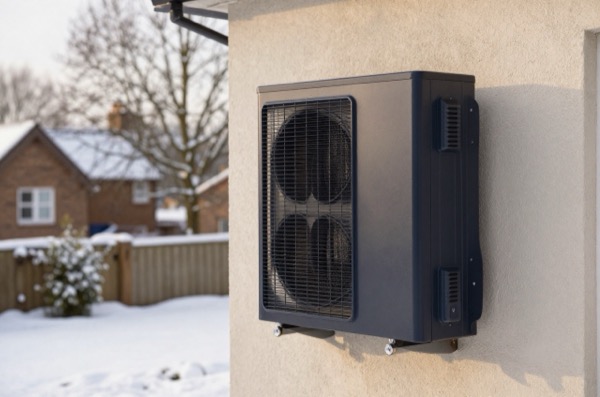
An air source heat pump (ASHP) extracts heat from outdoor air. It keeps extracting useful heat well below freezing, although its efficiency falls as the outdoor air gets colder. The unit sits outside, typically on a wall mount or ground plinth, and works year-round with no ground disturbance.
A ground source heat pump (GSHP) extracts heat from the ground, which is far more stable than the air: from about 10–15 m down it stays at the local mean annual air temperature, roughly 8–12°C across mainland UK.1 The heat extraction happens through a closed-loop system, either horizontal ground loops typically buried in trenches at about 1.2–1.5 m depth, or vertical boreholes. A borehole is only about 20 cm wide but typically somewhere between 75 and 200 m deep, depending on the home’s heat demand and the local geology.2
Efficiency: SCOP and Why It Matters
The measure of heat pump efficiency is the Seasonal Coefficient of Performance (SCOP), the ratio of heat output to electrical energy consumed, averaged over a heating season.
| Technology | Typical SCOP | Heat out per 1 kWh electricity |
|---|---|---|
| Air source heat pump | 2.5–3.5 | 2.5–3.5 kWh |
| Ground source (horizontal loop) | 3.2–4.0 | 3.2–4.0 kWh |
| Ground source (borehole) | 3.5–4.5 | 3.5–4.5 kWh |
| Modern gas boiler | ~0.90 | 0.9 kWh |
A higher SCOP means lower running costs for the same heat output. At the price cap electricity rate of 26.32p/kWh from 1 October 2026, a GSHP with a SCOP of 4.0 delivers heat at about 6.6p/kWh, and an ASHP with a SCOP of 3.0 at about 8.8p/kWh.3 Gas at the capped 7.97p/kWh through a 90% efficient boiler works out at about 8.9p per kWh of heat, so an average ASHP is now roughly level with gas on unit rates, and a better one beats it.3 Heat pump economics still turn on the ratio between electricity and gas prices.
Installation Costs
| System | Installed cost before grant (inc. VAT, 2026) |
|---|---|
| ASHP (3-bed semi) | £9,000–£14,000 (before grant; Boiler Upgrade Scheme grant: £7,500)4 |
| ASHP (4-bed detached) | £12,000–£18,000 (before grant; Boiler Upgrade Scheme grant: £7,500) |
| GSHP (horizontal loop, 3-bed) | £15,000–£22,000 (before grant; Boiler Upgrade Scheme grant: £7,500) |
| GSHP (horizontal loop, 4-bed) | £18,000–£28,000 (before grant; Boiler Upgrade Scheme grant: £7,500) |
| GSHP (borehole, any size) | £20,000–£40,000 (before grant; Boiler Upgrade Scheme grant: £7,500) |
The Energy Saving Trust puts the typical cost of installing an air source heat pump at around £12,000 (before grant; Boiler Upgrade Scheme grant: £7,500).5 It puts a ground source heat pump with its loop buried in trenches at around £15,000 (before grant; Boiler Upgrade Scheme grant: £7,500), and says a borehole adds considerably more.2
The GSHP premium over an equivalent ASHP is typically £6,000–£15,000 for horizontal loops and £12,000–£25,000 for boreholes, after accounting for the same BUS grant amount. This premium must be recovered through lower running costs to justify the choice.
Borehole drilling alone (for example, 2 × 100 m boreholes for a typical 3-bed property) can cost roughly £8,000–£16,000 before any heat pump equipment, depending on depth and ground conditions.
Ground Requirements
| System type | Land requirement | Soil suitability |
|---|---|---|
| Horizontal loop (standard) | ~300–500 m² per 10 kW | Clay soils best; poor in dry sand |
| Horizontal Slinky loop | ~150–300 m² per 10 kW | As above, more compact |
| Vertical borehole | No surface area (just borehole access point) | Suitable for most sites; geological survey needed |
| ASHP | 1–3 m² for outdoor unit | No ground works |
Horizontal loops require a large, unobstructed garden area that can be excavated and reinstated. On those figures, a 10–15 kW system needs roughly 300–750 m² of undisturbed standard loop field, and a smaller 6–8 kW system around 180–400 m². Most urban and suburban gardens cannot accommodate this.
Boreholes solve the space problem but add significant cost and require specialist drilling equipment, the rig needs vehicle access to the drilling position, so check the width and height clearance your driller needs.
The BUS Grant: Does It Apply to Both?
Yes. The Boiler Upgrade Scheme (BUS) grant of £7,500 applies to both ASHPs and GSHPs, including water source heat pumps and shared ground loops, in England and Wales.64 Until March 2027, a home heated by oil or LPG with no mains gas connection can get an extra £1,500 towards either.4 A valid EPC is no longer needed for applications made from 28 April 2026, and the old condition to install any loft and cavity wall insulation an EPC recommends first was dropped in 2024.78 The installer must be MCS-certified, and most new builds and social housing are excluded.9 Check GOV.UK for the current eligibility rules before you commit.
Which Is Right for Your Property?
Choose an ASHP if:
- You have a standard suburban or urban property.
- Your garden is small or fully landscaped.
- You want minimum ground disturbance.
- Budget is a primary concern, the ASHP payback period is shorter despite lower SCOP.
Choose a GSHP if:
- You have several hundred square metres of open garden that can be dug up for ground loops (see the land requirements above).
- You can accommodate borehole drilling access.
- You want the highest possible system efficiency (important for large, older, or poorly insulated properties where heating loads are high).
- The property is in a rural area with low ground disturbance costs.
- You are building new and can integrate ground loops at the groundworks stage cheaply.
Running Cost Comparison: Worked Example
Assumptions: 3-bed semi-detached, 80 m² of heated floor area, heating demand 12,000 kWh/year, electricity at the 26.32p/kWh cap and gas at 7.97p/kWh.
| System | SCOP | Annual electricity use | Annual heating cost |
|---|---|---|---|
| ASHP | 3.0 | 4,000 kWh | £1,053 |
| GSHP (horizontal) | 3.8 | 3,158 kWh | £831 |
| GSHP (borehole) | 4.2 | 2,857 kWh | £752 |
| Gas boiler (85% efficiency) | 0.85 | N/A (gas) | £1,125 |
The annual saving of a GSHP over an ASHP is £220–£300 per year in this example. At an installation premium of £10,000, the additional payback period is 33–45 years, significantly longer than the system’s warranty period. This calculation helps explain why ASHPs dominate new heat pump installations: since the Boiler Upgrade Scheme began, 97.6% of the grants it has paid were for air source heat pumps.10 GSHPs tend to be reserved for properties where their advantages are clear.
Finding a Qualified Installer
All heat pump installations eligible for the BUS grant must be carried out by MCS-certified installers.11 The MCS (Microgeneration Certification Scheme) directory at mcscertified.com lists certified installers.12 Get at least three quotes, heat pump pricing varies considerably, and the cheapest is rarely the best value in a high-stakes installation.
References (12)
Figures in this note were checked against the sources below on 2 October 2026. Superscript numbers in the text point to them. Every source the site cites, by topic.
- 1technicalfairBritish Geological Survey, guidance.RN-94GS85A British Geological Survey ground source heat pump report module. It says ground at 10–15 m is at the mean annual air temperature, which is about 8–12°C for mainland UK at sea level.
- 2technicalfairEnergy Saving Trust, guidance.RN-12Q6TOThe Energy Saving Trust's consumer guide to ground source heat pumps. It gives the typical width and depth range of a ground source borehole and says depth depends on heat demand and geology.
- 3technicalvery strongOfgem.RN-YYE8U2The live source for any running-cost sum in a heating note. For 1 October to 31 December 2026 the direct debit cap is 26.32p per kWh for electricity with a 54.83p daily standing charge, and 7.97p per kWh for gas with a 29.68p daily standing charge, giving a typical annual dual fuel bill of £1,723, a 4% rise on the previous period. Ofgem states these are the average unit rate and standing charge for direct debit customers in England, Scotland and Wales; gas prices include 5% VAT while electricity carried no VAT in this period. The cap is reset every three months, so any note quoting a pence-per-kWh figure should be dated against this page.
- 4costvery strongGOV.UK.RN-9EFNVZA price, true at 2026-09. The grant values: £7,500 towards an air source heat pump, £7,500 towards a ground source heat pump including water source heat pumps and those on shared ground loops, and £5,000 towards a biomass boiler. A further £1,500 is available until March 2027 where the property is heated by oil or LPG and has no mains gas connection. Only one grant is available per property. Capacity limits are 45kWth for an individual system, 70kWth for multiple heat pumps and 300kWth for shared ground loops. Hybrid systems pairing a gas boiler with a heat pump are not eligible, and an existing low carbon heating system cannot be replaced under the scheme.
- 5costfairEnergy Saving Trust.RN-X9NXFYA price, true at 2026-09. Energy Saving Trust advice page on air source heat pumps, giving the typical installed cost for a UK home.
- 6technicalvery strongGOV.UK (Department for Energy Security and Net Zero), a government page.RN-DJPZSBThe Boiler Upgrade Scheme application page: the grant amounts for an air source heat pump, ground source heat pump and biomass boiler, who is eligible, and the fact that the installer applies on the householder's behalf rather than the householder claiming it back. This is the official statement of the grant, so it is the figure to use rather than an installer's summary of it.
- 7technicalvery strongDepartment for Energy Security and Net Zero, guidance.RN-AWHPHIThe March 2024 DESNZ response to the consultation on amending the Boiler Upgrade Scheme regulations: a higher grant for ground source heat pumps, retention of the requirement for a valid EPC from the last 10 years, and removal of the requirement to install recommended loft and cavity wall insulation first (in force May 2024).
- 8technicalvery strongOfgem, guidance.RN-FAJTUKOfgem's scheme guidance for Boiler Upgrade Scheme installers, version 5.1. It settles that from 28 April 2026 a valid EPC is no longer needed, though an existing EPC's number must be supplied.
- 9technicalvery strongGOV.UK.RN-ZAQ300You must own the property, which can be a business premises, second home or rental, and you must be replacing a fossil fuel heating system such as oil, gas, electric or LPG. Properties that have already had government funding for a heat pump or biomass boiler, social housing, and most new builds still under construction are excluded, though a finished new build with a fossil fuel boiler and an owner-built self build can qualify. A biomass boiler additionally requires the property to be off the gas grid, in a rural location as defined in Ofgem guidance, and the boiler to hold an emissions certificate. The installer must commission and install the heat pump within 120 days of applying for the grant or it will not be eligible, and the application is made through an MCS certified installer.
- 10technicalvery strongOfgem, guidance.RN-4NY25MOfgem's annual report on the Boiler Upgrade Scheme for scheme year 4. It gives the share of all BUS grants paid since launch that went to air source heat pumps.
- 11technicalvery strongOfgem.RN-8EXIQ9Ofgem administers the Boiler Upgrade Scheme on behalf of the Department for Energy Security and Net Zero, handling voucher processing, payments, compliance monitoring and fraud investigation, but does not set scheme policy or certify installers and products. Ofgem lists £7,500 for air-to-water, ground source and water source heat pumps, £5,000 for biomass boilers, £2,500 for air-to-air heat pumps in residential properties, and £9,000 for air-to-water or ground source heat pumps in off-gas-grid properties until 31 March 2027. Only MCS certified installers can apply for and redeem vouchers on behalf of a property owner. Enquiries go to BUS.Enquiry@ofgem.gov.uk or 0330 053 2006.
- 12technicalstrongMCS (Microgeneration Certification Scheme).RN-ARWY4WThe public register of MCS certified installers, searchable by installer name, certification number, or by technology and location. MCS describes itself as the UK's quality mark for small-scale renewables such as solar panels and heat pumps, and this certification is the gate to the Boiler Upgrade Scheme grant. The technology filters set out exactly what MCS covers: air source heat pump, battery storage, biomass, exhaust air heat pump, ground or water source heat pump, micro CHP, small wind turbine, solar assisted heat pump, solar heating and solar PV. Use this to tell a reader how to check a quoted installer rather than take a claim on trust.
-
Temperature and Thermal Properties (Basic), British Geological Survey, accessed 30 September 2026. shop.bgs.ac.uk
-
Ground source heat pumps, Energy Saving Trust, accessed 30 September 2026. energysavingtrust.org.uk
-
Energy price cap unit rates and standing charges, Ofgem, accessed 29 September 2026. ofgem.gov.uk
-
Apply for the Boiler Upgrade Scheme: What you can get, GOV.UK (Department for Energy Security and Net Zero), accessed 15 September 2026. Priced at 2026-09 and left there. gov.uk
-
Air source heat pumps, Energy Saving Trust, accessed 30 September 2026. Priced at 2026-09 and left there. energysavingtrust.org.uk
-
Apply for the Boiler Upgrade Scheme, GOV.UK (Department for Energy Security and Net Zero), accessed 30 September 2026. gov.uk
-
Boiler Upgrade Scheme regulations: government response, Department for Energy Security and Net Zero, accessed 29 September 2026. assets.publishing.service.gov.uk
-
Boiler Upgrade Scheme: Installer Guidance V5.1, Ofgem, accessed 2 October 2026. ofgem.gov.uk
-
Apply for the Boiler Upgrade Scheme: Check if you’re eligible, GOV.UK (Department for Energy Security and Net Zero), accessed 30 September 2026. gov.uk
-
Boiler Upgrade Scheme Annual Report April 2025 to March 2026, Ofgem, accessed 30 September 2026. ofgem.gov.uk
-
Boiler Upgrade Scheme (BUS), Ofgem, accessed 30 September 2026. ofgem.gov.uk
-
Find an Installer, MCS, accessed 30 September 2026. mcscertified.com