Heating is the largest part of most UK households’ energy use: a government analysis of 2013 data found that 85% of domestic energy was used for heating purposes, mostly space heating.1 Choosing the right heating system, or understanding the costs of your existing one, can make a significant financial difference year on year. This guide compares gas, direct electric, and heat pump heating using realistic 2026 UK energy prices and a worked example for a typical three-bedroom semi-detached house.
2026 UK Energy Prices
The Ofgem price cap sets the maximum unit rates and standing charges for default tariffs. For 1 October to 31 December 2026, paying by Direct Debit, they are:
- Gas: 7.97p/kWh, with a standing charge of 29.68p a day2
- Electricity: 26.32p/kWh, with a standing charge of 54.83p a day2
- Economy 7: the cap does not set the day and night rates separately; on a multi-rate tariff like Economy 7 the peak and off-peak rates together cannot be more than the cap, so the off-peak rate is whatever your supplier sets.2
Electricity carries no VAT from 1 October 2026 to 31 March 2027, so these rates cannot be compared directly with earlier periods.2 They change quarterly and vary by region, so check the current cap before making heating decisions.
What Is the Coefficient of Performance?
Before comparing costs, it helps to understand efficiency:
- A gas boiler converts gas to heat at around 90–95 % efficiency (A-rated condensing boilers). So every 1 kWh of gas produces roughly 0.90–0.95 kWh of usable heat.
- Direct electric heaters are 100 % efficient at point of use, 1 kWh of electricity = 1 kWh of heat. They are costly to run purely because electricity is so much more expensive per unit than gas.
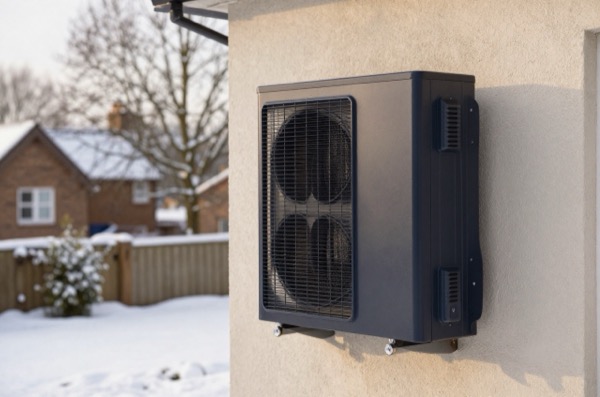
- Air source heat pumps move heat rather than generate it, achieving a Coefficient of Performance (COP) of 2.5–4.0 in typical UK conditions. A COP of 3 means 1 kWh of electricity produces 3 kWh of usable heat.
The seasonal figure across the whole year (SCOP, or the measured seasonal performance factor) is the more useful one: in the government-funded Electrification of Heat trial the median air source heat pump achieved 2.78, and the middle half of systems achieved between 2.55 and 3.05.3
Worked Example: 3-Bed Semi-Detached
A typical mid-terrace or semi-detached house with double glazing and loft insulation might require around 12,000–14,000 kWh of heat per year for space heating and hot water.
Using 13,000 kWh of heat demand and the October 2026 cap rates:
| System | Efficiency / COP | Energy input needed | Unit rate | Annual fuel cost |
|---|---|---|---|---|
| Gas condensing boiler | 92 % | 14,130 kWh gas | 7.97 p/kWh | £1,126 |
| Direct electric heaters | 100 % | 13,000 kWh electricity | 26.32 p/kWh | £3,422 |
| Economy 7 storage heaters | ~100 % | 13,000 kWh electricity, mostly off-peak | ~14.4 p/kWh off-peak (average) | ~£1,870 or more |
| Air source heat pump (SCOP 2.8) | 280 % | 4,643 kWh electricity | 26.32 p/kWh | £1,222 |
| Air source heat pump (SCOP 3.2) | 320 % | 4,063 kWh electricity | 26.32 p/kWh | £1,069 |
The Economy 7 row uses the Energy Saving Trust’s average off-peak Economy 7 price of 14.4p/kWh; your supplier sets the actual night rate, and any heat drawn at the day rate costs more.4
Standing charges and boiler/heat pump service costs are not included above. Add:
- Gas boiler: ~£110–£130 for the annual service, plus about £108 a year for the gas standing charge (29.68p a day)
- Heat pump: ~£120–£180 for the annual service, and no gas standing charge
Gas Boiler: The Baseline
At the cap from 1 October 2026, a condensing gas boiler and a well-installed heat pump cost about the same to run. In the example above the boiler’s fuel costs £1,126 a year and a heat pump’s £1,069–£1,222, and a home that goes fully electric also stops paying the gas standing charge of about £108 a year. The all-in annual cost for gas, with service and standing charge, is about £1,350.
The risk with gas is price volatility and the government’s long-term policy direction. The Future Homes and Buildings Standards, in force in England from 24 March 2027, are designed to ensure new homes are built with low carbon heating.5 For existing homes there is policy pressure to move away from gas, though no firm mandatory replacement date for existing boilers has been set as of 2026.
Direct Electric: Expensive but Simple
Direct electric heating (panel heaters, fan heaters, night storage heaters) is the most expensive heating method on a running-cost basis in the UK, about three times the annual fuel cost of gas. It is nonetheless common in:
- Flats without a gas connection
- Properties where gas infrastructure upgrade is prohibitively expensive
- Supplementary heating in well-insulated extensions
Economy 7 storage heaters partially close the gap by using cheaper overnight electricity, but require good insulation to retain heat through the day and are less comfortable to control than modern heating systems.
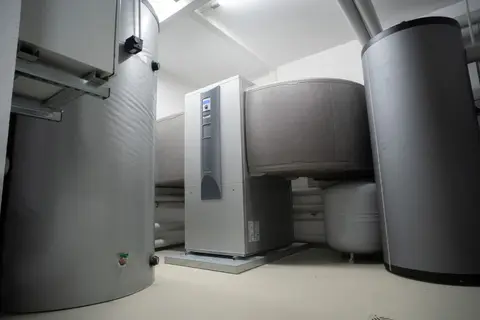
Heat Pumps: Lower Running Costs Than Electric, But Not Always Cheaper Than Gas
At the October 2026 cap, an air source heat pump running at SCOP 3.0 costs about £1,141 a year in fuel to heat the same 3-bed semi that a gas boiler heats for £1,126. The break-even is a seasonal COP of about 3.0 on unit rates alone, or about 2.8 once the gas standing charge is dropped; a heat pump performing better than that costs less to run than gas.
Where heat pumps genuinely save money is in homes heated by direct electric or LPG, where heat costs more per unit; against oil the gap is now small:
- Oil boiler: about 6.7 p/kWh → annual running cost about £970 at 90% boiler efficiency (about 14,400 kWh of oil for the 13,000 kWh example)
- LPG boiler: about 9.5 p/kWh → annual running cost about £1,370 at the same 90% efficiency
These are the Energy Saving Trust’s average prices for heating oil and LPG; the oil price in particular moves with the market, so check a current quote.4
On these figures a heat pump (£1,069–£1,222 a year) costs about 10–26 % more to run than an oil boiler but about 11–22 % less than LPG, so the running-cost case is strongest against LPG and direct electric; against oil it rests more on the grant, oil price swings and carbon. Until March 2027, a home heated by oil or LPG with no mains gas connection can also get an extra £1,500 from the Boiler Upgrade Scheme towards an air source or ground source heat pump.6
Capital Costs and Payback
| System | Typical installed cost |
|---|---|
| Gas condensing boiler (replacement) | £1,800–£3,500 |
| Direct electric heaters (full house) | £1,500–£4,000 |
| Economy 7 storage heaters (full house) | £2,000–£5,000 |
| Air source heat pump (fully installed) | £11,000–£15,500 (before grant; Boiler Upgrade Scheme grant: £7,500) |
| Ground source heat pump | £18,000–£42,000 (before grant; Boiler Upgrade Scheme grant: £7,500)7 |
The Boiler Upgrade Scheme (BUS) grant of £7,500 (as of 2026) reduces heat pump costs materially. After the grant, an installation in the £11,000–£15,500 range above costs about £3,500–£8,000 net.6
Payback vs gas (after BUS grant, 3-bed semi):
- Running cost saving: ~£0–£200/year, depending on the seasonal COP achieved
- Net capital difference vs new gas boiler (£1,800–£3,500): ~£1,700–£4,500 more for heat pump
- Implied payback: about 9–23 years at a £200 a year saving, and longer, or never, where the saving is smaller
However, if the gas boiler comparison point is a replacement that would cost £2,500–£3,500 anyway, and you factor in likely electricity-to-gas price ratio convergence over 10–15 years, the case improves. Many householders also weigh in carbon reduction, future-proofing, and EPC score improvements.
Electricity Tariffs Designed for Heat Pumps
Time-of-use tariffs offer much cheaper rates at set times, which improves heat pump economics when the system can pre-heat the building during cheap periods. Cosy Octopus, for example, has eight hours a day at rates 51% below the day rate in your region, and a peak rate 50% above it from 4pm to 7pm.8 If the day rate were at the 26.32p cap, the cheap rate would be about 12.9p/kWh, and with a COP of 3 the heat bought in those hours would cost about 4.3p/kWh, against about 8.7p/kWh for heat from a gas boiler at the cap.
Key Takeaways
- Direct electric is always the most expensive option at current UK tariffs, avoid it if gas or a heat pump is feasible
- On the October 2026 cap, gas and a heat pump with a seasonal COP around 3 cost about the same to run; a better-performing heat pump is cheaper
- Heat pumps make strongest financial sense in homes on direct electric or LPG, or with a time-of-use tariff; against oil, running costs are now close
- The BUS grant of £7,500 materially changes the capital equation for heat pumps
- Building Regulations Part L guidance sets a minimum efficiency of 92% for a new or replacement gas boiler on a wet heating system, which in practice means a condensing boiler except in exceptional circumstances, and expects heating controls such as a room thermostat with thermostatic radiator valves9
References (9)
Figures in this note were checked against the sources below on 2 October 2026. Superscript numbers in the text point to them. Every source the site cites, by topic.
- 1technicalvery strongDepartment of Energy and Climate Change, guidance.RN-SNUZCFA government statistical article estimating heat use by sector for 2013; it finds 85% of domestic energy is used for heating, most of it space heating.
- 2technicalvery strongOfgem.RN-YYE8U2The live source for any running-cost sum in a heating note. For 1 October to 31 December 2026 the direct debit cap is 26.32p per kWh for electricity with a 54.83p daily standing charge, and 7.97p per kWh for gas with a 29.68p daily standing charge, giving a typical annual dual fuel bill of £1,723, a 4% rise on the previous period. Ofgem states these are the average unit rate and standing charge for direct debit customers in England, Scotland and Wales; gas prices include 5% VAT while electricity carried no VAT in this period. The cap is reset every three months, so any note quoting a pence-per-kWh figure should be dated against this page.
- 3technicalfairEnergy Systems Catapult, for the Department for Energy Security and Net Zero, guidance.RN-R6VG0JThe summary report of the DESNZ-funded field trial of about 750 UK heat pumps; it gives the measured median seasonal performance factor of air source heat pumps (2.78, interquartile range 2.55 to 3.05).
- 4costfairEnergy Saving Trust.RN-2BXHT7A price, true at 2026-09. The Energy Saving Trust's published fuel price assumptions for Great Britain, including the average off-peak Economy 7 electricity price of 14.4p/kWh used in its savings figures.
- 5technicalvery strongMinistry of Housing, Communities and Local Government, guidance.RN-WMRZGFThe government's circular letter to building control bodies announcing the Future Homes and Buildings Standards: the Building Regulations etc. (Amendment) (England) Regulations 2026 and the 2026 editions of Approved Documents L and F. It gives the purpose (new buildings built with low carbon heating and high energy efficiency), the in-force date of 24 March 2027 (24 September 2027 for higher-risk building work), and the transitional arrangements, under which work notified before 24 March 2027 and started before 24 March 2028 stays under the previous rules.
- 6costvery strongGOV.UK.RN-9EFNVZA price, true at 2026-09. The grant values: £7,500 towards an air source heat pump, £7,500 towards a ground source heat pump including water source heat pumps and those on shared ground loops, and £5,000 towards a biomass boiler. A further £1,500 is available until March 2027 where the property is heated by oil or LPG and has no mains gas connection. Only one grant is available per property. Capacity limits are 45kWth for an individual system, 70kWth for multiple heat pumps and 300kWth for shared ground loops. Hybrid systems pairing a gas boiler with a heat pump are not eligible, and an existing low carbon heating system cannot be replaced under the scheme.
- 7costvery strongDepartment for Energy Security and Net Zero / Ofgem / MCS.RN-7X7D1VA price, true at 2025. DESNZ Boiler Upgrade Scheme statistics, July 2026, Table A1.3A. Voucher applications, redemptions and values by technology, so it says what the scheme is actually paying out rather than what it offers.
- 8technicalsupplier figureOctopus Energy, guidance.RN-XRSYGCThe supplier's own page for its heat pump tariff. It sets out three cheap periods totalling eight hours a day at 51% below the regional day rate, and a 4pm to 7pm peak 50% above it.
- 9technicalvery strongMinistry of Housing, Communities and Local Government.RN-L0FCJXThe in-force U-value tables a DIY insulation or door note must quote, with the exact numbers. Table 4.2, limiting U-values for new fabric elements in existing dwellings, sets roof 0.15, wall 0.18, floor 0.18, swimming pool basin 0.25, window 1.4 or Window Energy Rating Band B minimum, rooflight 2.2, doors with more than 60 per cent of the internal face glazed 1.4 or Doorset Energy Rating Band C minimum, and other doors 1.4 or Doorset Energy Rating Band B minimum. Table 4.3, for existing elements, gives a roof threshold of 0.35 and an improved value of 0.16, which is the figure a loft insulation note needs: paragraph 4.12 says a retained element whose U-value is higher than the column (a) threshold, for example through a loft or garage conversion, should be upgraded to the column (b) value. Paragraph 4.13 allows a lesser upgrade only where the improved value is not technically or functionally feasible or would not achieve a simple payback of 15 years or less. Paragraph 4.8 requires a replacement element to be no worse than the one it replaces as well as meeting Table 4.2. Paragraph 4.10 gives the heritage exception: where character must be maintained, a centre pane U-value of no more than 1.2 or low-emissivity secondary glazing. Note 9 records that the timber window concession of 1.6 or Band C ended on 14 June 2023. The 2021 edition came into force on 15 June 2022; a 2026 edition exists at https://assets.publishing.service.gov.uk/media/69c122a6cfa346b9d4704a55/ADL1_2026.pdf.
-
Special feature: Estimates of heat use in the UK (Energy Trends, December 2014), Department of Energy and Climate Change, accessed 30 September 2026. assets.publishing.service.gov.uk
-
Energy price cap unit rates and standing charges, Ofgem, accessed 29 September 2026. ofgem.gov.uk
-
Electrification of Heat Demonstration Project: Project Summary Report, Energy Systems Catapult, for the Department for Energy Security and Net Zero, accessed 30 September 2026. esc-production-2021.s3.eu-west-2.amazonaws.com
-
Our data, Energy Saving Trust, accessed 30 September 2026. Priced at 2026-09 and left there. energysavingtrust.org.uk
-
The Future Homes and Buildings Standards: Building Circular 01/2026, Ministry of Housing, Communities and Local Government, accessed 29 September 2026. gov.uk
-
Apply for the Boiler Upgrade Scheme: What you can get, GOV.UK (Department for Energy Security and Net Zero), accessed 15 September 2026. Priced at 2026-09, so no calibration is needed. gov.uk
-
Boiler Upgrade Scheme statistics, July 2026, Table A1.3A, Department for Energy Security and Net Zero / Ofgem / MCS, accessed 2 October 2026. Priced at 2025/26, so no calibration is needed. assets.publishing.service.gov.uk
-
Cosy Octopus, Octopus Energy, accessed 2 October 2026. octopus.energy
-
Approved Document L, Conservation of fuel and power, Volume 1: Dwellings, 2021 edition incorporating 2023 amendments, Ministry of Housing, Communities and Local Government, accessed 14 September 2026. assets.publishing.service.gov.uk