Damp and mould are among the most common bathroom complaints in UK homes, and inadequate ventilation is very often the cause. Building Regulations Part F sets minimum extract rates for every wet room. When an existing bathroom is refurbished, any existing extractor fan should be kept or replaced, although one does not have to be added where there was none.1 Getting this right is not just a question of comfort: a failing extractor can cause condensation damage to ceilings and joinery and may be flagged as a defect on a home survey.
This guide covers what the regulations actually require, how different fan types compare, what you should expect to pay, and how to choose the right unit for your bathroom.
What Building Regulations Say
Approved Document F (Ventilation) sets a minimum intermittent extract rate for bathrooms of 15 litres per second (54 m³/hr).1 For a separate WC without a bath or shower the minimum drops to 6 l/s, or an openable window meeting the purge ventilation guidance can be used instead.1 These figures apply to new dwellings and material changes of use, and to a wet room added to an existing home.1
Key requirements:
- In a bathroom with no openable window, an intermittent fan must have a 15-minute overrun (run-on timer) to clear residual moisture after you leave the room.1
- Fans must not recirculate air back into the same room, ducted extract to outside is required.1
- A bathroom with no external wall needs its fan to extract at four air changes per hour, to meet the purge ventilation standard.1
- In new homes ventilated by intermittent fans, the 2021 edition of Approved Document F, in force since 15 June 2022, also expects background ventilators (trickle vents) in every room with an external wall.1
Electrically, a fan directly above the bath or shower is usually in Zone 1, and one elsewhere in the room may be in Zone 2 or outside the zones altogether.2 Any fan in Zone 1 or 2 must be rated at least IPX4 (often marked IP44), rising to IPX5 where it may be exposed to water jets, for example during cleaning.3 Adding or altering wiring in these zones must be carried out by a registered competent person who self-certifies it, or notified to Building Control before it starts.4
Types of Bathroom Extractor Fan
Intermittent Axial Fans
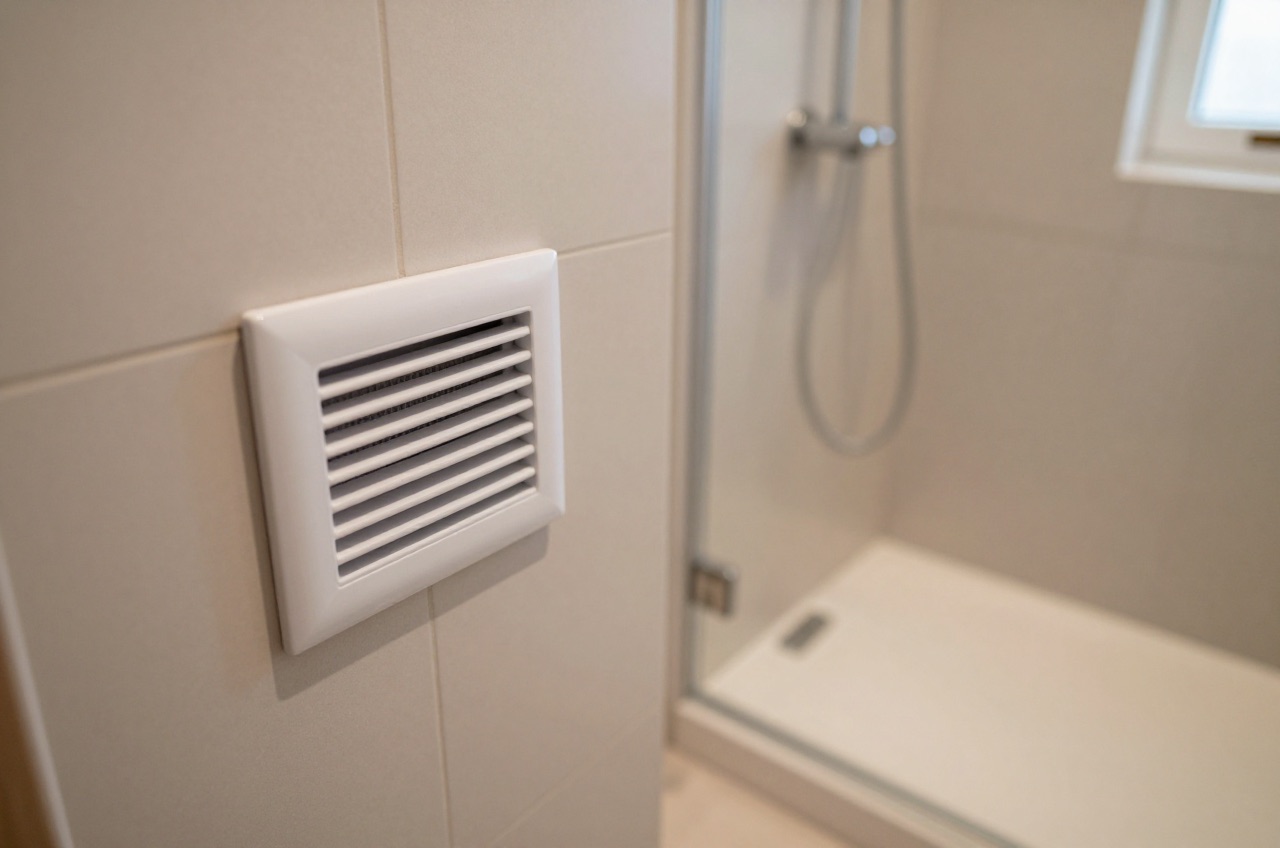
The most common type, a wall- or ceiling-mounted fan that runs when switched on (or triggered) and continues for a timed run-on period. These are inexpensive and straightforward to install, making them suitable for most renovation projects.
Fans with Humidistat
A humidistat sensor triggers the fan automatically when relative humidity exceeds a set threshold (typically 70–80 %). This eliminates the need to remember to switch the fan on and provides better moisture control. Ideal for families or rental properties.
Fans with PIR Motion Sensor
PIR-triggered fans switch on when someone enters the room and continue for a set period after the space is vacated. Convenient but less effective than humidistats for controlling peak moisture during showers.
Continuous Low-Rate (MVHR / dMEV)
Decentralised mechanical extract ventilation (dMEV) fans run continuously at a low rate and boost to a high rate, at least 8 l/s in a bathroom, when humidity or occupancy triggers them.1 These are required in some new-build specifications and perform best in airtight modern homes. They are quiet but more expensive to buy.
Inline/Remote Fans
For bathrooms where a wall or ceiling fan is impractical, often en-suites in converted lofts, a remote fan sits in the loft or duct run, connected to the room by flexible ducting. Quieter than axial units and easier to service.
Performance: Comparing Fan Types
| Fan Type | Min Extract Rate | Typical Noise (dB) | Typical Unit Cost | Installed Cost |
|---|---|---|---|---|
| Basic axial (timer) | 15 l/s | 35–45 dB | £20–£60 | £80–£160 |
| Axial with humidistat | 15 l/s | 33–42 dB | £50–£120 | £120–£220 |
| Axial with PIR | 15 l/s | 34–44 dB | £45–£110 | £110–£210 |
| dMEV continuous | 8 l/s (high rate) | 22–30 dB | £90–£200 | £180–£350 |
| Inline/remote fan | 15 l/s | 20–28 dB (at grille) | £80–£250 | £200–£450 |
Prices as at mid-2026. Inline fan costs vary significantly with duct run length.
Ducting: What You Need to Know
Extract fans must duct to outside air, routing into a loft void or wall cavity is not compliant and encourages mould within the structure. Options include:
- External wall termination, shortest duct run, highest efficiency, simplest to retrofit.
- Roof termination, used when an external wall is not accessible; requires a suitably rated roof tile or ridge vent.
- Soffit vent, common in modern houses; duct exits through the soffit. Ensure the soffit vent is not blocked by loft insulation.
Use rigid ducting (100 mm or 125 mm diameter rigid PVC or galvanised steel) wherever possible. Flexible duct is acceptable for short connections but adds resistance, reducing effective extract rate. Keep bends to a minimum and use swept bends rather than sharp right angles.
Longer duct runs, beyond a few metres, usually need a more powerful fan to maintain the required extract rate. Specify a fan by its installed performance at system resistance, not just the free-air rating on the box.
Cost to Supply and Install
| Scenario | Estimated Cost |
|---|---|
| Like-for-like fan replacement (existing wiring, same position) | £80–£160 |
| New fan installation, existing circuit (notifiable inside the special location) | £150–£280 |
| New fan + new wiring from consumer unit | £250–£500 |
| Inline fan with duct run through loft (up to 5 m) | £350–£600 |
| dMEV continuous fan, new install | £250–£450 |
Fan wiring in a bathroom is notifiable under Part P where it needs a new circuit, or where it sits inside a bathroom’s special location, the zone running from floor level to 2.25 m and 0.6 m out from the bath or shower tray, or 1.2 m from the shower head where there is no tray, which most fans over a bath or shower do.4 Replacing an existing fan on its existing cabling does not need to be notified.1 A registered competent person will self-certify; if you use an unregistered contractor, you must notify your local authority Building Control, whose fee varies by council and is typically around £270–£520 for this kind of building notice.4
Choosing the Right Fan
- Extract rate: Always confirm the installed performance at your estimated system resistance, most fan datasheets include a performance curve.
- Noise: For en-suites adjacent to bedrooms, target below 30 dB(A). Inline fans typically achieve this; axial fans rarely do.
- IP rating: at least IPX4 (often marked IP44) in Zone 1 (directly above the bath or shower) and Zone 2 (within 600 mm horizontally of the bath or shower edge, up to 2.25 m), and IPX5 where water jets may reach it.3
- Timer vs humidistat: A humidistat is almost always worth the extra cost. It works when the light switch is off, catches prolonged showers accurately, and reduces energy use versus a long fixed timer.
- Duct diameter: 100 mm is standard for most axial fans; 125 mm improves performance for longer runs or higher-capacity units.
Common Mistakes to Avoid
- Buying on free-air rating, fans are tested without ductwork; installed performance is always lower.
- Flexible duct throughout, adds resistance, creates condensation traps, and reduces extract rate significantly.
- Ducting into the loft, non-compliant and leads to structural damp.1
- No overrun timer, in a bathroom with no openable window, a fan that switches off with the light falls short of Approved Document F’s 15-minute overrun and fails to clear post-shower moisture.
- Skipping notification, new fan wiring on a new circuit or inside a bathroom’s special location is notifiable under Part P, and buyers’ solicitors often ask for the certificate.
A correctly specified and installed bathroom extractor fan is one of the best-value investments in a bathroom renovation. It protects the room’s finishes, prevents structural damage, and satisfies Building Control, small things that matter enormously when you come to sell.
The rules in this note are those that apply in England. Scotland, Wales and Northern Ireland have their own building standards and permitted development rights.
References (4)
Figures in this note were checked against the sources below on 30 September 2026. Superscript numbers in the text point to them. Every source the site cites, by topic.
- 1technicalvery strongMinistry of Housing, Communities and Local Government.RN-QD1SFFTable 1.1 sets minimum intermittent extract rates: kitchen with a cooker hood extracting outside 30 l/s, kitchen without one 60 l/s, utility room 30 l/s, bathroom 15 l/s, sanitary accommodation 6 l/s. Extract terminals and fans other than cooker hoods should be as high as practicable and no more than 400mm below the ceiling; a cooker hood should sit between 650mm and 750mm above the hob if the manufacturer gives no figure. Table 1.7 requires background ventilators of at least 8000mm2 equivalent area in habitable rooms and kitchens for a dwelling, 10,000mm2 for a single-storey dwelling. Background ventilators should be at least 1700mm above floor level and at least 500mm from a fan in the same room. On replacement windows, paragraph 3.14 says new windows must carry background ventilators no smaller than the originals, and paragraph 3.15 gives the fallback minimums where the old size is unknown: 8000mm2 habitable rooms, 8000mm2 kitchen, 4000mm2 bathroom. Paragraph 3.32 confirms that replacing an extractor fan or cooker hood on existing cabling is not notifiable.
- 2technicalstrongNICEIC, guidance.RN-8VV8NHNICEIC's householder guide to BS 7671 bathroom rules. It defines zones 0, 1 and 2 and covers sockets, shaver sockets, switches and RCD protection.
- 3technicalstrongThe IET, guidance.RN-76NYWBThe IET's technical article on Section 701 of BS 7671, locations containing a bath or shower. Explains the zones, 0, 1 and 2, what equipment and IP rating is permitted in each, the supplementary bonding rules and where a socket may and may not go. This is the source behind every statement about what can be installed near a bath, and it is written by the IET's own chief engineer answering the questions their helpline actually receives.
- 4technicalvery strongMinistry of Housing, Communities and Local Government.RN-JYJ3I5The document that decides what electrical work a homeowner may legally do themselves, and the exact list of notifiable jobs. Regulation 12(6A), reproduced at paragraph 2.5, makes only three things notifiable: the installation of a new circuit, the replacement of a consumer unit, and any addition or alteration to existing circuits in a special location. Regulation 12(9) defines special location as, in a room containing a bath or shower, the zone extending vertically from finished floor level to 2.25 metres (or the shower head position if higher) and horizontally 600mm from the edge of the bath tub or shower tray. Paragraph 2.7 states that all other electrical installation work is not notifiable, namely additions and alterations to existing installations outside special locations, and replacements, repairs and maintenance anywhere. Paragraph 2.8 gives worked examples: a built-in cooker is not notifiable unless a new cooker circuit is needed, and connecting an electric gate or garage door to an existing isolator is not notifiable but running a new circuit from the consumer unit to that isolator is. Paragraph 2.2 confirms Part P reaches outdoor work including fixed garden lighting, pond pumps and outbuildings such as sheds, detached garages and domestic greenhouses. Notifiable work must be certified by self-certification by a registered competent person, third-party certification, or a building control body (paragraph 3.1), with the compliance certificate issued within 30 days (paragraph 3.4). Note that Approved Document P is a source of guidance rather than a ban: non-notifiable work still has to comply with BS 7671.
-
Approved Document F, Ventilation, Volume 1: Dwellings, 2021 edition, Ministry of Housing, Communities and Local Government, accessed 14 September 2026. assets.publishing.service.gov.uk
-
Bathrooms and electrics: what you need to know, NICEIC, accessed 30 September 2026. niceic.com
-
Section 701: Locations containing a bath or shower, Institution of Engineering and Technology, accessed 30 September 2026. electrical.theiet.org
-
Approved Document P, Electrical safety: Dwellings, 2013 edition incorporating 2010 and 2013 amendments, Ministry of Housing, Communities and Local Government, accessed 14 September 2026. assets.publishing.service.gov.uk