The manifold is the nerve centre of a wet underfloor heating system. It distributes heated water from the boiler or heat pump to individual floor circuits and regulates the blend temperature, flow rate, and zone control for each loop. Get the manifold specification wrong and you end up with cold spots, inefficient running, or a system that can’t be balanced, all expensive problems to diagnose after the screed has been laid.
This guide explains what manifolds contain, how controls integrate with them, what to look for when specifying a system, and what you should expect to pay.
What Is a UFH Manifold?
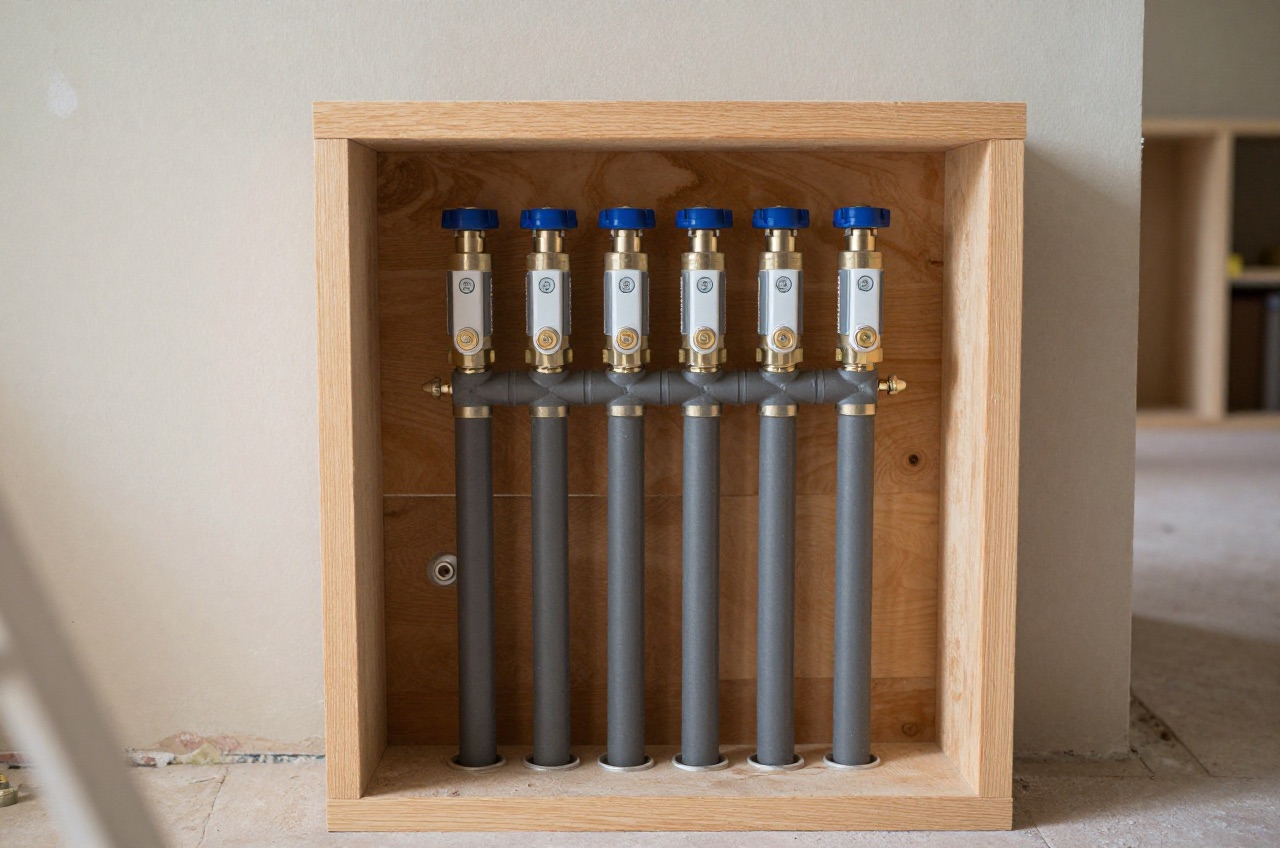
A manifold is a distribution header, typically made from brass or stainless steel, that connects the primary pipework from the heat source to multiple underfloor heating loops. Each loop serves one zone or room. Flow goes out through one manifold rail (the flow manifold) and returns cooled water through the second (the return manifold).
Most domestic manifolds are sold as matched pairs, a single assembly combining both rails on a bracket, pre-fitted with isolation valves, flow gauges, and air vents.
Core Components
Flow gauges (rotameters): Mounted on the flow side, these allow the installer to balance each circuit by adjusting flow rate (in litres per minute) to match the circuit length and heat demand.1 A 10 m circuit needs far less flow than an 80 m loop.
Actuators: Electrothermal actuators (usually 24 V or 230 V) sit on each port and are driven open or closed by the room thermostat signal. When a zone calls for heat, the actuator opens; when satisfied, it closes.
Blending valve / mixing valve: UFH circuits operate at low water temperatures, generally 30–55 °C, which warm the floor surface to about 23–29 °C.2 A thermostatic blending valve mixes return water with the boiler flow to achieve the correct supply temperature. Without this, the floor can run hotter than the surface limits used in BS EN 1264 design: 29 °C in occupied areas, 35 °C in perimeter zones and 33 °C in bathrooms.3
Pump: Some manifolds include an integral pump on the UFH circuit. Others expect an external pump set (pump, bypass valve, and blending valve combined). A dedicated UFH pump set is typically needed when the manifold is remote from the main circulation pump.
Auto air vent: UFH circuits are low-pressure and slow-moving, air can collect. A manual or automatic air vent on each manifold rail is essential.
Isolation valves: Each circuit should have individual isolation capability so a loop can be isolated for maintenance without draining the whole system.
Manifold Sizing
Manifolds are sized by the number of ports (circuits). Common sizes range from 2 to 12 ports, with multi-module systems allowing expansion.
| Manifold Size | Typical Application |
|---|---|
| 2–3 port | Single room extension, en-suite |
| 4–6 port | Medium flat or ground floor of a house |
| 7–10 port | Full ground floor of a larger property |
| 11–12 port | Large open-plan or multi-floor installation |
If a project spans two floors, separate manifolds per floor are usually more practical than a single large manifold with very long pipe runs.
Circuit length: As a common rule of thumb, keep each loop to about 100 m of 16 mm pipe (a little longer with larger pipe), although manufacturers’ own limits vary. Circuits much longer than the maker allows create excessive pressure drop and uneven heating. If a room is large, divide it into two shorter loops fed from adjacent ports rather than one very long loop.
Controls Architecture
Room Thermostats
Each independently controlled zone needs its own room thermostat. For residential use, programmable or smart thermostats (Wi-Fi enabled, with scheduling and app control) are now standard. Some systems integrate all zones into a single smart controller; others are zone-by-zone.
Underfloor heating responds slowly compared with radiators, thermal mass in the screed means heat stored from the morning continues to be felt for hours. Good programming and ideally weather compensation significantly improve efficiency.
Wiring Centre
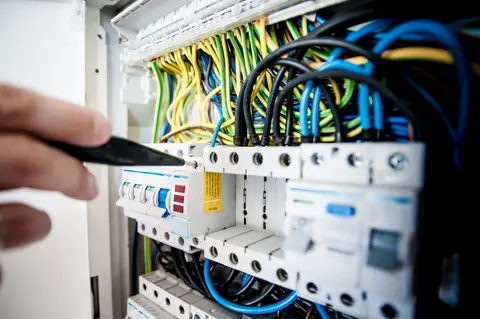
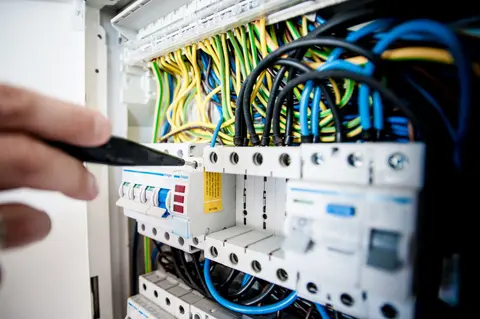
The wiring centre (also called a controller hub or junction box) receives signals from all room thermostats and drives the actuators on the manifold ports. It also manages the call-for-heat signal to the boiler, ensuring the boiler only fires when at least one zone demands it.1 A combined pump relay is usually included.
In a typical domestic system, the wiring centre mounts adjacent to the manifold. Some manufacturers integrate all of this into a manifold kit; others sell wiring centres separately.
Boiler Interlock and Pump Overrun
The wiring centre must include a boiler interlock, a hard-wired signal that prevents the boiler running when all zones are satisfied. Without it, the boiler fires regardless of demand, wasting energy and violating Building Regulations Part L.4
A pump overrun ensures the circulation pump continues briefly after the boiler shuts down, preventing localised overheating in the heat exchanger.
Weather Compensation
Heat pumps and modern condensing boilers produce their lowest running costs when operating at low flow temperatures, exactly what UFH systems need. Weather compensation adjusts the flow temperature dynamically based on outdoor temperature: on a cold day, 48 °C; on a mild day, 35 °C. Many boiler and heat pump manufacturers supply outdoor sensors compatible with their controls.
Costs: Supply and Installation
| Component | Supply Cost | Installed Cost (inc. labour) |
|---|---|---|
| Manifold (4–6 port, basic brass) | £150–£280 | £300–£550 |
| Manifold (4–6 port, stainless, with flowmeters) | £220–£400 | £400–£700 |
| Blending/mixing valve set | £80–£200 | included above |
| Actuators (per port) | £18–£35 each | £15–£25 labour each |
| Room thermostat (wired, programmable) | £35–£90 | £60–£150 fitted |
| Smart thermostat (Wi-Fi, per zone) | £80–£180 | £120–£250 fitted |
| Wiring centre / controller | £60–£180 | £80–£200 installed |
| Full controls package (6 zones, smart, installed) | - | £900–£2,000 |
Prices as at mid-2026. Complexity of cable runs, distance from consumer unit, and access difficulty affect labour costs considerably.
Specifying the Right System
Match to heat source: A gas condensing boiler needs a blending valve to bring its flow down to the UFH design temperature, typically 40–55 °C. Where a wet heating system is newly installed or fully replaced, Approved Document L expects it to be sized to run at a maximum flow temperature of 55 °C or lower where that is feasible.4 A heat pump works at 35–45 °C supply and benefits from weather compensation integrated with the pump controller. Some modern heat pumps communicate directly with UFH controllers via OpenTherm or proprietary protocols, check compatibility before purchasing.
Consider pipe centres: Closer pipe spacing (100–150 mm centres) gives more responsive heating and allows lower flow temperatures. Wider spacing (200–250 mm) is adequate for well-insulated new builds. Specify the manifold after the hydraulic design is complete, not before.
Zone sensibly: Bathrooms, living rooms, and bedrooms have different occupancy patterns and comfort temperatures. Grouping them into the same zone saves manifold ports but produces compromises. As a rule, each room with a door should be its own zone if budget allows. Where a heating system is installed in a new home, or a boiler is replaced in an existing one, Approved Document L expects each room to have thermostatic room controls, although some open-plan layouts can be controlled as a single zone.4
Budget for commissioning: A UFH system should be pressure-tested with water before screed is poured, commonly at 6 bar with the pressure kept on while the screed is laid, and thermally commissioned (balancing flow rates to each circuit and checking surface temperatures) after the screed has cured.5 Allow £150–£400 for commissioning by a specialist.
Common Problems and How to Avoid Them
- Cold spots: Usually caused by imbalanced flow rates, rebalance at the manifold flow gauges.
- System won’t reach temperature: Check the blend temperature setting, pump head, and circuit lengths. An undersized pump is a common cause.
- Actuator not opening: Check the thermostat wiring at the wiring centre; test the actuator with a multimeter.
- Air locks: Ensure all auto air vents are operational and that the system was properly filled and purged.
- Boiler short-cycling: Install or check the boiler interlock wiring, the boiler must not fire when no zones call.
A well-designed and properly installed UFH manifold and control system can give 20 years or more of service, although actuators and pumps may need replacing sooner. The upfront investment in quality components and commissioning pays back in consistent comfort and lower energy bills, particularly when paired with a heat pump.
References (5)
Figures in this note were checked against the sources below on 30 September 2026. Superscript numbers in the text point to them. Every source the site cites, by topic.
- 1technicalgoodBEAMA, guidance.RN-HY3WQBThe UK underfloor heating trade association's controls guide. It explains balancing each circuit to a design flow in litres per minute using the flow meters on the flow manifold.
- 2technicalgoodContract Flooring Association, guidance.RN-OQTBM3Trade association guidance on floor coverings over underfloor heating. It gives typical water temperatures of 30–55 °C and the resulting floor surface temperatures of 23–29 °C.
- 3technicalsupplier figureUponor, guidance.RN-ZARKB5A manufacturer's design manual for underfloor heating. It lists the maximum floor surface temperatures used in EN 1264 design: 29 °C occupied area, 35 °C edge zone and 33 °C bathrooms.
- 4technicalvery strongMinistry of Housing, Communities and Local Government.RN-L0FCJXThe in-force U-value tables a DIY insulation or door note must quote, with the exact numbers. Table 4.2, limiting U-values for new fabric elements in existing dwellings, sets roof 0.15, wall 0.18, floor 0.18, swimming pool basin 0.25, window 1.4 or Window Energy Rating Band B minimum, rooflight 2.2, doors with more than 60 per cent of the internal face glazed 1.4 or Doorset Energy Rating Band C minimum, and other doors 1.4 or Doorset Energy Rating Band B minimum. Table 4.3, for existing elements, gives a roof threshold of 0.35 and an improved value of 0.16, which is the figure a loft insulation note needs: paragraph 4.12 says a retained element whose U-value is higher than the column (a) threshold, for example through a loft or garage conversion, should be upgraded to the column (b) value. Paragraph 4.13 allows a lesser upgrade only where the improved value is not technically or functionally feasible or would not achieve a simple payback of 15 years or less. Paragraph 4.8 requires a replacement element to be no worse than the one it replaces as well as meeting Table 4.2. Paragraph 4.10 gives the heritage exception: where character must be maintained, a centre pane U-value of no more than 1.2 or low-emissivity secondary glazing. Note 9 records that the timber window concession of 1.6 or Band C ended on 14 June 2023. The 2021 edition came into force on 15 June 2022; a 2026 edition exists at https://assets.publishing.service.gov.uk/media/69c122a6cfa346b9d4704a55/ADL1_2026.pdf.
- 5technicalsupplier figureJohn Guest, guidance.RN-CTPIGCA pipe and fittings maker's installation guidance for underfloor heating. It advises a 6 bar pressure test before screed or flooring and keeping that pressure on while the screed is applied.
-
BEAMA Underfloor Heating Controls Guide for Domestic Properties, BEAMA, accessed 30 September 2026. beama.org.uk
-
Beyond Installation: CFA Guidance on Underfloor Heating, Contract Flooring Association, accessed 30 September 2026. cfa.org.uk
-
Uponor underfloor heating/cooling: Planning information, Uponor, accessed 30 September 2026. brandportal.uponor.com
-
Approved Document L, Conservation of fuel and power, Volume 1: Dwellings, 2021 edition incorporating 2023 amendments, Ministry of Housing, Communities and Local Government, accessed 14 September 2026. assets.publishing.service.gov.uk
-
Typical underfloor heating mistakes and how to avoid them: during installation, John Guest, accessed 30 September 2026. johnguest.com