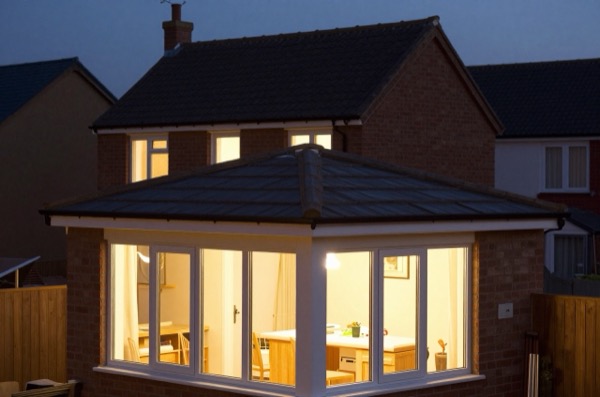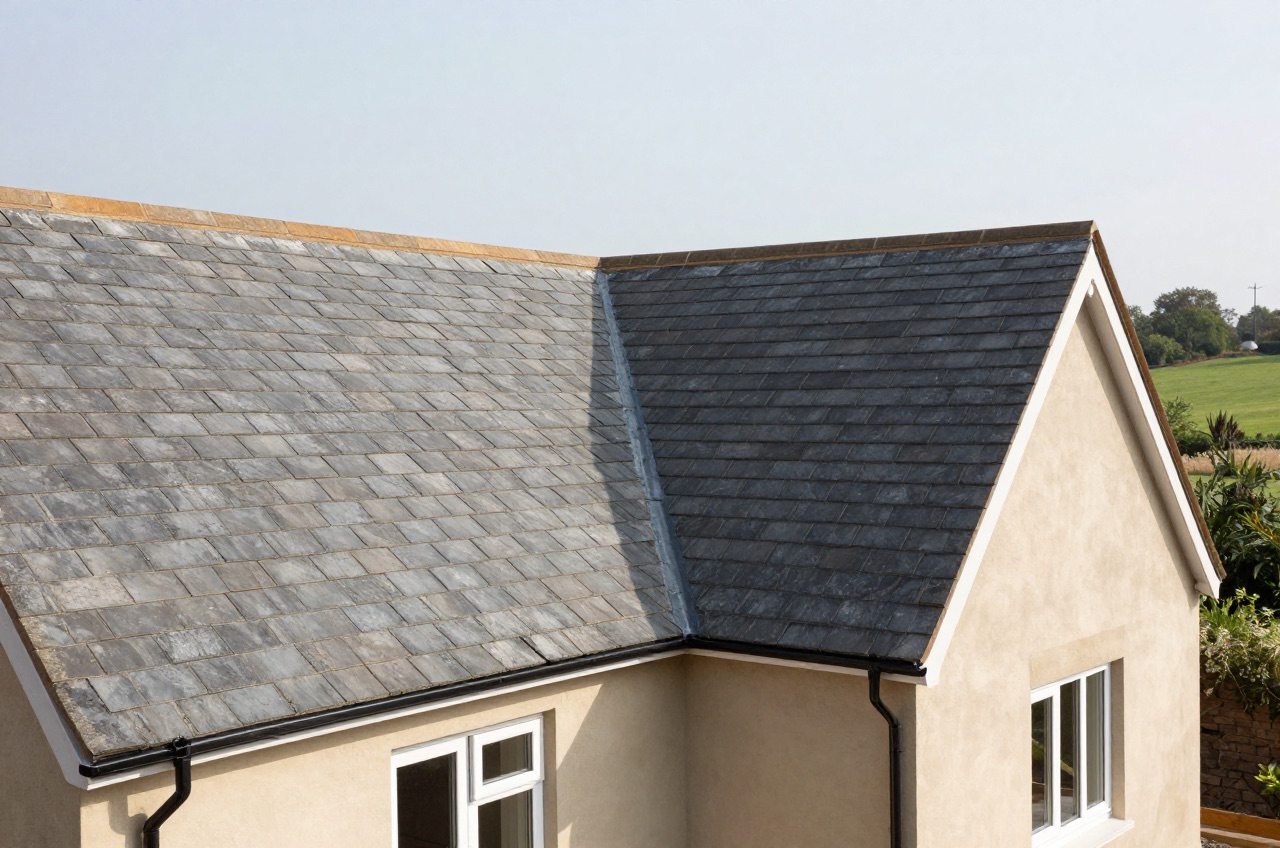
A roof is not one job but a system: the covering itself, the underlay and battens beneath it, the flashing at every junction, and the gutters and trims that carry water away. In 2026, a full replacement on a typical 3-bed semi costs £6,000–£14,000, while material choice alone can swing the price from £40/m² for felt to over £200/m² for natural slate, installed.
Most of the money in a roofing quote, though, is not decided by the covering. It is decided by how much of the roof you touch, because crossing one threshold turns a re-cover into a full thermal upgrade with building control attached. This guide sets out those thresholds first, then works through new roofs and roof windows, materials compared, flat roofs, the flashing and batten details, gutters and chimneys, ongoing repairs, access and safety, and the damp and waterproofing issues that tend to come up in the same conversation.
The Threshold That Decides the Scope
The single most useful number in UK roofing is 50%. Approved Document L treats stripping a roof back to its structure and rebuilding it as “renovation of a thermal element”, and once more than 50% of the surface of that element is renovated, the whole roof has to be brought up to a U-value of 0.16 W/m²K, not just the part you stripped.1 The National Federation of Roofing Contractors states the practical consequence: where refurbishment affects 50% or more of a roof’s area, you must either use a contractor registered with the NFRC Competent Person Scheme or contact Local Authority Building Control before work starts, so the thermal upgrade can be confirmed.2
That registration route matters financially. The NFRC trades as CompetentRoofer on the government’s list of authorised competent person schemes, which covers replacement of roof coverings on pitched and flat roofs plus connected work, and a scheme member can self-certify instead of paying for a building control application.3 Choosing an unregistered contractor for a full re-roof does not avoid the regulation, it just moves the cost to a building control submission and inspections.
Table 4.3 of Approved Document L is where the roof figures live: a retained roof with a U-value worse than the 0.35 W/m²K threshold has to be improved to 0.16.1 A brand new roof element in an existing house, such as a dormer or an extension roof, is held to a tighter 0.15 W/m²K under Table 4.2.1 There is a headroom concession for renovations: a higher U-value is acceptable where meeting 0.16 would limit head room, provided the insulation plus any required air gap is at least the depth of the rafters and the insulant achieves the lowest practicable U-value.1 For dormers, “roof” covers the roof parts and “wall” the cheeks, which is why a dormer is priced as two different specifications.1
| Trigger | Threshold | What it forces |
|---|---|---|
| Roof renovated (stripped and rebuilt) | more than 50% of the roof surface | whole roof upgraded to 0.16 W/m²K; NFRC CPS member or building control |
| Major renovation of the building | more than 25% of the external envelope | same upgrade applies |
| Roof retained during a loft conversion | existing U-value worse than 0.35 W/m²K | upgrade to 0.16 W/m²K |
| New roof element (dormer, extension) | any | 0.15 W/m²K |
| Roof enlargement under permitted development | 40 m³ terrace, 50 m³ other houses | over this, planning permission |
| Rooflight under permitted development | 0.15 m protrusion beyond the roof plane | over this, planning permission |
| Chimney or flue under permitted development | 1 m above the highest part of the roof | at or over this, planning permission |
Thresholds from Approved Document L, the NFRC and the General Permitted Development Order (England); the devolved nations set their own equivalents.1
New Roofs, Windows and Lanterns
Most re-roofs happen reactively rather than by choice. Roof replacement: signs you need one sets out the tell-tale signs, widespread batten rot, failed underlay, more than 20% of tiles gone, against the £6,000–£14,000 typical cost. For a fuller budget, new roof cost breaks the price down per square metre and compares re-roofing with repair, and because the shape of the roof drives both, types of roof explained sets out gable, hip, mansard and the rest with their planning implications.
Before you commit to a covering, check the structure can carry it. The Planning Portal’s guidance on new roofs sets out the two loads that matter: wind uplift, resisted by straps roughly 1.2 m long with a cranked end fixed to the wall plate at 2.0 m centres, and roof spread, resisted by ceiling joists fixed to the bottom of the rafters to stop them pushing the walls apart. A roof without ceiling joists needs an engineer’s advice.4 This is the reason swapping a light covering for a heavy one is never a like-for-like decision: see clay vs concrete roof tiles and floor and roof joist sizes, spans and spacing before assuming the existing timbers will do.
A re-roof or loft conversion is also the natural moment to add glazing. Under permitted development in England, a rooflight falls under Class C, which allows any other alteration to the roof provided it does not protrude more than 0.15 m beyond the plane of the original roof slope and does not sit higher than the highest part of the original roof.5 A dormer is a roof enlargement under Class B instead, capped at 40 cubic metres of added roof space on a terrace house and 50 cubic metres on anything else, with no part exceeding the existing ridge, nothing on the principal elevation fronting a highway, materials of similar appearance, and the enlargement set back at least 0.2 m from the eaves measured along the roof slope.6 Only the Class B right is withdrawn on article 2(3) land, which includes conservation areas: that exclusion is at B.1(f) and Class C has no equivalent, which is why a rooflight in a conservation area usually stays permitted development while a dormer does not.6 An Article 4 direction can still remove either; see conservation area rules and permitted development rights explained.
Structurally, fitting a rooflight means cutting through one or more rafters, and the cut ends need new support from doubled timbers spanning the opening on either side, called trimmers. The room served must be ventilated, and ventilation of the existing roof void has to be reconsidered because air must still flow through it.7 Roof window sizes explained decodes the Velux code system so you order the right unit first time, and where the structure below has a flat roof, a roof lantern usually makes more sense than a flush rooflight, our guide to rooflight and lantern materials compares U-values and cost across both. Choosing between rooflights and a full dormer for a loft specifically? Rooflight vs dormer loft conversion compares the space and cost trade-off directly.
Roofing Materials Compared
Material choice drives most of the difference between quotes. Roofing materials compared lines up slate, tile, felt and metal by cost per m² and lifespan in one table. If you’re set on slate specifically, natural slate vs fibre-cement slate explains why the natural product costs two to three times more, and slate roof tile types and lifespan breaks down Welsh, Spanish and synthetic options. Composite slate tiles are the third route. Whichever you choose, roof tile and slate fixing rules covers the BS 5534 nailing and clipping requirements, where the nail and clip specification depends on wind load calculations for the site.8
| Material | Installed Cost | Typical Lifespan |
|---|---|---|
| Natural slate | £130–£220/m²9 | 80–150 years |
| Concrete tile | £80–£120/m² | 40–60 years |
| GRP flat roof | £65–£110/m² | 30–50+ years |
| EPDM flat roof | £55–£95/m² | 30–50+ years |
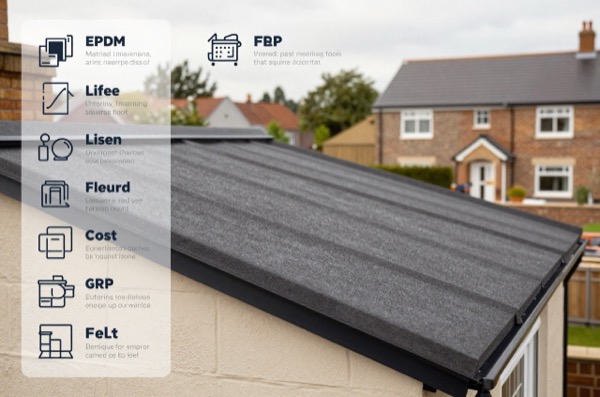
| Felt flat roof | £40–£70/m² | 10–15 years |
How to choose without over-thinking it. Divide the installed cost by the expected life and you get a cost per year, which is the only fair comparison between a slate roof and a felt one. On that basis natural slate is usually the cheapest covering a house will ever have, and felt the most expensive, but the comparison only holds if you expect to be responsible for the roof for that long. Three questions settle most cases. Will you still own the house when the covering fails, or is this a sale-condition job? Is there a planning or conservation constraint that fixes the material regardless of cost? And can the existing structure take the weight, or does the cheaper covering come with an engineer’s bill attached? Where the answers point to a short horizon and a free choice, a mid-life concrete tile or a good single-ply flat system is the rational buy, and paying slate money is a taste decision rather than an economic one.
Get the Inspection Before You Get the Quote
A £100–£250 roof inspection before you call contractors gives you an independent view of what actually needs doing, repair, partial re-cover, or full replacement, so you can spot a quote that’s over- or under-specified before you sign anything.
Flat Roofs
Extensions and garages usually mean a flat roof, and material choice matters more here because lifespans vary so widely. Flat roof types and costs compares EPDM, GRP and felt on price and durability, and EPDM vs GRP flat roof materials goes deeper on warm-roof build-ups for either system.
The build-up matters more than the membrane. In a warm deck, the insulation sits above the structural deck and below the waterproofing, so the deck stays at room temperature and there is no cold void to ventilate. In a cold deck, the insulation sits between the joists and the deck above it runs cold. Approved Document C requires cold deck roofs to be ventilated, precisely because moisture from the building can permeate the insulation and condense on the underside of the deck, and it sets a hard limit for surface condensation: a roof only meets the requirement if its U-value does not exceed 0.35 W/m²K at any point.10 That “at any point” clause is what rules out the common bodge of insulating the middle of a flat roof and stopping short at the perimeter. Replacing the waterproof membrane on a flat roof is itself listed as renovation of a thermal element, so a re-cover triggers the same 0.16 W/m²K upgrade a pitched re-roof does.1 Budget for a warm-deck rebuild, not a membrane swap.
Deciding whether to go flat or pitched at all? Flat roof vs pitched roof compares the two on cost and maintenance, and where the question is specifically about a loft dormer, flat-roof vs pitched-roof dormers covers the planning and lifespan differences that apply there. If the roof is to be planted, green roofs and living roofs add a substrate and drainage layer on top of all of the above.
Flashing, Battens and the Details
The details are what actually keep a roof watertight, and they are also where the standards live. The NFRC’s own index names the documents a specification should cite: BS 5250 for moisture management, BS 5534 for slating and tiling on pitched roofs, BS 6229 for flat roofs with continuously supported flexible coverings, BS 8612 for dry fixed ridge, hip and verge systems, and BS 8000-6 for slating and tiling workmanship, alongside Approved Documents A, B, H and L.11 Check that a quote names the current edition of each: the 2018 edition of BS 6229, for one, was withdrawn in December 2025.12 If a quote names none of them, it is a price rather than a specification.
Lead is still the default at abutments, valleys and chimneys, our guide to lead flashing alternatives covers Code 4 lead at £25–£45/m installed alongside cheaper Ubiflex and flashband options for theft-risk areas. Leadwork fails through workmanship far more often than through material: oversized sheets that cannot move, missing expansion joints and unclipped free edges are the usual culprits. The Lead Sheet Training Academy, a CITB Approved Training Organisation based at East Peckham in Kent, publishes Rolled Lead Sheet: The Complete Manual, which is the reference for lead codes, fixing centres and detailing at chimneys, valleys and abutments.13 Asking a roofer which lead code they are using, and why, is a fast competence test.
Underneath the tiles, roof batten sizes and grading and roofing battens and felt specification both cover BS 5534-graded treated timber, while roofing membranes and breathable felt explains why breathable underlay has replaced traditional bitumen felt on most modern re-roofs. Ridges and verges have moved the same way: since the 2014 revision of BS 5534, ridge and hip tiles have to be mechanically fixed rather than held by mortar alone, and dry-fix ridge, hip and verge systems are tested to BS 8612: see ridge tiles and dry ridge systems.14
Gutters, Fascias and Chimneys
Rainwater goods and the roofline trim take the most weather exposure of any external element. Guttering and downpipe materials compares uPVC, cast iron and aluminium on cost and lifespan. Where that water goes is regulated, not optional: Approved Document H sets a strict order of priority for rainwater discharge, first an adequate soakaway or other infiltration system, then, only where that is not reasonably practicable, a watercourse, and only then a sewer.15 Connecting a new extension’s downpipe straight into the foul drain is a common building control failure on an otherwise finished job.
The boards behind the gutters are covered in barge board, fascia and soffit replacement costs and, for what the three terms actually mean, how fascias, soffits and bargeboards differ. Chimneys need their own attention: chimney repair and flashing costs covers repointing and stack removal from the roof, while removing a chimney breast is the internal, structural side of the same job. Adding or replacing a chimney or flue is permitted development in England only if it does not exceed the highest part of the roof by 1 metre or more, with tighter rules on article 2(3) land where the wall or roof slope fronts a highway.16 A chimney cap on a disused stack keeps rain out but must not seal the flue completely, or the stack sweats.
Repairs, Maintenance and When to Stop Repairing
Not every problem needs a full re-roof. Roof repair costs and common problems breaks down minor slate and flashing repairs against the point where replacement becomes cheaper, and roof felt replacement explains the signs that it’s the underlay failing rather than the tiles. A roof inspection before you commit to either is money well spent, and leaking roof causes and fixes covers the emergency case.
The economics of repair versus replacement turn on three things, and only one of them is the covering. Scaffolding is a fixed cost that you pay whether you replace three slates or the whole roof, so a second patch repair within a couple of years usually costs more than doing the job once: scaffolding costs sets out the numbers. Labour is charged by the day, with roofers at £180–£280 nationally and £230–£360 in London and the South East, so an awkward roof is expensive regardless of material; see UK tradesperson day rates. And the 50% threshold means that once a repair grows past half the roof area, you are paying for the thermal upgrade anyway, at which point stopping at 49% to stay under the line is usually false economy.12 NFRC also recommends buying an Insurance Backed Guarantee, which backs up but is independent of the contractor’s own guarantee, since a contractor’s warranty is worthless if the business fails.2
Guttering needs the same routine attention, see gutter cleaning and repair, and moss is worth dealing with early, though not with a pressure washer: how to remove moss from a roof. And if you’re buying materials rather than paying a contractor to supply them, roofing merchants and suppliers covers trade pricing and bulk ordering.
Access and Safety
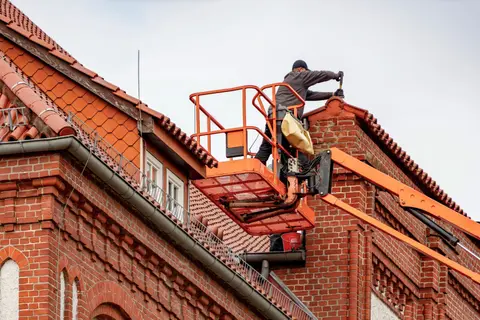
This is the part of a roofing quote homeowners try to negotiate away, and it is the part that should never move. HSE reports that almost one in five deaths in construction work involve roof work, with the main causes being falls from roof edges or openings and falls through fragile roofs and fragile rooflights. All roofs should be treated as fragile until a competent person has confirmed they are not; sloping roofs require scaffolding to prevent people or materials falling from the edge, with edge protection at the eaves; and flat roofs need a secure double guardrail and toeboard around the edge.17
For the small jobs a homeowner might genuinely do, HSE’s ladder rules are the ones to follow: the 1 in 4 rule, one unit out for every four units up, giving a 75 degree angle; the ladder extending at least 1 metre or three rungs above where you are working; and never working off the top three rungs.18 Clearing a gutter from a ladder is a defensible risk. Walking a pitched roof is not.
Scaffolding for roof work on a typical semi is usually quoted as one price covering erection, a set hire period and dismantling, commonly £700–£1,500 for one to two weeks and more for a longer hire or in London, which is why a quote that omits it is not cheaper, it is incomplete.
Damp, Waterproofing and Soundproofing
A sound roof is only part of keeping a building envelope dry and quiet. Below ground, cellar tanking and waterproofing covers the BS 8102 grades for basements, and damp proofing methods and costs explains how to diagnose rising, penetrating and condensation damp before specifying a fix.19 Above ground, draught-proofing your home is the cheapest of all these fixes and pays for itself within a year or two, while wet room tanking and waterproofing is the equivalent job inside a shower room. Noise is a related nuisance: soundproofing a room covers mass, decoupling and sealing for walls and ceilings, and soundproofing noisy pipes and soil stacks deals with the specific rattle of plumbing runs.
Where to Start
If your roof is visibly failing, start with roof replacement: signs you need one to confirm it’s actually time. For a full cost comparison across materials, roofing materials compared is the fastest way to see where your budget lands. And if the issue is a leak rather than a full re-roof, lead flashing alternatives is one of the most common single points of failure worth checking first.
Whatever the job, settle two questions before you accept a quote: what percentage of the roof area is being renovated, and what U-value the finished roof will achieve. Those two answers determine whether you are buying a repair or a rebuild, and every other line in the quote follows from them.
References (19)
Figures in this note were checked against the sources below on 30 September 2026. Superscript numbers in the text point to them. Every source the site cites, by topic.
- 1technicalvery strongMinistry of Housing, Communities and Local Government.RN-L0FCJXThe in-force U-value tables a DIY insulation or door note must quote, with the exact numbers. Table 4.2, limiting U-values for new fabric elements in existing dwellings, sets roof 0.15, wall 0.18, floor 0.18, swimming pool basin 0.25, window 1.4 or Window Energy Rating Band B minimum, rooflight 2.2, doors with more than 60 per cent of the internal face glazed 1.4 or Doorset Energy Rating Band C minimum, and other doors 1.4 or Doorset Energy Rating Band B minimum. Table 4.3, for existing elements, gives a roof threshold of 0.35 and an improved value of 0.16, which is the figure a loft insulation note needs: paragraph 4.12 says a retained element whose U-value is higher than the column (a) threshold, for example through a loft or garage conversion, should be upgraded to the column (b) value. Paragraph 4.13 allows a lesser upgrade only where the improved value is not technically or functionally feasible or would not achieve a simple payback of 15 years or less. Paragraph 4.8 requires a replacement element to be no worse than the one it replaces as well as meeting Table 4.2. Paragraph 4.10 gives the heritage exception: where character must be maintained, a centre pane U-value of no more than 1.2 or low-emissivity secondary glazing. Note 9 records that the timber window concession of 1.6 or Band C ended on 14 June 2023. The 2021 edition came into force on 15 June 2022; a 2026 edition exists at https://assets.publishing.service.gov.uk/media/69c122a6cfa346b9d4704a55/ADL1_2026.pdf.
- 2technicalgoodNational Federation of Roofing Contractors, a page from the body itself.RN-6QKMKTThe roofing trade body page that supplies the single most useful threshold for a roof repair note: the 50 per cent rule. Where refurbishment work affects 50 per cent or more of the roof area, the homeowner must either employ a roofing contractor registered with the NFRC Competent Person Scheme or contact Local Authority Building Control, because the roof must then be upgraded to meet the thermal requirements of Part L of the current Building Regulations. That is why a full re-roof costs materially more than a patch repair. NFRC CPS members can self-certify their roofing works without using building inspectors. NFRC is a scheme provider to TrustMark, the UK government endorsed quality scheme for home improvements. It recommends obtaining an Insurance Backed Guarantee, which backs up but is independent of the contractor's own guarantee, since contractors can go out of business. On quotes it advises selecting up to three contractors, getting recommendations from trusted sources, requesting written quotes, not choosing on price alone, and basing the choice on the quality of the advice given and confidence in the contractor.
- 3technicalvery strongMinistry of Housing, Communities and Local Government.RN-SAMO3MThe official list of competent person schemes whose members can self-certify certain building work instead of getting building regulations approval, published 4 April 2013 and last updated 12 March 2018. Named schemes with contact numbers include ATTMA, APHC, Assure Certification, Blue Flame Certification, the British Board of Agrement, BESCA, Capita Gas Registration and Ancillary Services trading as Gas Safe Register, CIGA, Certass, Certsure LLP trading as NICEIC, the Elmhurst Airtightness Scheme, Fensa Limited, HETAS Limited, NAPIT Registration Limited, the National Federation of Roofing Contractors trading as CompetentRoofer, and OFTEC. Two footnotes matter: the Gas Safe Register is not technically a competent person scheme although in practice its installers carry the same building regulations responsibilities, and Benchmark Certification Limited ceased to operate as a competent person scheme on 10 February 2017, becoming part of NAPIT Registration Limited that day. Installers joining an electrical scheme are added to the single electrical competent person register.
- 4technicalvery strongPlanning Portal, guidance.RN-XGHWIWExplains the two loads a replacement roof has to deal with. For wind uplift the roof must be tied down to the structure with straps roughly 1.2m long fixed to the wall plate at every 2.0m centres. For spreading, it explains that ceiling joists fixed to the bottom of the rafters stop the rafters pushing the walls apart, and that a roof left exposed without ceiling joists needs an engineer's advice. The page states it is not a definitive source of legal information and refers readers to their local building control authority, so pair it with Approved Document A for the 15 per cent loading threshold.
- 5technicalvery strongThe National Archives (legislation.gov.uk), legislation.RN-5QRXP7Class C permits any other alteration to the roof of a dwellinghouse, which is the right rooflight and Velux loft conversions rely on. Paragraph C.1(b) makes development not permitted if the alteration would protrude more than 0.15 metres beyond the plane of the roof slope, measured perpendicular to the original roof plane, and C.1(c) if the highest part of the alteration would be higher than the highest part of the original roof. C.1(d) excludes chimneys, flues, soil and vent pipes and solar equipment from the class, and condition C.2 requires any window in a roof slope forming a side elevation to be obscure-glazed and non-opening below 1.7 metres above the floor of the room.
- 6technicalvery strongThe National Archives (legislation.gov.uk), legislation.RN-KHYKNAClass B permits roof enlargements provided the roof space does not increase by more than 40 cubic metres for a terrace house or 50 cubic metres in any other case (B.1(d)), no part exceeds the height of the highest part of the existing roof (B.1(b)) and the work does not extend beyond the plane of any roof slope forming the principal elevation that fronts a highway (B.1(c)). The right is withdrawn on article 2(3) land, including conservation areas, and for houses created under Classes G, M, MA, N, P, PA or Q (B.1(a), (f) to (h)). Conditions in B.2 require materials of similar appearance, an enlargement set back not less than 0.2 metres from the eaves measured along the roof slope, and side-elevation windows that are obscure-glazed and non-opening unless the opening part is more than 1.7 metres above the floor.
- 7technicalvery strongPlanning Portal, guidance.RN-ITXSTKExplains that fitting a rooflight generally means cutting away part of one or more rafters or joists, so new support must be introduced, usually two pieces of timber fixed together spanning the new opening on either side. It directs the U-value limit to Approved Document L1 Volume 1, Table 4.2, and states that the room the rooflight serves must be ventilated, with the rooflight able to provide both rapid (purge) and background ventilation, and that ventilation of the roof void must also be considered.
- 8technicalgoodRoof Tile Association, guidance.RN-OYX8H0The Roof Tile Association's guide to BS 5534 fixings, explaining that nail and clip specification follows wind load calculations.
- 9costsupplier figureBuy Roof Slate.RN-CB8REPA price, true at 2026-01. A slate supplier's 2026 breakdown of what a slate roof costs: slate by origin, Welsh against Spanish and Brazilian, then labour, scaffolding and the total by property size and per square metre. A merchant that sells slate, so the material prices are their own published figures and the labour and scaffold elements around them are estimates rather than evidence.
- 10technicalvery strongMinistry of Housing, Communities and Local Government.RN-NPO8FJThe statutory figures behind a damp diagnosis, and the numbers to quote when a note explains why ground levels or a bridged damp proof course cause rising damp. Paragraph 5.2 requires that in an external wall the damp-proof course should be at least 150mm above the level of the adjoining ground (Diagram 8) unless part of the building protects the wall, and that in an external cavity wall the cavity should be taken down at least 225mm below the level of the lowest damp-proof course, or a damp-proof tray provided (Diagram 9a). For suspended timber ground floors it requires a ventilated air space of at least 75mm from the ground covering to the underside of any wall-plates and at least 150mm to the underside of the suspended timber floor or insulation, with ventilation openings on two opposing external walls of not less than 1,500mm2 per metre run of external wall or 500mm2 per square metre of floor area, whichever is greater; for suspended concrete floors the clear ventilated space is at least 150mm with the same opening sizes. Section 2.39 onwards covers radon, referring to BRE Report BR 211 for protective measures. The 2013 edition was published on 3 September 2013 with changes in effect from 1 October 2013.
- 11technicalgoodNational Federation of Roofing Contractors, a page from the body itself.RN-0NJ8CNThe roofing trade body's own index of the standards that govern UK roofing work, useful for checking which standard a note should name. It lists BS 5250:2021 management of moisture in buildings, BS 5534:2014+A2:2018 slating and tiling for pitched roofs and vertical cladding, BS 6229:2018 flat roofs with continuously supported flexible waterproof coverings, BS 8612:2018 dry fixed ridge, hip and verge systems, BS 8000-6:2013 slating and tiling workmanship, BS 8217:2005 reinforced bitumen membranes, BS 8218:1998 mastic asphalt roofing, BS 5427:2016+A1:2017 profiled sheet cladding and BS 8414-1 and 2:2020 fire performance of external cladding, alongside Approved Documents A, B, H and L.
- 12technicalstrongBSI, guidance.RN-0JTOABBSI's catalogue record for BS 6229:2018, which shows the 2018 edition as withdrawn, dated 16 December 2025.
- 13technicalgoodLead Sheet Training Academy, a page from the body itself.RN-J8WBI4The LSTA is the UK training body for lead and hard metal roofing, operating from a purpose-built facility at East Peckham in Kent and recognised as a CITB Approved Training Organisation. It publishes Rolled Lead Sheet: The Complete Manual, the standard reference for lead sheet codes, fixing centres and detailing at chimneys, valleys and abutments. It is the correct authority for a lead flashing note, and its training status is the credential to look for in a leadworker.
- 14technicalgoodRoof Tile Association, guidance.RN-3IZLADThe Roof Tile Association on BS 8612 dry-fix systems, noting the 2014 BS 5534 revision required ridge and hip tiles to be mechanically fixed.
- 15technicalvery strongMinistry of Housing, Communities and Local Government.RN-SM6TRWThe statutory source for soakaway design and the discharge hierarchy every garden drainage note should state. Requirement H3(3) lists the order of priority for rainwater discharge: (a) an adequate soakaway or other adequate infiltration system, or where not reasonably practicable (b) a watercourse, or where not reasonably practicable (c) a sewer. Paragraph 3.25 bars infiltration devices within 5 metres of a building or road, in ground where the water table reaches the bottom of the device at any time of year, too close to other drainage fields or soakaways, or where contamination could pollute groundwater. Paragraph 3.26: soakaways serving less than 100 square metres are generally square or circular pits filled with rubble or lined with dry-jointed masonry or perforated ring units. Paragraph 3.27: design to a return period of once in ten years, and for small soakaways serving 25 square metres or less a design rainfall of 10mm in 5 minutes may be assumed as the worst case. Paragraph 3.28 requires percolation tests to derive the infiltration rate, and paragraph 3.30 sends larger soakaways to BS EN 752-4 or BRE Digest 365 Soakaway design. Paragraphs 2.10 to 2.12 cover pervious paving over a granular storage reservoir and warn against its use where sediment or oil spillage would block the pores. For foul drainage, paragraph 2.33 sets a minimum 75mm internal diameter, or 100mm for a WC, and Table 6 gives minimum gradients of 1 in 40 for 75mm and 100mm at peak flows under 1 litre per second.
- 16technicalvery strongThe National Archives (legislation.gov.uk), legislation.RN-UW4IU6Class G permits installation, alteration or replacement of a chimney, flue or soil and vent pipe on a dwellinghouse. Not permitted where the chimney, flue or pipe would exceed the highest part of the roof by 1 metre or more. On article 2(3) land (conservation areas, National Parks, AONBs, the Broads and World Heritage Sites) it is not permitted on a wall or roof slope that both fronts a highway and forms the principal or a side elevation. Also excluded where the dwellinghouse was built under Part 20 of Schedule 2.
- 17technicalvery strongHealth and Safety Executive, guidance.RN-II89LGHSE states that almost one in five deaths in construction work involve roof work, with the main causes being falls from roof edges or openings and falls through fragile roofs and fragile rooflights. It requires all roofs to be treated as fragile until a competent person has confirmed otherwise, and calls for a working platform beneath the roof where possible, with stagings, guard rails, fall restraint, fall arrest and safety nets slung beneath and close to the roof. Sloping roofs need edge protection at the eaves, and on terraced properties to both front and rear; flat roofs need a secure double guardrail and toeboard around the edge. This is the citation for why a roof job needs scaffolding rather than a ladder.
- 18technicalvery strongHealth and Safety Executive, guidance.RN-21AA4HThe HSE rules a DIY note should quote whenever a job involves a ladder, in HSE's own words. For a leaning ladder, use the 1 in 4 rule: the ladder should be one space or unit of measurement out for every four spaces or units up, which is a 75 degree angle. Do not work off the top three rungs, and make sure the ladder extends at least 1 metre or three rungs above the point where you are working. Maintain three points of contact when climbing and wherever possible at the work position. Secure the ladder, for example by tying it, to prevent it slipping outwards or sideways. Only carry light materials and tools. For stepladders, do not stand and work on the top three steps, including a step forming the very top of the stepladder, unless there is a suitable handhold, and maintain three points of contact at the working position, meaning two feet and one hand. HSE frames ladders as suitable for low-risk, short-duration tasks only, which is the test to apply before recommending one for a whole-roof or whole-wall job.
- 19technicalstrongBSI.RN-UTBMKQThe current edition of the UK waterproofing code, published 31 March 2022, superseding BS 8102:2009. It gives recommendations and guidance on dealing with and preventing the entry of water from external sources into structures partly or wholly below ground, and it recognises three types of protection which a specification must name: Type A waterproofing barrier materials applied to the structure, Type B structurally integral watertight construction, and Type C drained cavity construction. It requires the waterproofing strategy to be set at the earliest planning and design stage, covering structural design, overall weatherproofing design, waterproofing design, construction sequencing and buildability, and it treats external drainage and openings as part of the strategy rather than as details. It also sets out evaluation of groundwater conditions, consideration of harmful ground gases, and the risk assessment that drives the choice of grade. Descriptors include basements, tanking, vapour barriers, render, ground-water drainage and site investigations. This is the standard to cite for a basement shower room or a below-ground floor build-up.
-
Approved Document L, Conservation of fuel and power, Volume 1: Dwellings, 2021 edition incorporating 2023 amendments, Ministry of Housing, Communities and Local Government, accessed 7 September 2026. assets.publishing.service.gov.uk
-
Homeowners: choosing a roofing contractor, National Federation of Roofing Contractors, accessed 7 September 2026. nfrc.co.uk
-
Competent person scheme: current schemes and how schemes are authorised, Ministry of Housing, Communities and Local Government, accessed 7 September 2026. gov.uk
-
Roof: building regulations, new roofs, weight (loading), Planning Portal, accessed 7 September 2026. planningportal.co.uk
-
The Town and Country Planning (General Permitted Development) (England) Order 2015, Schedule 2, Part 1, Class C: other alterations to the roof of a dwellinghouse, legislation.gov.uk, accessed 7 September 2026. legislation.gov.uk
-
The Town and Country Planning (General Permitted Development) (England) Order 2015, Schedule 2, Part 1, Class B: additions etc to the roof of a dwellinghouse, legislation.gov.uk, accessed 7 September 2026. legislation.gov.uk
-
Roof: building regulations, rooflights, Planning Portal, accessed 7 September 2026. planningportal.co.uk
-
A Contractor’s Guide to Roof Tile Fasteners: BS 5534 Compliance and Best Practices, Roof Tile Association, accessed 30 September 2026. rooftileassociation.co.uk
-
Slate Roof Cost 2026: Full UK Price Guide, Buy Roof Slate, accessed 18 September 2026. Priced at 2026-01, so no calibration is needed. buyroofslate.co.uk
-
Approved Document C, Site preparation and resistance to contaminants and moisture, 2004 edition incorporating 2010 and 2013 amendments, Ministry of Housing, Communities and Local Government, accessed 7 September 2026. assets.publishing.service.gov.uk
-
Standards and regulations for roofing and cladding, National Federation of Roofing Contractors, accessed 7 September 2026. nfrc.co.uk
-
BS 6229:2018, Flat roofs with continuously supported flexible waterproof coverings. Code of practice, BSI, accessed 30 September 2026. knowledge.bsigroup.com
-
Lead Sheet Training Academy, Lead Sheet Training Academy, accessed 7 September 2026. leadsheet.co.uk
-
The Dry Fix British Standard, Roof Tile Association, accessed 30 September 2026. rooftileassociation.co.uk
-
Approved Document H, Drainage and waste disposal, 2015 edition, Ministry of Housing, Communities and Local Government, accessed 7 September 2026. assets.publishing.service.gov.uk
-
The Town and Country Planning (General Permitted Development) (England) Order 2015, Schedule 2, Part 1, Class G: chimneys, flues etc on a dwellinghouse, legislation.gov.uk, accessed 7 September 2026. legislation.gov.uk
-
Roof work: construction health and safety, Health and Safety Executive, accessed 7 September 2026. hse.gov.uk
-
Types of ladder and using them safely, Health and Safety Executive, accessed 7 September 2026. hse.gov.uk
-
BS 8102:2022, Protection of below ground structures against water ingress. Code of practice, BSI, accessed 14 September 2026. knowledge.bsigroup.com