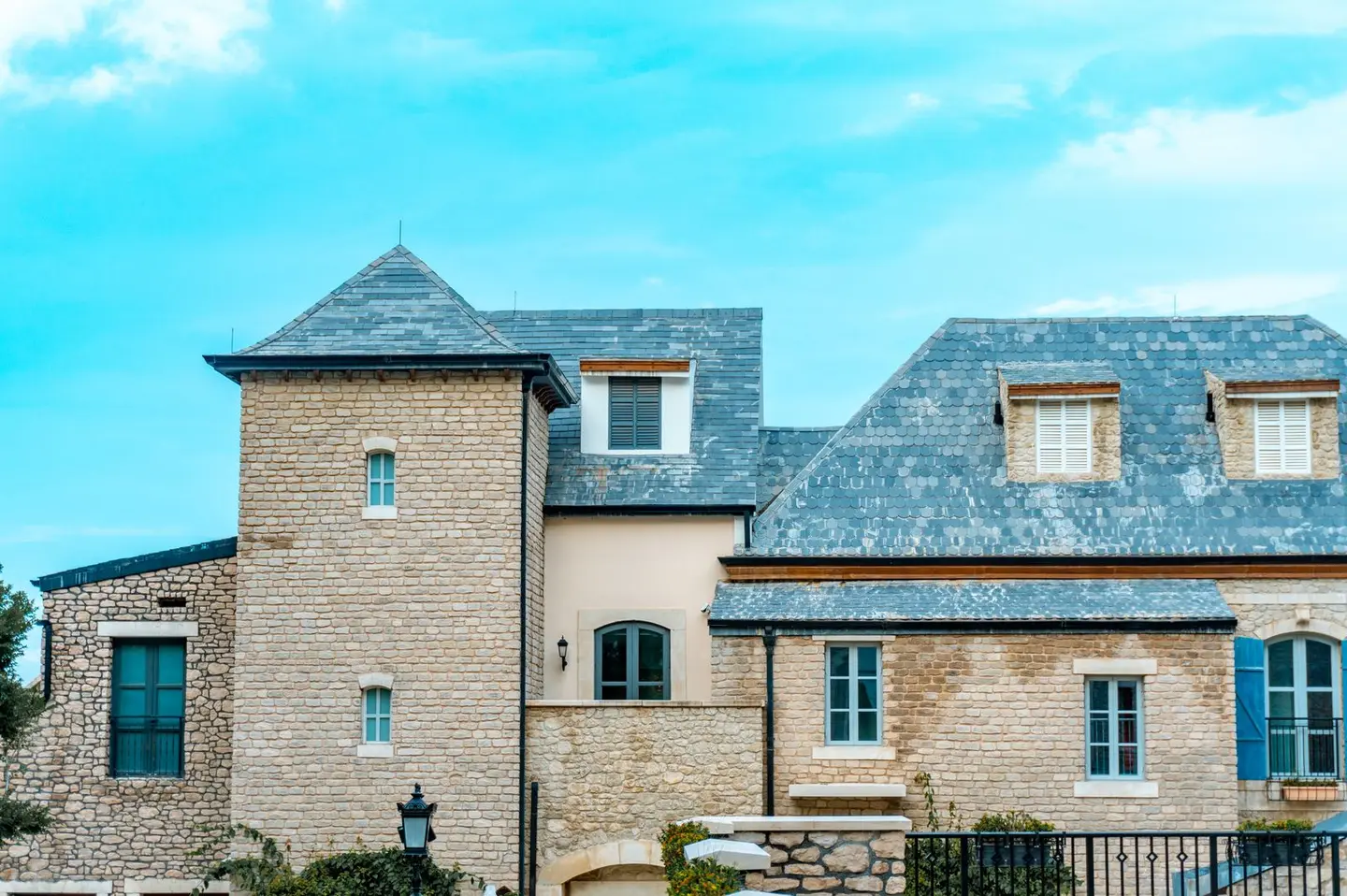
Slate is one of the oldest and most durable roofing materials in the UK. A well-laid natural slate roof can outlast the building it covers, which is why so many Victorian and Edwardian terraces still have their original Welsh slate in place more than a century after it was first laid. But slate is not a single product, there is natural slate from Wales, Spain, Portugal, Brazil, and China, as well as synthetic alternatives made from fibre-cement or rubber compounds, each with very different performance characteristics and price points.
Types of Slate Roof Tile
Natural Welsh Slate
Welsh roofing slate is quarried today at Penrhyn, Ffestiniog and Cwt-y-Bugail in North Wales.1 It is widely regarded as the benchmark for UK roofing. It is fine-grained, extremely hard, and naturally resistant to frost, acid rain, and UV degradation. The colour ranges from blue-grey to purple-grey depending on the quarry, and it weathers to a distinctive silver tone over decades.
Lifespan: 80–150 years; many 19th-century roofs are still sound.2 Weight: about 38 kg/m² for 5.5 mm Penrhyn slates at 500 × 250 mm on a 90 mm lap, and about 48 kg/m² for the 7 mm grade, worked from Welsh Slate’s published weights; a structural check is advisable on older roofs.34 Thickness: typically 4–9 mm for standard roofing grades.4 Certification: look for CE marking and compliance with BS EN 12326-1.5
Spanish and Portuguese Slate
Spanish slate (mainly from Galicia) is widely used in the UK because it is significantly cheaper than Welsh slate while still being genuine natural stone. Quality varies considerably, premium Spanish slate such as Cupa’s CUPA 12 range approaches Welsh quality, while lower-grade material can be more porous and prone to delamination.
Lifespan: 50–80 years for premium grades; 30–50 years for standard grades. Weight: about 35 kg/m² for the common 500 × 250 mm slate 5 mm thick, rising with thickness.3 Watch out for: calcium carbonate content, higher carbonate content means faster weathering in acid rain environments.6 Ask your supplier for the water absorption test result and classification under BS EN 12326-1 (lower absorption is better).65
Brazilian and Chinese Slate
Imported slates from Brazil and China can be cheaper than Spanish slate but vary enormously in quality. Some low-cost slate contains pyrite (iron sulphide), which can oxidise, causing rust-coloured staining and accelerated weathering; the thermal cycling test in BS EN 12326 shows whether it will.6 Unless the supplier can provide BS EN 12326 test results, ideally from continuous testing, treat low-cost imported slate with caution.6
Synthetic / Fibre-Cement Slate
Fibre-cement slates are made from cement reinforced with synthetic and natural fibres, pressed to imitate natural slate. They are lighter, more uniform, and considerably cheaper than natural slate.
Lifespan: typically 30–50 years; check the length of the manufacturer’s guarantee. Weight: about 20–23 kg/m² for a typical 4 mm slate, depending on the lap, so it can be used on older structures that cannot carry natural slate.7 Appearance: convincing from a distance but lacks the variation and depth of natural stone, planning authorities in Conservation Areas often require natural slate.
Reclaimed Slate
Reclaimed Welsh or Scottish slate, salvaged from re-roofing projects, can be an excellent choice for matching existing roofs or maintaining period character. Quality varies widely; insist on slates that have been sorted, tested for soundness (the tap test: a good slate rings, a delaminating one sounds dull), and sized uniformly.2
Price: £15–£60/m² depending on quality and source; can be comparable to new Spanish slate.
Cost Comparison Table
| Slate Type | Supply (£/m²) | Installed (£/m²) | Lifespan |
|---|---|---|---|
| Natural Welsh slate | £50–£120 | £120–£2208 | 80–150 years |
| Premium Spanish slate | £50–£100 | £90–£160 | 50–80 years |
| Standard Spanish slate | £40–£50 | £75–£130 | 30–50 years |
| Reclaimed Welsh/Scottish | £15–£60 | £80–£160 | 40–100 years |
| Fibre-cement synthetic | £19–£38 | £65–£110 | 30–50 years |
| Brazilian/Chinese slate | £20–£45 | £60–£100 | 15–40 years |
Supply prices per m² assume about 20 slates of 500 × 250 mm at a 100 mm lap.3 For a whole roof, one merchant sells standard-grade Spanish slate of that size for £2.14–£2.39 each including VAT, depending on quantity, or roughly £43–£48/m².9 Its prime-grade Brazilian slate of the same size is £2.27 each, about £45/m², so imported slate is not always much cheaper.10 Premium Spanish grades cost more: SSQ Del Carmen first grade starts at £5.14 a slate including VAT.11
Installed costs include breathable roofing felt (BS 5534 compliant), treated timber battens, stainless steel nails, lead soakers at abutments, and ridge tiles.12 Scaffolding is additional, typically £600–£1,200 for a standard semi-detached house.
Minimum Roof Pitch
Slate tiles require a minimum pitch to prevent wind-driven rain working its way under the overlap:
- Natural slate, Welsh or imported: 20° is the usual minimum, and only with the longer headlap BS 5534 sets for low pitches; steeper roofs can use a smaller lap13
- Fibre-cement slate: commonly 20–25°, depending on the headlap and exposure: Cedral’s slates, for example, need 25° with a 100 mm lap in severe exposure but can go down to 20° with a 150 mm lap (check the manufacturer’s fixing specification)14
Below these pitches, slate is not appropriate, consider a profiled metal roof or GRP membrane instead.
How to Choose
Match the existing roof: if you are replacing part of a slate roof rather than the whole, the new material must match the existing in colour, texture, and thickness.2 Where a listed building or an Article 4 direction is involved, councils usually expect “like for like” replacement.
Check your structure: thin natural slate is usually lighter than concrete interlocking tiles but much heavier than fibre-cement slate or metal sheet.3 A 150 m² roof of 5.5–7 mm Welsh slate weighs roughly 5,600–7,200 kg, so always get the roof structure checked by a structural engineer or surveyor before switching from a lighter covering to slate.15
Factor in the headlap: the headlap (the amount by which one course overlaps the one below) is determined by your roof pitch and exposure zone. In exposed locations, BS 5534 may require a larger headlap than the manufacturer’s minimum, reducing the number of slates per m² and increasing material cost.
Ask about the nail: specify copper or stainless steel nails.2 Conservation guidance says galvanised nails should be avoided, because the coating can be damaged when fixing or as the slate moves in the wind, leaving them prone to rust.2
Building Regulations and Conservation Areas
Re-roofing also brings in the energy rules. Stripping a roof back to the rafters counts as renovating it, and where more than 50% of the roof is renovated, Approved Document L expects the whole roof to be insulated to 0.16 W/m²K.16 The exception is where that would not pay for itself within 15 years, in which case the roof goes to the best standard that would.16 For a cold roof that usually means topping up the loft insulation, which is cheap; for a room in the roof it can mean insulating between and under the rafters.
Re-covering a pitched roof usually needs Building Regulations approval.15 A roofer registered with a competent person scheme for roof coverings, such as the NFRC’s CompetentRoofer or NAPIT, can self-certify the work; otherwise you will need to apply to building control, for example with a Building Notice.1718
Re-roofing that does not materially affect a house’s external appearance, such as like-for-like slate, usually does not need planning permission.19 On a listed building, though, works that would affect its character need listed building consent, and in a conservation area an Article 4 direction can bring a change of roofing material under planning control.2021 Fibre-cement slate is often resisted by conservation officers; reclaimed natural slate or premium Spanish slate is usually acceptable if it matches the original closely.
Value-for-Money Verdict
For most UK re-roofing projects, premium Spanish slate (Cupa grades or equivalent) hits the best balance of cost, longevity, and appearance. Welsh slate is worth the premium on a front elevation visible from the street, a Listed Building, or any roof where a 100-year lifespan is the priority.
Maintenance and Lifespan
Even the best natural slate roof needs attention:
- Annual check: inspect from ground level with binoculars for slipped, cracked, or missing slates after winter storms.2
- Moss and lichen: treat heavy growth with a biocide spray; do not use a pressure washer as this can damage the slate surface.
- Re-pointing: mortar bedded ridge tiles and hip tiles should be checked every 10–15 years and repointed as needed; consider switching to a dry ridge system to eliminate this maintenance task entirely.
- Flashings: lead flashings at chimneys and abutments can outlast the slates if the right code of lead is properly installed; check for cracking or lifting every decade.22
A natural slate roof that is kept watertight and has flashings maintained will genuinely outlast every other roofing material available in the UK market.
References (22)
Figures in this note were checked against the sources below on 2 October 2026. Superscript numbers in the text point to them. Every source the site cites, by topic.
- 1technicalsupplier figureWelsh Slate, guidance.RN-F5WM1VThe producer's company page. It names the three Welsh roofing slate quarries it operates today: Penrhyn, Ffestiniog and Cwt-y-Bugail.
- 2technicalfairInstitute of Historic Building Conservation, guidance.RN-NEXTM9IHBC homeowner guidance on slate and stone roofs. It supports the very long service life of a maintained natural slate roof.
- 3technicalsupplier figureCupa Pizarras, guidance.RN-73BAEDSpanish slate producer's technical FAQ on slate coverage and weight. It gives the common 500 x 250 x 5 mm slate as about 35 kg per square metre laid.
- 4technicalsupplier figureWelsh Slate Ltd, a data sheet.RN-BXJX6TWelsh Slate standard roofing slate sizes and weights in tonnes per 1000 slates, excluding packaging. Thickness grades are Capital 5.5mm, County 7mm and Celtic 9mm (nominal). Penrhyn Heather Blue: 600 x 350mm 3.23 / 4.12 / 5.29 t per 1000; 600 x 300mm 2.77 / 3.53 / 4.54; 550 x 300mm 2.54 / 3.23 / 4.16; 500 x 300mm 2.23 / 2.94 / 3.78; 500 x 250mm 1.93 / 2.45 / 3.15; 455 x 250mm 1.75 / 2.23 / 2.87; 400 x 250mm 1.54 / 1.96 / 2.52; 400 x 200mm 1.23 / 1.57 / 2.02; 350 x 250mm 1.35 / 1.72 / 2.21; 350 x 200mm 1.08 / 1.37 / 1.76; 300 x 300mm 1.51 / 1.76 / 2.27. Ffestiniog Blue Grey is slightly lighter, for example 500 x 250mm 1.86 / 2.36 / 3.04 t per 1000 and 400 x 200mm 1.19 / 1.51 / 1.94.
- 5technicalstrongBSI, a standard.RN-QVGL7FBS EN 12326-1:2014, the specification for slate and carbonate slate used on roofs and external cladding. Sets the test-based classification for water absorption, thermal cycling and sulphur dioxide exposure that produces the A1, T1, S1 ratings. Those ratings are the honest way to compare a Welsh slate with a Spanish or Brazilian one, as opposed to comparing them by origin and price.
- 6technicalfairNBS, guidance.RN-7MM0FGNBS technical article on specifying roofing slate to BS EN 12326. It explains that high carbonate content reduces durability and that slates are tested for sulphur dioxide exposure, the acid-rain test.
- 7technicalsupplier figureCedral (Etex), guidance.RN-G4UHUMCedral's technical data for its 4 mm Thrutone fibre cement slate, giving the weight of slating as about 20.4 kg/m² at a 100 mm lap rising to 22.8 kg/m² at a 150 mm lap.
- 8costsupplier figureBuy Roof Slate.RN-CB8REPA price, true at 2026-01. A slate supplier's 2026 breakdown of what a slate roof costs: slate by origin, Welsh against Spanish and Brazilian, then labour, scaffolding and the total by property size and per square metre. A merchant that sells slate, so the material prices are their own published figures and the labour and scaffold elements around them are estimates rather than evidence.
- 9costsupplier figureJJ Roofing Supplies.RN-V6ELK6A price, true at 2026-09. A roofing merchant's product page for standard-grade Spanish slate, 500 x 250 mm, with quantity prices from £2.08 each ex VAT at 21 off down to £1.78 at 1,050 off.
- 10costsupplier figureJJ Roofing Supplies.RN-J40NYZA price, true at 2026-09. A roofing merchant's product page for prime-grade Brazilian slate at 500 x 250 mm, priced at £2.27 each including VAT (£1.89 ex VAT), which is about £45/m² at 20 slates per m².
- 11costsupplier figureJJ Roofing Supplies.RN-2W8HQIA price, true at 2026-09. A roofing merchant's product page for SSQ Del Carmen first-grade Spanish slate, priced from £5.14 a slate including VAT, the basis for the premium Spanish supply price of up to about £100/m².
- 12technicalstrongBSI (British Standards Institution), a standard.RN-FCTWJDSTATUS: CURRENT. BS 5534:2014+A2:2018 published 28 February 2018. Full title is 'Slating and tiling for pitched roofs and vertical cladding. Code of practice' - NOT the older 2003 title 'Code of practice for slating and tiling', which is a common stale citation. Gives recommendations primarily for the design, performance and installation of new build pitched roofs including vertical cladding, and for normal re-roofing work including repairs, using slates, tiles, shingles and shakes and their associated components. The A2:2018 amendment reworked wind loads and uplift resistances of the roof covering and underlay around the Eurocodes and withdrew reliance on the tensile strength of mortar bedding to resist wind uplift, which is why mortar-bedded ridges and verges alone no longer satisfy the code. Batten grading rules sit inside this standard (clause 4.11 and its annex), not in BS 4978, BS 5756 or BS EN 14081.
- 13technicalsupplier figureCupa Pizarras, guidance.RN-HMVFTOA slate producer's technical FAQ summarising NHBC Standards 7.2.19 and BS 5534: natural slate can go down to 20° subject to headlap. Used because the NHBC and BSI texts cannot be fetched.
- 14technicalsupplier figureCedral (Etex), guidance.RN-NR2D7QCedral's UK roofing brochure with technical data for its fibre cement slates, including minimum pitches by exposure and headlap: 20° to 25° depending on lap and exposure.
- 15technicalvery strongPlanning Portal, guidance.RN-Y8X4RRThe Planning Portal on re-roofing: replacing a roof covering is normally building work needing approval, and where more than 25% of the roof area is being renewed the thermal element upgrade requirement is engaged. The 25% threshold is the number that decides whether a straight re-cover turns into an insulation upgrade.
- 16technicalvery strongMinistry of Housing, Communities and Local Government.RN-L0FCJXThe in-force U-value tables a DIY insulation or door note must quote, with the exact numbers. Table 4.2, limiting U-values for new fabric elements in existing dwellings, sets roof 0.15, wall 0.18, floor 0.18, swimming pool basin 0.25, window 1.4 or Window Energy Rating Band B minimum, rooflight 2.2, doors with more than 60 per cent of the internal face glazed 1.4 or Doorset Energy Rating Band C minimum, and other doors 1.4 or Doorset Energy Rating Band B minimum. Table 4.3, for existing elements, gives a roof threshold of 0.35 and an improved value of 0.16, which is the figure a loft insulation note needs: paragraph 4.12 says a retained element whose U-value is higher than the column (a) threshold, for example through a loft or garage conversion, should be upgraded to the column (b) value. Paragraph 4.13 allows a lesser upgrade only where the improved value is not technically or functionally feasible or would not achieve a simple payback of 15 years or less. Paragraph 4.8 requires a replacement element to be no worse than the one it replaces as well as meeting Table 4.2. Paragraph 4.10 gives the heritage exception: where character must be maintained, a centre pane U-value of no more than 1.2 or low-emissivity secondary glazing. Note 9 records that the timber window concession of 1.6 or Band C ended on 14 June 2023. The 2021 edition came into force on 15 June 2022; a 2026 edition exists at https://assets.publishing.service.gov.uk/media/69c122a6cfa346b9d4704a55/ADL1_2026.pdf.
- 17technicalgoodNational Federation of Roofing Contractors, a page from the body itself.RN-6QKMKTThe roofing trade body page that supplies the single most useful threshold for a roof repair note: the 50 per cent rule. Where refurbishment work affects 50 per cent or more of the roof area, the homeowner must either employ a roofing contractor registered with the NFRC Competent Person Scheme or contact Local Authority Building Control, because the roof must then be upgraded to meet the thermal requirements of Part L of the current Building Regulations. That is why a full re-roof costs materially more than a patch repair. NFRC CPS members can self-certify their roofing works without using building inspectors. NFRC is a scheme provider to TrustMark, the UK government endorsed quality scheme for home improvements. It recommends obtaining an Insurance Backed Guarantee, which backs up but is independent of the contractor's own guarantee, since contractors can go out of business. On quotes it advises selecting up to three contractors, getting recommendations from trusted sources, requesting written quotes, not choosing on price alone, and basing the choice on the quality of the advice given and confidence in the contractor.
- 18technicalvery strongMinistry of Housing, Communities and Local Government.RN-SAMO3MThe official list of competent person schemes whose members can self-certify certain building work instead of getting building regulations approval, published 4 April 2013 and last updated 12 March 2018. Named schemes with contact numbers include ATTMA, APHC, Assure Certification, Blue Flame Certification, the British Board of Agrement, BESCA, Capita Gas Registration and Ancillary Services trading as Gas Safe Register, CIGA, Certass, Certsure LLP trading as NICEIC, the Elmhurst Airtightness Scheme, Fensa Limited, HETAS Limited, NAPIT Registration Limited, the National Federation of Roofing Contractors trading as CompetentRoofer, and OFTEC. Two footnotes matter: the Gas Safe Register is not technically a competent person scheme although in practice its installers carry the same building regulations responsibilities, and Benchmark Certification Limited ceased to operate as a competent person scheme on 10 February 2017, becoming part of NAPIT Registration Limited that day. Installers joining an electrical scheme are added to the single electrical competent person register.
- 19technicalvery strongPlanning Portal, guidance.RN-355YOKPlanning Portal guidance on roofs. It says re-roofing that does not materially affect a house's appearance usually needs no planning permission.
- 20technicalvery strongMinistry of Housing, Communities and Local Government (GOV.UK), guidance.RN-SM4299States that planning permission is only needed if the work is development within section 55 of the Town and Country Planning Act 1990, and that interior alterations and works that do not materially affect the external appearance of a building are not development (paragraph 001). Explains permitted development rights under the GPDO 2015 and their restriction on article 2(3) land such as conservation areas, National Parks, AONBs, the Broads and World Heritage Sites (paragraphs 016 to 017), prior approval including the neighbour consultation scheme for larger single-storey rear extensions (paragraphs 026 to 032), lawful development certificates (paragraph 024) and article 4 directions, which must be applied in a measured and targeted way to the smallest geographical area possible and can make an authority liable for compensation (paragraphs 036 to 043). Page last updated 26 July 2023.
- 21technicalvery strongThe National Archives (legislation.gov.uk), legislation.RN-XN22L9The provision that decides when listed building consent is actually needed, and the answer to the common overstatement that any alteration to a listed building requires consent. Section 7(1): 'no person shall execute or cause to be executed any works for the demolition of a listed building or for its alteration or extension in any manner which would affect its character as a building of special architectural or historic interest, unless the works are authorised under section 8.' The trigger is therefore effect on character as a building of special architectural or historic interest, not alteration as such, so work with no effect on that character falls outside the restriction. Section 7(2) makes subsection (1) subject to section 33(1) of the Planning Act 2008, which excludes the requirement for other consents where development consent is required. Authorisation itself comes from section 8.
- 22technicalfairLead Sheet Advisory Service, guidance.RN-EPV6GEThe Lead Sheet Advisory Service's guide to lead codes. It describes Code 4 (1.80 mm, 20.41 kg/m²) as the code used for exposed flashings, pitched valley gutters and vertical cladding.
-
The Company, Welsh Slate, accessed 30 September 2026. welshslate.com
-
Natural Slate and Stone: Caring for your home, Institute of Historic Building Conservation, accessed 30 September 2026. ihbc.org.uk
-
How much does slate weight?, Cupa Pizarras, accessed 2 October 2026. cupapizarras.com
-
Roofing Slate Sizes and Weights, Welsh Slate, accessed 2 October 2026. welshslate.com
-
BS EN 12326-1:2014 Slate and stone for discontinuous roofing and external cladding. Specifications for slate and carbonate slate, BSI Knowledge, accessed 7 September 2026. knowledge.bsigroup.com
-
Roof slates and BS EN 12326, NBS, accessed 2 October 2026. thenbs.com
-
Cedral Thrutone Smooth fibre cement slates, Cedral (Etex), accessed 2 October 2026. cedral.world
-
Slate Roof Cost 2026: Full UK Price Guide, Buy Roof Slate, accessed 30 September 2026. Priced at 2026-01, so no calibration is needed. buyroofslate.co.uk
-
Spanish Standard Natural Slate 500mm x 250mm (pre holed), JJ Roofing Supplies, accessed 2 October 2026. Priced at 2026-09 and left there. jjroofingsupplies.co.uk
-
Brazilian Westland Prime Grade Graphite Roof Slate 500mm x 250mm (pre holed), JJ Roofing Supplies, accessed 2 October 2026. Priced at 2026-09 and left there. jjroofingsupplies.co.uk
-
SSQ Del Carmen First Grade Natural Spanish Roof Slate, JJ Roofing Supplies, accessed 2 October 2026. Priced at 2026-09 and left there. jjroofingsupplies.co.uk
-
BS 5534:2014+A2:2018 Slating and tiling for pitched roofs and vertical cladding. Code of practice, BSI Knowledge, accessed 7 September 2026. knowledge.bsigroup.com
-
What is the minimum pitch for slate roof?, Cupa Pizarras, accessed 30 September 2026. cupapizarras.com
-
Cedral fibre cement slates: roofing brochure (UK), Cedral (Etex), accessed 2 October 2026. cedral.world
-
Building regulations: Re-roofing - Roof - Planning Portal, Planning Portal, accessed 7 September 2026. planningportal.co.uk
-
Approved Document L, Conservation of fuel and power, Volume 1: Dwellings, 2021 edition incorporating 2023 amendments, HM Government, accessed 29 September 2026. assets.publishing.service.gov.uk
-
NFRC Homeowners, National Federation of Roofing Contractors (NFRC), accessed 7 September 2026. nfrc.co.uk
-
Competent person scheme - current schemes and how schemes are authorised, GOV.UK, accessed 7 September 2026. gov.uk
-
Roof: Planning permission, Planning Portal, accessed 30 September 2026. planningportal.co.uk
-
When is permission required?, Ministry of Housing, Communities and Local Government (GOV.UK), accessed 2 October 2026. gov.uk
-
Planning (Listed Buildings and Conservation Areas) Act 1990, section 7: Restriction on works affecting listed buildings, The National Archives (legislation.gov.uk), accessed 30 September 2026. legislation.gov.uk
-
About Lead Sheet, Lead Sheet Advisory Service, accessed 2 October 2026. leadsheetadvisoryservice.co.uk