Flashings seal the junction between a roof covering and a vertical surface, a chimney stack, parapet wall, dormer cheek, or abutment with a higher wall. They are critical weatherproofing details, and their failure is one of the most common causes of roof leaks. Lead has been the material of choice for centuries because of its formability, durability and self-sealing capability, but theft and cost have driven significant uptake of alternatives in recent years.
Lead Codes and Thickness
Lead sheet for roofing is specified by Code number, which corresponds to thickness and mass per square metre:1
| Code | Thickness (mm) | Mass (kg/m²) | Common Application |
|---|---|---|---|
| Code 3 | 1.32 | 14.97 | Soakers |
| Code 4 | 1.80 | 20.41 | Step flashings, aprons, upstands (most common) |
| Code 5 | 2.24 | 25.40 | Valley gutters, parapet gutters, flat roof coverings |
| Code 6 | 2.65 | 30.05 | Large gutter linings, flat roof areas |
| Code 7 | 3.15 | 35.72 | Flat roofs, parapet and box gutters, dormers |
| Code 8 | 3.55 | 40.26 | Flat roofs, gutters, dormers, bay roofs and canopies |
The uses follow the guide Associated Lead Mills publishes from the Lead Sheet Association’s manual, which keeps Code 3 for soakers and lists Code 4 for soakers, flashings and vertical cladding.2
For the majority of residential flashings, step flashings at chimney abutments, apron flashings over bay windows, soakers under slates, Code 4 is standard.3 Code 3 is commonly used for soakers, which are interleaved between the slates and covered by the flashing.3 Code 4 also serves for pitched valley gutters, and Code 5 is the usual step up for parapet, box and tapered gutters, or for valleys and flashings on more exposed roofs.2
The Lead Sheet Association’s Rolled Lead Sheet: The Complete Manual, now published by the Lead Sheet Training Academy, is the industry’s main reference for lead roofing details.4
Typical Flashing Details
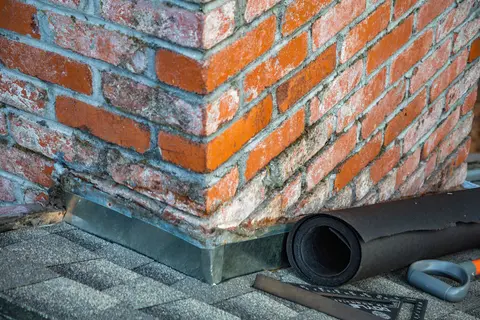
Step flashings (chimney and wall abutments): the most common lead detail. With slates and plain tiles, soakers are interleaved with each course and a stepped Code 4 flashing covers them; with interlocking tiles, a single stepped flashing is dressed down over the tiles. The top of each step is tucked at least 25 mm into a raked-out mortar joint, held with lead wedges and pointed.2 No single piece should be longer than 1.5 m, so that thermal movement stays manageable.2 The flashing should also stand well up the wall above the tile surface.
Soakers: L-shaped pieces of Code 3 lead placed under each slate at an abutment, with the vertical leg tucked behind the cover flashing.2 Each soaker’s length is the slate gauge plus the head lap plus 25 mm, and its upstand is turned against the wall.2
Valley gutters: Code 4 or Code 5 lead dressed into a valley between intersecting roof slopes. Each piece is no more than 1.5 m long and laps over the one below, with the lap sized to the roof pitch: the shallower the roof, the longer the lap.2
Apron flashings: a single-piece detail at the front face of a chimney stack, usually in Code 4, with an upstand of about 150 mm against the stack and an apron of 150–200 mm dressed over the roof covering.2
Lead Theft
Lead theft from roofs remains a significant problem, particularly on churches and other public buildings.5 The Scrap Metal Dealers Act 2013 requires cash-free transactions at scrap merchants, which has helped but not eliminated the problem.6
For properties with repeated theft incidents or high-risk locations, specifying an alternative material is practical rather than a downgrade.
Alternatives to Lead Flashing
Several products are established as lead substitutes in the UK:
Ubiflex (and similar flexible non-lead strips): Ubiflex Standard is an aluminium mesh coated in granular-faced bitumen, about 3.5 mm thick, supplied in 6 m and 12 m rolls in widths from 150 mm to 1 m.7 It is bonded down with the maker’s high-tack sealant, with clips in the mortar joint where wind exposure is severe, and self-adhesive versions are also made.7 It is far lighter than lead and has no scrap value.8 Ubbink gives Ubiflex Standard a 25-year product guarantee.8 Ubbink lists pitched valley linings among its uses, but check the maker’s details before using any non-lead strip where water will stand for long periods.8 Typical installed cost: £10–£18/m run for standard abutment widths.
GRP (glass-reinforced polyester) flashings: moulded to specific profiles for standard chimney sections and valley applications. Very rigid; excellent chemical resistance; no thermal creep. Colour-matched products available. Less suitable for non-standard shapes that require on-site forming. Installed, GRP flashings typically cost around £15–£25/m for standard chimney flashings, more for valley liners. As a supply-only guide, Roofing Superstore lists a 400 mm by 3 m GRP valley trough at £25.00 including VAT.9 Filon says the trough is unaffected by thermal movement and should last more than 30 years.9
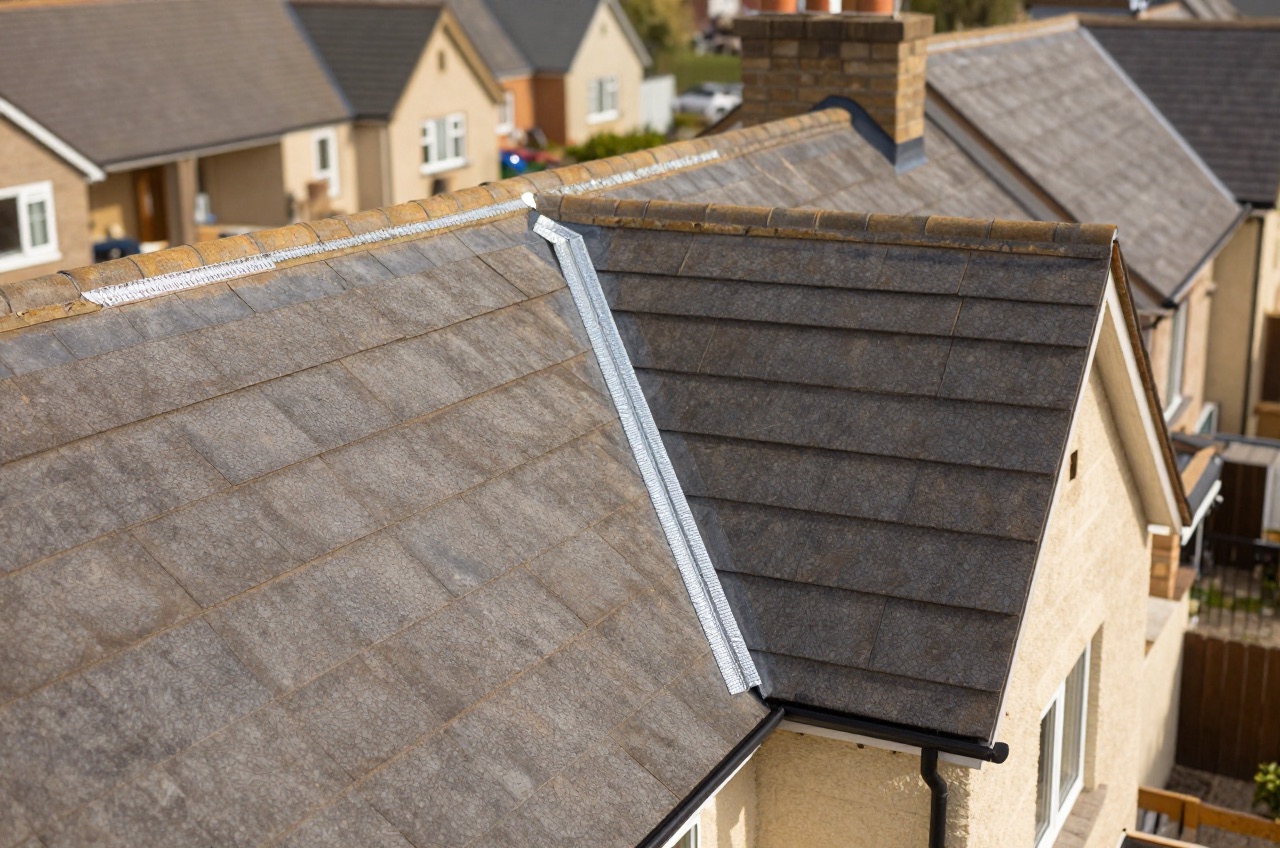
Self-adhesive flashing tape (flashband type): butyl or bitumen-based self-adhesive strips with a foil or mineral facing. Used for low-risk repairs, sealing pipe penetrations and temporary weather protection. Not a structural replacement for proper soakers and cover flashings on long-term work. Supply-only, a 10 m roll of 150 mm Bostik Flashband costs about £17, under £2 a metre.10
Zinc: a traditional alternative, specified by thickness rather than by code; the thinnest zinc sheet sold for roofing in the UK is 0.7 mm.11 It is far lighter than lead for the same area and is typically used on contemporary architecture where a grey metallic aesthetic is desired. VMZINC puts the life of a correctly designed and installed zinc roof at more than 100 years, falling towards 60 years only in severe industrial or marine air.11
Cost Comparison (Installed, per Linear Metre)
For a standard chimney abutment flashing (step and cover), as a rough guide that excludes scaffolding or other access:
| Material | Installed Cost (£/m) | Lifespan | Theft Risk |
|---|---|---|---|
| Lead Code 4 | £25–£45 | 80+ years | High |
| Ubiflex / non-lead composite | £10–£18 | 25-year maker’s guarantee | None |
| GRP flashing system | £15–£25 | 30+ years (maker’s claim) | None |
| Zinc | £30–£55 | 60–100+ years | Low |
| Self-adhesive flashband (repair) | £5–£10 | 5–15 years | None |
Wider girths and stepped work cost more: as a check on materials alone, Wickes lists a 300 mm by 3 m roll of Code 4 lead at £84, about £28 a metre before any labour.12 The Lead Sheet Training Academy says correctly installed lead sheet can last more than 80 years in the lower codes and over 100 years in the higher ones.13
UK Standards and Building Regs
- BS EN 12588: European standard for milled lead sheet for building use, thicknesses, tolerances, chemical composition.14
- Rolled Lead Sheet: The Complete Manual (Lead Sheet Association, now the Lead Sheet Training Academy): detailed industry guidance on lead roofing and flashing details, written to support the BS 6915 code of practice.4
- BS 6915: the British Standard code of practice for the design and construction of fully supported lead sheet roof and wall coverings, one of the roofing standards Approved Document C relies on.15
- BS 5534:2014+A2:2018: the code of practice for slating and tiling pitched roofs, the coverings that abutment flashings and soakers are detailed around.16
- Building Regulations Part C: Approved Document C expects a roof to resist the penetration of rain and snow to the inside of the building, and flashings at junctions are part of how a roof does that.15
On a listed building, replacing lead with a different material can affect the building’s character, and works that do so need listed building consent.17 In conservation areas lead is often expected, so agree any alternative in writing with the conservation officer before work starts.
References (17)
Figures in this note were checked against the sources below on 2 October 2026. Superscript numbers in the text point to them. Every source the site cites, by topic.
- 1technicalsupplier figureAssociated Lead Mills, guidance.RN-969MU5A UK lead mill's weight chart for rolled lead sheet to BS EN 12588. It gives the thickness and mass per square metre for Codes 3 to 8, matching every figure in the note's code table.
- 2technicalsupplier figureAssociated Lead Mills (technical content extracted from the Lead Sheet Association's Complete Manual), guidance.RN-SJ4L28A lead mill's guide whose technical content is extracted from the LSA manual. Its code chart lists Code 4 for soakers, flashings and cladding, and Code 5 for flashings, flat and pitched roofs and parapet, box and tapered gutters (use D).
- 3technicalfairLead Sheet Advisory Service, guidance.RN-EPV6GEThe Lead Sheet Advisory Service's guide to lead codes. It describes Code 4 (1.80 mm, 20.41 kg/m²) as the code used for exposed flashings, pitched valley gutters and vertical cladding.
- 4technicalgoodLead Sheet Training Academy, guidance.RN-FD70KEThe Lead Sheet Training Academy's page for the Rolled Lead Sheet manual. It describes the manual as the industry's technical standard for rolled lead sheet to BS EN 12588, endorsing BS 6915.
- 5technicalvery strongHistoric England, guidance.RN-4DZRPWHistoric England's advice page on heritage crime and metal theft from places of worship; it confirms metal theft remains a live problem for churches.
- 6technicalvery strongThe National Archives (legislation.gov.uk).RN-O1CYW4Section 12 of the Scrap Metal Dealers Act 2013: a scrap metal dealer must not pay for scrap metal in cash. Relevant to renovation because it is why a yard taking old lead, copper or a cast iron bath pays by traceable transfer, and why a cash offer is a warning sign.
- 7technicalsupplier figureUbbink (UK) Ltd, guidance.RN-7KRYO6Ubbink's datasheet for Ubiflex Standard. It gives the construction (aluminium mesh with granular-coated bitumen), widths of 150 to 1,000 mm, roll lengths of 6 and 12 m and a thickness of 3.5 mm.
- 8technicalsupplier figureUbbink, guidance.RN-JVWK11Ubbink's page on its Ubiflex non-lead flashings. It states the products are up to 80% lighter than lead and have no scrap value, which reduces the risk of theft.
- 9costsupplier figureRoofing Superstore.RN-JKKXDPA price, true at 2026-09. Roofing Superstore's single product page for Filon's 400 mm × 3 m GRP valley trough, listed at £25.00 including VAT.
- 10costsupplier figureToolstation.RN-GKKVOGA price, true at 2026-09. Toolstation's product page for a 150 mm × 10 m roll of Bostik Flashband at £16.99, which works out at about £1.70 a metre.
- 11technicalsupplier figureVMZINC UK, guidance.RN-GSVM5VVMZINC's UK FAQ on zinc roofing. It states that the thinnest zinc sheet sold for roofing in the UK is 700 microns (0.7 mm) and that zinc corrodes at about 2 microns a year.
- 12costsupplier figureWickes.RN-H6BGUGA price, true at 2026-09. Wickes's product page for Calder code 4 milled lead flashing, 300 mm girth on a 3 m roll. Published retail price for a named code and girth, which matters because code 3 to code 6 are the same metal at different thicknesses and prices.
- 13technicalsecondaryRIBA Journal (article by the Lead Sheet Training Academy), guidance.RN-R55Z11An article written and updated in November 2025 by the Lead Sheet Training Academy, published by the RIBA Journal. It gives the expected life of correctly installed rolled lead by code.
- 14technicalstrongBritish Standards Institution (BSI).RN-TWR4YVBS EN 12588:2006, rolled lead sheet for building purposes. The standard that defines the lead codes, Code 3 to Code 8, by thickness and weight. A flashing specified as Code 4 means this document, and using too light a code is the commonest cause of early failure.
- 15technicalvery strongMinistry of Housing, Communities and Local Government.RN-NPO8FJThe statutory figures behind a damp diagnosis, and the numbers to quote when a note explains why ground levels or a bridged damp proof course cause rising damp. Paragraph 5.2 requires that in an external wall the damp-proof course should be at least 150mm above the level of the adjoining ground (Diagram 8) unless part of the building protects the wall, and that in an external cavity wall the cavity should be taken down at least 225mm below the level of the lowest damp-proof course, or a damp-proof tray provided (Diagram 9a). For suspended timber ground floors it requires a ventilated air space of at least 75mm from the ground covering to the underside of any wall-plates and at least 150mm to the underside of the suspended timber floor or insulation, with ventilation openings on two opposing external walls of not less than 1,500mm2 per metre run of external wall or 500mm2 per square metre of floor area, whichever is greater; for suspended concrete floors the clear ventilated space is at least 150mm with the same opening sizes. Section 2.39 onwards covers radon, referring to BRE Report BR 211 for protective measures. The 2013 edition was published on 3 September 2013 with changes in effect from 1 October 2013.
- 16technicalstrongBSI (British Standards Institution), a standard.RN-FCTWJDSTATUS: CURRENT. BS 5534:2014+A2:2018 published 28 February 2018. Full title is 'Slating and tiling for pitched roofs and vertical cladding. Code of practice' - NOT the older 2003 title 'Code of practice for slating and tiling', which is a common stale citation. Gives recommendations primarily for the design, performance and installation of new build pitched roofs including vertical cladding, and for normal re-roofing work including repairs, using slates, tiles, shingles and shakes and their associated components. The A2:2018 amendment reworked wind loads and uplift resistances of the roof covering and underlay around the Eurocodes and withdrew reliance on the tensile strength of mortar bedding to resist wind uplift, which is why mortar-bedded ridges and verges alone no longer satisfy the code. Batten grading rules sit inside this standard (clause 4.11 and its annex), not in BS 4978, BS 5756 or BS EN 14081.
- 17technicalvery strongThe National Archives (legislation.gov.uk), legislation.RN-XN22L9The provision that decides when listed building consent is actually needed, and the answer to the common overstatement that any alteration to a listed building requires consent. Section 7(1): 'no person shall execute or cause to be executed any works for the demolition of a listed building or for its alteration or extension in any manner which would affect its character as a building of special architectural or historic interest, unless the works are authorised under section 8.' The trigger is therefore effect on character as a building of special architectural or historic interest, not alteration as such, so work with no effect on that character falls outside the restriction. Section 7(2) makes subsection (1) subject to section 33(1) of the Planning Act 2008, which excludes the requirement for other consents where development consent is required. Authorisation itself comes from section 8.
-
ALM Rolled Lead Weight Chart, Associated Lead Mills, accessed 30 September 2026. associatedlead.co.uk
-
Guide to Rolled Lead, Associated Lead Mills (technical content extracted from the Lead Sheet Association’s Complete Manual), accessed 30 September 2026. associatedlead.co.uk
-
About Lead Sheet, Lead Sheet Advisory Service, accessed 30 September 2026. leadsheetadvisoryservice.co.uk
-
Rolled Lead Sheet: The Complete Manual, Lead Sheet Training Academy, accessed 30 September 2026. leadsheet.co.uk
-
Theft From Places of Worship, Historic England, accessed 2 October 2026. historicengland.org.uk
-
Scrap Metal Dealers Act 2013, Section 12, Scrap metal not to be bought for cash etc., legislation.gov.uk, accessed 12 September 2026. legislation.gov.uk
-
Ubiflex Standard waterproof flashing: product information, Ubbink (UK) Ltd, accessed 30 September 2026. cdn-blob.ubbink.com
-
Ubiflex lead substitutes, Ubbink, accessed 30 September 2026. ubbink.com
-
GRP Tile Valley Trough Under Batten (Filon V-Flow GTF14) - 400mm x 3m, Roofing Superstore, accessed 2 October 2026. Priced at 2026-09 and left there. roofingsuperstore.co.uk
-
Bostik Flashband 150mm x 10m, Toolstation, accessed 2 October 2026. Priced at 2026-09 and left there. toolstation.com
-
Frequently asked questions, VMZINC UK, accessed 30 September 2026. vmzinc.com
-
Calder Code 4 Roof Lead Flashing - 300mm x 3m, Wickes, accessed 2 October 2026. Priced at 2026-09 and left there. wickes.co.uk
-
The top ten dos and don’ts of rolled lead sheet, RIBA Journal (article by the Lead Sheet Training Academy), accessed 2 October 2026. ribaj.com
-
BS EN 12588:2006, Lead and lead alloys. Rolled lead sheet for building purposes, British Standards Institution (BSI), accessed 12 September 2026. knowledge.bsigroup.com
-
Approved Document C: Site preparation and resistance to contaminants and moisture (2004 edition incorporating 2010 and 2013 amendments), HM Government / Ministry of Housing, Communities and Local Government, accessed 12 September 2026. assets.publishing.service.gov.uk
-
BS 5534:2014+A2:2018 Slating and tiling for pitched roofs and vertical cladding. Code of practice, British Standards Institution (BSI), accessed 30 September 2026. knowledge.bsigroup.com
-
Planning (Listed Buildings and Conservation Areas) Act 1990, section 7: Restriction on works affecting listed buildings, legislation.gov.uk, accessed 30 September 2026. legislation.gov.uk