A leaking or crumbling chimney stack is one of the most disruptive roof problems a homeowner faces. Water tracks down the flue, saturates masonry, and can cause damp patches well inside the house before you ever notice the exterior damage. Acting early is almost always cheaper than waiting, a £400 repointing job left for two winters can become a £2,000 structural repair or a complete removal.
This guide covers the full cost spectrum for chimney work in the UK, from simple flashing patches to demolishing a redundant stack, including the factors that push prices up and what to check before you hire.
Typical Chimney Repair Costs at a Glance
| Work type | Typical UK cost (2026) | Notes |
|---|---|---|
| Repointing (one stack) | £300 – £900 | Scaffold or cherry-picker extra |
| Chimney pot replacement (per pot) | £150 – £350 | Includes fitting and new flaunching |
| Lead flashing strip repair | £150 – £300 | Partial re-dressing or lap repair |
| Full flashing replacement | £250 – £600 | Back gutter, side soakers, front apron |
| Chimney cap / cowl fitting | £80 – £200 | Per pot, labour included |
| Stack repointing + flashing (combined) | £600 – £1,400 | Common job when scaffold is up |
| Chimney stack removal (above roofline) | £800 – £1,800 | Includes making good, no internal work |
| Full chimney removal (stack + breast) | £1,500 – £3,500 | Structural calcs, beam likely needed |
| Internal chimney breast removal | £1,200 – £2,800 | RSJ, redecoration not included |
Prices are for a typical two-storey semi-detached or terraced house. Add 15–25% for London and the South East.
What Drives Chimney Repair Costs
Scaffold vs cherry-picker vs ladder
Most chimney work requires safe working at height. A traditional scaffold lift to chimney height typically costs £400–£800 for a week’s hire, including erect and strike. A cherry-picker (MEWP) can be cheaper for a single day, around £300–£500 hire, but only works where there’s vehicular access and the garden is flat enough. These access costs are often the largest single line on the quote, which is why it makes sense to bundle jobs when scaffold is already up.
Height and roof pitch
A chimney on a two-storey roof is straightforward. Three storeys, a steep pitch (over 40°), or a valley location significantly increases both risk and time. Expect 20–40% on top of the baseline figures above.
Stack size and condition
A single-flue Victorian stack with two pots is a morning’s work to repoint. A large multi-flue stack serving multiple fireplaces, common in older terraced houses, may need a full day and considerably more mortar. Where spalling brickwork needs individual brick replacement, costs rise sharply: allow £15–£30 per brick for cut-and-tuck replacement.
Flashing type and condition
Lead is the standard and the best material: Code 4 lead is 1.80 mm thick and is the usual weight for exposed flashings, while the thinner Code 3 is often used for soakers.1 The heavier Code 5, at 2.24 mm, is a common choice for back gutters.1 A full set of lead flashings for a standard stack, front apron, side soakers and stepped flashings, back gutter, usually needs no more than 2–3 m² of lead, and Code 4 currently retails at around £78–£93/m² supply only, plus labour. Some houses have mortar or aluminium flashings which are cheaper to install but far less durable; replacing them with lead is almost always worthwhile.
Chimney Flashing: What Needs Doing and When
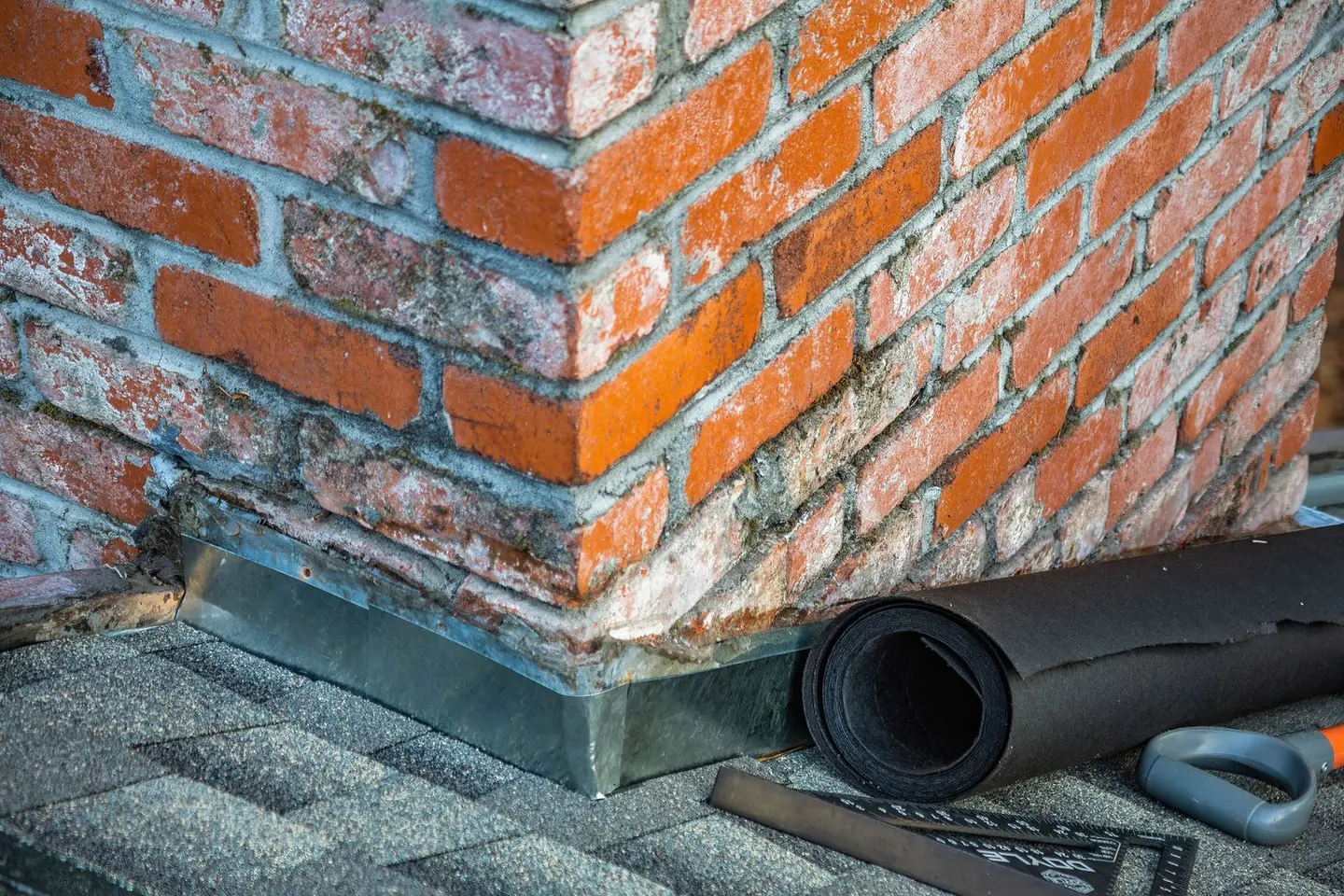
Flashing fails in three ways: it lifts out of the raggle (the mortar joint it’s tucked into), the lead cracks due to thermal fatigue, or it was installed with inadequate overlap in the first place.
Signs of flashing failure:
- Damp patch on a chimney breast wall, often appearing after heavy rain
- Visible gap between lead and brickwork
- Water staining on the ceiling below the stack
- Cracked or missing pointing along the top edge of the flashing
A competent roofer will re-dress the lead if it has lifted but is otherwise sound. If the lead is cracked or was installed with too little lap between pieces, replacement is the right call.
Get two quotes when flashing is involved
Flashing failures are easy to misdiagnose from the ground. Always ask the roofer to show you photographs from the roof before accepting a quote, and get two opinions if the first quote is over £500.
Chimney Removal: Stack Only vs Full Removal
Many homeowners with redundant fireplaces choose to remove the chimney rather than repair it. There are two very different scopes of work:
Stack removal (above roofline only): The brickwork is taken down to just below the roof tile level, the roof is re-tiled and felted, and a lead or fibreglass patch is installed. This eliminates the maintenance liability. A structural engineer is not usually needed when the chimney breasts below are left in place. This is the simpler and more popular option.
Full removal including the breast: Taking out the internal chimney breast opens up floor space but requires removing a structural element. An RSJ or padstone arrangement must support the floors and walls above. Building Regulations approval is required, and a Full Plans application usually suits better than a Building Notice because the engineer’s calculations need approving before work starts.2 Expect a local authority fee of £200–£400 plus the cost of a structural engineer’s specification (£500–£1,000). Without a completion certificate for the work, a buyer’s solicitor is likely to raise it when you sell, and you may need to regularise the work or offer indemnity insurance. Some mortgage lenders are now querying evidence of approval even on older removals.
Party Wall Considerations
If the chimney is on or close to a party wall (in a terrace or semi-detached), the Party Wall etc. Act 1996 almost certainly applies.3 For work to the party wall itself, such as cutting away a chimney breast, you must serve a party structure notice on the adjoining owner at least two months before work starts.4 Most neighbours agree without formal dispute, but don’t skip the notice, it protects you if structural damage is later alleged.
Building Regulations and Listed Buildings
Like-for-like repairs to an existing stack are not normally “building work” as regulation 3 of the Building Regulations 2010 defines it, so they need no Building Regulations approval.5 However:
- Solid fuel work: relining a flue for a live fire or fitting a stove has to be notified to Building Control, either through a competent person scheme such as HETAS, whose registered installers self-certify, or by applying to the council directly6
- Listed buildings need Listed Building Consent for any alteration that would affect their character, which can include changing pot styles or lead type, so check with your local planning authority before instructing a roofer7
- Conservation areas may restrict visible changes even on unlisted buildings
Choosing a Chimney Repair Contractor
For straightforward repointing and flashing work, look for a roofer who:
- Carries Public Liability insurance of at least £2 million
- Provides a written quote that specifies materials (mortar mix, lead code)
- Is a member of the National Federation of Roofing Contractors (NFRC) or the Confederation of Roofing Contractors (CORC)
For structural removal work, a builder with structural experience is more appropriate, alongside a structural engineer. Never accept a verbal-only quote for chimney breast removal, the structural specification must be in writing.
Avoid any contractor who offers to do the job without scaffold “to keep costs down” unless they can demonstrate a legitimate MEWP alternative. Working off a ladder on a chimney is both dangerous and a sign of corner-cutting.
Quick Decision Guide
- Damp patch on chimney breast wall → check flashings first; repoint if brickwork is also soft
- Stack looking tatty but structurally sound → repoint and cap pots; budget roughly £460–£1,300 before access costs
- Fireplace unused for 10+ years → consider stack removal; usually pays back in reduced maintenance
- Fireplace unused, want more space → full breast removal, budget £2,200–£4,900 all-in with building regs and engineer
- Stack on boundary with neighbour → serve Party Wall notice before anything structural
The rules in this note are those that apply in England. Scotland, Wales and Northern Ireland have their own building standards and permitted development rights.
References (7)
Figures in this note were checked against the sources below on 30 September 2026. Superscript numbers in the text point to them. Every source the site cites, by topic.
- 1technicalfairLead Sheet Advisory Service, guidance.RN-EPV6GEThe Lead Sheet Advisory Service's guide to lead codes. It describes Code 4 (1.80 mm, 20.41 kg/m²) as the code used for exposed flashings, pitched valley gutters and vertical cladding.
- 2technicalvery strongLABC Front Door, guidance.RN-5M61SBLABC's homeowner guidance on chimney removal. It says a building regulations application is needed to remove a chimney breast and why the full plans route usually suits.
- 3technicalvery strongThe National Archives (legislation.gov.uk), legislation.RN-WKDENHSection 2(2) lists the building owner's rights over a party structure: (a) underpin, thicken or raise; (b) make good, repair or rebuild a defective party structure; (c) to (e) demolish and rebuild non-conforming partitions, connected buildings and party structures of insufficient strength or height; (f) to cut into a party structure for any purpose, which may include inserting a damp proof course; (g) to cut away a footing, projecting chimney breast, jamb, flue or other projection to enable a wall to be built; (h) to cut away overhanging parts of an adjoining building; (j) insert flashings; (k) execute incidental works; (l) raise or rebuild a party fence wall; (m) reduce wall heights; (n) expose a previously enclosed party wall. Paragraph (f) is the one that catches chasing or breaking through a shared wall for pipework, which makes it party wall work requiring a party structure notice.
- 4technicalvery strongThe National Archives (legislation.gov.uk), legislation.RN-C6XFB7A party structure notice must be served at least two months before the date on which the proposed work will begin, and must state the building owner's name and address, the nature and particulars of the proposed work (with plans, sections and load particulars where special foundations are proposed) and the date the work will begin. The notice ceases to have effect if the work has not begun within twelve months of service or is not then prosecuted with due diligence. Two months for a party structure notice against one month for a section 6 excavation notice is the distinction to cite.
- 5technicalvery strongThe National Archives, legislation.RN-ZCMRHVRegulation 3 of the Building Regulations 2010, the meaning of building work. Lists what counts: erecting or extending a building, providing or extending a controlled service or fitting, material alteration, work required by a material change of use, and inserting insulation into a cavity wall. If a job is not on this list it is not building work, so this is the first place to check whether approval is needed at all.
- 6technicalstrongHETAS.RN-PIL37XHETAS is the only competent person scheme specialising in solid fuel and biomass appliance installation, so it is the scheme that covers wood burning stoves, multifuel stoves, biomass boilers, associated chimney and flue work, chimney sweeping and biomass servicing, plus solar thermal through MCS. The practical point for a homeowner is the paperwork: a Certificate of Compliance issued by a HETAS registered installer satisfies the legal requirement to notify a solid fuel installation to local authority building control in England and Wales, avoiding a separate building regulations application. The certificate records that the installer was trained and assessed to work in accordance with the Building Regulations and the manufacturer's instructions, and a compliant installation includes a carbon monoxide alarm and a notice plate at the appliance. Without that certificate the installation is unnotified and will surface on a conveyancing search.
- 7technicalvery strongThe National Archives (legislation.gov.uk), legislation.RN-XN22L9The provision that decides when listed building consent is actually needed, and the answer to the common overstatement that any alteration to a listed building requires consent. Section 7(1): 'no person shall execute or cause to be executed any works for the demolition of a listed building or for its alteration or extension in any manner which would affect its character as a building of special architectural or historic interest, unless the works are authorised under section 8.' The trigger is therefore effect on character as a building of special architectural or historic interest, not alteration as such, so work with no effect on that character falls outside the restriction. Section 7(2) makes subsection (1) subject to section 33(1) of the Planning Act 2008, which excludes the requirement for other consents where development consent is required. Authorisation itself comes from section 8.
-
About Lead Sheet, Lead Sheet Advisory Service, accessed 30 September 2026. leadsheetadvisoryservice.co.uk
-
What are the issues around removing a chimney stack or chimney breast?, LABC Front Door, accessed 30 September 2026. labcfrontdoor.co.uk
-
Party Wall etc. Act 1996, section 2: repair etc. of party wall: rights of owner, legislation.gov.uk, accessed 30 September 2026. legislation.gov.uk
-
Party Wall etc. Act 1996, section 3: party structure notices, legislation.gov.uk, accessed 30 September 2026. legislation.gov.uk
-
The Building Regulations 2010, regulation 3: meaning of building work, legislation.gov.uk, accessed 30 September 2026. legislation.gov.uk
-
Find a HETAS installer, HETAS, accessed 30 September 2026. hetas.co.uk
-
Planning (Listed Buildings and Conservation Areas) Act 1990, section 7: restriction on works affecting listed buildings, legislation.gov.uk, accessed 30 September 2026. legislation.gov.uk