Roof felt, more accurately called sarking membrane or underlay, is the secondary line of defence beneath tiles or slates. It is not designed to keep the roof watertight on its own, but it catches any water that drives through gaps in the primary covering and directs it to the gutters, while also reducing heat loss and draughts at ceiling level.
Bitumen-impregnated felt came into wide use as a roof underlay in the UK from the 1960s onwards and remained the usual choice through the 1980s. Many roofs built in that era now have felt that is 40–60 years old, well beyond its design life, and are starting to show the consequences.
How Long Does Roof Felt Last?
| Material type | Typical lifespan | Notes |
|---|---|---|
| Traditional bitumen felt (type 1F) | 20–40 years | Becomes brittle; common in homes built 1960s–1990s |
| Heavier reinforced bitumen felt | 30–50 years | Thicker specification, slower degradation |
| Breathable (air-permeable) membrane | 40–60+ years | Modern standard; durable once covered, but rated for only a limited period of UV exposure |
| High-performance vapour-permeable (VP) | 50+ years | Premium product; used in cold-roof and warm-roof applications |
Bitumen felt exposed to cyclic temperature changes eventually embrittles, cracks, and sheds. In warm attic conditions (a roof void can get very hot on a sunny summer day), degradation accelerates significantly.
Signs That Roof Felt Is Failing
From the loft:
- Visible daylight through the roof (cracks or holes in the felt)
- Felt hanging down in sags between rafters (has detached from battens or become heavy with accumulated moisture)
- Fine powdery black debris on the loft floor directly below the roof, this is degraded bitumen
- Damp patches on loft joists or rafters that cannot be traced to a specific tile or flashing failure
- Strong musty smell in the loft on damp days
From outside:
- A roofer lifting one or two tiles and finding felt that crumbles or tears on handling
- Tiles that lift or rattle in high winds, which calls for a check of the tile fixings and of the felt beneath them
At ceiling level:
- Staining on ceilings directly under the roof void, particularly after windblown rain, when no obvious tile damage exists
- Drips during or immediately after prolonged driving rain from directions that would put water past the tile laps
If the felt is simply old and brittle but no water is entering, it is worth planning replacement in the next few years: once it starts allowing water in, secondary damage (to battens, rafters, insulation, and ceiling finishes) accumulates quickly.
What Replacement Involves
Roof felt replacement cannot be done without stripping the primary covering. The process is:
- Remove roof tiles or slates carefully (salvageable tiles can be reused, reducing material cost)
- Remove existing battens (often rotted at the ends if felt has failed)
- Strip old felt from rafters
- Fix new breathable membrane over the rafters, lapping joints per manufacturer guidance
- Fix new treated softwood tile battens, with counterbattens where the design calls for them
- Relay tiles or slates
- Re-bed and re-point ridge, hips, and verges
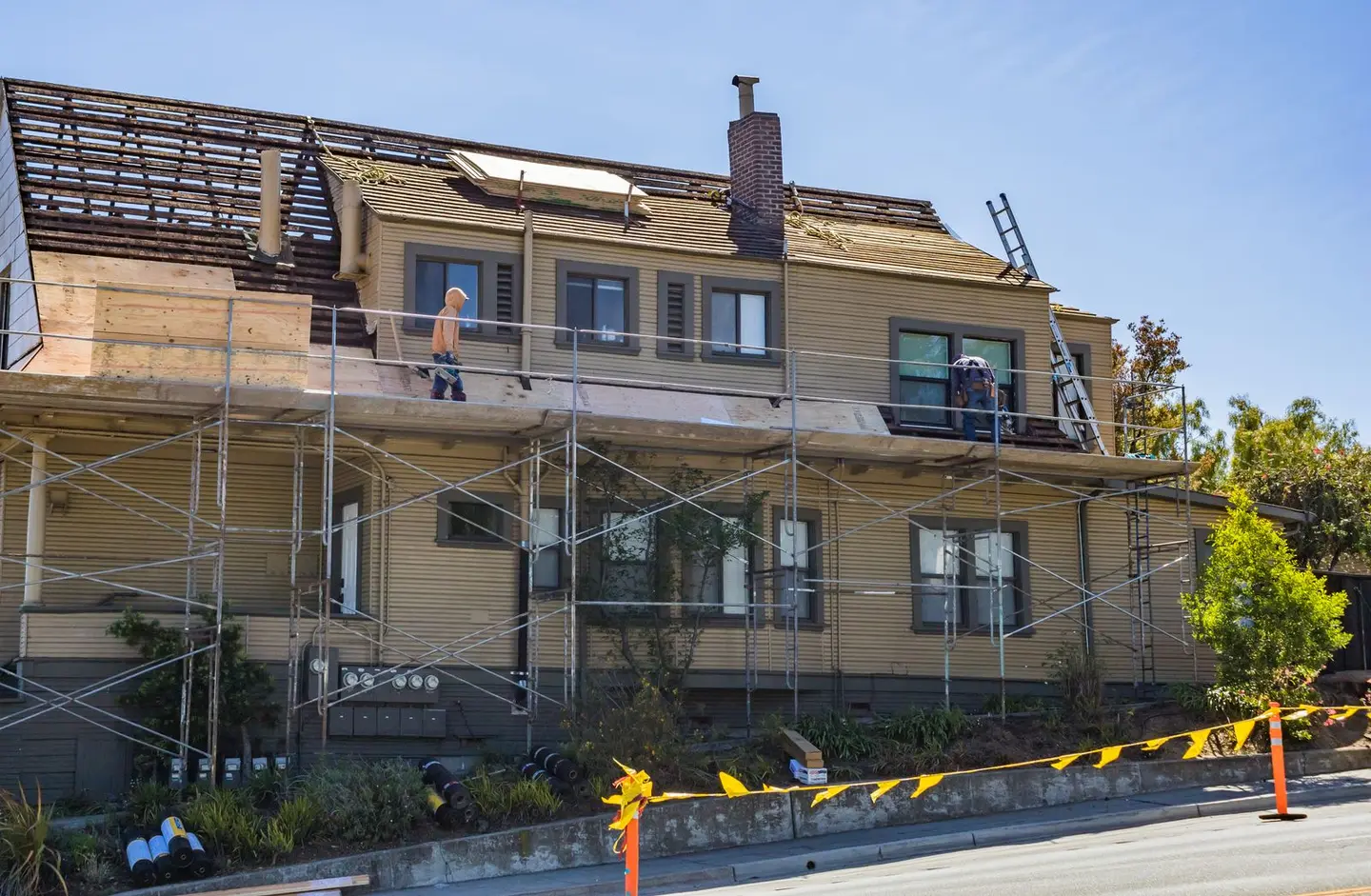
This is a full roof strip and relay, structurally simple but labour-intensive. Scaffolding is needed: HSE guidance is that sloping roofs require scaffolding to stop people or materials falling from the edge.1
Breathable vs Traditional Felt
Modern breathable (air-permeable) membranes have significant advantages over traditional bitumen felt:
Traditional bitumen felt:
- A type HR (high vapour resistance) underlay, so moisture rising from the house cannot pass through it2
- Requires a ventilation gap between felt and insulation to prevent condensation3
- Relies on ventilation openings, usually at the eaves and ridge, to carry that moisture out of the roof void2
Breathable membrane:
- Allows water vapour to pass outward while remaining impermeable to liquid water2
- Can be laid in contact with insulation without a ventilation gap (subject to manufacturer specification)
- Still has to form part of a roof designed against condensation: Approved Document C points to BS 5250 for this4
- NHBC guidance is that high-level ventilation should usually still be provided, even with a vapour-permeable (LR) underlay2
For most residential pitched roofs, a breathable membrane to BS EN 13859-1 (underlays for discontinuous roofing) is the correct modern replacement.5 In BS 5250 terms that is a type LR (low resistance) underlay, with a water vapour resistance of no more than 0.25 MNs/g.2
Roof Felt Replacement Cost (UK, 2026)
Costs vary significantly based on roof complexity (number of hips, valleys, dormers), pitch, tile salvageability, and access.
| Roof size / property type | Supply & fit cost range (2026) |
|---|---|
| Small detached / semi (40–60 m²) | £800–£1,600 |
| Standard semi-detached (60–80 m²) | £1,200–£2,500 |
| Detached (80–120 m²) | £1,800–£4,000 |
| Complex roof with dormers / multiple hips | Add £300–£800 per dormer or hip valley |
| New tiles (if originals not reusable) | Add £15–£40/m² supply |
| New replacement slates | Add £25–£60/m² supply |
Roofers outside London typically charge about £150–£300 a day each, more in London. A typical semi-detached will take a two-man team three to five days.
Scaffolding for roof access on a standard two-storey house is commonly priced at about £600–£1,200, usually with a four-week hire period included: this is usually the largest single cost in addition to the roof work itself.
Building Regulations and Permitted Development
Replacing the felt means stripping the roof back to the rafters. Approved Document L counts stripping an element down to its structural components and rebuilding it as renovating a thermal element.6 If more than 50% of the roof, or more than 25% of the whole external envelope, is renovated, the whole roof should be brought up to at least 0.16 W/m²K where that is technically, functionally and economically feasible; on a cold pitched roof that usually means topping up the loft insulation.6 Replacing roof coverings is Building Regulations work that a roofer registered with a competent person scheme can self-certify; otherwise, notify building control before starting.7
If the tile or slate type is being changed, particularly in a conservation area or on a listed building, permitted development rules and/or listed building consent may apply.8 Check with the local planning authority before proceeding.
The rules in this note are those that apply in England. Scotland, Wales and Northern Ireland have their own building standards and permitted development rights.
References (8)
Figures in this note were checked against the sources below on 2 October 2026. Superscript numbers in the text point to them. Every source the site cites, by topic.
- 1technicalvery strongHealth and Safety Executive, guidance.RN-II89LGHSE states that almost one in five deaths in construction work involve roof work, with the main causes being falls from roof edges or openings and falls through fragile roofs and fragile rooflights. It requires all roofs to be treated as fragile until a competent person has confirmed otherwise, and calls for a working platform beneath the roof where possible, with stagings, guard rails, fall restraint, fall arrest and safety nets slung beneath and close to the roof. Sloping roofs need edge protection at the eaves, and on terraced properties to both front and rear; flat roofs need a secure double guardrail and toeboard around the edge. This is the citation for why a roof job needs scaffolding rather than a ladder.
- 2technicalsupplier figureA. Proctor Group, guidance.RN-L6S0SQA membrane manufacturer's technical article setting out the BS 5250 underlay types; it says traditional bitumen roofing felt is a type HR underlay that vapour cannot pass through.
- 3technicalvery strongLABC Warranty, guidance.RN-A2P67ZLABC Warranty's technical manual chapter on roofs. It reproduces BS 5534 Table 3 minimum batten sizes, batten length, support and nailing rules, grading and marking, and the HR and LR underlay definitions.
- 4technicalvery strongMinistry of Housing, Communities and Local Government.RN-NPO8FJThe statutory figures behind a damp diagnosis, and the numbers to quote when a note explains why ground levels or a bridged damp proof course cause rising damp. Paragraph 5.2 requires that in an external wall the damp-proof course should be at least 150mm above the level of the adjoining ground (Diagram 8) unless part of the building protects the wall, and that in an external cavity wall the cavity should be taken down at least 225mm below the level of the lowest damp-proof course, or a damp-proof tray provided (Diagram 9a). For suspended timber ground floors it requires a ventilated air space of at least 75mm from the ground covering to the underside of any wall-plates and at least 150mm to the underside of the suspended timber floor or insulation, with ventilation openings on two opposing external walls of not less than 1,500mm2 per metre run of external wall or 500mm2 per square metre of floor area, whichever is greater; for suspended concrete floors the clear ventilated space is at least 150mm with the same opening sizes. Section 2.39 onwards covers radon, referring to BRE Report BR 211 for protective measures. The 2013 edition was published on 3 September 2013 with changes in effect from 1 October 2013.
- 5technicalstrongBSI, a standard.RN-LD6IGVBS EN 13859-1:2014, the definitions and characteristics of underlays for discontinuous roofing, meaning tiled and slated roofs. Sets what a roofing membrane must declare on water resistance, vapour permeability and strength. The standard that separates a breather membrane from a traditional bitumen felt, which decides whether the roof space needs separate ventilation.
- 6technicalvery strongMinistry of Housing, Communities and Local Government.RN-L0FCJXThe in-force U-value tables a DIY insulation or door note must quote, with the exact numbers. Table 4.2, limiting U-values for new fabric elements in existing dwellings, sets roof 0.15, wall 0.18, floor 0.18, swimming pool basin 0.25, window 1.4 or Window Energy Rating Band B minimum, rooflight 2.2, doors with more than 60 per cent of the internal face glazed 1.4 or Doorset Energy Rating Band C minimum, and other doors 1.4 or Doorset Energy Rating Band B minimum. Table 4.3, for existing elements, gives a roof threshold of 0.35 and an improved value of 0.16, which is the figure a loft insulation note needs: paragraph 4.12 says a retained element whose U-value is higher than the column (a) threshold, for example through a loft or garage conversion, should be upgraded to the column (b) value. Paragraph 4.13 allows a lesser upgrade only where the improved value is not technically or functionally feasible or would not achieve a simple payback of 15 years or less. Paragraph 4.8 requires a replacement element to be no worse than the one it replaces as well as meeting Table 4.2. Paragraph 4.10 gives the heritage exception: where character must be maintained, a centre pane U-value of no more than 1.2 or low-emissivity secondary glazing. Note 9 records that the timber window concession of 1.6 or Band C ended on 14 June 2023. The 2021 edition came into force on 15 June 2022; a 2026 edition exists at https://assets.publishing.service.gov.uk/media/69c122a6cfa346b9d4704a55/ADL1_2026.pdf.
- 7technicalvery strongMinistry of Housing, Communities and Local Government.RN-SAMO3MThe official list of competent person schemes whose members can self-certify certain building work instead of getting building regulations approval, published 4 April 2013 and last updated 12 March 2018. Named schemes with contact numbers include ATTMA, APHC, Assure Certification, Blue Flame Certification, the British Board of Agrement, BESCA, Capita Gas Registration and Ancillary Services trading as Gas Safe Register, CIGA, Certass, Certsure LLP trading as NICEIC, the Elmhurst Airtightness Scheme, Fensa Limited, HETAS Limited, NAPIT Registration Limited, the National Federation of Roofing Contractors trading as CompetentRoofer, and OFTEC. Two footnotes matter: the Gas Safe Register is not technically a competent person scheme although in practice its installers carry the same building regulations responsibilities, and Benchmark Certification Limited ceased to operate as a competent person scheme on 10 February 2017, becoming part of NAPIT Registration Limited that day. Installers joining an electrical scheme are added to the single electrical competent person register.
- 8technicalvery strongThe National Archives (legislation.gov.uk), legislation.RN-XN22L9The provision that decides when listed building consent is actually needed, and the answer to the common overstatement that any alteration to a listed building requires consent. Section 7(1): 'no person shall execute or cause to be executed any works for the demolition of a listed building or for its alteration or extension in any manner which would affect its character as a building of special architectural or historic interest, unless the works are authorised under section 8.' The trigger is therefore effect on character as a building of special architectural or historic interest, not alteration as such, so work with no effect on that character falls outside the restriction. Section 7(2) makes subsection (1) subject to section 33(1) of the Planning Act 2008, which excludes the requirement for other consents where development consent is required. Authorisation itself comes from section 8.
-
Roof work, Health and Safety Executive, accessed 2 October 2026. hse.gov.uk
-
Vapour and Air Permeable Membranes Explained, A. Proctor Group, accessed 30 September 2026. proctorgroup.com
-
Technical Manual Version 11, Section 11: Roofs, LABC Warranty, accessed 2 October 2026. labcwarranty.co.uk
-
Approved Document C: Site preparation and resistance to contaminants and moisture, 2004 edition incorporating 2010 and 2013 amendments, HM Government, accessed 30 September 2026. assets.publishing.service.gov.uk
-
BS EN 13859-1:2014 Flexible sheets for waterproofing. Definitions and characteristics of underlays. Underlays for discontinuous roofing, BSI (British Standards Institution), accessed 6 September 2026. knowledge.bsigroup.com
-
Approved Document L, Conservation of fuel and power, Volume 1: Dwellings, 2021 edition incorporating 2023 amendments, HM Government, accessed 30 September 2026. assets.publishing.service.gov.uk
-
Competent person scheme: current schemes and how schemes are authorised, GOV.UK, accessed 30 September 2026. gov.uk
-
Planning (Listed Buildings and Conservation Areas) Act 1990, section 7: Restriction on works affecting listed buildings, legislation.gov.uk, accessed 2 October 2026. legislation.gov.uk