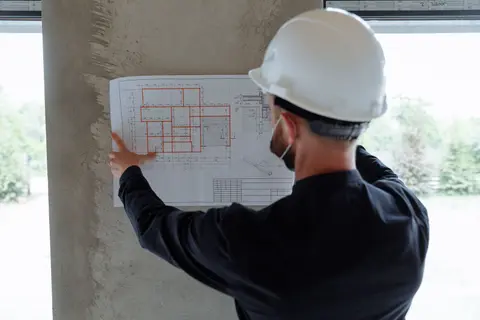
Hiring a structural engineer is not optional for load-bearing wall removals, loft conversions, extensions, or any project involving the structure of your home. Building control will require their calculations; your contractor will need their drawings; and your home insurer may ask for evidence of sign-off. Yet most homeowners have little idea what to budget. This guide gives you realistic 2026 fee ranges and explains what each element of the service actually involves.
What You Are Paying For
Structural engineering fees for domestic work typically cover some combination of:
- Structural calculations, the mathematical analysis of loads, spans, and beam sizes. This is the core technical product.
- Structural drawings, annotated drawings showing the engineer’s specification, dimensioned for the builder and building control.
- Site visit(s), inspection of the existing structure before design, and/or inspection of the completed installation.
- Building control coordination, submitting calculations, responding to queries and confirming the finished structure so that building control can issue the completion certificate.
- Party wall matters, some structural engineers also act as party wall surveyors (a separate fee arrangement).
For most domestic projects, a structural engineer’s package is a combination of calculations plus drawings. Site visits are often priced separately or as an add-on.
Typical Fees by Job Type (2026)
| Job type | Typical fee range | Notes |
|---|---|---|
| Single steel beam / RSJ for wall removal | £400–£800 | Straightforward single-span, standard loading |
| Loft conversion structural package | £800–£2,000 | Includes ridge beam, floor joists, steelwork |
| Single-storey rear extension | £700–£1,800 | Foundations, structural walls, roof |
| Two-storey extension | £1,200–£3,000 | Greater load paths, more complex drawings |
| Basement conversion | £2,500–£6,000+ | Retaining walls, waterproofing, underpinning |
| Structural survey / investigation | £500–£2,0001 | Report on existing structure condition |
| Subsidence / crack investigation | £500–£1,500 | Includes report with recommendations |
| Party wall agreement (structural input) | £300–£600 | Add-on to main fee if required |
All figures are for England; London and the South East typically sit at the upper end of these ranges or above them. The HomeOwners Alliance’s 2026 guide puts a structural engineer’s work on a loft conversion or extension at £750–£2,200.2 It puts a structural engineer’s report at £500–£2,000.2
Fixed Fee vs Hourly Rate
Most structural engineers quote a fixed fee for domestic projects once they have seen the drawings and scope. This protects the homeowner and is common practice for anything up to and including a double-storey extension.
Hourly rates are used for:
- Ongoing site inspections beyond those included in the fixed scope
- Unforeseen structural issues discovered during works
- Expert witness or dispute resolution work
- Large or complex projects where scope is uncertain
Typical hourly rates in 2026:
| Level | Rate |
|---|---|
| Graduate / junior engineer | £60–£90/hr |
| Chartered engineer (MIStructE or CEng) | £90–£150/hr |
| Senior / principal engineer | £130–£200/hr |
The HomeOwners Alliance puts a typical structural engineer’s rate at around £100 an hour in 2026.23
For most homeowners, these rates are relevant only when something unexpected happens on site, for instance, if demolition reveals a buried timber ground beam that changes the bearing strategy.
What Affects the Price?
Complexity of the structural problem
A single RSJ over a 3-m opening carrying one floor is near the bottom of the complexity scale. A loft conversion on a house with an unusual roof structure, or an extension on a sloping site with made ground, requires substantially more analysis.
Number of elements
Each beam, pad foundation, or structural connection adds engineering time. A project with four separate steel beams costs more to engineer than one with one.
Quality of existing information
If the engineer has access to good existing drawings (original construction drawings, previous structural calculations), the assessment is faster. If they have to measure up from scratch or investigate hidden construction, expect to pay more.
Requirement for site visits
A calculation-only service with no site visit will be cheaper, but is only appropriate when the engineer has confidence in the drawings and there are no unknowns. For any complex or older building, at least one site visit should be included. An additional inspection visit typically adds £175–£300 to the fee.2
Location
London and the South East consistently command higher fees than the Midlands, North of England, Scotland or Wales, usually noticeably more for equivalent scope.
Firm size
Small practices and sole practitioners typically charge less than large multidisciplinary engineering firms, who carry higher overheads. For most domestic work, a sole practitioner or small structural engineering firm will deliver exactly what you need.
Getting a Quote: What to Provide
To get an accurate fixed-fee quote, send the structural engineer:
- Architectural drawings (planning drawings are usually sufficient at quote stage)
- A clear description of the works, what walls are being removed, what beams are needed, what floors are being altered
- The house construction, approximate age, masonry or timber frame, whether it is a mid-terrace, semi or detached
- Any existing surveys, a recent level 3 survey (full structural survey) will already contain useful information4
- The project programme, when do you need the calculations?
Avoid asking an engineer to quote blind (no drawings, no description). You will receive a very wide range and no ability to compare quotes meaningfully.
Do You Need a Structural Survey as Well?
There is sometimes confusion between a structural engineer fee (design service for a specific project) and a structural survey (inspection and report on the condition of an existing property). They are different services.
An RICS Level 3 Home Survey (formerly called a Building Survey, and often loosely called a full structural survey) assesses the overall condition of a building before purchase or renovation: it flags defects, damp, cracking, and structural issues.4 This typically costs from about £630 to £1,500 or more, depending on the property’s size and value.5
If you are buying a property you intend to renovate, a Level 3 survey is an investment that can save significant money by identifying problems before you commit. A structural engineer’s design fee comes later, once you know what you want to build.
Key Points
- Fixed fees for domestic structural engineering packages typically run £400–£3,000 for most householder projects, and £2,500–£6,000 or more for basements and other complex work.
- Where you can, instruct a chartered engineer: a Chartered Structural Engineer (MIStructE) or a chartered civil engineer (MICE). You can check an engineer’s membership in the Institution of Structural Engineers’ online directory at istructe.org.6
- Site visits should be included in the scope for any structural alteration to an older building.
- Get at least two quotes; large price differences usually reflect a difference in what is included, not just a different day rate.
- Building control will need the structural calculations before approving your works, factor the lead time (often one to four weeks from instruction to delivery, depending on the engineer’s workload) into your project programme.
References (6)
Figures in this note were checked against the sources below on 2 October 2026. Superscript numbers in the text point to them. Every source the site cites, by topic.
- 1costsupplier figureSBS Structural and Architectural Design.RN-OXEAC5A price, true at 2026-09. SBS Structural and Architectural Design publishing its own price guidance for this work. A trade supplier writing about what it charges is evidence of the market rate and not a quotation, and the cost book treats it as one figure among several rather than on its own
- 2costfairHomeOwners Alliance, guidance.RN-6O3Y7XA price, true at 2026-09. HomeOwners Alliance on structural engineer costs in 2026, around £100 an hour, with typical fees for common jobs: calculations for a beam over a knocked-through wall, an extension design, a structural survey. A consumer body's figures, so treat the hourly rate as indicative and the list of what needs an engineer at all as the useful part.
- 3costsupplier figureSimplify Structures.RN-PKT6F3A price, true at 2026-09. Simplify Structures publishing its own price guidance for this work. A trade supplier writing about what it charges is evidence of the market rate and not a quotation, and the cost book treats it as one figure among several rather than on its own
- 4technicalstrongRoyal Institution of Chartered Surveyors, guidance.RN-FNUWS8RICS's consumer guide to home surveys: the Level 1, 2 and 3 survey types, what each includes, and what they cost. The professional body that defines the levels, so this is the authority for what a Level 3 survey actually commits the surveyor to, as distinct from a lender's valuation, which is not a survey at all.
- 5costfairHomeOwners Alliance.RN-9W5S6NA price, true at 2026-09. A consumer body's 2026 guide to survey costs, giving the typical price of a specialist damp survey as £150 to £300.
- 6technicalstrongInstitution of Structural Engineers, guidance.RN-YORWXDThe Institution of Structural Engineers' find-an-engineer page, which offers a public directory for checking whether an individual is a member of the Institution.
-
Structural Engineer Cost London 2026 | Fees from £400 (Fixed Price), SBS Structural and Architectural Design, accessed 2 October 2026. Priced at 2026-09, so no calibration is needed. sbsstructures.co.uk
-
How much does a structural engineer cost?, HomeOwners Alliance, accessed 30 September 2026. Priced at 2026-09 and left there. hoa.org.uk
-
Structural Engineer Cost: From £450 | Midlands 2026, Simplify Structures, accessed 16 September 2026. Priced at 2026-09, so no calibration is needed. simplifystructures.co.uk
-
House surveys (UK): the costs, types and benefits of an RICS Home Survey, Royal Institution of Chartered Surveyors, accessed 7 September 2026. rics.org
-
How much does a house survey cost?, HomeOwners Alliance, accessed 2 October 2026. Priced at 2026-09 and left there. hoa.org.uk
-
Find an engineer, Institution of Structural Engineers, accessed 30 September 2026. istructe.org