Pebbledash, that rough, gritty external coating applied to millions of UK homes between the 1920s and 1970s, divides opinion sharply. Increasingly, homeowners are choosing to remove it in favour of smooth silicone or monocouche render. This guide sets out what the process involves, what it realistically costs in 2026, and what you need to think through before committing.
What Is Pebbledash?
Pebbledash is a sand-and-cement render, usually applied in two or more coats, with small pebbles or chips thrown onto the final coat while it is still wet. The result is hard-wearing but visually polarising. In the 1990s and 2000s, many homeowners had it painted over; today, full removal is more common.
The coating is bonded directly to the masonry substrate, usually brick, block, or stone, which means removal requires physical force, and there is a real risk of damaging the underlying brickwork.
Methods of Removal
Manual Hack-Off
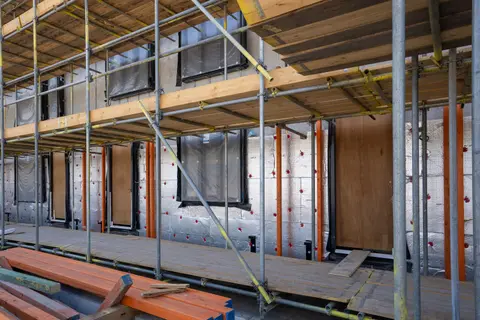
The most common approach. A scaffolder sets up access, and a renderer uses angle grinders, chisels, and SDS hammers to break the pebbledash free in sections. The debris is bagged and skipped. On well-bonded render, this is slow, heavy work. Expect some spalling to brick arrises and possible crumbling of soft mortar joints. If the pebbledash has been painted, old coats may contain lead, which was widely used in paint until the 1960s, so on an older house have the paint tested before grinding or hacking it off, and keep the dust damped down and contained.1
Mechanical Grinding or Planing
Specialist machines can plane back external render on relatively flat elevations. This is faster but leaves a textured substrate that still needs preparation. It is more common on smooth painted renders than genuine pebbledash.
Wet Render Removal Systems
Some contractors offer chemical or softening treatments to loosen the dash before hacking off. Results vary with how well the original dash was applied, and on small projects the added material cost rarely offsets any time saved.
Cost Breakdown
Prices below are for the full scope: scaffold, hack-off, debris removal, substrate repair, bonding coat, and a standard silicone or monocouche finish render. Supply and fit, 2026 UK rates.
| Work Scope | Low | Mid | High |
|---|---|---|---|
| Scaffolding (3-bed semi) | £800 | £1,100 | £1,600 |
| Hack-off labour (per m²) | £8 | £12 | £18 |
| Substrate repair (per m²) | £5 | £9 | £15 |
| Bonding/scratch coat (per m²) | £8 | £11 | £14 |
| Finish render, silicone (per m²) | £12 | £16 | £20 |
| Total per m² (excluding scaffold) | £33 | £48 | £67 |
| Typical 3-bed semi (120 m², with scaffold) | £4,760 | £6,860 | £9,640 |
Note: end terraces and detached properties with more complex elevations, bay windows, or chimney stacks will sit at the higher end. Gable-end access can add several hundred pounds to scaffold costs.
Removal Cost by London Area
The base range above is UK-wide. London and its fringe carry a labour premium. The figures below apply an uplift of about 10–20% to the base range, which is our estimate rather than a published index, so check it against local quotes. That gives these 2026 estimates for the areas we’re asked about most:
| Area | Cost per m² (strip + re-render) | 3-bed semi, all-in |
|---|---|---|
| Inner South-West London (Balham, Clapham, Wandsworth) | £40–£80 | £5,700–£11,600 |
| Outer South-West London (Wimbledon Park, Raynes Park, Kingston) | £37–£75 | £5,300–£10,800 |
| Surrey fringe (Ewell, Epsom, Sutton, Cheam) | £36–£74 | £5,200–£10,600 |
| Rest of UK (base range) | £33–£67 plus scaffold | £4,800–£9,600 |
These figures cover removing the pebbledash and re-rendering in one job, the way it should be quoted, since scaffold is up once and the substrate gets repaired before the new system goes on. Scaffolding on the public highway needs a council licence: Hammersmith and Fulham charges £660 a month for a residential frontage of up to 15 m, plus a refundable damage deposit.2 Surrey County Council charges £208 per 28 days.3 A skip licence in Hammersmith and Fulham is £165 a fortnight, and parking bay suspensions cost extra, which is part of the inner-London gap.2
What Drives the Price
Existing bond strength. Pebbledash that has been painted multiple times can bond so tightly that removal causes extensive brick damage, requiring additional re-pointing and patching.
Substrate condition. Older homes, especially those built before the Second World War, often have soft lime-mortar joints. Aggressive removal can dislodge mortar, adding significant repair costs. A render specialist should inspect and price the substrate repair separately.
Render specification. Monocouche (through-coloured, one-coat) render at £18–£25/m² supply is more expensive than standard silicone render, but is faster to apply and eliminates the need to paint. Silicone render at about £9–£12/m² supply is the more common choice for cost-conscious projects.
Property type. Semi-detached and terraced houses are simpler to scaffold and access than detached properties. Bungalows avoid upper-storey scaffold costs but still need hop-up or low-level staging.
Building Regulations and Planning
Stripping pebbledash back to the masonry and re-rendering counts as renovating a thermal element under Approved Document L, whose definition includes rendering the external surface of a wall.4 If more than 50% of a wall is renovated, or more than 25% of the whole external envelope, the whole wall should be improved to at least 0.30 W/m²K where that is technically, functionally and economically feasible.4 Where reaching that would not pay back within 15 years, the guidance asks for the best standard that does.4 For render removed from a wall, the area that counts is the whole elevation the wall sits in.4 In practice that makes external wall insulation a Building Regulations question on most full re-render jobs, so talk to Building Control before starting.
Removing pebbledash and re-rendering does not normally require planning permission, provided you are using a like-for-like or visually similar material and finish.5 However, there are exceptions:
- Conservation areas and Article 4 Directions: in a conservation area, National Park or other article 2(3) land, cladding any part of a house’s exterior with render or pebble dash is outside permitted development, so it needs planning permission.5 An Article 4 Direction can remove permitted development rights elsewhere too. Check with your local planning authority before starting.
- Listed buildings: works that would affect a listed building’s character need Listed Building Consent, and changing its external render usually would.6 Pebbledash removal on a listed property often involves consulting a conservation officer, as the original render may form part of the historic character.
- PD rights removed by condition: some new-build estates have planning conditions removing permitted development for external finishes.
In Scotland, Wales, and Northern Ireland, local rules differ slightly; always confirm with your planning department.
Risks and Things to Watch For
Brick damage is common. Even a careful hack-off on older brickwork will cause some spalling. If you have decorative or handmade bricks you want to expose, budget for repointing and specialist repair. If the finish is going back on, minor damage is filled and bonded during substrate preparation.
Damp migration. Pebbledash, despite its appearance, does provide some weather resistance. Removing it and leaving the substrate exposed, even briefly, during autumn or winter can allow driving rain into the wall. Plan for a prompt turnaround between removal and new render, or specify a temporary weatherproof coat.
Party wall issues. If the render wraps a party wall or an abutting neighbour’s elevation, you may need their agreement before starting work on shared or adjacent fabric.
Cold bridging and insulation opportunity. Many homeowners now combine pebbledash removal with the installation of external wall insulation (EWI). If your walls are solid brick or stone (common in pre-1920 UK housing), EWI during a re-render project can save significant heating costs. External wall insulation typically costs £85–£130/m² installed, and doing it during a re-render means the scaffold goes up only once.7 Around 100 mm of insulation can bring a solid brick wall, usually assumed to be about 2.1 W/m²K uninsulated, to roughly 0.30 W/m²K.8
Finding a Contractor
Pebbledash removal and re-rendering should be carried out by a specialist external renderer, not a general builder. Ask for:
- Examples of substrate repair work, not just finished renders
- A written breakdown of scaffold, hack-off, substrate, and render costs separately
- Details of the render system specified (brand, thickness, finish, colour chip)
- Confirmation that silicone or monocouche systems carry a manufacturer’s technical warranty (often 10 years or more)
Most reputable renderers will want to inspect the elevation before quoting. Be wary of any quote that does not include a site visit.
Is It Worth It?
Smooth render significantly improves kerb appeal and, in competitive markets, can noticeably boost a property’s perceived value. The cost is not trivial, expect about £4,800–£9,600 for a typical semi, but a quality job will last 20–30 years with minimal maintenance. If you are already planning EWI, the combined project cost per square metre falls relative to doing the two works separately.
If budget is tight, painting over existing pebbledash remains a viable short-term option. Masonry paint applied to properly cleaned and repaired pebbledash will last 8–12 years and costs £10–£18/m² installed, far cheaper, though it does not address the underlying texture.
References (8)
Figures in this note were checked against the sources below on 2 October 2026. Superscript numbers in the text point to them. Every source the site cites, by topic.
- 1technicalvery strongHealth and Safety Executive, guidance.RN-DF6UI1HSE's construction lead page. It states lead pigments were commonly used in paints for buildings until the 1960s and that lead was not removed from all commonly used paint until the early 1980s, which is the date test any note about stripping paint in an older house needs. The highest-risk activities it names are stripping or preparing leaded paint from doors and windows, working with lead on roofs, hot cutting of lead or leaded paint in demolition, and blast removal of old leaded paint. Health effects include anaemia and kidney disease, with chronic exposure risking kidney, nerve and brain damage, and a link to a small number of occupational cancers. The governing law is the Control of Lead at Work Regulations 2002, which requires employers to protect employees from the risks from lead, applied through an Assess, Control and Review model with FFP3 respiratory protection at an assigned protection factor of 20, changed work methods, dust control, protective clothing, hygiene and medical surveillance.
- 2coststrong locallyLondon Borough of Hammersmith & Fulham.RN-KM89I9A price, true at 2026-09. An inner London council's schedule of highway licence fees from April 2026. It charges £660 a month for a scaffold licence on a residential site up to 15 m, with a refundable damage deposit.
- 3coststrong locallySurrey County Council.RN-UXHUQLA price, true at 2026-09. Surrey County Council's page on licences for scaffolding or hoarding on the public highway. It sets the fee at £208 per 28-day period, renewable at the same rate.
- 4technicalvery strongMinistry of Housing, Communities and Local Government.RN-L0FCJXThe in-force U-value tables a DIY insulation or door note must quote, with the exact numbers. Table 4.2, limiting U-values for new fabric elements in existing dwellings, sets roof 0.15, wall 0.18, floor 0.18, swimming pool basin 0.25, window 1.4 or Window Energy Rating Band B minimum, rooflight 2.2, doors with more than 60 per cent of the internal face glazed 1.4 or Doorset Energy Rating Band C minimum, and other doors 1.4 or Doorset Energy Rating Band B minimum. Table 4.3, for existing elements, gives a roof threshold of 0.35 and an improved value of 0.16, which is the figure a loft insulation note needs: paragraph 4.12 says a retained element whose U-value is higher than the column (a) threshold, for example through a loft or garage conversion, should be upgraded to the column (b) value. Paragraph 4.13 allows a lesser upgrade only where the improved value is not technically or functionally feasible or would not achieve a simple payback of 15 years or less. Paragraph 4.8 requires a replacement element to be no worse than the one it replaces as well as meeting Table 4.2. Paragraph 4.10 gives the heritage exception: where character must be maintained, a centre pane U-value of no more than 1.2 or low-emissivity secondary glazing. Note 9 records that the timber window concession of 1.6 or Band C ended on 14 June 2023. The 2021 edition came into force on 15 June 2022; a 2026 edition exists at https://assets.publishing.service.gov.uk/media/69c122a6cfa346b9d4704a55/ADL1_2026.pdf.
- 5technicalvery strongThe National Archives (legislation.gov.uk), legislation.RN-Z0XQ8VParagraph A.1 sets the householder extension limits: buildings may not cover more than 50 per cent of the curtilage (A.1(b)); a single-storey rear extension may not extend more than 4 metres beyond the rear wall of a detached house or 3 metres for any other house, nor exceed 4 metres in height (A.1(f)), rising to 8 metres and 6 metres under the larger home extension route (A.1(g)); an extension of more than one storey may not extend more than 3 metres beyond the rear wall or be within 7 metres of the rear boundary (A.1(h)); eaves within 2 metres of a boundary may not exceed 3 metres (A.1(i)); a side extension may not exceed 4 metres in height, have more than one storey or be wider than half the width of the original house (A.1(j)). Paragraph A.2 removes cladding and side or multi-storey rear extensions on article 2(3) land such as conservation areas. A.3 requires materials of similar appearance and obscure-glazed, non-opening upper-floor side windows unless the opening part is more than 1.7 metres above the floor, and A.4 sets the neighbour consultation (prior approval) procedure with its 42-day determination period.
- 6technicalvery strongThe National Archives (legislation.gov.uk), legislation.RN-XN22L9The provision that decides when listed building consent is actually needed, and the answer to the common overstatement that any alteration to a listed building requires consent. Section 7(1): 'no person shall execute or cause to be executed any works for the demolition of a listed building or for its alteration or extension in any manner which would affect its character as a building of special architectural or historic interest, unless the works are authorised under section 8.' The trigger is therefore effect on character as a building of special architectural or historic interest, not alteration as such, so work with no effect on that character falls outside the restriction. Section 7(2) makes subsection (1) subject to section 33(1) of the Planning Act 2008, which excludes the requirement for other consents where development consent is required. Authorisation itself comes from section 8.
- 7technicalgoodFederation of Master Builders, guidance.RN-ZI6XL2The Federation of Master Builders on external wall insulation cost: the per square metre range, what drives it, and the costs people do not expect, moving downpipes and meter boxes, extending eaves, making good around windows. A federation of the builders who do the work, so the list of what is really in the job is the valuable part and the price band is wide by nature.
- 8technicalvery strongBuilding Research Establishment for the Department of Energy and Climate Change, guidance.RN-SZDDULA BRE research report published by government; it records 2.1 W/m²K as the standard assumed solid wall U-value and finds measured values are generally lower.
-
Construction hazardous substances: Lead, Health and Safety Executive, accessed 2 October 2026. hse.gov.uk
-
Highways licensing fees and charges, London Borough of Hammersmith & Fulham, accessed 2 October 2026. Priced at 2026-09 and left there. lbhf.gov.uk
-
Scaffolding and hoarding licences, Surrey County Council, accessed 2 October 2026. Priced at 2026-09 and left there. surreycc.gov.uk
-
Approved Document L, Conservation of fuel and power, Volume 1: Dwellings, 2021 edition incorporating 2023 amendments, HM Government, accessed 29 September 2026. assets.publishing.service.gov.uk
-
The Town and Country Planning (General Permitted Development) (England) Order 2015, Schedule 2, Part 1, Class A, UK Government, accessed 29 September 2026. legislation.gov.uk
-
Planning (Listed Buildings and Conservation Areas) Act 1990, section 7, UK Government, accessed 30 September 2026. legislation.gov.uk
-
External wall insulation cost in the UK | FMB, Federation of Master Builders, Federation of Master Builders, accessed 6 September 2026. fmb.org.uk
-
Solid wall heat losses and the potential for energy saving: the nature of solid walls in situ, Building Research Establishment for the Department of Energy and Climate Change, accessed 30 September 2026. assets.publishing.service.gov.uk