Rendering the exterior of a house is one of the most transformative renovations available for the money. A well-specified modern silicone or monocouche render can dramatically improve kerb appeal, protect the wall structure from moisture, and, when combined with external wall insulation, meaningfully reduce heat loss. It is also one of the most variable-cost jobs in construction, ranging from under £30/m² for basic sand-and-cement to £130/m² or more for EWI with premium render finish.
Typical Whole-House Rendering Costs (2026)
These figures assume a standard two-storey semi-detached or terraced house (approximately 120–160 m² of external wall area), in good structural condition, in the Midlands or North of England. Expect to pay more in London and the South East, where trade day rates run roughly 10–20% higher than elsewhere.
| House Size | Sand-and-Cement | Monocouche | Silicone Render | EWI + Silicone |
|---|---|---|---|---|
| 1-bed flat / terrace | £2,500–£4,500 | £3,500–£6,000 | £4,500–£8,000 | £8,000–£14,000 |
| 2–3 bed semi / terrace | £4,500–£8,500 | £6,000–£12,000 | £8,000–£15,000 | £14,000–£25,000 |
| 3–4 bed detached | £7,000–£14,000 | £10,000–£18,000 | £13,000–£22,000 | £22,000–£40,000 |
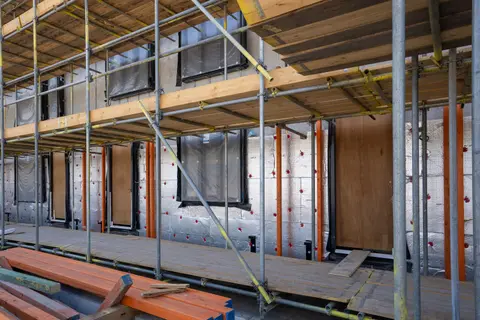
Scaffold hire for a standard semi typically runs £1,200–£2,500 and is usually included in full rendering quotes but worth confirming.
Render Types Explained
Sand-and-Cement Render
The traditional two- or three-coat system: scratch coat, float coat, and finish coat mixed on site from sand, cement, and often a plasticiser. Costs £25–£50/m² installed. Hard and stiff, prone to cracking as the building moves, and, if painted, needs repainting every 5–10 years. Still widely used because it is understood by most plasterers and relatively low-cost.
Monocouche Render (Through-Coloured)
A factory-blended, through-coloured render applied as a single material, usually in two passes, to a nominal 16–20 mm.1 The colour is integral (pigment throughout the material), so surface chips are less visible. Examples in the UK include weber.pral M and K Rend Silicone K1.21 Cost: £40–£65/m² installed. It is not normally painted, so there is no repainting cycle, and the system’s third-party certificate states its expected life. Some products, such as K Rend Silicone K1, include silicone water repellents that reduce dirt pick-up.1
Silicone Render
A thin-coat decorative finish, usually only a few millimetres thick, applied over a base coat (usually polymer-modified cement, often on insulation board).3 The silicone binder makes the surface highly flexible, hydrophobic, and vapour-open. Cost: £55–£90/m² installed. K Rend’s Silicone TC range is one UK example.3 Colours are stable and the surface is naturally dirt-resistant. As with monocouche, the system’s third-party certificate states its expected life.
Polymer / Acrylic Render
Similar to silicone in application (thin-coat over base coat) but uses acrylic rather than silicone binder. Slightly less vapour-open; more prone to algae in shaded areas. Cost: £40–£70/m² installed. More common in budget EWI systems.
Pebbledash
A finish coat of mortar into which small aggregate stones are thrown (“dashed”) before the coat dries. Highly textured and durable; common on 1920s–1960s housing. Replacing existing pebbledash costs £30–£55/m². Note: removing existing pebbledash is labour-intensive, adds noticeably to the cost per square metre, and often damages the substrate.
External Wall Insulation (EWI) with Render
The most thermally effective option: rigid insulation boards (EPS, PUR, or mineral wool) are mechanically fixed and adhesive-bonded to the wall, then a basecoat, mesh, and silicone finish are applied. An uninsulated solid brick wall has a U-value of roughly 1.6–2.1 W/m²K: BRE field measurements found a median of about 1.6–1.7, against the 2.1 that energy assessments have long assumed.4 Around 100 mm of insulation brings that down to about 0.32 W/m²K, while Approved Document L asks for 0.30 W/m²K when a wall is insulated as part of a renovation, so a slightly thicker board, or one with a lower thermal conductivity, is usually needed to meet it.54 Cost: £80–£130/m² installed. EWI was eligible for grants under the Great British Insulation Scheme (GBIS) until that scheme closed on 31 March 2026, and remains eligible under ECO4 for qualifying households until ECO4 ends on 31 December 2026.678 (2023 price, brought to 2026)
Cost Breakdown: What You’re Paying For
| Cost Element | % of Total Job | Notes |
|---|---|---|
| Scaffold | 12–20% | Reduced if self-erecting or using tower sections |
| Preparation (crack repair, key coat, removal of old render) | 10–20% | Major variable, old render can add significantly |
| Materials (render systems, mesh, beads) | 25–35% | Higher for EWI (insulation board cost) |
| Labour (plasterers, day rate about £250–£300/day outside London, 2026)9 | 35–45% | Major UK regional variable |
| Drip beads, expansion beads, reveals | 3–7% | Often underquoted; required at all openings |
Day Rates and Labour Costs
Experienced external renderers typically charge around £250–£300 per day in most of England (2026), with London rates nearer £290–£340/day and specialist silicone or EWI operatives sometimes more. A two-coat sand-and-cement render on a semi takes approximately 5–8 operative-days; monocouche or silicone (which require less material prep but more precise application) take 6–10 days including base coat curing time.
Planning and Building Regulations
Planning Permission
In most cases, re-rendering an existing house like-for-like does not need planning permission, because maintenance works that do not materially affect the external appearance of a building are not development.10 However:
- In a conservation area, National Park or other article 2(3) land, cladding a house in render, pebble dash, stone, timber, plastic or tiles is not permitted development, so rendering a brick house there needs planning permission11
- Elsewhere, rendering a house that is not already rendered is only permitted development if the new finish is of a similar appearance to the existing exterior, so covering exposed brick in render may need planning permission12
- Article 4 Directions in some areas remove PD rights for external alterations13
- Listed buildings require Listed Building Consent for any works that would affect their character as a building of special architectural or historic interest, which can include a change of render type or colour14
If you are changing from brick (no render) to rendered, or from one render colour to another in a conservation area, consult the LPA before work begins.
Building Regulations
EWI needs building control involvement, and the hook is worth naming correctly. Insulating an existing external wall is the renovation of a thermal element under regulation 23, which, where more than half of the wall’s surface is renovated, requires the whole wall to be brought up to the energy efficiency requirement, so far as that is technically, functionally and economically feasible.15 Regulation 12 is the separate procedural rule: anyone intending to renovate a thermal element must give a building notice or apply for building control approval with full plans.16 Material alteration is defined in regulation 3 rather than in regulation 12.17 Local authority building control or a registered building control approver should be notified, particularly if the work is grant-funded: ECO4, which runs to 31 December 2026, has installations quality-assured through TrustMark, as GBIS did before it closed on 31 March 2026.6 Re-rendering is not the same as repainting.5 Stripping the old render and renewing it counts as renovating the wall, and where more than 50% of a wall is renewed, Approved Document L expects that wall to be insulated to 0.30 W/m²K where that pays back within 15 years, so building control has to be involved.5
Common Problems and How to Avoid Them
Cracking, caused by applying cement render too rigidly, inadequate key coat adhesion, or insufficient expansion joints. Silicone and monocouche renders are significantly more crack-resistant than sand-and-cement; movement joints should be provided where the render system maker specifies, typically every few metres on large walls and over any structural joints.
Algae and staining, north- and east-facing elevations are most prone; specify hydrophobic and biocide-treated renders.1 Silicone render performs best here.
Delamination, render pulling away from the wall, usually because the substrate was not properly prepared (loose plaster, contamination, dusty surface) or because damp was present during application.
Efflorescence, white salts leaching through the surface; common on sand-and-cement over previously wet walls. Ensure the building is dry before application.
Getting Accurate Quotes
When obtaining quotes, ask contractors to specify:
- Render system by name and manufacturer (not just “monocouche” or “silicone”)
- Number of coats and minimum thicknesses
- Whether scaffold is included
- Preparation scope (what cracking and previous render removal is included)
- Warranty: what the render maker guarantees, for how long, and whether that depends on the work being done by one of its approved installers
Three competitive quotes for a whole-house render job are standard; prices for the same specification can vary widely between contractors, so comparing like-for-like on the system specification is essential.
The rules in this note are those that apply in England. Scotland, Wales and Northern Ireland have their own building standards and permitted development rights.
References (17)
Figures in this note were checked against the sources below on 2 October 2026. Superscript numbers in the text point to them. Every source the site cites, by topic.
- 1technicalsupplier figureK Rend (Kilwaughter Minerals), a data sheet.RN-CVW55AWater repellent, cement based, polymer modified self coloured render supplied in 25 kg sacks, Kitemarked and CE marked to BS EN 998-1:2010. Mixing 4 to 5 litres of clean water per 25 kg sack, 10 minutes mixing, open time approximately one hour. One coat coverage 1.6 kg per mm thickness per m2; one coat requires approximately 26 to 32 kg/m2 at a nominal 16 to 20 mm thickness, normally applied in two passes. Kitemark classifications: compressive strength CS II, capillary water absorption category W2, thermal conductivity P=50% 0.43. Applied with a 12 mm or 14 mm mortar nozzle, levelled to 4 to 8 mm per pass, with most finishes at a recommended finished thickness of 12 to 14 mm and a minimum 10 mm of coloured K Rend left.
- 2technicalsupplier figureTravis Perkins, guidance.RN-33S4Z2A national builders' merchant's product page for weber.pral M. It confirms the product is sold in the UK as a through-coloured monocouche render, which the existing K Rend footnote does not cover.
- 3technicalsupplier figureK Rend (Kilwaughter Minerals), guidance.RN-GYX4KMK Rend's product guide describes its silicone thin coat range as ready-to-use resin renders applied over a primer and base coat, suited to external wall insulation systems.
- 4technicalstrongBRE, guidance.RN-UG9KYGBRE's SAP consultation paper on wall U-values. Measured solid walls had a median of 1.59 W/m²K (1.69 corrected) against the 2.1 RdSAP assumed.
- 5technicalvery strongMinistry of Housing, Communities and Local Government.RN-L0FCJXThe in-force U-value tables a DIY insulation or door note must quote, with the exact numbers. Table 4.2, limiting U-values for new fabric elements in existing dwellings, sets roof 0.15, wall 0.18, floor 0.18, swimming pool basin 0.25, window 1.4 or Window Energy Rating Band B minimum, rooflight 2.2, doors with more than 60 per cent of the internal face glazed 1.4 or Doorset Energy Rating Band C minimum, and other doors 1.4 or Doorset Energy Rating Band B minimum. Table 4.3, for existing elements, gives a roof threshold of 0.35 and an improved value of 0.16, which is the figure a loft insulation note needs: paragraph 4.12 says a retained element whose U-value is higher than the column (a) threshold, for example through a loft or garage conversion, should be upgraded to the column (b) value. Paragraph 4.13 allows a lesser upgrade only where the improved value is not technically or functionally feasible or would not achieve a simple payback of 15 years or less. Paragraph 4.8 requires a replacement element to be no worse than the one it replaces as well as meeting Table 4.2. Paragraph 4.10 gives the heritage exception: where character must be maintained, a centre pane U-value of no more than 1.2 or low-emissivity secondary glazing. Note 9 records that the timber window concession of 1.6 or Band C ended on 14 June 2023. The 2021 edition came into force on 15 June 2022; a 2026 edition exists at https://assets.publishing.service.gov.uk/media/69c122a6cfa346b9d4704a55/ADL1_2026.pdf.
- 6technicalvery strongOfgem.RN-FPPUSLECO4 is the fourth phase of the Energy Company Obligation across Great Britain. It applies to measures installed from 1 April 2022 and runs until 31 December 2026 following a nine-month extension; ECO3 closed on 31 March 2022 and ECO4 came into force in July 2022. The scheme places a Home Heating Cost Reduction Obligation on medium and large energy suppliers to promote measures that improve the ability of low-income, fuel-poor and vulnerable households to heat their homes, funding insulation and heating upgrades for both homeowners and tenants. Ofgem also lists the Great British Insulation Scheme as a separate obligation on this page.
- 7technicalvery strongOfgem.RN-RDOIJRThe scheme, formerly known as ECO+, ran from April 2023 to 31 March 2026 and is now closed. It obliged medium and large energy suppliers to deliver measures reducing energy use in the least energy-efficient homes in Great Britain. Eligibility was homes with an EPC rating of D to G in Council Tax bands A to D in England, or A to E in Scotland and Wales, plus low-income and vulnerable households. Unlike ECO4, which funds whole-house packages, GBIS mostly delivered a single insulation measure per home. This is the page to cite when a note has to say a grant route has closed rather than leave a reader chasing it.
- 8coststrong locallyRoyal Borough of Greenwich, Housing and Safer Communities, a government page.RN-SXB1KMA price, true at 2023-06, brought forward on the Construction Output Price Index. The priced schedules from a London borough's capital programme delivery contract with its contractor, published as a spreadsheet. Genuine competitively tendered rates for housing works at real scale, which is rare to see in public. Read them as contract rates for volume work under a framework, which is a different market from a homeowner buying one job.
- 9coststrongConstruction Industry Joint Council, published by Build UK.RN-243N56A price, true at 2025-03. The Construction Industry Joint Council Working Rule Agreement pay resolution effective 30 June 2025: the basic minimum hourly and weekly rates by classification, from General Operative through the four Skill Rates to Craft Rate, plus daily fare and travel allowances. This is the negotiated national agreement, not a survey, so it is the definitive floor for construction labour cost. It is a minimum an employer must pay, not what a firm charges a homeowner, which carries overhead and profit on top.
- 10technicalvery strongThe National Archives (legislation.gov.uk), legislation.RN-M6VJS2Section 55(1) defines development as the carrying out of building, engineering, mining or other operations in, on, over or under land, or the making of any material change in the use of any buildings or other land. Section 55(2)(a) excludes works to a building which affect only the interior of the building or which do not materially affect the external appearance of the building, which is why internal renovation does not need planning permission.
- 11technicalvery strongThe National Archives (legislation.gov.uk), legislation.RN-Z0XQ8VParagraph A.1 sets the householder extension limits: buildings may not cover more than 50 per cent of the curtilage (A.1(b)); a single-storey rear extension may not extend more than 4 metres beyond the rear wall of a detached house or 3 metres for any other house, nor exceed 4 metres in height (A.1(f)), rising to 8 metres and 6 metres under the larger home extension route (A.1(g)); an extension of more than one storey may not extend more than 3 metres beyond the rear wall or be within 7 metres of the rear boundary (A.1(h)); eaves within 2 metres of a boundary may not exceed 3 metres (A.1(i)); a side extension may not exceed 4 metres in height, have more than one storey or be wider than half the width of the original house (A.1(j)). Paragraph A.2 removes cladding and side or multi-storey rear extensions on article 2(3) land such as conservation areas. A.3 requires materials of similar appearance and obscure-glazed, non-opening upper-floor side windows unless the opening part is more than 1.7 metres above the floor, and A.4 sets the neighbour consultation (prior approval) procedure with its 42-day determination period.
- 12technicalvery strongMinistry of Housing, Communities and Local Government (gov.uk), guidance.RN-3OBUOMThe government's own clause-by-clause interpretation of GPDO Schedule 2 Part 1, published 13 April 2016 and last updated 10 September 2019, and the document a planning officer will actually reach for. It explains the improvement or extension of homes without applying for planning permission where that would be out of proportion with the impact of the works, and defines the terms the Order uses that most disputes turn on: original dwellinghouse, curtilage, principal elevation, and how heights are measured on sloping ground. For Class E it works through what incidental to the enjoyment of the dwellinghouse means in practice, which is the test that excludes a garden room used as self-contained living accommodation, and how the 50 per cent curtilage calculation is done. Use it in preference to a paraphrase whenever a note has to explain why a particular garden building does or does not qualify.
- 13technicalvery strongThe National Archives (legislation.gov.uk), legislation.RN-3LA2VCArticle 4(1) allows the Secretary of State or the local planning authority, where satisfied that it is expedient that development should not be carried out without permission, to direct that the permission granted by article 3 does not apply to all or any development of a Part, Class or paragraph of Schedule 2 in a specified area, or to any particular development. The procedures for making, modifying or cancelling a direction are set out in Schedule 3, and a direction does not affect development for which prior approval was granted before it took effect.
- 14technicalvery strongThe National Archives (legislation.gov.uk), legislation.RN-XN22L9The provision that decides when listed building consent is actually needed, and the answer to the common overstatement that any alteration to a listed building requires consent. Section 7(1): 'no person shall execute or cause to be executed any works for the demolition of a listed building or for its alteration or extension in any manner which would affect its character as a building of special architectural or historic interest, unless the works are authorised under section 8.' The trigger is therefore effect on character as a building of special architectural or historic interest, not alteration as such, so work with no effect on that character falls outside the restriction. Section 7(2) makes subsection (1) subject to section 33(1) of the Planning Act 2008, which excludes the requirement for other consents where development consent is required. Authorisation itself comes from section 8.
- 15technicalvery strongThe National Archives, guidance.RN-8USAEIthe regulation that brings external wall insulation on an existing house within Part L
- 16technicalvery strongThe National Archives (legislation.gov.uk), legislation.RN-37ODVXRegulation 12(1) applies to anyone intending to carry out building work, replace or renovate a thermal element, change a building's energy status or make a material change of use. Regulation 12(2) requires that person to give the relevant authority either a building notice under regulation 13 or an application for building control approval with full plans under regulation 14. Full plans are compulsory where the Regulatory Reform (Fire Safety) Order 2005 applies (12(3)), where the building fronts onto a private street (12(4)) and where paragraph H4 of Schedule 1 applies (12(5)). Regulation 12(6) exempts work done by a competent person listed in Schedule 3, work listed in Schedule 4, and work inspected by a Schedule 3A third party certifier appointed before work starts. Regulation 12(6A) still requires notification for Part P electrical work consisting of a new circuit, a consumer unit replacement, or any addition or alteration to existing circuits in a special location such as the zone around a bath or shower. Regulation 12(8) allows a building notice after the event for emergency repairs. Text is up to date to 7 September 2026.
- 17technicalvery strongThe National Archives, legislation.RN-ZCMRHVRegulation 3 of the Building Regulations 2010, the meaning of building work. Lists what counts: erecting or extending a building, providing or extending a controlled service or fitting, material alteration, work required by a material change of use, and inserting insulation into a cavity wall. If a job is not on this list it is not building work, so this is the first place to check whether approval is needed at all.
-
Product Data Sheet: Silicone K1, K Rend (Kilwaughter Minerals), accessed 30 September 2026. k-rend.s3-assets.com
-
Weber.Pral M Through Colour Monocouche Chalk Render 25kg, Travis Perkins, accessed 2 October 2026. travisperkins.co.uk
-
K Rend Product Guide (February 2025), K Rend (Kilwaughter Minerals), accessed 30 September 2026. k-rend.s3-assets.com
-
CONSP:16 Wall U-values for existing dwellings, BRE, accessed 30 September 2026. files.bregroup.com
-
Approved Document L, Conservation of fuel and power, Volume 1: Dwellings, 2021 edition incorporating 2023 amendments, HM Government, accessed 29 September 2026. assets.publishing.service.gov.uk
-
Energy Company Obligation (ECO), Ofgem, accessed 30 September 2026. ofgem.gov.uk
-
Great British Insulation Scheme, Ofgem, accessed 7 September 2026. ofgem.gov.uk
-
Equans pricing schedules, Royal Borough of Greenwich Capital Programme Delivery Contractors contract SPS-2686, Document 4 Pricing Schedules, Royal Borough of Greenwich, Housing and Safer Communities, accessed 2 October 2026. Priced at 2023-06; brought to 2026 on the Construction Output Price Index, housing repair and maintenance (Great Britain), published by Office for National Statistics, a factor of 1.0358. royalgreenwich.gov.uk
-
CIJC Resolution and Promulgation, Working Rule Agreement, from 30 June 2025, Construction Industry Joint Council, published by Build UK, accessed 2 October 2026. Priced at 2025-03, so no calibration is needed. builduk.org
-
Town and Country Planning Act 1990, section 55: Meaning of development and new development, legislation.gov.uk, accessed 30 September 2026. legislation.gov.uk
-
The Town and Country Planning (General Permitted Development) (England) Order 2015, Schedule 2, Part 1, Class A, legislation.gov.uk, accessed 29 September 2026. legislation.gov.uk
-
Permitted development rights for householders: Technical Guidance (September 2019), Ministry of Housing, Communities and Local Government, accessed 30 September 2026. assets.publishing.service.gov.uk
-
The Town and Country Planning (General Permitted Development) (England) Order 2015, article 4: Directions restricting permitted development, legislation.gov.uk, accessed 30 September 2026. legislation.gov.uk
-
Planning (Listed Buildings and Conservation Areas) Act 1990, section 7: Restriction on works affecting listed buildings, legislation.gov.uk, accessed 30 September 2026. legislation.gov.uk
-
The Building Regulations 2010, regulation 23: Requirements relating to thermal elements, The National Archives, accessed 14 September 2026. legislation.gov.uk
-
The Building Regulations 2010, regulation 12: Giving of a building notice or an application for building control approval, legislation.gov.uk, accessed 30 September 2026. legislation.gov.uk
-
The Building Regulations 2010, regulation 3: Meaning of building work, legislation.gov.uk, accessed 30 September 2026. legislation.gov.uk