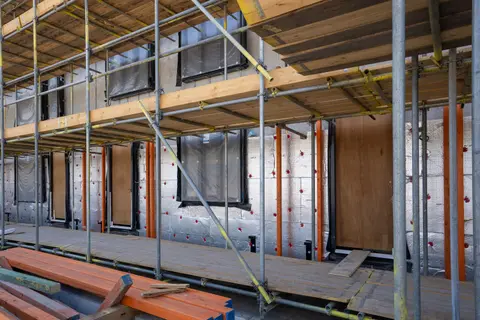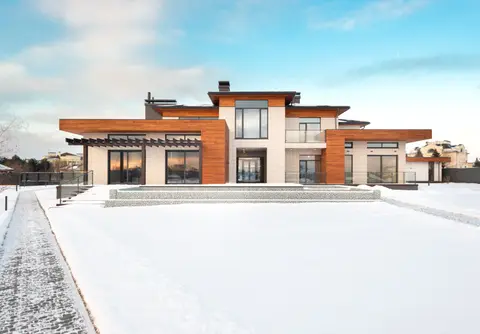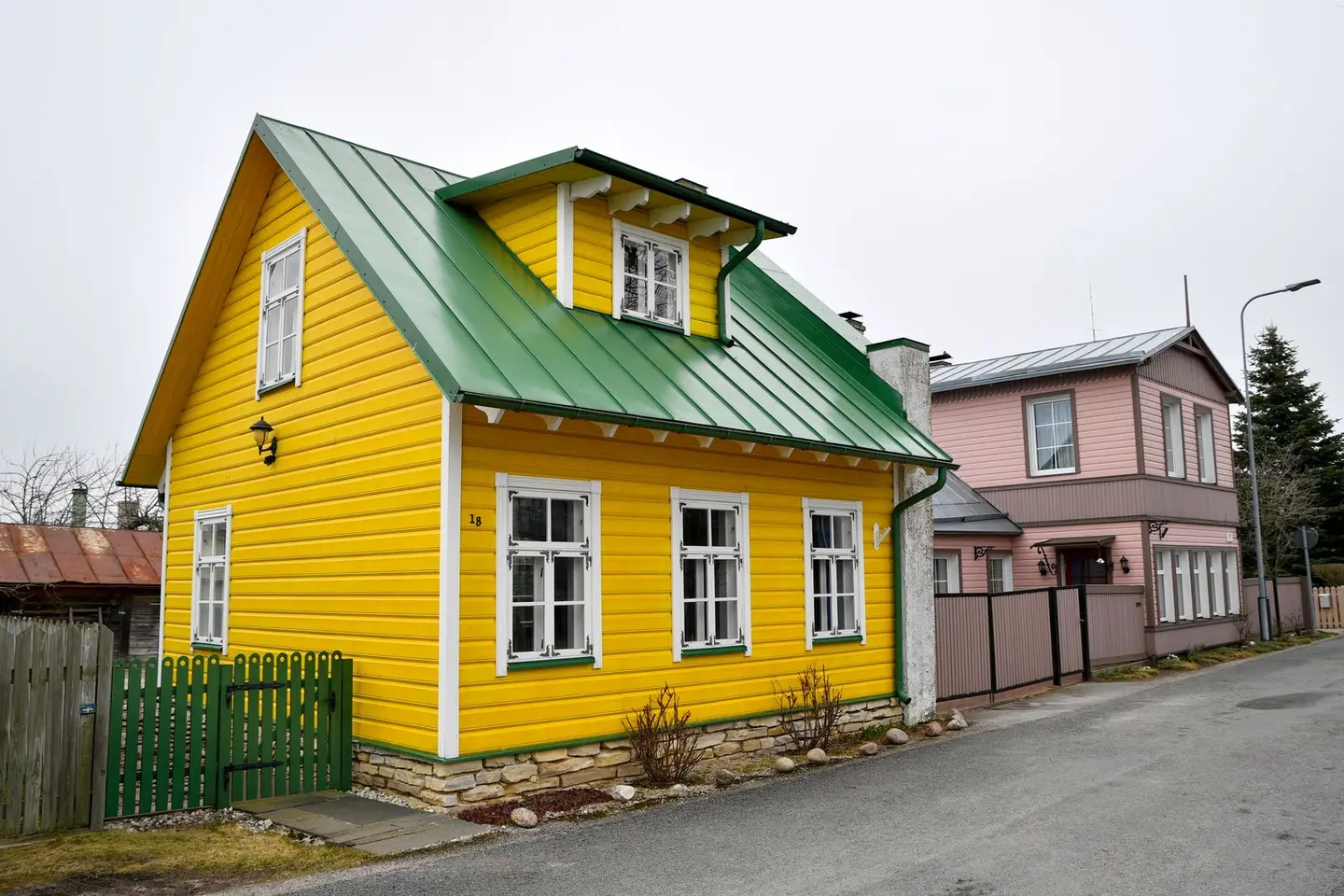
Timber cladding brings natural variation, texture and warmth to elevations that brick or render cannot match. It is also among the most labour-responsive materials: a well-chosen, well-detailed species can last for decades with little maintenance; a poorly treated softwood in a damp exposure zone can fail in a decade. Species, profile, fixing method and initial treatment together determine how the cladding performs over its life.
Species Overview
Treated Softwood (Scots pine, Spruce, Redwood)
European softwood, typically Scots pine (Pinus sylvestris) or Spruce, is the most cost-effective option. Untreated, its heartwood is rated only slightly durable (Class 4) under BS EN 350, and its sapwood is usually regarded as not durable (Class 5), so it deteriorates rapidly in exposed conditions.12 To achieve serviceable life as external cladding, softwood must be pressure-treated with a suitable preservative to achieve Use Class 3.2 (above ground, repeatedly wetted) per BS 8417:2024 (preservation of wood, code of practice).3
Tanalised or Vacsol-treated softwood in UC3.2 is widely available and competitively priced. It performs well when details are correct (ventilated cavity, back-primed before fixing, all end-grain cuts re-treated on site), but it must be decorated, typically painted or opaque-stained, and redecoration is needed every 3–5 years in moderate UK exposure.
Cost: roughly £15–£35/m² supply; £50–£95/m² installed (including battens, breather membrane, fixings).
Western Red Cedar (Thuja plicata)
Imported western red cedar is rated durable (Class 2 under BS EN 350), with natural extractives that resist decay without preservative treatment.4 Home-grown British western red cedar is rated only moderately durable.5 It is dimensionally stable and lightweight, approximately 390 kg/m³, which makes it easier to handle and fix than hardwood alternatives.45
Cedar weathers to an even silver-grey within 1–3 years if left untreated; this silvering is a surface oxidation process that does not compromise the wood’s structural integrity. Many architects specify untreated cedar precisely for this weathered appearance, which eliminates ongoing decoration costs. If the natural colour is preferred, a UV-stable oil or clear finish requires reapplication every 4–6 years.
Cedar is well suited to the UK climate, performs in moderate-to-severe exposure zones, and, unlike softwood, does not need pressure treatment. Its main disadvantages are cost and supply chain: most UK cedar is imported from Canada and the USA.
Cost: roughly £50–£90/m² supply; £85–£150/m² installed (estimates).
Siberian Larch (Larix sibirica)
Siberian larch has become the mainstream ‘quality’ cladding timber in UK new-build and self-build, largely replacing western red cedar on cost grounds. Its heartwood is rated moderately durable (Class 3), with a tight grain and resin content that gives better weathering resistance than European spruce.6 Slow-grown Siberian larch weighs about 680–700 kg/m³ when dried, and plantation-grown stock is lighter, so it is noticeably heavier than cedar.6 It tends to split when nailed, so pre-drilling is recommended, particularly at board ends.6
Larch weathers similarly to cedar, progressing from honey-gold through orange-brown to silver-grey over 2–4 years. It can be left untreated or finished with an oil for colour retention. Movement on drying is moderate; well-dried stock minimises gapping and cupping.
Siberian larch from FSC-certified sources is widely available in the UK; European larch (Larix decidua) is a domestic alternative with similar properties and marginally lower cost.
Cost: roughly £35–£65/m² supply; £70–£125/m² installed.
Thermally Modified Timber
Thermal modification (trade names include ThermoWood and Platowood) heats timber to around 190–230°C in the presence of steam, breaking down the hemicellulose sugars that decay fungi feed on and reducing equilibrium moisture content. The process transforms naturally non-durable species (ash, pine, spruce) to durability Class 2 (durable) or better without chemical preservatives.7 Lunawood’s durability-class product is modified at 212°C and carries a BRE endorsement for an expected service life of 30 years as cladding.7 Thermo-ash and thermo-pine are the most common UK-market products.
Thermally modified timber is darker in colour (mid-brown to chocolate, depending on temperature), more dimensionally stable than untreated timber, and has slightly lower density. It is particularly valued in Passivhaus and low-VOC projects where chemical treatments are undesirable.
The main risk is brittleness: thermal modification reduces bending strength compared with unmodified timber. ThermoWood is not sold as strength-graded timber and must not be used for load-bearing structures.8 Fixings are usually pre-drilled to avoid splitting.
Cost: roughly £45–£90/m² supply; £80–£150/m² installed (estimates).
Profiles
Cladding profile affects drainage behaviour, shadow lines, and the total quantity of timber required per m² of elevation.
| Profile | Description | Typical board width | Coverage ratio |
|---|---|---|---|
| Featheredge (bevelled) | Tapered section, thin at top, thick at bottom; overlapping | 100–150 mm | 1.2–1.4× face area |
| Shiplap | Rebated overlap, gives horizontal shadow line | 95–125 mm | 1.15–1.25× |
| Tongue and groove (TGV) | Interlocking; can be vertical or horizontal | 95–120 mm | 1.05–1.10× |
| Open-joint vertical (rainscreen) | Boards fixed vertically with open gap; wind-wash ventilation | 95–150 mm | 1.1–1.3× (incl. gap) |
| Waney-edge (live edge) | Rustic profile retaining natural edge | Variable | 1.3–1.5× |
Featheredge and shiplap are the traditional UK choices for horizontal cladding; open-joint vertical boards are common in contemporary architecture and allow faster drying of any penetrating moisture.
Weathering and Silvering
All timber cladding weathers if left untreated, and the rate of silvering depends on UV exposure, rain washing, and species. On south-facing elevations, silvering can occur within the first year; on north-facing walls, the same process may take several years. Uneven silvering on mixed-orientation elevations is a common complaint.
To accelerate uniform silvering at installation, a dilute iron-tannate solution (‘accelerated weathering’ wash) can be applied. Alternatively, an iron-oxide pigmented wood oil in a silver-grey tone gives an immediately consistent appearance.
If maintaining natural colour, penetrating oil-based finishes (Osmo, Sikkens Cetol, Rubio Monocoat etc.) are preferred over film-forming paints. Oils breathe with the wood; paint traps moisture beneath a film and eventually peels.
Fixings
Western red cedar is an acidic timber that can corrode ordinary steel fixings in damp conditions and cause black iron staining, and tannin-rich timbers such as larch and oak stain in the same way.5 Use stainless steel fixings throughout: A2 (304) stainless suits general external conditions, upgraded to A4 (316, marine grade) in coastal, highly exposed or polluted locations.9 Coated or plated fixings corrode, staining the boards and failing early.9
Hidden fixing systems (clips that engage the board profile from the rear) give a clean face without exposed fastener heads, but must allow for thermal and moisture movement: boards should not be pinned rigidly at both ends.
Back-priming all boards before installation seals the rear face and reduces moisture cycling, which is the primary driver of cupping and splitting.
Ventilated Cavity
All timber cladding requires a ventilated cavity between the cladding and the breather membrane or substrate. The battens create the cavity, and cladding suppliers recommend primary battens at least twice the thickness of the cladding board, so 20 mm boards need battens of at least 40 mm, with continuous airflow at the top and bottom of the cavity.10 The cavity allows moisture that penetrates gaps or joints to drain and evaporate; without it, cladding remains wet for extended periods and decay is accelerated even in naturally durable species.
Cost Comparison Summary
| Species / product | Supply cost (m²) | Installed cost (m²) | Maintenance interval | Natural durability class |
|---|---|---|---|---|
| Treated softwood | £15–£35 | £50–£95 | 3–5 years (decorate) | 4–5 → UC3.2 treated |
| Siberian larch | £35–£65 | £70–£125 | 6–10 years (oil) or none | 3 |
| Western red cedar | £50–£90 | £85–£150 | None (silver) or 4–6 years (oil) | 2 (imported) |
| Thermo-ash / thermo-pine | £45–£90 | £80–£150 | 5–10 years (oil) | 2 or better |
Supply prices are 2026 UK merchant prices per m² excluding VAT (softwood and larch widely available; cedar and thermowood from specialist merchants), and the cedar and thermally modified figures are estimates. Specialist suppliers quote cladding boards at roughly £25 to £90 per m² plus VAT, depending on species and profile.11 Installed costs add roughly £10–£15/m² for counter battens, breather membrane and stainless fixings and £25–£45/m² for labour, but not scaffold.
Relevant UK Standards and Guidance
- BS EN 350:2016, durability of wood and wood-based products: testing and classification of natural durability (it replaced BS EN 350-2)2
- BS 8417:2024, preservation of wood: code of practice, use class specification (the 2011 edition was withdrawn in August 2024)
- BS EN 335, durability of wood: use classes (UC 1–5)
- NHBC Standards Chapter 6.9, curtain walling and cladding
- BS 1202, nails for use with wood (material specifications)
- Building Regulations Approved Document B, fire spread: on a house up to 11 m high, external wall surfaces less than 1 m from a relevant boundary need Class B-s3, d2 or better, which untreated timber cladding typically does not reach, and taller residential buildings need Class A2-s1, d012
For most UK self-builds and renovation projects in moderate exposure zones, Siberian larch represents the best balance of cost, durability and low maintenance. Cedar remains the premium natural choice where budget allows; thermally modified timber suits contemporary projects where chemical preservatives are undesirable and weathering to a dark tone is acceptable.
The rules in this note are those that apply in England. Scotland, Wales and Northern Ireland have their own building standards and permitted development rights.
References (12)
Figures in this note were checked against the sources below on 30 September 2026. Superscript numbers in the text point to them. Every source the site cites, by topic.
- 1technicalgoodTimber Development UK, guidance.RN-J3EHSNTDUK's species sheet for European redwood (Scots pine). It rates the timber slightly durable, which is durability class 4.
- 2technicalgoodBritish Woodworking Federation, guidance.RN-5MTP2PBWF guidance on timber durability and specification. States that where national requirements and end use are not available, the moisture content of the timber shall not exceed 13% for heated buildings or 16% for use in unheated buildings. Useful as the ceiling figure against which the common trade rule of thumb of 8 to 12% kiln-dried moisture content for kitchen worktops and interior joinery can be sanity-checked.
- 3technicalstrongBSI (British Standards Institution), a standard.RN-1YSDSKSTATUS: CURRENT. BS 8417:2024 published 15 August 2024, superseding BS 8417:2011+A1:2014. Gives recommendations and guidance for the preservative treatment of wood to provide protection against biodeterioration in end-use situations. Covers solid wood and glued laminated wood (Glulam); excludes wood-based panel products, physically or biologically modified wood, and curative treatments. It takes into account the natural durability and treatability of the wood, the use class as defined in BS EN 335, and the desired service life, and recommends penetration and retention levels for different timber components. This is the source of the Use Class 2 / Use Class 4 language on treated batten and fence post labelling, and of the stated desired service lives (30 or 60 years) manufacturers quote. Treatment certificates quoting BS 8417:2011 predate the 2024 rewrite.
- 4technicalgoodTRADA.RN-LKUHDPTRADA's wood species entry for imported Western red cedar: durability class, movement, working properties and typical uses. The species data behind a cladding specification.
- 5technicalgoodTRADA (Timber Research and Development Association) / BM TRADA.RN-DMUS83TRADA's wood species entry for British-grown Western red cedar. Worth holding separately from the imported entry, because home-grown cedar differs in density and durability from the imported timber and the two are not interchangeable in a cladding spec.
- 6technicalgoodTimber Development UK, guidance.RN-UQ03K3TDUK's species sheet for Siberian larch. It lists the heartwood as moderately durable and describes it as a very resinous wood.
- 7technicalsupplier figureLunawood, guidance.RN-K95IWDA thermally modified timber producer's product fact sheet. It gives Thermo-D durability class 2 under BS EN 350 and a BRE-endorsed 30-year service life as cladding.
- 8technicalfairInternational ThermoWood Association, guidance.RN-0B2059The ThermoWood trademark owner's technical handbook. It describes the three process phases, including high-temperature drying with controlled heating to prevent cracking.
- 9technicalsupplier figureVastern Timber, guidance.RN-8Y321JA cladding supplier's fixing specification guidance. It says to use stainless steel throughout, A2 for general external use and A4 in coastal, exposed or polluted sites.
- 10technicalsupplier figureVastern Timber, guidance.RN-CTJ13DA cladding supplier's batten guidance. It says primary battens should be at least twice the board thickness (40 mm for 20 mm boards) with airflow at the top and bottom of the cavity.
- 11costsupplier figureVastern Timber.RN-XGI2P5A price, true at 2026-09. A UK timber cladding supplier's product page. It gives supply prices for cladding boards of £25 to £90 per m2 plus VAT depending on species and profile.
- 12technicalvery strongMinistry of Housing, Communities and Local Government.RN-J0UZDBApproved Document B Volume 1, fire safety in dwellings, 2019 edition with the 2020, 2022 and 2025 amendments and the forthcoming 2026 and 2029 changes collated in. Covers means of warning and escape, internal fire spread through linings and structure, external fire spread and access for the fire service. This is the document behind escape window sizes, protected stairways, the 4.5 metre rule and the fire doors a loft conversion needs.
-
Redwood, European, Timber Development UK, accessed 30 September 2026. timberdevelopment.uk
-
Durability, British Woodworking Federation, accessed 12 September 2026. bwf.org.uk
-
BS 8417:2024 - Preservation of wood. Code of practice, British Standards Institution, accessed 12 September 2026. knowledge.bsigroup.com
-
Cedar, Western red (imported), TRADA, accessed 12 September 2026. trada.co.uk
-
Cedar, Western Red (British) | Wood Species Database | TRADA, TRADA (Timber Research and Development Association) / BM TRADA, accessed 12 September 2026. trada.co.uk
-
Larch, Siberian, Timber Development UK, accessed 30 September 2026. timberdevelopment.uk
-
Lunawood Thermowood fact sheet, Lunawood, accessed 30 September 2026. lunawood.com
-
ThermoWood Handbook, International ThermoWood Association, accessed 30 September 2026. thermowood.fi
-
Fixings for timber cladding, Vastern Timber, accessed 30 September 2026. vastern.co.uk
-
Timber battens behind timber cladding, Vastern Timber, accessed 30 September 2026. vastern.co.uk
-
Timber cladding, Vastern Timber, accessed 30 September 2026. Priced at 2026-09 and left there. vastern.co.uk
-
Approved Document B (fire safety) volume 1: Dwellings, 2019 edition incorporating 2020, 2022, 2025 and 2026 amendments, Ministry of Housing, Communities and Local Government, accessed 30 September 2026. assets.publishing.service.gov.uk