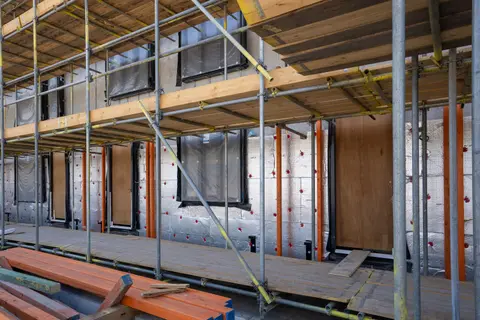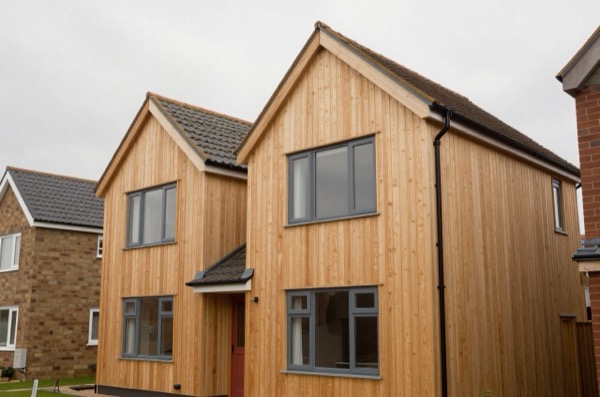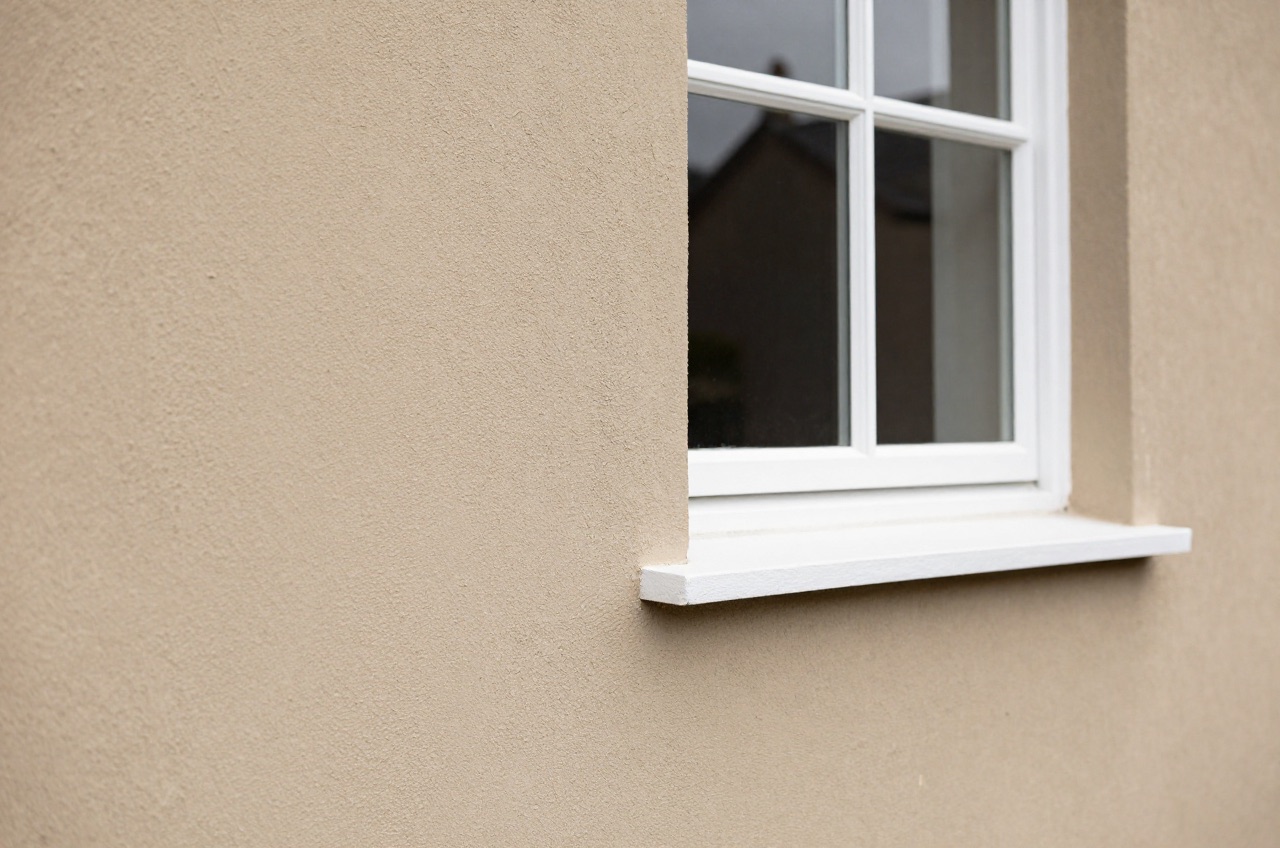
External render serves two functions simultaneously: it protects the substrate from wind-driven rain and it provides the visual finish of the wall. The choice of render type has a significant influence on long-term durability, crack susceptibility, and maintenance requirements, and the substrate and exposure zone largely dictate which system is appropriate.
Traditional Sand-Cement Render
Sand-cement render is the oldest and most widely used system in UK construction. A typical three-coat application consists of a scratch coat, a straightening (floating) coat, and a finishing coat, with undercoats typically about 8–12 mm each and a thinner finish, for a total of roughly 20–35 mm. Mix proportions vary by coat:
- Scratch coat: 1:3 to 1:4 (cement:sharp sand), relatively strong to bond to substrate
- Straightening coat: 1:4 to 1:5, slightly weaker to avoid the outer layer being stronger than inner (a common cause of delamination)
- Finish coat: 1:5 to 1:6, weakest outer coat, sometimes with lime added for workability
Adding hydrated lime improves workability and water retention, reduces shrinkage cracking, and adds some flexibility.1 For rendering a solid masonry wall, Approved Document C gives a nominal 1:1:6 (cement:lime:sand) mix, or 1:0.5:4 on dense concrete blocks.2 It also asks for two coats with a total thickness of at least 20 mm and a scraped or textured finish.2
Sand-cement render is significantly more prone to shrinkage and thermal cracking than proprietary systems, particularly on rigid substrates like engineering brick or smooth blockwork, or where it is applied in thick lifts. Cracks allow water ingress and can lead to frost spalling in exposed locations.
Cost: £15–£25/m² installed (three coats, including labour, scaffold not included). Material cost alone: £2.50–£5/m². Requires skilled tradespeople; finish quality is highly labour-dependent.
Monocouche Render
Monocouche (French: single layer) is a factory-batched, pre-pigmented, one-coat render, built up to about 15–20 mm and then scraped back to expose the texture, with the colour integral to the mix.3 Monocouche products are declared to BS EN 998-1 (specification for mortar for masonry, rendering and plastering mortars) as one-coat renders.3
The through-colour means that minor surface chips or scratches are less visible than with painted finishes. Monocouche is available in dozens of pigmented colours (Parex offers 48 for Monorex GM); check what colour-fastness the manufacturer will stand behind.3
Monocouche performs well on brick, block, and EWI (external wall insulation) basecoats in sheltered to moderate exposure. It is inherently more flexible than sand-cement because it is formulated with polymer modifiers, giving it a degree of crack-bridging and improved adhesion. However, makers ask to be consulted before it is used in very severe exposure or coastal locations, and it is more sensitive to substrate preparation: a poorly primed or dusty substrate causes delamination.3
Key application points:
- Applied in two passes within the same day (key application then float/texture)
- Substrate must be primed with the manufacturer’s specified bonding agent
- Not to be applied below 5°C (Parex asks for 8°C with dark colours), with special precautions above 30°C, and not onto substrates in direct sun or hot drying winds3
Cost: £20–£35/m² installed (single coat, pigmented). Material cost: £8–£15/m² depending on coverage. Colour matching replacement patches is difficult; damaged areas can be conspicuous.
Silicone and Acrylic Thin-Coat Systems
Thin-coat renders (typically 1.5–3 mm application thickness) are polymer-modified, mineral or synthetic-binder systems applied as a finish coat over a prepared cementitious basecoat or EWI mesh-and-adhesive layer.4 They are the dominant finish used in EWI (External Wall Insulation) systems, the thin coat is applied over the reinforcement mesh embedded in adhesive over the insulation board.
Silicone renders use a silicone-resin binder that makes the cured surface highly hydrophobic, water beads off rather than being absorbed. This dramatically reduces biofouling (algae, moss) compared with acrylic or sand-cement and extends redecoration cycles. A good silicone render in a moderate exposure zone can go 15–20 years without significant maintenance.
Acrylic renders use an acrylic polymer binder, are slightly more flexible than silicone, and are more cost-effective but less water-repellent. They are still substantially better than sand-cement in crack resistance and adhesion on EWI.
Both are available in textured finishes (fine scratch, medium scratch, roughcast) and a wide colour palette. Colours are BS or RAL referenced; check for fade resistance certification.
| Render type | Application thickness | Coats | Flexibility | Hydrophobicity | Maintenance cycle |
|---|---|---|---|---|---|
| Sand-cement | 20–35 mm | 3 | Low | Low | 5–10 years (paint) |
| Monocouche | 15–20 mm | 1 | Medium | Medium | 10–15 years |
| Acrylic thin-coat | 1.5–3 mm | 1 (over basecoat) | High | Medium | 10–15 years |
| Silicone thin-coat | 1.5–3 mm | 1 (over basecoat) | High | Very high | 15–20+ years |
Cracking: The Critical Risk Factor
Render cracks when tensile stress exceeds the tensile strength of the material. The main causes are:
- Shrinkage cracking: cement paste shrinks as it hydrates. Thick coats with high cement content are most vulnerable.
- Thermal movement: the outer face of a rendered wall heats and cools far more than the wall behind it, particularly on dark, sunny elevations, and the repeated movement contributes to cracking.
- Substrate movement: differential movement between masonry leaves, or between a render and an EWI substrate.
- Application errors: coats applied too fast (not allowing the previous coat to achieve adequate strength), or the external coat being richer (higher cement content) than the internal coat.
EWI basecoat systems address cracking by incorporating an alkali-resistant glass fibre mesh embedded in the basecoat, which distributes thermal stresses across the surface and bridges micro-cracks before they propagate.5 The thin silicone or acrylic finish applied over this system can tolerate substrate micro-movement without visible cracking.
Costs Compared
| System | Supply cost (m²) | Installed cost (m²) | Expected lifespan to first major rework |
|---|---|---|---|
| Sand-cement (3-coat) | £2.50–£5 | £15–£25 | 15–25 years (subject to decoration) |
| Monocouche | £8–£15 | £20–£35 | 20–30 years |
| Acrylic thin-coat (EWI or basecoat) | £5–£10 | £30–£45 | 20–25 years |
| Silicone thin-coat (EWI or basecoat) | £8–£14 | £35–£55 | 25–35 years |
Scaffold costs (typically £15–£30/m² for typical domestic heights) are excluded from all figures above. On a full house re-render, scaffold is the single largest additional cost item.
Relevant UK Standards and Guidance
- BS EN 998-1:2016, specification for mortar for masonry: rendering and plastering mortars6
- BS EN 13914-1:2016, design, preparation and application of external rendering7
- BS 5262:1991, code of practice for external renderings (withdrawn in 2006 but still referenced in many older specs)8
- BRE Digest 196, external rendered finishes
- ETAG 004 / EAD 040083-01-0404, external thermal insulation composite systems (ETICS) with renderings9
- Building Regulations Approved Document C, moisture resistance (substrate preparation)2
- Approved Document L, conservation of fuel and power: renewing render over more than 50% of a wall counts as renovating a thermal element, which brings in an insulation upgrade where it is feasible10
For new buildings and EWI installations on existing walls, silicone thin-coat over a mesh-reinforced basecoat represents the current best-practice finish in the UK market: lower long-term maintenance cost, better weather resistance, and significantly reduced crack risk compared with sand-cement.
The rules in this note are those that apply in England. Scotland, Wales and Northern Ireland have their own building standards and permitted development rights.
References (10)
Figures in this note were checked against the sources below on 30 September 2026. Superscript numbers in the text point to them. Every source the site cites, by topic.
- 1technicalsupplier figureHanson (Heidelberg Materials UK), guidance.RN-4JUCDXMaker's data sheet for hydrated lime (CL 90-S): it improves plasticity, workability and water retention of Portland cement mortars and renders, with a table of cement:lime:sand designations.
- 2technicalvery strongMinistry of Housing, Communities and Local Government.RN-NPO8FJThe statutory figures behind a damp diagnosis, and the numbers to quote when a note explains why ground levels or a bridged damp proof course cause rising damp. Paragraph 5.2 requires that in an external wall the damp-proof course should be at least 150mm above the level of the adjoining ground (Diagram 8) unless part of the building protects the wall, and that in an external cavity wall the cavity should be taken down at least 225mm below the level of the lowest damp-proof course, or a damp-proof tray provided (Diagram 9a). For suspended timber ground floors it requires a ventilated air space of at least 75mm from the ground covering to the underside of any wall-plates and at least 150mm to the underside of the suspended timber floor or insulation, with ventilation openings on two opposing external walls of not less than 1,500mm2 per metre run of external wall or 500mm2 per square metre of floor area, whichever is greater; for suspended concrete floors the clear ventilated space is at least 150mm with the same opening sizes. Section 2.39 onwards covers radon, referring to BRE Report BR 211 for protective measures. The 2013 edition was published on 3 September 2013 with changes in effect from 1 October 2013.
- 3technicalsupplier figureSika Limited (Parex).RN-3X5QXSSika's product data sheet for Parex Monorex GM monocouche render, January 2022. Coverage, thickness, mixing and substrate requirements from the manufacturer, which is the specification a render guarantee depends on.
- 4technicalgoodInsulated Render and Cladding Association (INCA).RN-AJLMMDThe Insulated Render and Cladding Association on external wall insulation finishes. The trade body for EWI describing the finish options and what each demands of the substrate and the detailing.
- 5technicalgoodInsulated Render and Cladding Association (INCA), guidance.RN-J08J2OINCA's best practice guide to EWI: system components, including polymer-modified basecoats reinforced with glass fibre mesh that spread stresses into the mesh and insulation.
- 6technicalstrongBSI, a standard.RN-NMRO24The product standard for bagged render and plaster, the one a monocouche, silicone or Tyrolean render should be declared to. Published 30 Nov 2016, Current, with Designated status for UKCA marking. Part 1 of the BS EN 998 series applies to factory made rendering and plastering mortars based on inorganic binders for external rendering and internal plastering on walls, ceilings, columns and partitions, and contains definitions, final performance requirements, the assessment and verification of constancy of performance regime and the marking requirements. The binder boundary is spelt out: a calcium sulphate binder may be used as an additional binder with air lime, and if air lime is the principal active binding component the mortar is covered here, but if calcium sulphate is the principal binder it falls under EN 13279 instead. Three exclusions matter on site: site-made rendering and plastering mortars are outside its scope and are covered by codes of application and national specifications; mortars with calcium sulphate as principal binder are excluded; and special fire-resistant and acoustic mortars, structural repair mortars, smoothing and trueing materials, paints, coatings, thin-layer organic renders and prefabricated units such as plasterboard are not dealt with.
- 7technicalstrongBSI, a standard.RN-WDGC6TThe standard behind a correct render specification, published 31 March 2016 and current but under review. It sets requirements and recommendations for the design, preparation and application of renders based on cement, lime or other mineral binders and combinations of them, masonry cement, polymer modified binder based renders, and renders with organic binders. It covers rendering on both new and old backgrounds and the maintenance and non-structural repair of existing work, and gives guidance on site-made, factory-made and semi-finished factory-made renders, including material requirements for reinforcement, carriers and beads and for screws, plugs and anchor fixings, and the background characteristics that govern the design of a rendering system. It explicitly excludes external thermal insulation composite systems (ETICS), gypsum-based external renders, historic monument rendering, concrete structural repair, liquid-retaining structures, sealant specification and flashing design, which is worth noting because EWI render is covered elsewhere.
- 8technicalstrongBSI, guidance.RN-LVAUA3BSI's catalogue entry for BS 5262:1991, Code of practice for external renderings, showing it was published in October 1991 and withdrawn on 31 August 2006.
- 9technicalfairEuropean Organisation for Technical Assessment (EOTA), guidance.RN-KIK2X4EOTA's list of European Assessment Documents: EAD 040083-00-0404 for ETICS with renderings, superseded by 040083-01-0404 adopted on 31 October 2024.
- 10technicalvery strongMinistry of Housing, Communities and Local Government.RN-L0FCJXThe in-force U-value tables a DIY insulation or door note must quote, with the exact numbers. Table 4.2, limiting U-values for new fabric elements in existing dwellings, sets roof 0.15, wall 0.18, floor 0.18, swimming pool basin 0.25, window 1.4 or Window Energy Rating Band B minimum, rooflight 2.2, doors with more than 60 per cent of the internal face glazed 1.4 or Doorset Energy Rating Band C minimum, and other doors 1.4 or Doorset Energy Rating Band B minimum. Table 4.3, for existing elements, gives a roof threshold of 0.35 and an improved value of 0.16, which is the figure a loft insulation note needs: paragraph 4.12 says a retained element whose U-value is higher than the column (a) threshold, for example through a loft or garage conversion, should be upgraded to the column (b) value. Paragraph 4.13 allows a lesser upgrade only where the improved value is not technically or functionally feasible or would not achieve a simple payback of 15 years or less. Paragraph 4.8 requires a replacement element to be no worse than the one it replaces as well as meeting Table 4.2. Paragraph 4.10 gives the heritage exception: where character must be maintained, a centre pane U-value of no more than 1.2 or low-emissivity secondary glazing. Note 9 records that the timber window concession of 1.6 or Band C ended on 14 June 2023. The 2021 edition came into force on 15 June 2022; a 2026 edition exists at https://assets.publishing.service.gov.uk/media/69c122a6cfa346b9d4704a55/ADL1_2026.pdf.
-
Hanson Hydrated Lime technical data sheet, Hanson (Heidelberg Materials UK), accessed 30 September 2026. packedproducts.heidelbergmaterials.co.uk
-
Approved Document C: Site preparation and resistance to contaminants and moisture, HM Government / Ministry of Housing, Communities and Local Government, accessed 12 September 2026. assets.publishing.service.gov.uk
-
Product Data Sheet Parex® MONOREX GM, January 2022, Version 01.01, Sika Limited (Parex), accessed 12 September 2026. gbr.sika.com
-
EWI Finishes - Insulated Render and Cladding Association, Insulated Render and Cladding Association (INCA), accessed 12 September 2026. inca-ltd.org.uk
-
Best Practice Guide: External Wall Insulation, Insulated Render and Cladding Association (INCA), accessed 30 September 2026. inca-ltd.org.uk
-
BS EN 998-1:2016 – Specification for mortar for masonry - Rendering and plastering mortar, BSI (British Standards Institution), accessed 12 September 2026. knowledge.bsigroup.com
-
BS EN 13914-1:2016 Design, preparation and application of external rendering and internal plastering, External rendering, BSI (British Standards Institution), accessed 12 September 2026. knowledge.bsigroup.com
-
BS 5262:1991 Code of practice for external renderings, BSI, accessed 30 September 2026. knowledge.bsigroup.com
-
European Assessment Documents (EADs), European Organisation for Technical Assessment (EOTA), accessed 30 September 2026. eota.eu
-
Approved Document L, Conservation of fuel and power, Volume 1: Dwellings, 2021 edition incorporating 2023 amendments, HM Government, accessed 29 September 2026. assets.publishing.service.gov.uk