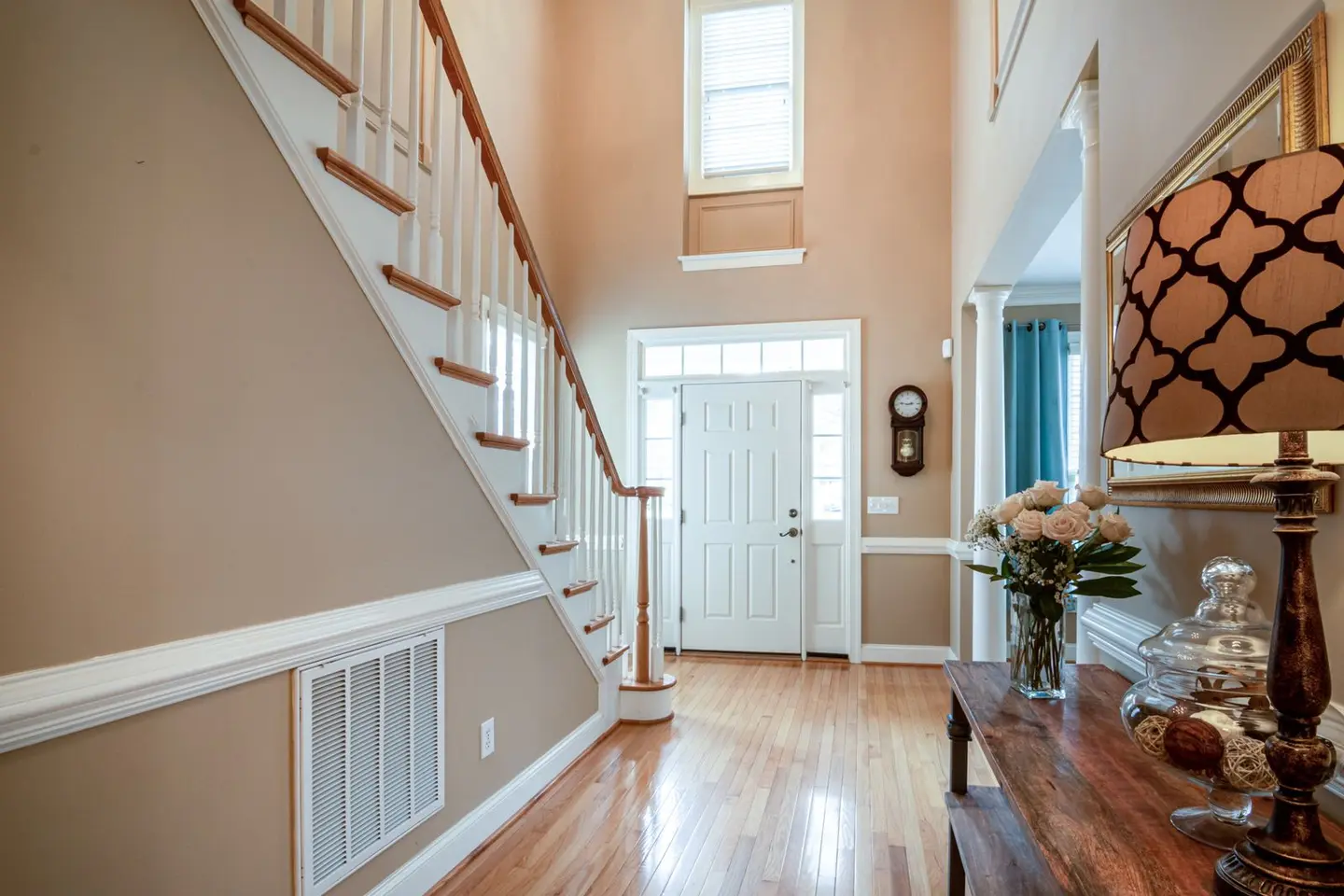
New banister spindles, also called balusters or stair balusters, are one of the most cost-effective ways to transform the look of a staircase. A full set of 26 replacement spindles on a standard 13-tread straight flight typically costs about £55–£650 for materials, depending on whether you choose softwood, oak or metal; glass panels cost more. Most homeowners can fit pine or metal spindles themselves in a weekend; oak and glass are better left to a joiner.
The single most important thing to get right before you buy anything is compliance with Building Regulations Approved Document K (Protection from falling, collision and impact). The maximum permitted gap between spindles is 99 mm, a 100 mm sphere must not be able to pass through any opening in the balustrade.1 The rule applies to new staircases, and Local Authority Building Control advises meeting it whenever an existing balustrade is replaced or refurbished.2
Spindle Types and Materials
Pine (Softwood)
Painted softwood spindles are the traditional British staircase staple and remain the cheapest option. Typically available in 32 mm square, 41 mm square, and turned profiles, they are easy to cut, sand, and finish. Pine spindles take paint well but will show dents and scuffs more readily than hardwood over time.
Sizes: 32 mm and 41 mm square are the usual sections, typically about 900 mm long. Turned profiles (with a barrel or vase shape) are a common decorative choice.
Cost: £2–£6 per spindle. A standard flight (26 spindles) costs £52–£156 for materials. A plain 41 mm pine stop-chamfered spindle, 900 mm long, costs about £4 including VAT at a builders’ merchant.3
Oak (Hardwood)
Oak spindles are the premium timber option and suit both traditional and contemporary interiors. They can be left natural (oiled or lacquered) or painted. Oak is harder and heavier than pine, which makes cutting and fitting slightly more demanding. Oak is almost always used where the handrail and newel posts are also oak, as mixing hardwood and softwood is visually inconsistent.
Sizes: 32 mm and 41 mm square most common; 900 mm and 1,100 mm lengths to suit different floor-to-floor heights. Prism and stop-chamfered profiles are common contemporary choices.
Cost: £8–£18 per spindle. A standard flight costs £208–£468 for materials. A plain 41 mm white oak stop-chamfered spindle, 900 mm long, costs about £11 including VAT at a builders’ merchant.4
Metal (Steel and Wrought Iron Style)
Metal spindles, usually mild steel powder-coated in black, chrome, or antique brass, or genuine wrought iron, offer a contemporary or period look with minimal visual bulk. They are particularly popular in open-plan homes where a slender profile keeps sightlines clear. Metal spindles are fixed with top and bottom cups, threaded connections, or welded brackets depending on the type.
Sizes: Typically 12–16 mm round bar, 900 mm or 1,100 mm; square section 12×12 mm also available. Twisted, basket-weave, and plain bar styles are common.
Cost: £5–£25 per spindle for standard powder-coated steel. Genuine hand-forged wrought iron can reach £30–£60 per spindle.
Glass
Glass balustrades and glass-infill spindle panels are the most expensive option and are usually specified on contemporary staircases where an open, light-filled feel is the priority. These are almost always installed by a specialist because the channel or clamp fixings must carry the loads Part K sets for guarding.1 The glass must be safety glass, and LABC advises laminated glass, which stays in place if it breaks; toughened glass is allowed in some positions depending on the space in front of it.2
Glass is typically used as full panels between newels rather than individual spindles. Costs are quoted per panel or per linear metre rather than per spindle.
Cost: £80–£250 per panel (600 mm wide) or £150–£400 per linear metre installed. DIY glass fitting is not recommended.
LVL and Engineered Timber
Laminated veneer lumber (LVL) spindles have emerged as a cost-effective hardwood alternative. They use thin layers of veneer bonded under pressure to produce a dimensionally stable, knot-free product that accepts stain and oil well. LVL spindles look like solid hardwood at a lower price point and with less waste on cutting.
Cost: £6–£14 per spindle.
Material and Cost Comparison
| Material | Typical size | Cost per spindle | DIY-friendly? | Maintenance |
|---|---|---|---|---|
| Pine (painted) | 32 mm or 41 mm sq | £2–£6 | Yes | Repaint every 5–8 years |
| Oak (natural/painted) | 32 mm or 41 mm sq | £8–£18 | Yes (with care) | Oil/lacquer every 3–5 years |
| LVL engineered timber | 41 mm sq | £6–£14 | Yes | Oil or lacquer |
| Metal (powder-coated steel) | 12–16 mm round | £5–£25 | Yes | Wipe clean; touch-up chips |
| Wrought iron (hand-forged) | varies | £30–£60 | No | Annual wax or paint |
| Glass panel | 600 mm wide panel | £80–£250/panel | No | Clean with glass cleaner |
Building Regulations Part K: What You Need to Know
Approved Document K sets the structural and dimensional requirements for staircases, ramps, and protective barriers. The key rules for spindles are:
Maximum gap: The openings in any balustrade, including gaps between spindles, between a spindle and the stringer (the angled side board), and between the bottom of the handrail and the top of the string, must not allow a 100 mm sphere to pass through.1 In practice this means the centre-to-centre spacing can be no more than the spindle width plus 99 mm (131 mm for a 32 mm spindle, 140 mm for a 41 mm spindle); most fitters work comfortably under that, but always verify by measuring rather than relying on rules of thumb.
Handrail height: On a stair, the handrail must be at least 900 mm above the pitch line (an imaginary line connecting the nosings of the treads) and no more than 1,000 mm.1 On a landing, the guarding should also be at least 900 mm high, measured from the floor.2 In any building that may be used by children under five, which includes an ordinary home, the guarding should not be easy to climb: Approved Document K says to avoid horizontal rails.1
Structural load: Approved Document K says guarding must resist, as a minimum, the loads given in BS EN 1991-1-1 and its UK National Annex.1 For stairs and landings inside a single-family home that is usually taken as a horizontal line load of 0.36 kN/m at handrail height (roughly 36 kg per metre); communal stairs, balconies and public buildings need higher figures. This is why glass panels, metal systems, and newel post connections must be structurally engineered rather than assumed to be adequate.
When Do You Need Building Regulations Approval?
Replacing spindles in an existing staircase does not normally need a Building Regulations application: LABC says work to alter or replace existing handrails in a home is generally uncontrolled and need not be notified.2 The new balustrade should still meet the Part K standards above, because it is the safety barrier on the stair. However:
- If your home was built to the accessible standards M4(2) or M4(3), or the stair serves a split-level ground floor, LABC says work on the handrail or balustrade counts as a material alteration and must be notified to building control.2
- If the work goes beyond the balustrade, for example replacing or repositioning the staircase itself or altering the structure around it, check with building control before you start, as that can be controlled building work.
- If your staircase currently has gaps wider than 99 mm, close them up while the balustrade is being worked on: building control will expect it on any notified job, and it removes a real trap for small children.
Where notification is needed, a Building Notice (paid to your local authority building control) or an application through a registered building control approver (the private-sector route, called an approved inspector before April 2024) is the usual route. Fees vary by authority, so check your council’s published charges.
How to Count the Spindles You Need
The number of spindles on a staircase depends on three things: the number of treads, the width of each tread, and the spacing required to meet the 99 mm gap rule. A practical method:
- Measure the going (horizontal depth) of a typical tread, usually 220–250 mm for a standard domestic stair.
- For a 32 mm spindle, allow two spindles per tread as a starting point. For an open-plan stair with wider treads, you may need three.
- Add spindles for any landing section, measured at one spindle per 100–110 mm of landing run.
- Add 10% for waste and cutting.
Example: A 13-tread staircase with 230 mm going and 32 mm square spindles.
- 13 treads × 2 spindles = 26 spindles
- Landing run of 1,200 mm ÷ 110 mm = 11 spindles
- Total: 37 spindles, plus 10% waste = 41 spindles to order
Always mark out the spacing on the stringer before cutting or ordering, and use a spacer block to check the gap measurement is under 99 mm before fixing any spindle.
DIY vs Joiner Installation
DIY is practical for pine and metal spindles on a standard flight where the newels, handrail, and strings are staying in place. The key tools are a mitre saw (to cut spindles to the angled pitch line), a chisel (to cut mortises in handrail and string if using mortise-and-tenon fixing), and a drill. Screwed or dowelled fixings into pre-routed channels (the system used by most modern staircase suppliers) are the easiest DIY approach.
Hire a joiner if: you are fitting solid oak spindles with a traditional mortise-and-tenon joint (the angled cuts require precision); you are installing glass panels (structural fixing and sealing require specialist knowledge); your staircase has unusual geometry (winders, curved strings, open riser details); or you need Building Regs sign-off on the finished work. A joiner typically charges £250–£600 for a full spindle replacement on a standard flight, plus materials, taking 1–2 days.
Cost Summary: Full Spindle Replacement, Standard 13-Tread Staircase
| Specification | Materials | Labour (joiner) | Total |
|---|---|---|---|
| Pine, painted, DIY | £55–£160 | - | £55–£160 |
| Pine, painted, joiner | £55–£160 | £250–£400 | £305–£560 |
| Oak, oiled, DIY | £210–£470 | - | £210–£470 |
| Oak, oiled, joiner | £210–£470 | £300–£600 | £510–£1,070 |
| Metal (steel bar), DIY | £130–£650 | - | £130–£650 |
| Metal, joiner | £130–£650 | £250–£450 | £380–£1,100 |
| Glass panels, specialist | £800–£2,000 | included | £800–£2,000 |
These figures cover 26 spindles for the flight and fixing consumables, at the per-spindle prices above; add spindles for any landing (see the counting example). They exclude a new handrail, newel post replacement, stringer repair and decorating; a 3.6 m handrail kit adds roughly £70–£230.
The rules in this note are those that apply in England. Scotland, Wales and Northern Ireland have their own building standards and permitted development rights.
References (4)
Figures in this note were checked against the sources below on 30 September 2026. Superscript numbers in the text point to them. Every source the site cites, by topic.
- 1technicalvery strongMinistry of Housing, Communities and Local Government.RN-XH6E39The standard that decides whether a loft ladder is legal and when a raised deck needs a balustrade. Published 3 January 2013, it covers protection from falling, collision and impact including stairs, ladders, ramps, guarding and vehicle barriers. Paragraph 1.31 states that retractable ladders must not be used as a means of escape. Paragraph 1.32 permits a fixed ladder, with fixed handrails on both sides, only for access in a loft conversion containing one habitable room, and only where there is not enough space without altering the existing space for a compliant stair, which is the rule that catches most loft ladder installations. Paragraph 1.29 restricts alternating tread stairs to loft conversions. For a private stair the maximum pitch is 42 degrees (Table 1.1 note 1), the normal relationship between rise and going is twice the rise plus the going between 550mm and 700mm, and for dwellings external tapered steps forming part of the building need a going of at least 280mm. Paragraph 3.1 requires guarding wherever it is reasonably necessary for safety at the edge of a floor, gallery, balcony, roof, light well, basement or similar sunken area. Paragraph 3.2 requires guarding to be at least the height in Diagram 3.1, allows any wall, parapet or balustrade to serve as guarding, and requires it to resist the loads in BS EN 1991-1-1 with its UK National Annex and PD 6688-1-1, with BS 6180 for barrier and infill panel design. Handrails should be positioned 900mm to 1000mm from the pitch line or floor.
- 2technicalvery strongLABC, guidance.RN-IM3YF7LABC guidance on replacing stair handrails and balustrades in homes: the work is usually uncontrolled, but LABC sets out good practice, including the 100 mm ball rule, whenever a balustrade is replaced or refurbished.
- 3costsupplier figureHarlow Bros.RN-V7M13BA price, true at 2026-09. Builders' merchant product page for a 41 x 41 x 900 mm solid pine stop-chamfer spindle, priced at £4.04 including VAT (£3.37 ex VAT) each, which sits inside the note's £2–£6 range.
- 4costsupplier figureBuilder Depot.RN-DA635UA price, true at 2026-09. Builders' merchant product page for a Richard Burbidge 41 mm white oak stop-chamfer spindle, 900 mm long, at £10.74 including VAT, inside the note's £8–£18 oak range.
-
Approved Document K, Protection from falling, collision and impact, 2013 edition, Ministry of Housing, Communities and Local Government, accessed 14 September 2026. assets.publishing.service.gov.uk
-
Replacing handrails and balustrades on stairs in the home, LABC, accessed 30 September 2026. labc.co.uk
-
Pine Timber Stop Chamfer Stair Spindle 41 x 900 mm SC090/41P, Harlow Bros, accessed 30 September 2026. Priced at 2026-09 and left there. harlowbros.co.uk
-
41mm Richard Burbidge White Oak Stop Chamfer Spindle 900mm WOSC090, Builder Depot, accessed 30 September 2026. Priced at 2026-09 and left there. builderdepot.co.uk