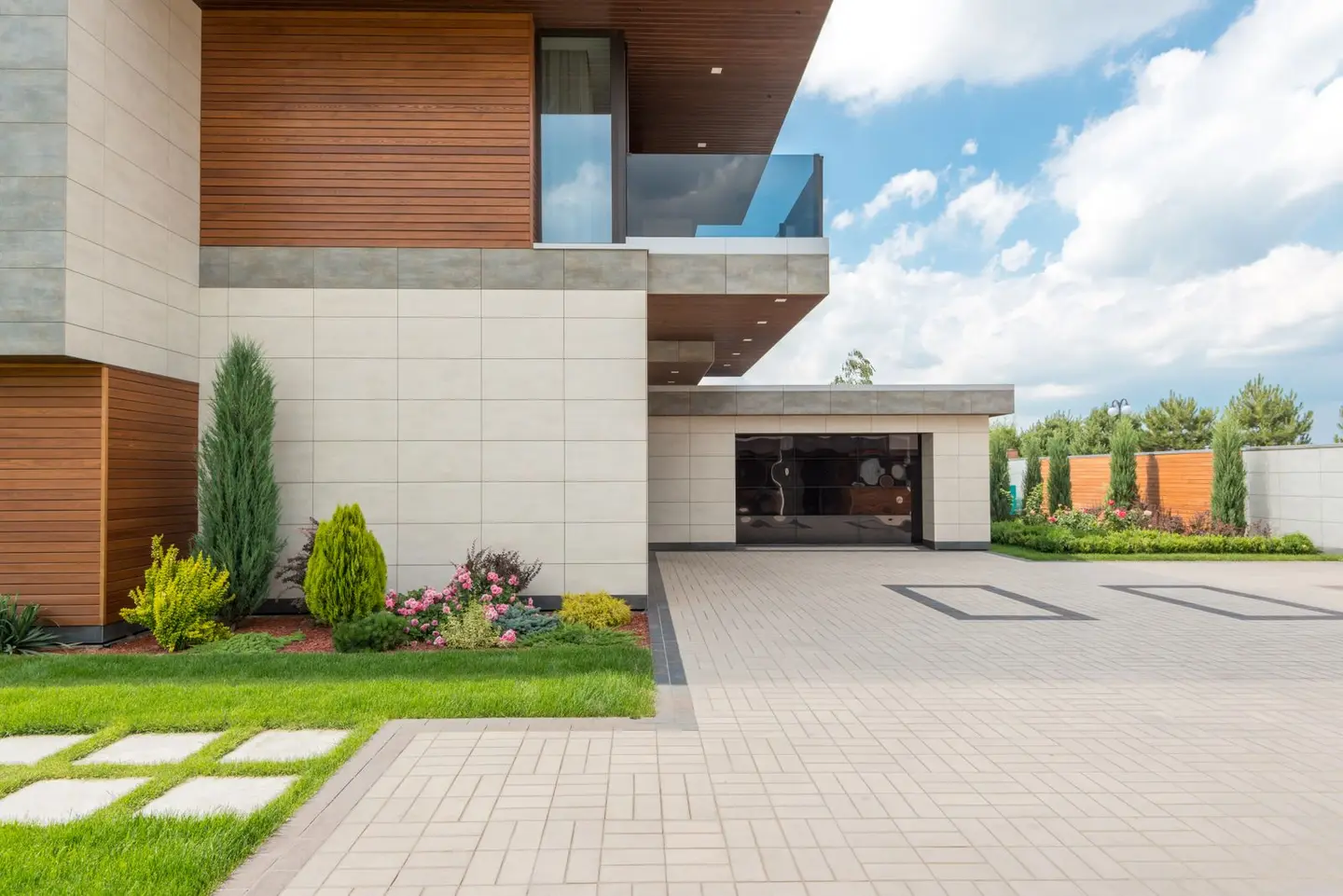
A new driveway is one of the most impactful changes you can make to a property’s kerb appeal and practical usability, but it also involves planning rules, drainage obligations, and contractor decisions that catch homeowners off guard. Getting the groundwork right before a single spade goes in is what separates a driveway that performs well for 15–25 years from one that cracks, floods, or falls foul of enforcement action.
A new driveway in the UK in 2026 can cost from under £2,000 for a modest gravel or tarmac drive (40 m² of tarmac is about £1,600–£2,800 on the rates below) to £12,000 or more for a large block paving or resin-bound installation with kerbs and drainage works. This checklist covers every stage of the planning and installation process.
Step 1: Check Whether You Need Planning Permission
In England, front driveways are subject to specific planning rules that came into force on 1 October 2008 and now sit in Class F of Part 1 of Schedule 2 to the Town and Country Planning (General Permitted Development) (England) Order 2015.1 The key principle: if the surface is permeable, or rainwater from it is directed to a lawn, border or soakaway on your own land, no planning permission is needed; a front hard surface of more than 5 square metres that does neither needs planning permission.2
Permitted development applies if you are:
- Installing a new hard surface of any size at the front of your house, and
- The surface allows rainwater to drain through it (permeable block paving, gravel, resin-bound with permeable base) or surface water is directed to a lawn, border, or soakaway, not to the public highway or sewer
If your proposed surface is impermeable (standard tarmac, concrete, standard block paving with jointed mortar), covers more than 5 square metres, and its water is not directed to a permeable area within your property, you will need planning permission.2
For rear driveways or drives not serving the principal elevation, different rules may apply, check with your local planning authority if unsure.
Step 2: Understand SuDS and Drainage Requirements
Sustainable Drainage Systems (SuDS) are designed to manage surface water at source rather than discharging it to the public sewer, reducing flood risk and pollution. For new driveways, your SuDS obligations depend on the type of surface:
- Permeable surfaces (permeable block paving, gravel, resin-bound with open-grade base): water drains through the surface and into the sub-base, filtering naturally, these inherently comply
- Impermeable surfaces with a soakaway: water runs off the surface into a drainage channel, then into a soakaway (a rubble-filled pit or plastic crate system) in the garden, this also complies if the soakaway is properly designed
- Running water onto a lawn or border: acceptable if the volume is manageable and there is no risk of flooding neighbours or the highway
- Running to the public highway or sewer: not permitted without planning consent
A drainage contractor or civil engineer can assess your soil type (drainage rates vary hugely, clay drains slowly, sandy soils quickly) and size a soakaway appropriately. Soakaway installation costs depend on the depth and capacity needed and on the ground, so ask for the soakaway to be priced as its own line in the quote.
Step 3: Choose Your Material
| Material | Supply & install cost (per m²) | Lifespan | Maintenance |
|---|---|---|---|
| Gravel (loose) | £15–£35 | 5–10 years (top up periodically) | Rake periodically; edge restraints needed |
| Tarmac / macadam | £40–£70 | 15–25 years | Seal every 3–5 years |
| Block paving (concrete) | £80–£1203 | 20–30 years | Re-sand joints every few years |
| Block paving (natural stone) | £100–£160 | 30+ years | As above; higher upfront cost |
| Resin bound (permeable) | £70–£1104 | 15–25 years | Low; UV-stable resins resist fading |
| Pattern-imprinted concrete | £50–£85 | 15–20 years | Seal every 2–3 years; can crack |
| Loose slate / decorative aggregate | £20–£45 | 5–10 years | Rake and top up |
The cited prices in this table were published in 2024 and brought to 2026. What that means.
Tarmac is generally the most cost-effective hard surface; block paving and resin bound cost more but offer better aesthetics and, in the case of resin bound, inherent permeability.
For a typical 40m² driveway, indicative total costs: tarmac £1,600–£2,800; block paving £3,200–£4,800; resin bound £2,800–£4,400.
Step 4: Plan the Layout and Levels
Before contacting contractors, think through:
- Size and shape: measure the area accurately. Allow for turning space if needed, can you currently manoeuvre safely onto the drive?
- Levels: does the existing ground slope towards the house? Surface water must fall away from the building. Where a drive has to slope towards the house, government guidance is to fit a drainage channel to collect the water before it reaches the building.1
- Edge restraints: all loose or semi-rigid surfaces need haunched concrete edging or similar restraints to prevent spread. Factor this into the quote.
- Existing surfaces: if there is an existing drive, the cost of breaking it out and taking the old material away will be added, and on an old concrete drive this can be a significant line in the quote.
- Dropped kerb: if you do not have an existing dropped kerb, you will need one before vehicles can use the drive legally. This requires approval from the local highway authority, which charges a non-refundable application fee (about £180–£300 at the councils we checked) and then builds the crossing or has its approved contractor do it; published council prices for the construction run from about £1,575 to £3,050.
Step 5: Get Quotes and Evaluate Contractors
Getting at least three quotes is strongly recommended for any driveway project over £1,500. When requesting quotes:
- Ask for a written itemised quote (not a verbal price or a single-line estimate)
- Confirm what the quote includes: excavation, sub-base, surface material, edging, drainage, waste removal, and any site reinstatement
- Check the specification: what depth of sub-base? What grade of material? MOT Type 1 sub-base, commonly 100–150mm deep, is the usual base for a conventional drive, but a permeable drive needs an open-graded stone sub-base instead, because Type 1 holds too much fine material to let water through1
- Ask to see previous work: request two or three completed examples you can view in person or by photograph
- Check for reviews: Google and Checkatrade reviews from the last 12 months are more reliable than those from 3+ years ago
- Confirm waste disposal: spoil, concrete, and old asphalt must be disposed of at a licensed facility. Ask if this is included or if you will receive a waste transfer note
Step 6: Contractor Checks
| Check | Why it matters |
|---|---|
| Are they VAT registered? | Driveway companies with turnover above the threshold (£90,000 in 2026) must be VAT registered; ask for their VAT number |
| Do they carry public liability insurance? | Ask for a copy of the certificate and check the cover limit and expiry date; it is not a legal requirement, so do not assume they have it |
| Will they provide a written contract? | A contract sets out the spec, price, payment schedule, and completion date, do not proceed without one |
| Do they require a large deposit? | A modest deposit is common, often 10–25%; be wary of anyone asking for 50% or more upfront |
| Are they members of a trade body? | BALI (British Association of Landscape Industries) membership, or a paving manufacturer’s approved-installer scheme, provides some quality assurance |
| Do they handle planning if needed? | If you need planning permission, confirm who is responsible for the application |
A trader must register for VAT once taxable turnover over the last 12 months goes over £90,000, so a smaller firm may quite properly charge no VAT.5
Step 7: Driveway Checklist Summary
Use this list to track progress through your project:
- Measured the area and sketched the layout
- Checked whether planning permission is required (surface type and drainage)
- Confirmed whether a dropped kerb exists or needs to be applied for
- Assessed drainage options (permeable surface, soakaway, or surface run-off to garden)
- Chosen material and confirmed it meets SuDS/planning requirements
- Obtained at least three written, itemised quotes
- Checked contractor reviews, insurance, and VAT registration
- Confirmed the specification (sub-base depth, material grade, edging type)
- Signed a written contract with payment schedule
- Agreed completion date and access arrangements
Timescales
Most standard driveways, up to around 60m², can be completed in 2–4 days once the contractor is on site. Allow 2–4 weeks for scheduling after accepting a quote. Planning permission, if required, adds at least two months: a householder application should normally be decided within 8 weeks of submission.1 A dropped kerb application can also take several weeks, so check your highway authority’s stated timescale.
Start the process earlier than you think you need to, good driveway contractors book up fast, especially in spring and early summer.
References (5)
Figures in this note were checked against the sources below on 30 September 2026. Superscript numbers in the text point to them. Every source the site cites, by topic.
- 1technicalvery strongDepartment for Communities and Local Government, guidance.RN-91Z38WGovernment guidance for householders on paving front gardens. Its construction section describes about 150 mm of compacted sub-base over a geotextile for a driveway.
- 2technicalvery strongThe National Archives (legislation.gov.uk), legislation.RN-4C9X4BClass F permits the provision within the curtilage of a dwellinghouse of a hard surface for any purpose incidental to the enjoyment of the dwellinghouse, or its replacement in whole or in part. Condition F.2 applies where the hard surface would lie between a wall forming the principal elevation and a highway and its area would exceed 5 square metres: the surface must then be made of porous materials, or provision made to direct run-off water to a permeable or porous area or surface within the curtilage.
- 3costvery strongValuation Office Agency, a government page.RN-RSLGJ5A price, true at 2024-04, brought forward on the Construction Output Price Index. The Valuation Office Agency's Rating Cost Guide 2026: estimated replacement costs per square metre for building types, used by the VOA for contractor's basis rating valuations. Each code gives a construction description, the unit of measurement and an ERC at a UK mean location factor of 1.00. It is official, free and unusually comprehensive, and it is a replacement cost for rating rather than a market tender price, which is why the guidance notes matter as much as the table.
- 4costsupplier figureStoneSet Resin.RN-7L9XC4A price, true at 2026-09. a resin driveway installer's own customer-facing range for a resin bound driveway in 2026, £60 to £120 and above per square metre. It is the retail counterpart to the trade split published by Advanced Resin Solutions, and the two together are why this rate no longer rests on aggregated quote data alone
- 5technicalvery strongHM Revenue and Customs (GOV.UK), a government page.RN-J2B1F3When a business must register for VAT: the taxable turnover threshold, the backward and forward look tests, and voluntary registration. This is why a small builder's quote may carry no VAT at all while a larger firm's carries 20% on the same work, which is a genuine price difference and not a discount.
-
Guidance on the permeable surfacing of front gardens, Department for Communities and Local Government, accessed 30 September 2026. assets.publishing.service.gov.uk
-
The Town and Country Planning (General Permitted Development) (England) Order 2015, Schedule 2, Part 1, Class F, The National Archives, accessed 30 September 2026. legislation.gov.uk
-
Rating Cost Guide 2026, codes 33U1KA, 33U1KF and 33U1P5, Valuation Office Agency, accessed 16 September 2026. Priced at 2024-04; brought to 2026 on the Construction Output Price Index, housing repair and maintenance (Great Britain), published by Office for National Statistics, a factor of 1.0239. assets.publishing.service.gov.uk
-
How Much Does a Resin Bound Driveway Cost in 2026?, StoneSet Resin, accessed 30 September 2026. Priced at 2026-09, so no calibration is needed. stonesetresin.co.uk
-
Register for VAT: when to register, HM Revenue & Customs (GOV.UK), accessed 30 September 2026. gov.uk