Plastering a wall yourself is one of the more rewarding DIY projects, but also one of the hardest to master on a first attempt. The technique is unforgiving: once the plaster starts to set, you have a narrow window to work it smooth. With the right preparation, the correct materials for your substrate, and an understanding of what “green” plaster looks like, a beginner can achieve a finish good enough to paint without hiring in a tradesperson.
This guide covers a two-coat system, a backing (base) coat followed by a finish coat, which is the correct approach for most UK walls that have been stripped back to brick or blockwork. Bare plasterboard and existing sound plaster need only the finish coat, which follows the same finish-coat steps.
Tools and Materials Checklist
Get everything together before you start. Once you mix plaster you cannot leave it to hunt for a trowel.
Tools:
- Plasterer’s hawk (300 × 300 mm)
- 480 mm stainless steel finishing trowel
- 450 mm feather-edge rule (or a longer aluminium straight-edge)
- Mixing bucket (25-litre minimum)
- Corded drill with mixing paddle (600–750 W)
- Corner bead applicator or tin snips
- Bucket of clean water and a sponge
- Step ladder and good lighting (side-rake a work light to spot imperfections)
Materials (per 10 m² of wall):
- 3–4 × 25 kg bags Thistle Hardwall or a similar gypsum undercoat (Thistle Bonding Coat on smooth, low-suction backgrounds such as concrete)
- 1 × 25 kg bag Thistle Multi-Finish or Thistle Board Finish
- Suction-control primer or bonding agent to suit the wall (see below)
- Metal angle beads and 25 mm galvanised screws or staples
- Clean tap water
At 11 mm, a 25 kg bag of Thistle Hardwall covers about 3 m², so 10 m² of wall takes three to four bags.1 A 25 kg bag of Multi-Finish covers about 10 m² at 2 mm.2
Preparing the Surface
Sound preparation determines 80% of the result.
- Remove all dust, grease and loose material. Wire-brush crumbling mortar joints on brick; scrape away any old wallpaper adhesive.
- Control the suction. British Gypsum’s guidance is a suction-control primer (Thistle GypPrime) on high-suction backgrounds and a bonding agent (Thistle Bond-it) on smooth or low-suction ones.3 Many plasterers use diluted PVA instead; if you do, plaster onto it while it is still tacky, and follow the plaster maker’s instructions.
- Fix angle beads to all external corners using a spirit level. Beads define the final thickness and give you a guide to rule off against.
- Check for services. Mark the position of any cables or pipes with a felt tip before plastering over them.
Mixing the Plaster
Always add plaster to water, not water to plaster.
- Put about 11.5 litres of clean cold water in the bucket for a 25 kg bag of Multi-Finish; a bag of Hardwall takes about 15 litres.2
- Add plaster steadily while mixing with the paddle drill on a low speed.
- Aim for a smooth, lump-free consistency like thick yoghurt.
- Clean the bucket and paddle immediately after use, hardened plaster accelerates the set of your next mix.
Do not add extra water once mixed. Retempering (rewetting) destroys the chemical set and results in weak, powdery plaster.
Applying the Backing Coat
The backing coat builds thickness, typically 8–11 mm, and provides a mechanical key for the finish coat.1
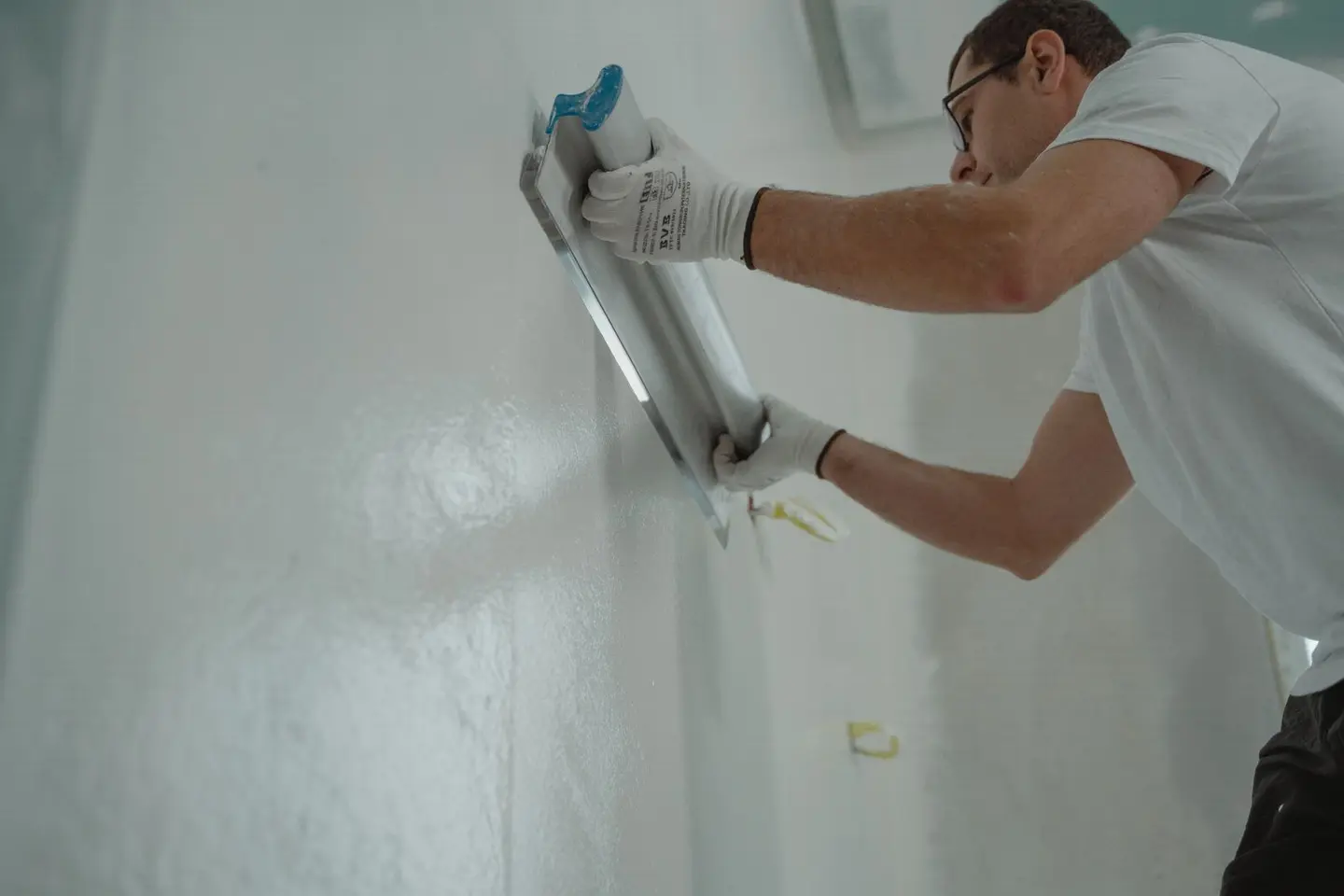
- Load the hawk and cut off a strip onto the trowel.
- Apply from the bottom up in firm, sweeping upward strokes. Keep the trowel at roughly 15° to the wall.
- Rule off horizontally with the straight-edge between angle beads to establish a flat plane. Fill any hollows and rule off again.
- Scratch the surface with a devilling float or comb scratcher before it fully sets (typically 45–90 minutes after application). These horizontal scratches provide the key.
- Allow to firm up, usually 2–4 hours depending on temperature and suction. The surface should feel hard to the touch but still slightly cool.
Applying the Finish Coat
This is the coat you see. Work quickly: a mix of Multi-Finish has a working time of about 40 minutes and a minimum set time of about 90 minutes.2
| Stage | Timing | Trowel Angle |
|---|---|---|
| First coat, about 1 mm | 0–20 min | 10–15°, lay material on |
| Second coat, to at least 2 mm in total | 20–45 min | 5–10°, compress and level |
| Closing in | 45–60 min | 5–10°, flatten and fill |
| First and second trowel | 90–100 min | 2–5°, tight to wall, damp brush or sponge |
| Final trowel | about 120 min | 1–2°, close trowel to a matt finish |
These timings follow British Gypsum’s instructions for Multi-Finish, which put closing in at 45–60 minutes and the final trowel at about 120 minutes; high-suction walls shorten them and cold weather lengthens them.4
- Apply the finish plaster in two thin coats, about 1 mm and then enough to bring the total to at least 2 mm, onto the firm, scratched backing coat.
- Rule off with the straight-edge using a gentle figure-of-eight motion to remove ridges.
- As the plaster tightens (the sheen starts to leave it), make tighter trowel passes, slightly wetting the face of the trowel with a damp sponge.
- Do not over-trowel. Burnishing too early tears the surface; too late and it drags.
Drying, Curing and Painting
| Stage | Typical Time at 18°C | Notes |
|---|---|---|
| Touch-dry | 1–2 hours | Do not touch or knock |
| Through-dried (backing + finish) | 4–7 days | Colour changes from dark to uniform pale pink/cream |
| Ready for mist coat | 4–7 days minimum | Diluted emulsion (70/30 paint:water) seals the surface |
| Ready for full decoration | 10–14 days | Full moisture out |
Never apply heat to speed drying, it causes cracking and hollows. Keep the room above 2°C until the plaster is dry, which is British Gypsum’s minimum for Multi-Finish, and avoid very hot, dry conditions.3
Cost Breakdown
| Item | Typical Cost |
|---|---|
| Materials (per 10 m², two coats) | £65–£95 |
| Hired plasterer (per m², labour only) | £8–£18 |
| Hired plasterer (per m², supply & fix) | £15–£28 |
| Re-skim a medium room (about 3.3 × 3 m, walls only, hired out) | £400–£1,250 ex VAT |
London and South-East rates sit at the top of these ranges; Wales, the North and Midlands at the lower end.
A 25 kg bag of Thistle Hardwall was about £15.60 at a builders’ merchant in September 2026.1 A 25 kg bag of Multi-Finish was about £10.70.2 Three to four bags of Hardwall and one of Multi-Finish for 10 m² therefore come to roughly £57–£73, before beads and primer. Which?’s November 2025 survey of its Trusted Traders put re-skimming the walls of a medium room, about 3.3 m by 3 m, at £400–£1,250 excluding VAT.5
Common Beginner Mistakes
- Mixing too stiff or too sloppy, both make trowelling harder. Test a small amount first.
- Skipping suction control on high-suction brick walls, the backing coat dries too fast to work.
- Applying finish coat too thick, 2–3 mm is enough; thicker coats crack.
- Stopping mid-wall, wet edges blend; dry edges leave ridges.
- Painting too soon, new plaster is alkaline. A mist coat neutralises this and prevents paint from peeling.
When to Call a Professional
Plastering is a genuine skill. If your wall area exceeds 15 m², involves curved surfaces or archways, or the existing substrate is uneven by more than 12 mm, a competent tradesperson will produce a far better result more quickly. Flatness tolerances come from new-home warranty standards rather than the Building Regulations: LABC Warranty’s technical manual allows a maximum deviation of ±3 mm under a 2 m straight-edge on internal walls, a useful benchmark to agree with a plasterer before work starts.6 That matters most on a new build or conversion, where a building control officer will also be inspecting the work.
A one-day plastering course (typically £150–£250) through a local college or specialist training centre can pay for itself on the very first room.
References (6)
Figures in this note were checked against the sources below on 30 September 2026. Superscript numbers in the text point to them. Every source the site cites, by topic.
- 1technicalsupplier figureBuilder Depot, guidance.RN-IJ8U4WMerchant product page reproducing British Gypsum's technical data for Thistle Hardwall undercoat plaster: coverage of 3 m² per 25 kg bag at 11 mm, which gives three to four bags per 10 m².
- 2technicalsupplier figureBuilder Depot, guidance.RN-XKTCXDMerchant product page reproducing British Gypsum's technical data for Thistle Multi-Finish: coverage of 10 m² per 25 kg bag at a 2 mm thickness.
- 3technicalsupplier figureBritish Gypsum, guidance.RN-9N3R5GBritish Gypsum's own plaster selector guide (hosted on Travis Perkins' document store because british-gypsum.com is behind a bot challenge). It specifies GypPrime for high-suction and Bond-it for low-suction or smooth backgrounds.
- 4technicalsupplier figureB&Q, guidance.RN-JYSW60Retailer product page carrying the maker's step-by-step timetable for Multi-Finish: two coats to at least 2 mm, closing in at 45–60 minutes, trowelling at 90 and 100 minutes and a final trowel at 120 minutes.
- 5costfairWhich?.RN-8TMWBNA price, true at 2026-09. Which? cost guide based on a survey of nine Trusted Traders in November 2025; it prices re-skimming the walls of a medium room of about 3.3 m by 3 m at £400–£1,250 excluding VAT.
- 6technicalvery strongLABC Warranty, guidance.RN-P8UQ7TLABC Warranty's new-home technical manual, tolerances section: internal walls must be flat to a maximum deviation of ±3 mm measured with a 2 m straight edge.
-
British Gypsum Thistle Hardwall 25kg, Builder Depot, accessed 30 September 2026. builderdepot.co.uk
-
British Gypsum Thistle Multi Finish Plaster 25kg, Builder Depot, accessed 30 September 2026. builderdepot.co.uk
-
The Thistle plaster selector guide, British Gypsum, accessed 30 September 2026. dam-assets.apps.travisperkins.group
-
Thistle MultiFinish Plaster, 25kg, 25L Bag, B&Q, accessed 30 September 2026. diy.com
-
How much does plastering cost?, Which?, accessed 30 September 2026. Priced at 2026-09 and left there. which.co.uk
-
Technical Manual Version 11, Section 20: Tolerances, LABC Warranty, accessed 30 September 2026. labcwarranty.co.uk