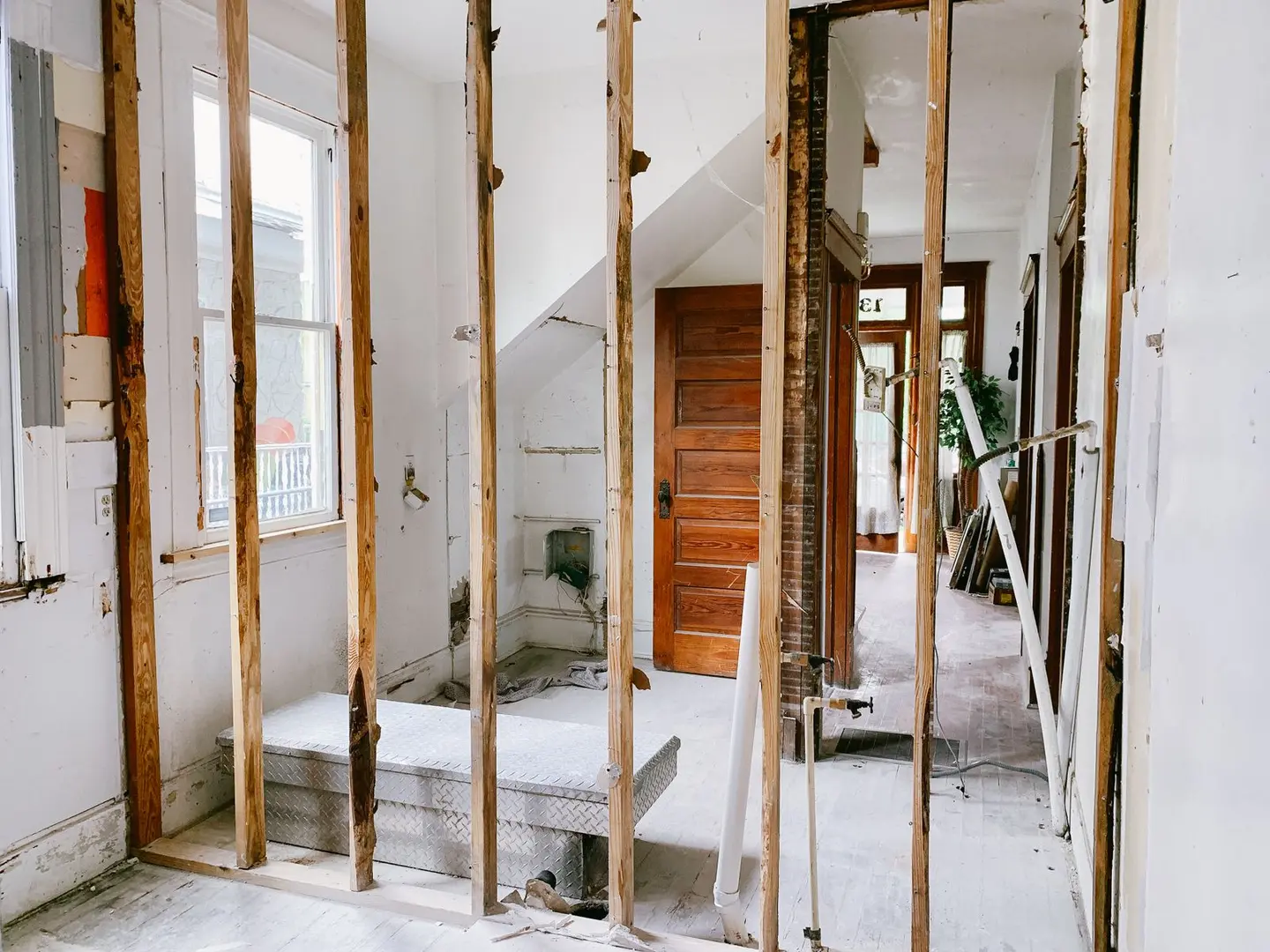
Standing in a damp, tired house with sagging floors and a crumbling roof, it is tempting to conclude that knocking it all down and starting again would be simpler. Sometimes it is. More often, it is not, demolition and rebuild is almost always more expensive than renovation, takes longer and carries its own planning risks.
But “almost always” leaves room for exceptions. There are houses so structurally compromised, so poorly laid out, or so thermally inefficient that renovation would cost more than demolition and construction of a higher-quality replacement. Knowing which situation you are in requires an honest appraisal of the structure, a realistic cost comparison and a clear view of your planning position.
The cost comparison: renovation vs rebuild
These are the headline figures for England and Wales in 2026. Costs vary significantly by location, specification and project complexity; London adds roughly 20–30% to all figures.
| Scope | Cost range (£/m² of floor area) | Notes |
|---|---|---|
| Light renovation (cosmetic + M&E update) | £300–£600/m² | Kitchens, bathrooms, redecoration, new boiler |
| Medium renovation (structural + full M&E) | £700–£1,100/m² | Some structural work, rewire, replumb, new roof |
| Heavy renovation (gut-strip + extension) | £1,100–£1,600/m² | Full strip-back, structural alterations, extension |
| Demolition and rebuild (standard specification) | £1,800–£2,400/m² | Includes demolition, groundworks, structure, fit-out |
| Demolition and rebuild (high specification) | £2,400–£3,500/m² | Passive house, high-end finishes, architect-designed |
| Demolition costs (standalone) | £8,000–£25,000 | Dependent on size, access, asbestos, materials disposal |
These figures are for the build itself. Add professional fees (architect, structural engineer, project manager) at 10–18% of construction costs, and factor in VAT: renovation of an existing dwelling is usually standard-rated at 20%, with the reduced 5% rate available mainly on conversions and on a home that has not been lived in during the two years before work starts, while new build is zero-rated, which is a meaningful financial advantage for rebuild.1
VAT: the rebuild advantage
New builds benefit from zero-rated VAT on the builder’s construction work and the materials they supply (VATA 1994, Schedule 8, Group 5), provided any pre-existing building is demolished completely to ground level first.1 Architects’, surveyors’ and other consultants’ fees stay standard-rated either way.1 Most renovation work is standard-rated at 20%, though there are important exceptions: converting non-residential premises into a dwelling, or changing the number of dwellings, can be charged at 5%, and so can renovating a home that has not been lived in during the two years before work starts.1 The builder charges the same 5% on the materials they supply and fix, not just on the labour.1
For a 150 m² house costing £2,000/m² to rebuild (£300,000 in construction costs), zero-rated VAT saves around £60,000 compared to a renovation at 20%. This is a genuine financial argument in favour of rebuild that is often overlooked.
Planning considerations
Planning is not merely a formality, it can decide the question for you.
Permitted development rights for rebuild: Knocking down a house and building a new one needs full planning permission for the new house.2 Demolition on its own can be permitted development under Part 11, Class B of the General Permitted Development Order, subject to first asking the council whether it needs to approve the method of demolition and any restoration of the site, but permission to demolish does not mean permission to rebuild.3 The Part 20, Class ZA right to demolish and rebuild covers purpose-built detached blocks of flats and certain detached commercial buildings, not houses.4 The council will assess the proposal against local and national policy as if it were any other new development.
Replacement dwellings in the Green Belt: Planning policy in England (National Planning Policy Framework, policy GB7(1)(b)) allows replacement dwellings in the Green Belt provided the new house is for the same use and not materially larger than the one it replaces.5 Extending the existing house instead is judged against the original building, meaning the house as it stood on 1 July 1948 or as first built if later, and must not be a disproportionate increase in size.5 This can make rebuild viable where it would otherwise be refused, but the size restriction is limiting, you cannot use a rebuild as a vehicle to double the footprint.
Flood zones and contaminated land: A replacement house is a new dwelling, so in Flood Zones 2 and 3 the application needs a site-specific flood risk assessment.6 It may also face the flood risk sequential test, from which national policy exempts householder development such as extensions.6 Similarly, the council can attach land contamination conditions to the permission for a new house, requiring investigation and any remediation, which a renovation that needs no planning application would not trigger.
Permitted development rights after rebuild: a new dwelling on a cleared site starts with its Class A, B and C householder rights unused, whereas a heavily extended existing house may have used some of these allowances already. This is a subtle but real benefit of rebuilding, with two cautions. If the new dwelling is itself built under Part 20 of Schedule 2, Classes A, B and C are expressly not available to it.78 And the planning permission for the replacement can withdraw some permitted development rights by condition, so read the decision notice.9
Structural condition: the core question
The most important input to the renovate-or-rebuild decision is the condition of the existing structure. Commission an RICS Level 3 Home Survey (formerly called a building survey) from an RICS-regulated surveyor before committing to either route, and a structural engineer’s report where the survey raises structural concerns.10 Key questions:
- Foundations: Is there evidence of subsidence, heave or inadequate depth? Underpinning an existing house costs £10,000–£30,000 and upward; rebuilding removes the problem.
- Structure: Are the walls solid load-bearing brick or block in adequate condition, or cavity walls with failed wall ties? Retying costs £1,500–£4,000 but is manageable. Crumbling solid walls are a different matter.
- Roof structure: Is the roof structure sound? A Victorian cut-rafter roof in reasonable condition can be re-slated economically; a trussed rafter roof with rotten members in an inaccessible ceiling may cost more to repair than a new structure.
- Thermal performance: An inter-war or early post-war house may have a U-value of 1.5–2.0 W/m²K for walls. Its single-glazed windows, if any remain, are assessed at 4.8 W/m²K in timber or PVC frames and 5.7 W/m²K in metal ones.11 Bringing it to EPC band C or better through retrofit is possible but expensive: external wall insulation, triple glazing, new ventilation. A new build under the 2021 Part L standards is measured against a notional dwelling with 0.18 W/m²K walls.12 Each new wall must also be no worse than 0.26 W/m²K.12 If you want a Passive House (walls typically around 0.10–0.15 W/m²K), new build is dramatically easier and usually cheaper to achieve.
- Contamination: Homes built or refurbished before 2000 may contain asbestos in artex, floor tiles, pipe lagging or roof sheets.13 Before demolition or major refurbishment the survey needed is a refurbishment or demolition survey, which must find asbestos hidden in the building fabric before structural work starts.14 A survey for a house typically costs a few hundred pounds; removal runs from a few hundred pounds for a small item to tens of thousands for extensive work.
When rebuild makes sense
Consider demolition and rebuild seriously when:
- The structure has severe, recurring or expensive-to-fix issues (failing foundations, irreparable damp, collapsed roof)
- The layout is so poor that the cost of structural reconfiguration rivals new build
- You want to maximise energy performance and Passive House or near-zero-carbon is your goal
- The existing gross internal area is so small that an extension is needed anyway, and the extension plus renovation cost approaches or exceeds rebuild cost
- You are in a planning context that allows replacement (Green Belt replacement, or the existing house has no architectural merit and the council indicates it would grant permission for a contemporary replacement)
- The site has VAT-advantaged status (zero-rated rebuild saves substantial sums on high-specification projects)
When renovation makes more sense
Renovation is usually the better choice when:
- The existing structure is fundamentally sound, good foundations, solid walls, decent roof structure
- There is architectural or historic merit to the building that a rebuild would destroy (listed building consent would almost certainly be refused for demolition)
- The budget is constrained and you can phase the work over several years
- Planning risk is high, the site is restricted, the council is conservative, or a rebuild would not be permitted at the size you want
- The property is tenanted and you need to manage disruption
A worked example
A 1930s semi-detached in the Midlands: 80 m² gross internal area, valued at £220,000 in current poor condition.
Option A, heavy renovation: Re-roof (£12,000), rewire (£6,000), replumb (£8,000), structural wall removal with steel (£15,000), insulation and windows (£18,000), kitchen and bathrooms (£22,000), general works and decoration (£15,000). Total: approximately £96,000 + 15% fees = £110,400. Post-work value estimate: £290,000–£310,000.
Option B, demolition and rebuild to 120 m²: Demolition (£12,000), planning and fees (£18,000), new build at £2,000/m² = £240,000, finishes and externals (£20,000). Total: approximately £290,000. Post-work value estimate: £380,000–£420,000 for a new, larger, energy-efficient house.
Option B creates more value, but requires £180,000 more investment and carries planning risk. Only the right buyer with the right budget and planning confidence should pursue it. For most owners, Option A is the rational choice.
Phasing and interim living
One often-overlooked factor is where you live during works. Renovation can sometimes be phased so one part of the house is habitable; demolition and rebuild is absolute, you need alternative accommodation for the entire build programme, typically 12–18 months. Renting during this period adds £12,000–£30,000 or more to the rebuild cost, depending on location.
Factor this in before the numbers appear to favour rebuild.
References (14)
Figures in this note were checked against the sources below on 30 September 2026. Superscript numbers in the text point to them. Every source the site cites, by topic.
- 1technicalvery strongHM Revenue & Customs, guidance.RN-KBNHMBHMRC's main VAT notice for building work, last updated 26 August 2026. Sets out that construction of a new building and work to an existing building is normally standard rated at 20%, with exceptions: 0% for new qualifying dwellings and for housing association conversions of non-residential buildings, and 5% for a 'changed number of dwellings' conversion (section 7) and for renovation or alteration of a dwelling not lived in during the 2 years immediately before work starts (section 8, conditions at 8.1.2 and 8.3). Cites the law: VAT Act 1994 section 30 and Schedule 8 Group 5 for zero rating, section 29A and Schedule 7A Groups 6 and 7 for the reduced rate. Also explains the developer input tax block on goods that are not building materials (VAT (Input Tax) Order 1992 articles 2 and 6) and points self builders to the DIY housebuilders refund scheme.
- 2technicalvery strongPlanning Portal (MHCLG and TerraQuest), guidance.RN-6RE3SAExplains when demolition needs consent: any demolition in a conservation area needs approval, and full planning permission is required to demolish pubs, concert halls, theatres and live music venues, or buildings made unsafe or uninhabitable. Permitted development rights for demolition do not apply where the land is already subject to a planning permission for redevelopment. Stresses that consent to demolish does not carry any right to build a replacement.
- 3technicalvery strongThe National Archives (legislation.gov.uk), legislation.RN-RZS9QPPart 11 Class B permits any building operation consisting of the demolition of a building, but B.1 excludes it where: (a) the building was rendered unsafe or uninhabitable by the action or inaction of a person with an interest in the land and could be made safe by repair or temporary support; (b) the demolition is 'relevant demolition' for the purposes of section 196D of the Act, i.e. an unlisted building in a conservation area; (c) the building was last used as a drinking establishment (Use Classes Order article 3(6)(p) or (q)); (d) it was last used as a concert hall, live music venue or theatre; (e) it is a statue, memorial or monument in place for at least 10 years, with five exceptions including one within the curtilage of a dwellinghouse. This is the provision that makes conservation area demolition a planning application rather than permitted development.
- 4technicalvery strongThe National Archives, guidance.RN-93V058GPDO 2015 Part 20 Class ZA: the demolish-and-rebuild right applies to a purpose-built detached block of flats or certain detached commercial buildings.
- 5technicalvery strongMinistry of Housing, Communities and Local Government, guidance.RN-N9YVG3NPPF (August 2026) policy GB7(1)(b): replacement buildings in the Green Belt are not inappropriate if for the same use and not materially larger.
- 6technicalvery strongMinistry of Housing, Communities and Local Government, guidance.RN-C20SVXNPPF (August 2026) flood risk chapter: every development proposal in Flood Zones 2, 3a and 3b needs a site-specific flood risk assessment.
- 7technicalvery strongThe National Archives (legislation.gov.uk), legislation.RN-5QRXP7Class C permits any other alteration to the roof of a dwellinghouse, which is the right rooflight and Velux loft conversions rely on. Paragraph C.1(b) makes development not permitted if the alteration would protrude more than 0.15 metres beyond the plane of the roof slope, measured perpendicular to the original roof plane, and C.1(c) if the highest part of the alteration would be higher than the highest part of the original roof. C.1(d) excludes chimneys, flues, soil and vent pipes and solar equipment from the class, and condition C.2 requires any window in a roof slope forming a side elevation to be obscure-glazed and non-opening below 1.7 metres above the floor of the room.
- 8technicalvery strongThe National Archives (legislation.gov.uk), legislation.RN-Z0XQ8VParagraph A.1 sets the householder extension limits: buildings may not cover more than 50 per cent of the curtilage (A.1(b)); a single-storey rear extension may not extend more than 4 metres beyond the rear wall of a detached house or 3 metres for any other house, nor exceed 4 metres in height (A.1(f)), rising to 8 metres and 6 metres under the larger home extension route (A.1(g)); an extension of more than one storey may not extend more than 3 metres beyond the rear wall or be within 7 metres of the rear boundary (A.1(h)); eaves within 2 metres of a boundary may not exceed 3 metres (A.1(i)); a side extension may not exceed 4 metres in height, have more than one storey or be wider than half the width of the original house (A.1(j)). Paragraph A.2 removes cladding and side or multi-storey rear extensions on article 2(3) land such as conservation areas. A.3 requires materials of similar appearance and obscure-glazed, non-opening upper-floor side windows unless the opening part is more than 1.7 metres above the floor, and A.4 sets the neighbour consultation (prior approval) procedure with its 42-day determination period.
- 9technicalvery strongMinistry of Housing, Communities and Local Government, guidance.RN-ZUBQTCPlanning practice guidance on conditions: councils can restrict permitted development rights by condition, which must say precisely which rights are withdrawn.
- 10technicalstrongRoyal Institution of Chartered Surveyors, guidance.RN-FNUWS8RICS's consumer guide to home surveys: the Level 1, 2 and 3 survey types, what each includes, and what they cost. The professional body that defines the levels, so this is the authority for what a Level 3 survey actually commits the surveyor to, as distinct from a lender's valuation, which is not a survey at all.
- 11technicalstrongBRE, guidance.RN-F7IWDSRdSAP 10 Table 24 default window values used for EPCs: single glazing of any age is 4.8 W/m2K in wood or PVC frames and 5.7 in metal frames.
- 12technicalvery strongMinistry of Housing, Communities and Local Government.RN-L0FCJXThe in-force U-value tables a DIY insulation or door note must quote, with the exact numbers. Table 4.2, limiting U-values for new fabric elements in existing dwellings, sets roof 0.15, wall 0.18, floor 0.18, swimming pool basin 0.25, window 1.4 or Window Energy Rating Band B minimum, rooflight 2.2, doors with more than 60 per cent of the internal face glazed 1.4 or Doorset Energy Rating Band C minimum, and other doors 1.4 or Doorset Energy Rating Band B minimum. Table 4.3, for existing elements, gives a roof threshold of 0.35 and an improved value of 0.16, which is the figure a loft insulation note needs: paragraph 4.12 says a retained element whose U-value is higher than the column (a) threshold, for example through a loft or garage conversion, should be upgraded to the column (b) value. Paragraph 4.13 allows a lesser upgrade only where the improved value is not technically or functionally feasible or would not achieve a simple payback of 15 years or less. Paragraph 4.8 requires a replacement element to be no worse than the one it replaces as well as meeting Table 4.2. Paragraph 4.10 gives the heritage exception: where character must be maintained, a centre pane U-value of no more than 1.2 or low-emissivity secondary glazing. Note 9 records that the timber window concession of 1.6 or Band C ended on 14 June 2023. The 2021 edition came into force on 15 June 2022; a 2026 edition exists at https://assets.publishing.service.gov.uk/media/69c122a6cfa346b9d4704a55/ADL1_2026.pdf.
- 13technicalvery strongHealth and Safety Executive, guidance.RN-5PLWW8HSE's asbestos frequently asked questions: the health risks, which work is licensed and which is not, what a householder may and may not do themselves, and where the free HSE publications are. The quickest authoritative answer to whether a particular job needs a licensed contractor.
- 14technicalvery strongHealth and Safety Executive, guidance.RN-W6ISC0HSE's definition of the two asbestos survey types, which is the correction for notes that invent a third or call it an R&D survey as though that were the formal name. A survey aims to give accurate information on the location, amount and condition of asbestos-containing materials, assess damage or deterioration and whether remedial action is needed, provide the information to produce an asbestos register and an asbestos management plan, and identify hidden ACMs to be removed before refurbishment work or demolition. There are two types: a management survey, whose main aim is to let the dutyholder produce the register and management plan and manage ACMs during normal occupation and use, and a refurbishment or demolition survey, which is the one needed before invasive works. Both types are likely to require sampling.
-
Buildings and construction (VAT Notice 708), HM Revenue and Customs, accessed 9 September 2026. gov.uk
-
Demolition: planning permission, Planning Portal, accessed 30 September 2026. planningportal.co.uk
-
The Town and Country Planning (General Permitted Development) (England) Order 2015, Schedule 2, Part 11, The National Archives, accessed 30 September 2026. legislation.gov.uk
-
The Town and Country Planning (General Permitted Development) (England) Order 2015, Schedule 2, Part 20, The National Archives, accessed 30 September 2026. legislation.gov.uk
-
National Planning Policy Framework, Chapter 13: Protecting Green Belt land (GB1 to GB8), Ministry of Housing, Communities and Local Government, accessed 30 September 2026. gov.uk
-
National Planning Policy Framework, Chapter 18: Managing flood risk and coastal change (F1 to F9), Ministry of Housing, Communities and Local Government, accessed 30 September 2026. gov.uk
-
The Town and Country Planning (General Permitted Development) (England) Order 2015, Schedule 2, Part 1, Class C, The National Archives, accessed 14 September 2026. legislation.gov.uk
-
The Town and Country Planning (General Permitted Development) (England) Order 2015, Schedule 2, Part 1, Class A, The National Archives, accessed 30 September 2026. legislation.gov.uk
-
Use of planning conditions, Ministry of Housing, Communities and Local Government, accessed 30 September 2026. gov.uk
-
House surveys: the costs, types and benefits of an RICS Home Survey, Royal Institution of Chartered Surveyors, accessed 30 September 2026. rics.org
-
RdSAP 10 Specification (12 February 2024), BRE, accessed 30 September 2026. files.bregroup.com
-
Approved Document L, Conservation of fuel and power, Volume 1: Dwellings, 2021 edition incorporating 2023 amendments, Ministry of Housing, Communities and Local Government, accessed 14 September 2026. assets.publishing.service.gov.uk
-
Asbestos - FAQs, Health and Safety Executive, accessed 30 September 2026. hse.gov.uk
-
The duty to manage asbestos in buildings: Arrange an asbestos survey, Health and Safety Executive, accessed 30 September 2026. hse.gov.uk