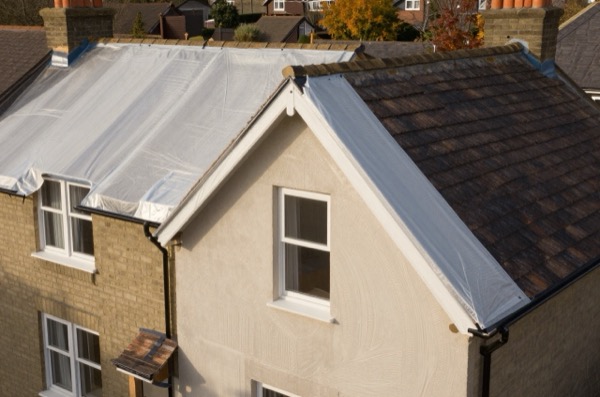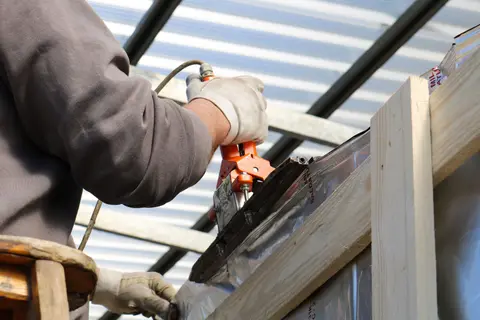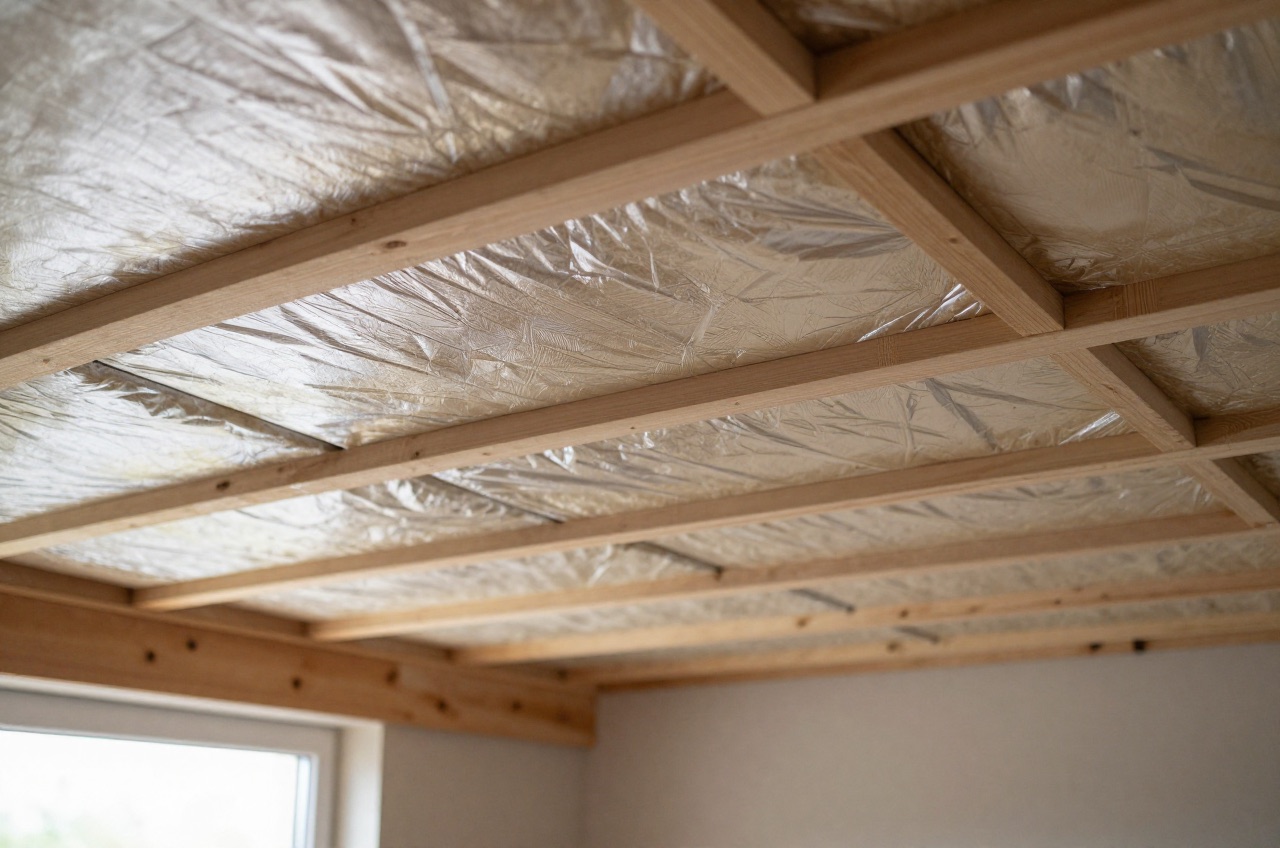
Few insulation products generate more controversy in the UK construction industry than multifoil reflective insulation. Some manufacturers have claimed equivalence to 200 mm or more of mineral wool from a product only 25–40 mm thick. The BRE and building control bodies have pushed back: BRE’s U-value conventions draw on Building Control Alliance guidance on using multifoil under Part L.1 The following is an attempt to set out what multifoil actually does, where the physics supports its use, and where it falls short.
How Multifoil Works
Multifoil products consist of multiple layers of low-emissivity (low-e) aluminium foil separated by thin wadding (polyester, bubble wrap, or foam spacers). The insulating effect comes from two mechanisms:
-
Radiation reflection: low-e aluminium surfaces have an emissivity of 0.03–0.05 compared to 0.9 for most building materials. A low-e surface reflects approximately 95–97% of incident long-wave (thermal) radiation rather than absorbing and re-emitting it.
-
Enclosed air layer resistance: each layer of foil with an adjacent air gap adds a small resistance to conductive and convective heat transfer.
The total thermal resistance (R-value) depends on the number of layers, the thickness of each air gap, and critically, the conditions on either side of the installed product. This is where the controversy lies. Reflective insulation only performs as claimed if there are still-air gaps (minimum 20–25 mm) on both sides of the product, those gaps are sealed from convection, and the surfaces facing the air gap are actually low-emissivity (not contaminated by dust or moisture, which raises emissivity toward conventional materials).1
Claimed vs Tested Performance
Declared performance comes from laboratory tests on the product, either of its core resistance and surface emissivity or in a hot box with an airspace on each side, under idealised conditions: perfect installation, clean foil surfaces, well-sealed air gaps, no air movement.1 Under these conditions a good multifoil product and its two airspaces together typically achieve R-values of approximately 1.5–2.5 m²K/W, which is equivalent to 65–110 mm of glass wool (λ 0.044).
What the calculation conventions say:
- BRE’s Conventions for U-value calculations (BR 443, 2019 edition) says U-values with multifoil should use test data for the specific product; where correctly measured data are missing, it sets a default of R 1.7 m²K/W for the multifoil and its adjacent airspaces together, roughly 70–75 mm of mineral wool.1
- That default rests on a 2005 BRE study, The thermal performance of multi-foil insulation, and on Building Control Alliance guidance.1
- Building control bodies and SAP assessors generally expect U-values based on accredited test data for the specific product, usually shown on a third-party certificate, rather than a marketing figure.1
The core issue is installation sensitivity. In a real roof construction, air gaps are often not sealed against convection, foil surfaces can pick up dust over time, and battens can compress the product and the air spaces beside it.1
Required Air Gaps and Installation Details
For a multifoil product to perform anywhere near its stated R-value, the following conditions must be met:
- Air gap on cold side (outer): minimum 25 mm between multifoil and roof deck or sarking board. This is typically achieved via counter-battens.
- Air gap on warm side (inner): minimum 25 mm between multifoil and internal ceiling or plasterboard. Achieved via service battens or studwork.
- Edges sealed: the perimeter of each air gap cavity must be sealed to prevent convective bypass; open-edged cavities allow warm air to circulate and dramatically reduce effective resistance.
- Foil surface condition: clean, uncompressed, facing into the cavity.
These requirements add installation complexity and material cost (counter-battens, service void). In many retrofit applications, the installation quality required is not achieved, and the product performs substantially below its stated value.
Where Multifoil Provides Genuine Value
There are applications where multifoil products offer a legitimate performance contribution:
Thin roof retrofits: where rafter depth is only 75–100 mm and there is no way to achieve adequate mineral wool depth without losing ceiling height, a multifoil over the rafter deck (under a ventilated counter-batten arrangement) combined with mineral wool in the rafter bays can contribute meaningfully to a much better roof U-value without major structural alteration. Approved Document L asks for 0.16 W/m²K when a roof is renovated, or the lowest U-value that is technically and functionally feasible with a simple payback of 15 years or less where that cannot be met.2
Agricultural buildings: most farm buildings are exempt from the Building Regulations, so Part L targets do not apply, and where condensation control is the primary concern (multifoils act as combined vapour control and partial insulation layer), multifoils are well-established and cost-effective.3
Summer shading in lightweight construction: in garden buildings, home offices and similar, reflective foils under a thin roof can reduce solar heat gain in summer, a useful benefit that complements rather than replaces insulation.
Under floor (suspended timber): a multifoil fixed below the joists can add some resistance and useful draught resistance, but only a sealed air gap above it earns the low-emissivity benefit, because BRE’s conventions do not apply the low-emissivity airspace value to a surface facing the ventilated void under a suspended floor.1
Where It Doesn’t Work
Multifoil cannot substitute for conventional insulation in the following scenarios:
- Cold loft floors: the installation conditions required (sealed air gaps, clean foil) are not achievable on a horizontal surface with foot traffic above
- Full-fill cavity walls: with no air gap on either side, the low-emissivity surfaces do nothing and only the thin core of the product adds resistance1
- Under solid floors: no air gap; no radiant mechanism
- As the sole insulation in a Part L compliant new build: building control will require evidence of U-value compliance, and multifoil-only systems cannot reliably achieve the 0.16 W/m²K limiting roof U-value, let alone the lower values most designs need, in habitable roof constructions without substantial supplementary insulation2
Cost and Comparison
| Product | Supply cost (£/m²) | Realistic R-value (m²K/W) | Effective mineral wool equiv. (mm) |
|---|---|---|---|
| Basic bubble/foil (1 layer) | £2–£4 | 0.2–0.5 | 10–20 mm |
| Standard multifoil (5–8 layers) | £5–£9 | 0.8–1.5 | 35–65 mm |
| Premium multifoil (10–12 layers) | £9–£14 | 1.3–2.2 | 55–95 mm |
| 100 mm glass wool roll | £3–£5 | ~2.3 | 100 mm |
| 100 mm rock wool slab | £4–£7 | ~2.5 | 100 mm |
On a cost-per-unit-of-thermal-resistance basis, mineral wool rolls outperform multifoil products in most applications. The multifoil premium makes sense only when space is the primary constraint and installation conditions can be rigorously controlled.
Building Regulations and SAP Compliance
Multifoil products assessed under BR 443 and holding a current BBA certificate or equivalent third-party certification can be used in SAP calculations, but the following conditions apply:
- The assessed equivalent thickness or R-value from the BBA certificate (not the manufacturer’s datasheet) must be used
- Air gap conditions specified in the BBA certificate must be demonstrated in the construction drawings
- Building control has discretion to require additional independent evidence or in-situ testing
The BBA has issued certificates for several multifoil products; check that the certificate is current and applicable to the specific installation configuration before specifying. UKAS suspended the BBA’s accreditation on 26 February 2026, so while that stands the BBA cannot issue new accredited certificates and a renewal falling inside the suspension may not be supportable. A certificate issued before that date remains valid, and equivalent third-party certification from another UKAS-accredited body, or a European Technical Assessment, carries the same weight.4
Relevant standards and guidance:
- BR 443:2019, conventions for U-value calculations, including reflective insulation1
- BBA certificates, third-party performance data; check bba.co.uk for specific product certificates
- Approved Document L (2021), Part L compliance requires verified U-values2
- BS 5250:2021, vapour control and condensation risk (multifoil as VCL element)5
- BBA Information Bulletin No 3, Reflective foil insulation: conventions for U-value calculations (2010), which BR 443 refers to for thickness conventions1
The honest engineering verdict: multifoil products work within their physics, radiant reflection in a clean, sealed air gap is a real phenomenon. The problem is that real-world installations rarely achieve the conditions required for peak performance, and marketing claims have significantly overstated what these products deliver in typical UK construction. Use them as a supplementary layer in space-constrained applications, always combined with conventional insulation, and rely only on BBA-certified R-values.
The rules in this note are those that apply in England. Scotland, Wales and Northern Ireland have their own building standards and permitted development rights.
References (5)
Figures in this note were checked against the sources below on 30 September 2026. Superscript numbers in the text point to them. Every source the site cites, by topic.
- 1technicalstrongBRE, guidance.RN-KVNMZYBRE's conventions for U-value calculations (BR 443, 2019). Its multifoil section rests on a BRE study and on Building Control Alliance guidance on multifoil and Part L compliance.
- 2technicalvery strongMinistry of Housing, Communities and Local Government.RN-L0FCJXThe in-force U-value tables a DIY insulation or door note must quote, with the exact numbers. Table 4.2, limiting U-values for new fabric elements in existing dwellings, sets roof 0.15, wall 0.18, floor 0.18, swimming pool basin 0.25, window 1.4 or Window Energy Rating Band B minimum, rooflight 2.2, doors with more than 60 per cent of the internal face glazed 1.4 or Doorset Energy Rating Band C minimum, and other doors 1.4 or Doorset Energy Rating Band B minimum. Table 4.3, for existing elements, gives a roof threshold of 0.35 and an improved value of 0.16, which is the figure a loft insulation note needs: paragraph 4.12 says a retained element whose U-value is higher than the column (a) threshold, for example through a loft or garage conversion, should be upgraded to the column (b) value. Paragraph 4.13 allows a lesser upgrade only where the improved value is not technically or functionally feasible or would not achieve a simple payback of 15 years or less. Paragraph 4.8 requires a replacement element to be no worse than the one it replaces as well as meeting Table 4.2. Paragraph 4.10 gives the heritage exception: where character must be maintained, a centre pane U-value of no more than 1.2 or low-emissivity secondary glazing. Note 9 records that the timber window concession of 1.6 or Band C ended on 14 June 2023. The 2021 edition came into force on 15 June 2022; a 2026 edition exists at https://assets.publishing.service.gov.uk/media/69c122a6cfa346b9d4704a55/ADL1_2026.pdf.
- 3technicalvery strongThe National Archives (legislation.gov.uk), legislation.RN-Y7MVZKClass 7 is the conservatory and porch exemption every extension note leans on: the erection at ground level of an extension consisting of a conservatory, porch, covered yard or covered way, or a carport open on at least two sides, is exempt from the building regulations where the floor area does not exceed 30 square metres. Where a conservatory or porch is wholly or partly glazed, the glazing must still satisfy Part K4 and K5.1 to K5.4 and Part N of Schedule 1. Class 6 exempts small detached buildings up to 30 square metres single storey and up to 15 square metres otherwise, which is the garden room threshold.
- 4technicalstrongUnited Kingdom Accreditation Service.RN-BNGAIDThe live UKAS register of accredited bodies currently under sanction. It records the British Board of Agrement under imposed suspension from 26 February 2026 across all four of its accreditations: ISO/IEC 17065 product certification and ISO/IEC 17021 management systems under reference 0113, ISO/IEC 17020 inspection under 4345, and ISO/IEC 17025 testing under 0357. This is the page to check before repeating any advice that treats a BBA certificate as accredited third party assurance.
- 5technicalstrongBSI, a standard.RN-8KZI9QBS 5250:2021, the code of practice for managing moisture in buildings. The UK standard covering ventilation, vapour control layers, roof space and wall construction moisture risk, and the interaction between insulation and condensation. The 2021 revision reorganised the guidance considerably, so an older source quoting BS 5250 may be describing a superseded structure.
-
Conventions for U-value calculations, BR 443, 2019 edition, BRE, accessed 30 September 2026. cibse.org
-
Approved Document L, Conservation of fuel and power, Volume 1: Dwellings, 2021 edition incorporating 2023 amendments, Ministry of Housing, Communities and Local Government, accessed 14 September 2026. assets.publishing.service.gov.uk
-
The Building Regulations 2010, Schedule 2: Exempt buildings and work, The National Archives, accessed 30 September 2026. legislation.gov.uk
-
Organisations under sanction, United Kingdom Accreditation Service, accessed 7 September 2026. ukas.com
-
BS 5250:2021, Management of moisture in buildings. Code of practice, BSI, accessed 14 September 2026. knowledge.bsigroup.com