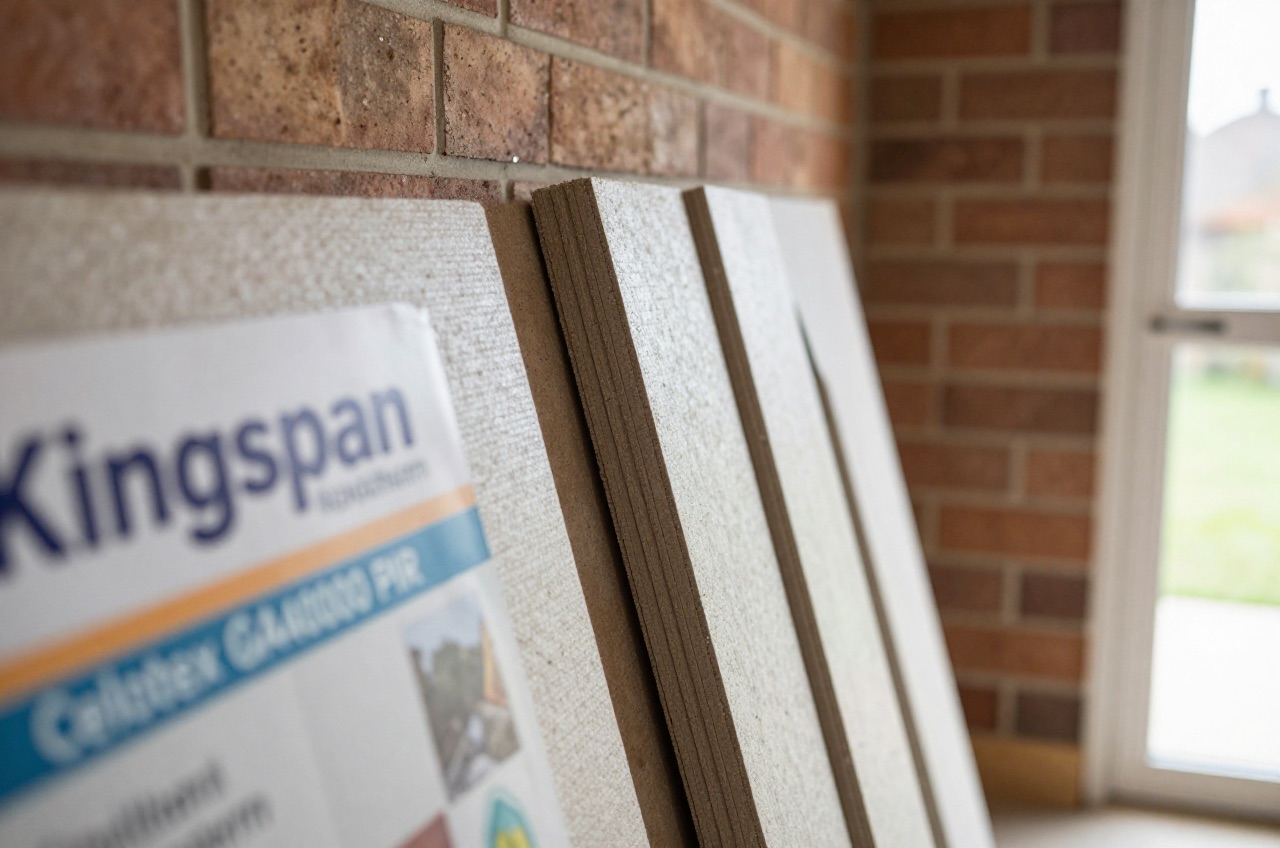
PIR (polyisocyanurate) rigid insulation boards are the go-to material when space is limited but thermal performance can’t be compromised. They deliver up to twice the insulating value per millimetre of mineral wool, which is why they dominate applications like flat roofs, slimline wall build-ups, and floor-slab insulation where every millimetre counts.
Kingspan and Celotex are two of the best-known brands in the UK, and while there are differences between specific product ranges, the competition between them drives pricing and means the technical specifications are closely matched. Celotex boards are now sold under Soprema’s SOPRATHERM name, so SOPRATHERM GA4000 is the former Celotex GA4000.1 This guide covers sizes, performance data, and current pricing across the most common applications.
What Is PIR Insulation?
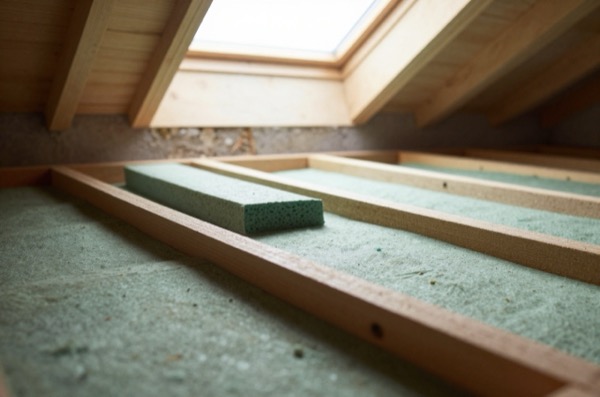
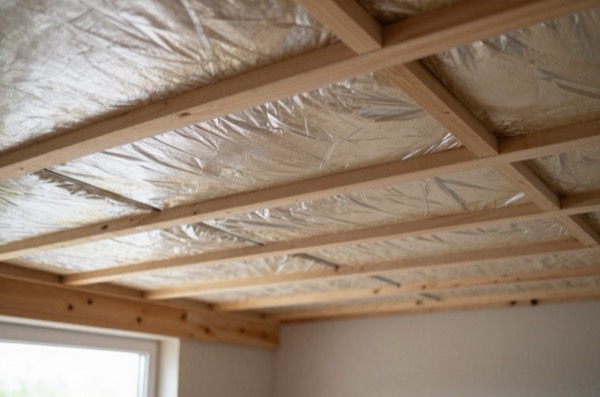
PIR is a closed-cell rigid foam, manufactured by reacting polyols and isocyanates. The closed-cell structure traps gas within the foam matrix, giving it a thermal conductivity (λ) of 0.022–0.028 W/mK, significantly better than the 0.032–0.044 W/mK typical of mineral wool. The boards are faced on both sides with a foil or glass-tissue facing, which gives the product its characteristic silver or cream appearance; a foil facing with taped joints can also act as a vapour control layer.
PIR is not the same as EPS (expanded polystyrene) or XPS (extruded polystyrene). EPS and XPS are usually cheaper but have higher λ values (0.030–0.040 W/mK). EPS also has lower compressive strength than PIR, but XPS is made in grades of 300 kPa and more and is the usual choice for heavily loaded floors and inverted roofs.2 PIR is the right choice where thin profiles and high performance are needed; EPS/XPS suit applications where bulk insulation is acceptable and cost is the priority.
Standard Sizes and Available Thicknesses
The standard sheet format for Kingspan and Celotex roof, floor and general-purpose boards is 1200 × 2400 mm.1 Partial-fill cavity boards are smaller, typically 1200 × 450 mm so they fit between rows of wall ties.3 Thicknesses available vary by product range:
| Thickness | Common applications |
|---|---|
| 25 mm | Below screed (supplementary layer), sarking |
| 40 mm | Floor (lower performance), cavity closer |
| 50 mm | Floor insulation, wall sarking, secondary layer |
| 60 mm | Flat roof decks, floor slab over ground |
| 70 mm | Floor, warm roof (supplementary) |
| 75 mm | Rafter insulation (between+below), floor |
| 80 mm | Warm flat roof (main layer) |
| 90 mm | High-performance floor/roof build-up |
| 100 mm | Full warm roof, rafter insulation |
| 120 mm | High-performance warm roof |
| 150 mm | Maximum standard stock depth |
Not all thicknesses are stocked at all merchants, 25, 50, 75, and 100 mm are the most reliably available. Intermediate sizes often need ordering.
Kingspan vs Celotex: Performance Comparison
Both brands make separate boards for different jobs, and Kingspan sells two different foams: its Therma boards are PIR, and its Kooltherm boards are phenolic.45 Some of the most common:
| Product | Brand | Core | λ (W/mK) | Primary use |
|---|---|---|---|---|
| Thermapitch TP10 | Kingspan | PIR | 0.022 | Pitched roof, between and over rafters |
| Kooltherm K107 | Kingspan | Phenolic | 0.019 | Pitched roof, between and over rafters |
| Thermawall TW50 | Kingspan | PIR | 0.022 | Partial fill cavity walls |
| GA4000 | Celotex | PIR | 0.022 | General purpose: roofs, walls and floors |
| CW4000 | Celotex | PIR | 0.022 | Partial fill cavity walls |
| PL4000 | Celotex | PIR bonded to 12.5 mm plasterboard | 0.022 (core) | Insulated plasterboard for dry-lining walls and ceilings |
Kingspan’s Thermapitch TP10, a PIR board, is declared at 0.022 W/mK.6 Kingspan declares 0.022 W/mK for Thermawall TW50 and 0.019 W/mK for the phenolic Kooltherm K107.78 SOPRATHERM, formerly Celotex, declares 0.022 W/mK for GA4000 and CW4000, and for the PIR core of PL4000, which is bonded to 12.5 mm plasterboard.931 The phenolic Kooltherm floor and pitched roof boards are better, at 0.019, which matters in thin build-ups: 50 mm of phenolic does roughly the job of 60 mm of PIR.710 Always check the current datasheet, because λ varies by product and sometimes by thickness.
Cost per m² by Thickness (2026 UK Merchant Prices)
Prices below are for standard PIR boards (Celotex GA4000 or Kingspan equivalent) at typical merchant rates. Premium phenolic products (Kooltherm) cost much more, often about twice as much at the same thickness.
| Thickness | Cost per m² (supply only) |
|---|---|
| 25 mm | £8 – £12 |
| 40 mm | £10 – £15 |
| 50 mm | £12 – £16 |
| 60 mm | £13 – £18 |
| 75 mm | £15 – £20 |
| 100 mm | £18 – £2411 |
| 120 mm | £22 – £28 |
| 150 mm | £26 – £34 |
The cited prices in this table were published in 2024 and brought to 2026. What that means.
A standard 1200 × 2400 mm board at 100 mm costs approximately £52–£70 per sheet (2.88 m² per sheet).12 A 100 mm Kooltherm K107 phenolic board, by comparison, was listed at £45.70/m² including VAT in September 2026, roughly twice the PIR rate or more.13 Builders’ merchants are often cheaper than DIY stores, and trade accounts offer further discount on larger orders.
Application-Specific Guidance
Warm Flat Roof
The most demanding application. The insulation sits above the structural deck (typically plywood or concrete) and below the waterproofing membrane. It must be dimensionally stable, be strong enough in compression to take foot traffic during installation, and provide a consistent substrate for the membrane.
Part L sets the roof standard tighter than the 0.18 W/m²K a lot of specifications assume. It is 0.15 W/m²K for a new thermal element in an existing dwelling, and 0.16 W/m²K both for a roof being renovated and for any roof in a new dwelling.14 The 0.18 figure belongs to walls and floors, not roofs. Using 100 mm PIR (λ = 0.022) gives U ≈ 0.21 W/m²K, not enough on its own. 120 mm reaches about 0.18, which clears the wall and floor standard but still misses the roof one, and 150 mm reaches about 0.14. That is why most flat roof refurbs spec 150 mm as the single main layer.
Pitched Roof (Between Rafter)
Between-rafter insulation must leave a 50 mm clear ventilation gap above the insulation (on a cold roof) or use a breathable membrane with reduced gap.15 For a 175 mm rafter depth with a 50 mm ventilation gap, you have 125 mm to insulate. 100 mm of PIR (λ = 0.022) between the rafters with a 25 mm layer below them gives roughly 0.2 W/m²K once the rafters bridging the insulation are allowed for. That is short of the 0.15 W/m²K Approved Document L asks of new roof fabric in an existing home.14 Getting there usually takes a thicker layer below the rafters, often an insulated plasterboard, or a phenolic board, so ask the manufacturer for a U-value calculation for your exact build-up.
Solid Ground Floor
PIR below a screed must be strong enough in compression to carry the screed and the floor loads, so use a board its maker rates for floors. Celotex GA4000, declared at 140 kPa, and Kingspan’s phenolic Kooltherm K103 floor board are standard choices.1 For 100 mm PIR on a solid ground floor, U is typically about 0.17–0.20 W/m²K, depending on the floor’s size and exposed perimeter; 120 mm brings it to roughly 0.15–0.17 W/m²K, inside the 0.18 W/m²K Approved Document L sets for a new floor in an existing home.14
Cavity Wall (Partial Fill)
Partial-fill cavity boards come in several thicknesses; SOPRATHERM CW4000, for example, is made from 40 mm to 100 mm.3 The clear residual cavity must be at least 50 mm to maintain resistance to moisture bridging, check local exposure zone.16 Kingspan’s Thermawall TW50 and Celotex’s CW4000 are made for this job.8
Fire Performance
PIR insulation is combustible. On its own, a foil-faced PIR board is usually classed only Euroclass E or F in standard tests (SOPRATHERM GA4000, the former Celotex GA4000, is Euroclass F), and it will ignite and burn when exposed to direct flame, unlike mineral wool, which is typically A1.1 This has significant implications:
- PIR must not be left exposed in habitable rooms: Approved Document B expects the wall and ceiling linings of rooms over 4 m² to reach Euroclass C-s3, d2, which a class F board cannot, so it is covered, typically with at least 12.5 mm plasterboard17
- In cavity wall applications, the residual air cavity provides some separation but does not remove the combustibility risk
- Regulation 7(2) of the Building Regulations requires materials in the external walls of a relevant building (broadly, a residential building with a storey at least 18 m above ground) to be class A2-s1, d0 or A1, which rules PIR out, and Part B (fire safety) adds guidance on combustible materials in cavity walls18
For residential renovation below 18 m this is rarely a practical barrier, but always confirm with Building Control if you’re unsure about your specific application.
Cutting and Installation
PIR boards cut cleanly with a fine-tooth handsaw or a Stanley knife and straightedge. The foil facing scores and the board snaps cleanly for straight cuts. A reciprocating saw speeds up cutting thicker boards. Key installation points:
- Tape all joints with PIR foil tape, untaped joints significantly degrade the effective U-value and create cold bridges
- Stagger joints in multi-layer build-ups so no joint aligns through the full depth
- Mechanically fix where the board is vertical (wall application), adhesive alone is insufficient
Kingspan and Celotex both publish technical datasheets (many of their boards are BBA certified) and U-value calculation tools on their websites, always use the manufacturer’s figure for the specific product and application rather than generic PIR values, as λ varies between product lines.71
References (18)
Figures in this note were checked against the sources below on 2 October 2026. Superscript numbers in the text point to them. Every source the site cites, by topic.
- 1technicalsupplier figureSOPREMA UK (Celotex), guidance.RN-VU7PFRManufacturer product page on the Celotex site, now run by SOPREMA UK. It confirms GA4000 is now sold as SOPRATHERM GA4000.
- 2technicalsupplier figureUnilin Insulation (formerly Xtratherm), a data sheet.RN-4TS29GRigid extruded polystyrene board, 1250 x 600 mm, thicknesses 30, 40, 50, 60, 80, 100, 120, 140 and 160 mm. Thermal conductivity 0.033 to 0.035 W/mK. Compressive strength CS(10Y) 300 kPa. Reaction to fire: Euroclass E. Published R-values (m2K/W): 30 mm 0.90, 40 mm 1.20, 50 mm 1.50, 60 mm 1.80, 80 mm 2.25, 100 mm 2.85, 120 mm 3.40, 140 mm 4.00, 160 mm 4.25. The range is also available in 500 kPa and 700 kPa grades.
- 3technicalsupplier figureSOPREMA UK (Celotex), guidance.RN-YH7TV9Manufacturer product page for the CW4000 partial-fill cavity board. It gives nominal board dimensions of 1200 x 450 mm.
- 4technicalsupplier figureKingspan Insulation, guidance.RN-WLLQP4The maker's product brochure for Kooltherm K108 cavity board, hosted on Kingspan's document store. It states that the Kooltherm core is a fibre-free rigid thermoset phenolic insulant, with a thermal conductivity of 0.019 W/mK.
- 5technicalsupplier figureKingspan Insulation, guidance.RN-Z0970NKingspan's GB page for its Therma range. It states that Therma boards have a rigid thermoset PIR core with a declared thermal conductivity of 0.022 to 0.027 W/mK.
- 6technicalsupplier figureKingspan Insulation, guidance.RN-OZHXNYKingspan's product page for Thermapitch TP10, a PIR board for pitched roofs between and over rafters, with its declared thermal conductivity of 0.022 W/mK.
- 7technicalsupplier figureKingspan Insulation, a data sheet.RN-I1EE5HRigid thermoset phenolic (PF) board to BS EN 13166: 2012 + A2: 2016, faced both sides with a low emissivity composite foil. Declared thermal conductivity 0.019 W/mK. Declared compressive strength 100 kPa to BS EN 826: 2013. Standard board 2.4 m x 1.2 m. BBA Certificate 16/5299 covers thicknesses 25 to 150 mm, made at Pembridge, Herefordshire. Published R-values (m2K/W): 25 mm 1.30, 40 mm 2.10, 50 mm 2.60, 60 mm 3.15, 70 mm 3.65, 75 mm 3.90, 80 mm 4.20, 90 mm 4.70, 100 mm 5.25, 110 mm 5.75. Fire: under System 4 AVCP, K107 has a Euroclass rating of F.
- 8technicalsupplier figureKingspan Insulation, guidance.RN-G818Z5Kingspan product page for Thermawall TW50. It confirms it is a PIR cavity wall board at 0.022 W/mK that keeps a clear cavity.
- 9technicalsupplier figureSOPREMA UK (Celotex), guidance.RN-BIRHMASOPREMA's product page for SOPRATHERM PL4000, the former Celotex PL4000 insulated plasterboard. It gives a PIR core of 0.022 W/mK bonded to 12.5 mm tapered edge plasterboard.
- 10technicalsupplier figureKingspan Insulation, guidance.RN-F2PHW0Kingspan product page for a phenolic Kooltherm board. It gives a thermal conductivity of 0.019 W/mK, against 0.022 W/mK for Kingspan's PIR boards.
- 11costvery strongValuation Office Agency, a government page.RN-RSLGJ5A price, true at 2024-04, brought forward on the Construction Output Price Index. The Valuation Office Agency's Rating Cost Guide 2026: estimated replacement costs per square metre for building types, used by the VOA for contractor's basis rating valuations. Each code gives a construction description, the unit of measurement and an ERC at a UK mean location factor of 1.00. It is official, free and unusually comprehensive, and it is a replacement cost for rating rather than a market tender price, which is why the guidance notes matter as much as the table.
- 12costsupplier figureWickes, guidance.RN-046U8FA price, true at 2026-09. A retailer product page for a 100 mm Kingspan TP10 PIR pitched-roof board. It gives the board size, coverage, declared thermal conductivity and current price.
- 13costsupplier figureMaterials Market.RN-E3Q1F1A price, true at 2026-09. A building materials retailer's product page for a pack of three 100 mm Kooltherm K107 phenolic boards. It prices them at £45.70 per m2 including VAT; no national DIY chain lists the product.
- 14technicalvery strongMinistry of Housing, Communities and Local Government.RN-L0FCJXThe in-force U-value tables a DIY insulation or door note must quote, with the exact numbers. Table 4.2, limiting U-values for new fabric elements in existing dwellings, sets roof 0.15, wall 0.18, floor 0.18, swimming pool basin 0.25, window 1.4 or Window Energy Rating Band B minimum, rooflight 2.2, doors with more than 60 per cent of the internal face glazed 1.4 or Doorset Energy Rating Band C minimum, and other doors 1.4 or Doorset Energy Rating Band B minimum. Table 4.3, for existing elements, gives a roof threshold of 0.35 and an improved value of 0.16, which is the figure a loft insulation note needs: paragraph 4.12 says a retained element whose U-value is higher than the column (a) threshold, for example through a loft or garage conversion, should be upgraded to the column (b) value. Paragraph 4.13 allows a lesser upgrade only where the improved value is not technically or functionally feasible or would not achieve a simple payback of 15 years or less. Paragraph 4.8 requires a replacement element to be no worse than the one it replaces as well as meeting Table 4.2. Paragraph 4.10 gives the heritage exception: where character must be maintained, a centre pane U-value of no more than 1.2 or low-emissivity secondary glazing. Note 9 records that the timber window concession of 1.6 or Band C ended on 14 June 2023. The 2021 edition came into force on 15 June 2022; a 2026 edition exists at https://assets.publishing.service.gov.uk/media/69c122a6cfa346b9d4704a55/ADL1_2026.pdf.
- 15technicalvery strongLABC Warranty, guidance.RN-A2P67ZLABC Warranty's technical manual chapter on roofs. It reproduces BS 5534 Table 3 minimum batten sizes, batten length, support and nailing rules, grading and marking, and the HR and LR underlay definitions.
- 16technicalvery strongMinistry of Housing, Communities and Local Government, guidance.RN-YZL3J2The Approved Document for Part C. It sets out how a suspended timber ground floor must be built and ventilated, including the size of the ventilation openings, the requirement for a free air path between opposing walls, and the clearances beneath the floor.
- 17technicalvery strongMinistry of Housing, Communities and Local Government.RN-J0UZDBApproved Document B Volume 1, fire safety in dwellings, 2019 edition with the 2020, 2022 and 2025 amendments and the forthcoming 2026 and 2029 changes collated in. Covers means of warning and escape, internal fire spread through linings and structure, external fire spread and access for the fire service. This is the document behind escape window sizes, protected stairways, the 4.5 metre rule and the fire doors a loft conversion needs.
- 18technicalvery strongThe National Archives (legislation.gov.uk), legislation.RN-Z3KFVUThe regulation behind the combustible cladding ban. Regulation 7(2) requires materials in the external walls or specified attachments of a relevant building to achieve European Classification A2-s1, d0 or A1 for reaction to fire, and regulation 7(1A) prohibits relevant metal composite materials in external walls. Regulation 7(4) defines a relevant building as one with a storey at least 18 metres above ground level, excluding roof-top plant areas and storeys consisting only of plant rooms, containing one or more dwellings, an institution, or a room for residential purposes. Regulation 7(3) lists the exempt components: cavity trays between masonry leaves, parts of roofs connected to external walls, door frames and doors, electrical installations, fibre optic cables, insulation and waterproofing below ground or up to 300mm above it, intumescent and fire-stopping materials, membranes, seals, gaskets, fixings, sealants and backer rods, solar shading device components other than the primary shade element, thermal break materials used for Part L compliance, window frames and glass, and balcony floor layers classified A1fl or A2fl-s1 over an imperforate substrate.
-
SOPRATHERM GA4000, SOPREMA UK (Celotex), accessed 30 September 2026. celotex.co.uk
-
XPS 300 rigid extruded polystyrene insulation board, Unilin Insulation, accessed 30 September 2026. unilininsulation.co.uk
-
SOPRATHERM CW4000, SOPREMA UK (Celotex), accessed 30 September 2026. celotex.co.uk
-
Kingspan Kooltherm K108 Cavity Board brochure, Kingspan Insulation, accessed 30 September 2026. store.filerobot.com
-
Therma, Kingspan Insulation, accessed 30 September 2026. insulation.kingspan.com
-
Thermapitch TP10, Kingspan Insulation, accessed 29 September 2026. insulation.kingspan.com
-
Kooltherm K107 Pitched Roof Board, product brochure, Great Britain and Ireland, sixth issue 04/2026, Kingspan Insulation, accessed 30 September 2026. kingspan.com
-
Thermawall TW50, Kingspan Insulation, accessed 30 September 2026. insulation.kingspan.com
-
SOPRATHERM PL4000, SOPREMA UK (Celotex), accessed 30 September 2026. celotex.co.uk
-
Kooltherm K103 Floorboard, Kingspan Insulation, accessed 30 September 2026. insulation.kingspan.com
-
Rating Cost Guide 2026, Valuation Office Agency, accessed 16 September 2026. Priced at 2024-04; brought to 2026 on the Construction Output Price Index, housing repair and maintenance (Great Britain), published by Office for National Statistics, a factor of 1.0239. assets.publishing.service.gov.uk
-
Kingspan TP10 Roof Insulation Board - 2400 x 1200 x 100mm, Wickes, accessed 2 October 2026. Priced at 2026-09 and left there. wickes.co.uk
-
100mm Kingspan Kooltherm K107 Pitched Roof Insulation Board 2400mm x 1200mm, Materials Market, accessed 2 October 2026. Priced at 2026-09 and left there. materialsmarket.com
-
Approved Document L, Conservation of fuel and power, Volume 1: Dwellings, 2021 edition incorporating 2023 amendments, Ministry of Housing, Communities and Local Government, accessed 13 September 2026. assets.publishing.service.gov.uk
-
Technical Manual Version 11, Section 11: Roofs, LABC Warranty, accessed 2 October 2026. labcwarranty.co.uk
-
Approved Document C, Site preparation and resistance to contaminants and moisture, 2004 edition incorporating 2010 and 2013 amendments, Ministry of Housing, Communities and Local Government, accessed 14 September 2026. gov.uk
-
Approved Document B (fire safety) volume 1: Dwellings, 2019 edition incorporating 2020, 2022, 2025 and 2026 amendments, HM Government (GOV.UK), accessed 2 October 2026. assets.publishing.service.gov.uk
-
The Building Regulations 2010, regulation 7: Materials and workmanship, legislation.gov.uk, accessed 14 September 2026. legislation.gov.uk