Sub-base material sits between the ground and the finished surface, whether that is a concrete slab, block paving, tarmac or a building floor. Getting the sub-base right prevents settlement, surface cracking and drainage problems. In domestic construction, the terms “hardcore”, “Type 1” and “scalpings” are often used interchangeably, but they are distinct products with different performance characteristics and the wrong choice will cause problems within a few years.
MOT Type 1 is the specification most often required by engineers and local authorities for driveways and paths. Understanding why, and when cheaper alternatives are acceptable, saves money without compromising quality.
What MOT Type 1 Is
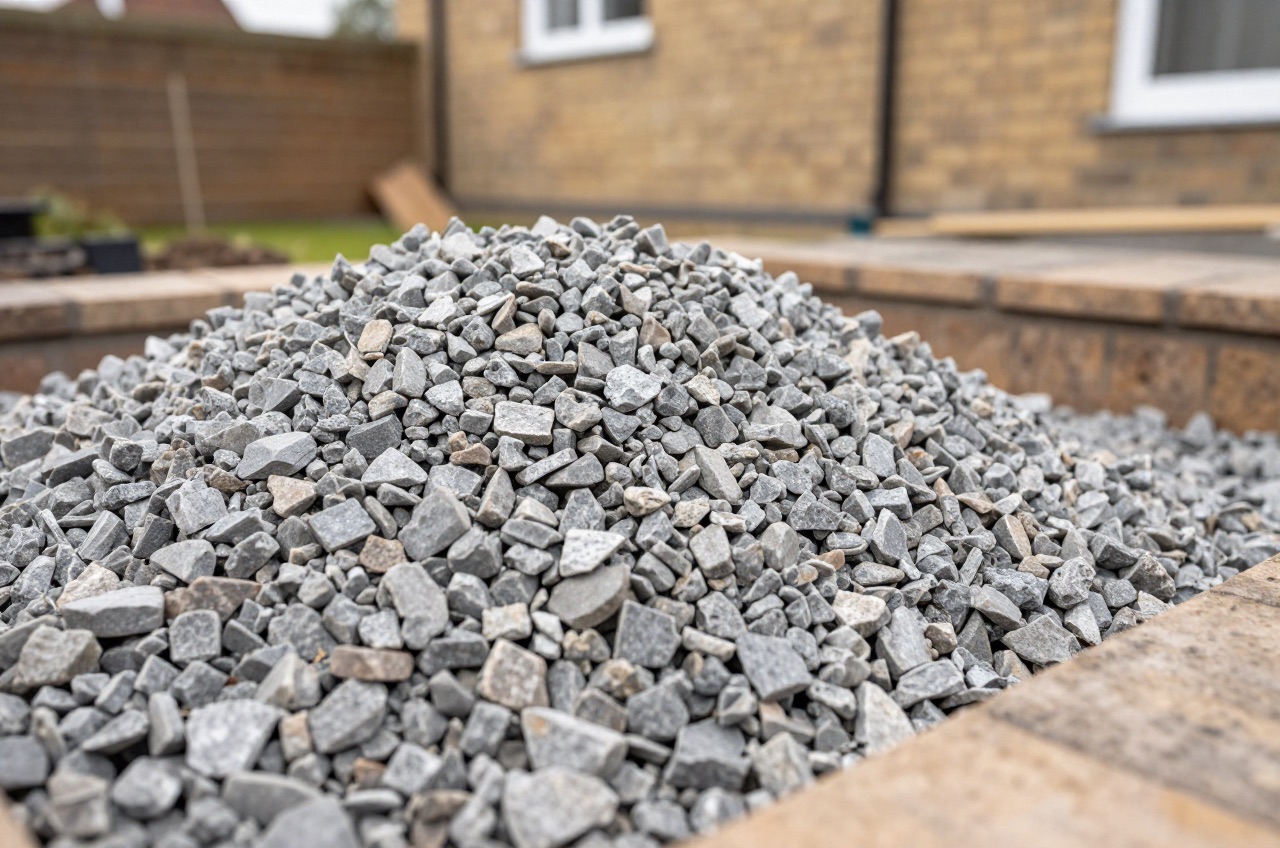
MOT Type 1 (more formally, a Type 1 unbound mixture to Clause 803 of the Specification for Highway Works, Volume 1 of the Manual of Contract Documents for Highway Works) is a crushed rock or recycled concrete product with a tightly controlled grading: a well-graded mix designated 0/31.5 mm (or 0/20 mm), with all of it passing a 63 mm sieve.1 The grading curve ensures that fine particles fill the voids between coarser ones, producing a dense, interlocking matrix that compacts well and resists deformation under load.
The key properties that make Type 1 the preferred sub-base:
- Well-graded, particles from dust up to 63 mm, most of them under 31.5 mm, ensure good interlock and minimal voids after compaction
- Angular aggregate, crushed faces key together; rounded gravel does not compact as effectively
- Fines content controlled, no more than 9% passing the 0.063 mm sieve (category UF9, or UF12 where the contract allows), which limits frost susceptibility and softening when wet1
- High bearing capacity after compaction, well-compacted Type 1 gives a firm, stable layer suitable as a direct sub-base under flexible pavements
Type 1 can be made from crushed rock such as limestone, granite or gritstone, or from crushed concrete and other recycled aggregates.1 Recycled Type 1 is typically £5–£8/tonne cheaper and is acceptable for most non-adoptable domestic uses, but check with Building Control for applications under building slabs.
Hardcore vs Type 1 vs Scalpings
| Material | Grading | Compaction | Best Use | Cost (2026) |
|---|---|---|---|---|
| General hardcore (mixed rubble) | Uncontrolled | Poor (variable) | Bulk fill only | £18–£30/tonne loose |
| Recycled concrete hardcore | 0–100 mm mixed | Moderate | Non-structural filling | £20–£32/tonne loose |
| MOT Type 1 (primary) | 0/31.5 mm well-graded | Excellent | Driveways, paths, slab sub-base | £28–£55/tonne delivered |
| MOT Type 1 (recycled) | 0/31.5 mm well-graded | Excellent | As above, non-adoptable | £22–£38/tonne delivered |
| Scalpings (quarry waste) | 0–75 mm, variable fines | Moderate | Temporary access, farm tracks | £15–£25/tonne |
| Type 2 (can include natural sand and gravel) | 0/31.5 mm, can be rounded | Good | Lower-grade sub-base, not a substitute for Type 1 | £22–£35/tonne |
General hardcore, broken brick, concrete rubble from demolition, is suitable only for bulk void filling where structural performance is not required. It cannot be relied on to compact uniformly or achieve a consistent bearing capacity. Never use it directly under a ground-bearing slab or as the sole sub-base for a driveway.
Scalpings are quarry by-products with a high proportion of fines. They compact reasonably well but can be frost-susceptible and may pump (fine particles migrate upward under repeated loading in wet conditions). They are acceptable for farm tracks and temporary access roads; not ideal for permanent domestic hard standings.
Compaction: Depth and Method
Compaction is the most critical factor in sub-base performance. Uncompacted material will settle, causing surface cracking, rocking pavers and ponding water.
Layer thickness for compaction:
- Maximum compacted layer depth: about 150 mm even with the heaviest plate compactors commonly available for hire, and less with a light plate
- Heavier plant can compact thicker layers: the Specification for Highway Works rates a vibratory roller of over 1,800 kg per metre width of roll for 225 mm layers in 10 passes, but plant that heavy is rarely available on domestic sites1
- Compact in layers no thicker than the plant can handle; with a heavy plate and a total required depth of 300 mm, place and compact 150 mm, then place and compact a second 150 mm layer
Compaction equipment:
| Equipment | Practical compacted layer | Hire Cost (day) | Best For |
|---|---|---|---|
| Plate compactor (80 kg) | up to about 75 mm | £35–£65 | Tight areas, final passes |
| Plate compactor (300 kg) | up to about 150 mm | £80–£120 | Driveways, general sub-base |
| Vibrating roller (1 t) | up to about 100 mm | £150–£250 | Larger areas, tarmac prep |
These are practical guides rather than tested ratings. The Specification for Highway Works method table starts at vibrating plates of over 1,400 kg per m² of base plate, which it rates for 110 mm layers of Type 1 in 8 passes.1 It rates a vibrating roller of 700–1,300 kg per metre width of roll for 110 mm layers in 16 passes, and as unsuitable for 150 mm layers.1 Most hire-shop plates weigh far less per square metre of base plate than that, so thinner layers and extra passes are the safe choice.
Run the plate compactor in overlapping passes until there is no visible movement in the surface, typically 6–8 passes or more for Type 1. A simple check is to push a steel rod or bar into the surface by hand: if it goes in easily, the material needs more compaction or is too wet.
Do not compact material that is saturated, wet fines will pump rather than interlock. If weather is consistently wet, cover laid material with polythene sheeting overnight.
Depths Required
The required depth of compacted Type 1 depends on the applied load and the bearing capacity of the subgrade. Government guidance on permeable front driveways, for example, describes about 150 mm of compacted sub-base laid over a geotextile for a car driveway.2 Typical depths:
| Application | Compacted Type 1 Depth | Notes |
|---|---|---|
| Pedestrian path | 75–100 mm | On firm natural ground |
| Domestic driveway (cars) | 100–150 mm | Min 100 mm on good ground; 150 mm on clay |
| Driveway (vans/HGV occasional) | 200–250 mm | Two 100–125 mm compacted layers |
| Ground-bearing slab sub-base | 150 mm typical | Common practice, 200 mm on weak ground; Part C sets no minimum (see below) |
| Adoptable highway sub-base | 225–350 mm | Set by the adopting highway authority’s design |
Worth being precise about what Part C actually says here, because the 100 mm figure is usually attached to the wrong layer. Approved Document C asks for a well compacted hardcore bed no greater than 600 mm deep of clean broken brick or similar inert material, and for the concrete to be at least 100 mm thick.3 It sets no minimum hardcore depth at all. The 100 mm is the slab, not the sub-base. Deeper than 600 mm, the guidance warns of a risk of excessive settlement and cracking of the floor slab, and advises a suspended floor slab instead.3
Cost Per Tonne and Bulk Bag
Prices vary significantly by region and by delivery quantity:
| Supply Format | Typical Cost (2026) |
|---|---|
| Loose tipped (6–20 tonne wagon) | £28–£55/tonne delivered4 |
| Bulk bag (approximately 850 kg) | £65–£95 per bag |
| Small bags (about 40 kg, builders’ merchant) | About £5 a bag, over £120/tonne |
At the top of the range, one London merchant charges £1,032.04 including VAT for a 20-tonne loose load of Type 1, about £52 a tonne.5 A national retailer sells an 800 kg jumbo bag of Type 1 for £75, excluding delivery.6 Small bags are the dearest way to buy: the London merchant’s 40 kg bag is £4.98 including VAT, over £120 a tonne.7
Coverage: at a compacted density of about 2.1–2.2 t/m³, 1 tonne of Type 1 laid 150 mm deep covers roughly 3 m². A 40 m² driveway at 150 mm compacted depth is 6 m³ of Type 1, or roughly 13 tonnes.
Bulk bags are convenient for small jobs or restricted access sites (suburban side return, rear garden via gate) but the per-tonne cost is 2–3× higher than loose. For anything over 10 m², a loose-tip delivery from an aggregate supplier is significantly cheaper.
Uses in Building Construction
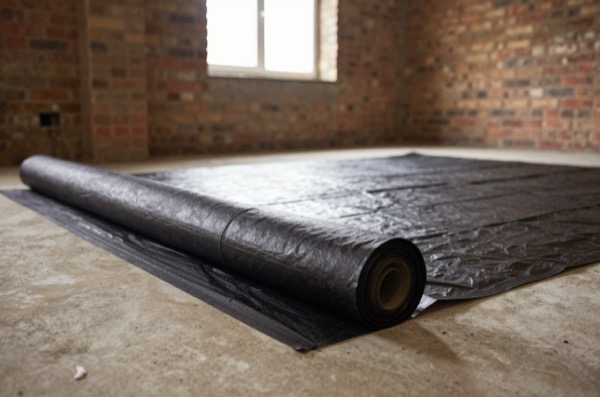
Under a ground-bearing floor slab, the compacted Type 1 or hardcore layer serves two functions: it provides a stable working platform for casting concrete, and it distributes point loads from the slab into the subgrade. Approved Document C also requires the floor to resist ground moisture, and its standard ground-supported slab has a damp-proof membrane above or below the concrete; where sulphates could contaminate the hardcore, the membrane goes at the base of the slab, on top of the hardcore.3
The front garden is where this is forced on you. Laying more than 5 m² of hard surface between the principal elevation of the house and the highway is only permitted development if the surface is made of porous materials, or run-off is directed to a permeable or porous area within the curtilage.8 Otherwise it needs planning permission. For a permeable drive, an open-graded sub-base such as 4/20 stone or Type 3 replaces dense-graded Type 1, whose fines slow drainage, so rain can soak through and be held in the voids.2 The rule bites on the area between the house front and the road, not on a driveway at the side or rear.
Key Standards and References
- Clause 803, Specification for Highway Works (MCHW Vol 1), the defining specification for Type 1 granular sub-base1
- BS EN 13242:2002+A1:2007, aggregates for unbound and hydraulically bound materials, and BS EN 13285, the unbound mixtures standard that Type 1 must conform to under the Specification for Highway Works19
- Building Regs Approved Document C, site preparation and resistance to moisture; sub-base under floor slabs
- NHBC Standards Chapter 5.1, substructure and ground-bearing floors (hardcore and fill for NHBC-warranted homes)
- BRE Digest 251, assessment of damage in low-rise buildings, with particular reference to progressive foundation movement, used to classify cracking10
References (10)
Figures in this note were checked against the sources below on 2 October 2026. Superscript numbers in the text point to them. Every source the site cites, by topic.
- 1technicalvery strongNational Highways (Standards for Highways), guidance.RN-2BAKGJThis is the specification that the term MOT Type 1 actually comes from: Clause 803 of Series 800 of the Specification for Highway Works. Clause 803.1 states Type 1 unbound mixture shall be made from crushed rock, crushed slag, crushed concrete, recycled aggregates, manufactured aggregates or well burnt non-plastic shale, and may contain up to 10 per cent by mass of natural sand passing the 4 mm test sieve, with crushed gravel permitted only where contract Appendix 7/1 allows. Clause 803.2 requires the mixture to meet BS EN 13285 and Table 8/1, with grading summarised in Table 8/6a, which sets 100 per cent passing 63 mm, 75 to 99 per cent passing 31.5 mm, 43 to 81 per cent passing 16 mm, 23 to 66 per cent passing 8 mm, 12 to 53 per cent passing 4 mm, 6 to 42 per cent passing 2 mm, 3 to 32 per cent passing 1 mm and 0 to 9 per cent passing 0.063 mm. Table 8/6b applies only to trench reinstatements and narrow widenings less than 1 m. Note this PDF is the November 2021 revision and carries a superseded watermark, so quote the clause and revision date together.
- 2technicalvery strongDepartment for Communities and Local Government, guidance.RN-91Z38WGovernment guidance for householders on paving front gardens. Its construction section describes about 150 mm of compacted sub-base over a geotextile for a driveway.
- 3technicalvery strongMinistry of Housing, Communities and Local Government, guidance.RN-YZL3J2The Approved Document for Part C. It sets out how a suspended timber ground floor must be built and ventilated, including the size of the ventilation openings, the requirement for a free air path between opposing walls, and the clearances beneath the floor.
- 4costsupplier figureBuilder Depot.RN-LM0KSXA price, true at 2026-09. The same merchant’s MOT Type 1 in a 10 tonne loose tipped load. Held beside the 20 tonne page because the pair is the evidence that load size, not the material, is most of the spread: the smaller load is about 36 per cent dearer per tonne from the same seller on the same day.
- 5costsupplier figureBuilder Depot.RN-O0BPZUA price, true at 2026-09. A London builders merchant’s product page for MOT Type 1 granular sub-base delivered as a 20 tonne loose tipped load, priced ex and inc VAT and per kg. This is the bulk price a driveway or slab actually gets, as distinct from the same material in a bulk bag, which is roughly double per tonne. A published list price on a named product with the load size in the name, which is what a materials figure per tonne has to rest on.
- 6costsupplier figureWickes.RN-T7X0W6A price, true at 2026-09. Wickes' product page for an 800 kg jumbo bag of MOT Type 1 at £75 excluding delivery, which supports the bulk bag price range in the cost table.
- 7costsupplier figureBuilder Depot.RN-6U09SPA price, true at 2026-09. A London builders' merchant's product page for a 40 kg bag of MOT Type 1 sub-base at £4.98 including VAT, about £124.50 a tonne, showing small bags are stocked but cost far more per tonne.
- 8technicalvery strongThe National Archives (legislation.gov.uk), legislation.RN-4C9X4BClass F permits the provision within the curtilage of a dwellinghouse of a hard surface for any purpose incidental to the enjoyment of the dwellinghouse, or its replacement in whole or in part. Condition F.2 applies where the hard surface would lie between a wall forming the principal elevation and a highway and its area would exceed 5 square metres: the surface must then be made of porous materials, or provision made to direct run-off water to a permeable or porous area or surface within the curtilage.
- 9technicalstrongBSI (British Standards Institution), a standard.RN-DP7TITSTATUS: CURRENT (marked Under Review). BS EN 13242:2002+A1:2007 was published 12 December 2002 and was amended in May 2008 to incorporate CEN amendment A1:2007. It specifies the properties required of aggregates obtained from natural, manufactured or recycled materials for use in unbound and hydraulically bound materials in civil engineering work and road construction, covering grading, particle shape, resistance to fragmentation, resistance to wear, and chemical and durability requirements. This is the standard behind MOT Type 1 and Type 3 sub base and the recycled equivalents used under a driveway or patio: a note specifying a compacted granular sub base should cite BS EN 13242 for the aggregate and the Specification for Highway Works Series 800 for the Type 1 grading itself. Catalogue page confirms number, title, date, amendment, status and scope; the property tables are paywalled.
- 10technicalstrongBRE Electronic Publications, guidance.RN-BHTZZ6The primary document behind every crack category a surveyor quotes, and the reference a note should name rather than repeating the categories second hand. Digest 251 was written by R Driscoll, published by BRE with a publication date of 01 January 1995 for the revised edition, ISBN 1860810454, and runs to 8 pages. Its description states that it discusses the assessment and classification of visible damage resulting from structural distortion, and that it includes a table classifying cracks from category 0, hairline cracks of less than about 0.1mm width, to category 5, cracks usually greater than 25mm width. Its indexed keywords are cracks, distortion, bulge, foundation movement and subsidence. The store page also notes that the two photographs of wall cracking scanned poorly into the PDF and may need contrast adjustment. Those two anchor figures, 0.1mm at category 0 and 25mm at category 5, are the ones a cracks note can cite with confidence.
-
Manual of Contract Documents for Highway Works, Volume 1, Specification for Highway Works, Series 800: Road Pavements, Unbound, Cement and Other Hydraulically Bound Mixtures (November 2021 amendment), National Highways (Standards for Highways), accessed 29 September 2026. standardsforhighways.co.uk
-
Guidance on the permeable surfacing of front gardens, Department for Communities and Local Government, accessed 29 September 2026. assets.publishing.service.gov.uk
-
Approved Document C, Site preparation and resistance to contaminants and moisture, 2004 edition incorporating 2010 and 2013 amendments, Ministry of Housing, Communities and Local Government, accessed 14 September 2026. gov.uk
-
MOT Type 1 Sub Base 10 Tonne Loose Load, Builder Depot, accessed 2 October 2026. Priced at 2026-09, so no calibration is needed. builderdepot.co.uk
-
MOT Type 1 Sub Base 20 Tonne Loose Load, Builder Depot, accessed 18 September 2026. Priced at 2026-09 and left there. builderdepot.co.uk
-
Suburban Build MOT Type 1 - Jumbo Bag, Wickes, accessed 2 October 2026. Priced at 2026-09 and left there. wickes.co.uk
-
MOT Type 1 Sub Base 40kg, Builder Depot, accessed 2 October 2026. Priced at 2026-09 and left there. builderdepot.co.uk
-
The Town and Country Planning (General Permitted Development) (England) Order 2015, Schedule 2, Part 1, Class F, legislation.gov.uk, accessed 13 September 2026. legislation.gov.uk
-
BS EN 13242:2002+A1:2007 Aggregates for unbound and hydraulically bound materials for use in civil engineering work and road construction, British Standards Institution, accessed 29 September 2026. knowledge.bsigroup.com
-
Assessment of damage in low-rise buildings, with particular reference to progressive foundation movement. Revised 1995 (DG 251), BRE, accessed 29 September 2026. bregroup.com