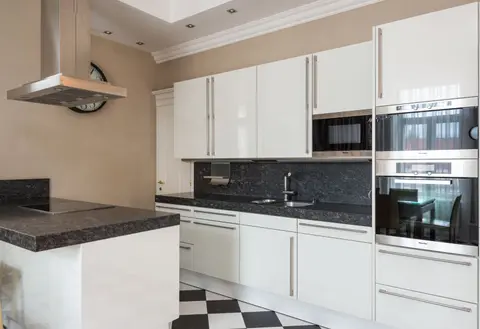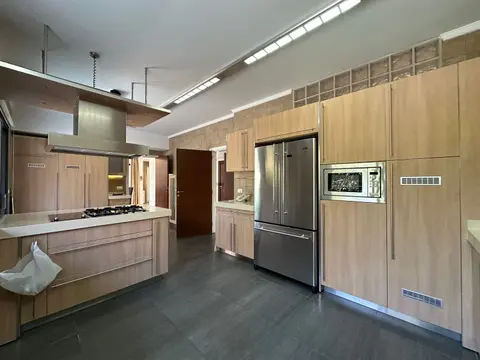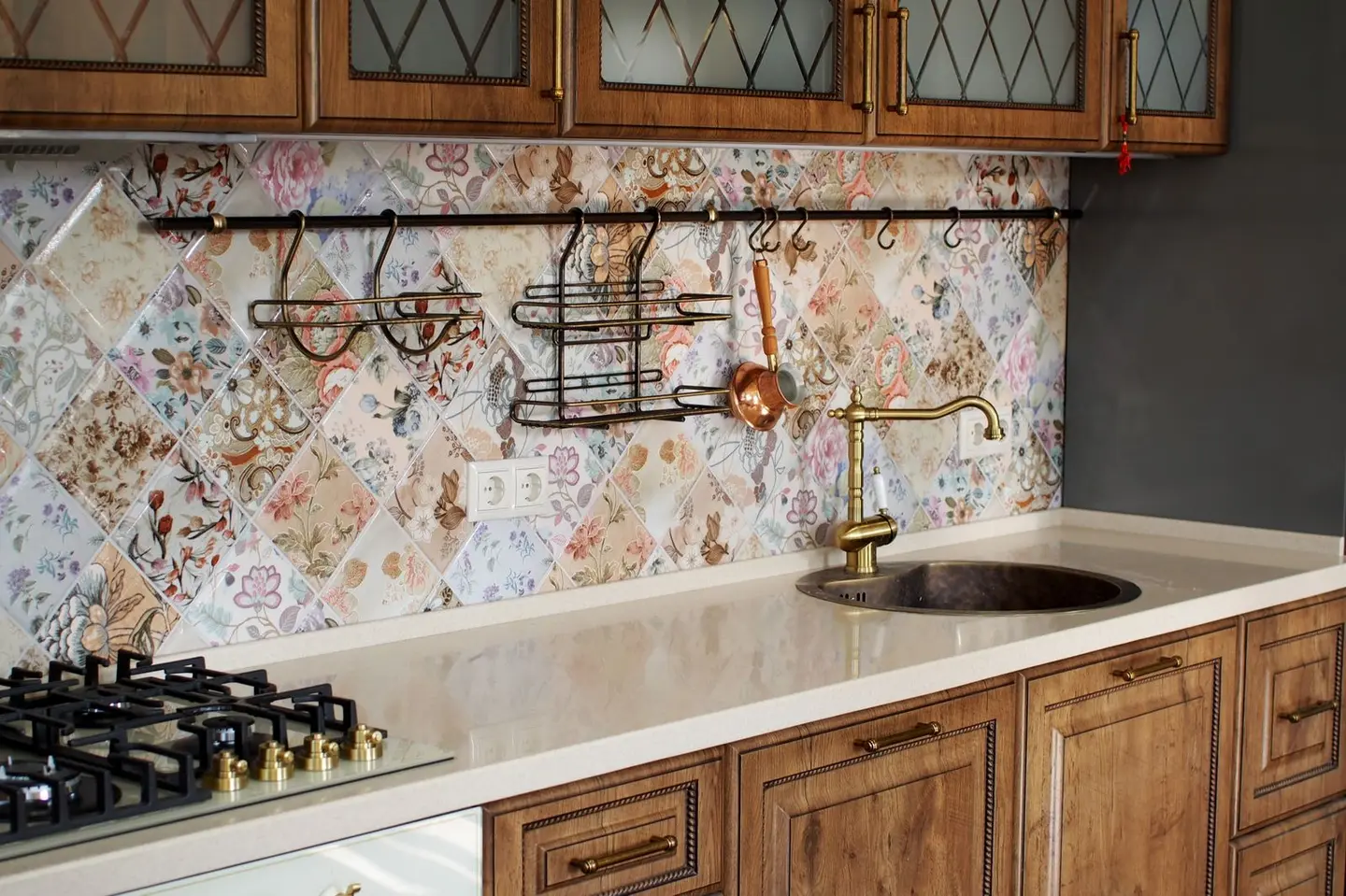
The area between your worktop and the units above is one of the most-touched surfaces in the kitchen, splashed with water, grease, and cooking debris every day. Getting the finishing detail right here is not just aesthetic; it protects your wall plaster from moisture damage. Three distinct solutions exist: a worktop upstand, wall tiles, or a panel splashback, and they differ significantly in cost, maintenance, and visual effect.
Worktop Upstands
An upstand is a narrow strip of the same (or complementary) material as the worktop, typically 15–20 mm thick and 100–150 mm tall, fitted tight to the back and side edges of the worktop and sealed with silicone where it meets the wall.
Why Use an Upstand?
- Waterproofs the vulnerable joint between worktop and wall without tiling the entire zone.
- Creates a clean, minimal look, particularly with stone or quartz.
- Much cheaper and faster than tiling.
- Allows for wall imperfections: the silicone joint takes up small variations of a few millimetres.
Upstand Costs
| Material | Supply (per linear metre) | Fitted (per linear metre) |
|---|---|---|
| Matching quartz/granite upstand | £40–£100 | £80–£160 |
| Laminate upstand (matching worktop) | £15–£401 | £20–£60 |
| Solid oak timber upstand | £30–£60 | £50–£90 |
| Ceramic tile upstand (100 mm strip) | £10–£25 per tile | £40–£80 per lin m fitted |
Fitting is typically done by the same stonemason or joiner who fits the worktop; adding it at the same appointment keeps costs lower than a return visit.
Fitting an Upstand
The back of the worktop must be scribed to the wall so the gap is uniform. The upstand sits against the wall and is bonded with adhesive or mechanical fixings, then finished with a bead of neutral-cure silicone (not acid-cure, which can discolour stone). The silicone joint must be maintained over time, re-silicone every 5–10 years or sooner if it discolours or cracks.
Worktop Edge Profiles
The front edge of a worktop is shaped by the fabricator during CNC machining. The profile you choose affects the look and, to a small degree, the cost (more complex profiles take longer to machine).
| Profile | Description | Best for | Extra cost |
|---|---|---|---|
| Square (pencil) edge | Clean 90° corners, slightly eased | Contemporary kitchens | None |
| Bevelled edge | 45° chamfer on top corner | Modern/transitional | £5–£15 per lin m |
| Half bullnose | Single curved top | Family kitchens (no sharp edge) | £10–£20 per lin m |
| Full bullnose | Both top and bottom curved | Traditional kitchens | £15–£25 per lin m |
| Ogee | S-curve profile | Traditional/Shaker style | £20–£40 per lin m |
| Waterfall | Worktop material continues vertically to floor on island ends | Showpiece islands | No standard rate; significant material use |
For safety, particularly in households with young children or elderly residents, avoid sharp 90° profiles on islands where people walk. A half bullnose or 3 mm eased edge is a sensible default.
Tiled Splashbacks
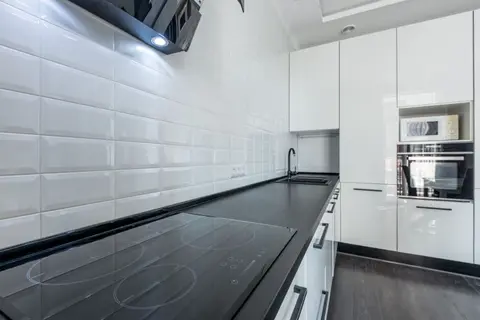
Tiling the zone between worktop and wall units remains the most popular choice in UK kitchens. It gives maximum design flexibility and can extend higher than an upstand if desired.
Typical specification:
- Tile depth: wall tiles 6–10 mm; glass or large-format tiles 8–15 mm.
- Adhesive: a cement-based adhesive classified under BS EN 12004-1 (an improved C2 grade is a common choice for kitchens) or dedicated kitchen tile adhesive.2
- Grout: epoxy grout around the hob and sink for stain resistance; standard cement grout elsewhere.
Cost of tiling a kitchen splashback:
| Tile type | Tile cost (per m²) | Labour (per m²) | Total per m² fitted |
|---|---|---|---|
| Standard ceramic | £20–£60 | £30–£50 | £50–£110 |
| Porcelain | £40–£120 | £35–£60 | £75–£180 |
| Handmade/Metro tile | £50–£150 | £35–£60 | £85–£210 |
| Large format (600 × 300 mm+) | £60–£200 | £50–£80 | £110–£280 |
A typical kitchen splashback is 0.8–1.5 m², add hob and worktop perimeter together, then deduct windows. See our tiling guide for step-by-step fitting instructions.
Important: the joint between the last row of tiles and the worktop must be silicone, not grout. Grout is rigid and will crack as the worktop and wall move independently. Use a colour-matched silicone.
Panel Splashbacks
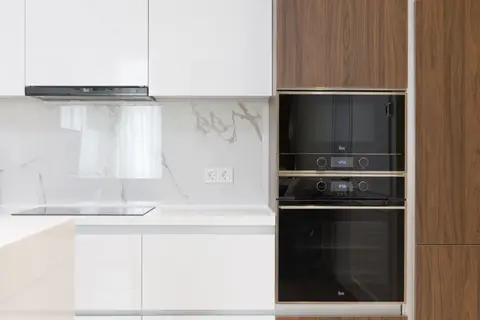
Glass, acrylic, and stainless-steel panel splashbacks are a single-piece alternative to tiling. They are especially popular behind induction hobs where a grout-free surface is easy to wipe down.
| Panel type | Supply cost (per m²) | Fitted cost (per m²) |
|---|---|---|
| Toughened glass (colour-painted) | £120–£350 | £180–£500 |
| Acrylic sheet | £30–£80 | £60–£130 |
| Stainless steel (brushed) | £80–£200 | £120–£280 |
| Mirrored glass | £150–£400 | £200–£550 |
Glass splashbacks are made from toughened safety glass to BS EN 12150-1, usually 6 mm or 8 mm thick, and must be ordered to exact size with cutouts pre-machined for sockets and switches.3 Allow a few weeks’ lead time for made-to-measure glass. Installation uses a structural silicone adhesive; no fixings pierce the glass.
Acrylic is cheaper but scratches more easily and, being combustible and heat-sensitive, is not suitable directly behind a gas hob.
Gas hob note: BS 6172 is the British Standard for installing domestic gas cooking appliances, and the hob maker’s installation instructions set the minimum clearances to combustible materials beside and above the hob, including any hood or shelf.4 Behind a gas hob, use a non-combustible splashback: toughened glass and ceramic tile are suitable; painted MDF or acrylic are not. Our guide to Building Regulations covers the wider rules for kitchen work.
Upstand vs Tiling vs Panel: Decision Guide
| Upstand | Tiled | Panel | |
|---|---|---|---|
| Cost | Lowest | Moderate | Moderate–high |
| Maintenance | Silicone only | Grout cleaning | Wipe clean |
| Lead time | Same day as worktop | 1–3 days to tile | A few weeks (made-to-measure glass) |
| Visual impact | Minimal/clean | Textured/varied | Bold/seamless |
| Best behind hob | No | Yes (ceramic) | Yes (toughened glass) |
| DIY-friendly | Moderate | Yes | No (glass) |
The most practical all-round choice for most kitchens is a matching stone upstand at the back and ends, combined with tiling or a glass panel directly behind the hob. This balances cost with the right material performance in the most demanding zone.
References (4)
Figures in this note were checked against the sources below on 30 September 2026. Superscript numbers in the text point to them. Every source the site cites, by topic.
- 1costsupplier figureToolstation.RN-GLXSM0A price, true at 2026-09. the merchant list price of a laminate postformed worktop upstand, the matching trim fitted along the back of a laminate worktop
- 2technicalstrongBSI, a standard.RN-TL1I4RBS EN 12004-1:2017, published 28 February 2017, committee B/539, prepared by CEN/TC 67 Ceramic tiles, current; it supersedes BS EN 12004:2007+A1:2012. The scope covers three types of ceramic tile adhesive: cementitious for internal and external installations, and dispersion and reaction resin for internal installations only, on walls and floors. It gives the terminology for the products, working methods and application properties, specifies the performance requirements and the appurtenant test methods, the assessment and verification of constancy of performance, and the classification, designation and marking of tile adhesives, which is where the C, D and R type letters and class numbers on a bag of adhesive come from. It expressly does not provide criteria or recommendations for the design and installation of ceramic tiles, which is BS 5385. It notes tile adhesives may also be used for natural and agglomerated stones if they do not adversely affect the material. BS EN 12004-2:2017 gives the test methods.
- 3technicalstrongBSI (British Standards Institution), a standard.RN-VKPEGHSTATUS: CURRENT (marked Under Review). BS EN 12150-1:2015+A1:2019 was published 31 May 2019 and supersedes BS EN 12150-1:2015, which had itself replaced BS EN 12150-1:2000. It establishes tolerances, flatness, edgework, fragmentation and the physical and mechanical characteristics of monolithic flat thermally toughened soda lime silicate safety glass for use in buildings. Curved toughened glass is described in Annex A but is not part of the standard, and glass built into laminated or insulating glass units, or coated after toughening, falls under the relevant assembly product standard instead. Part 2 (BS EN 12150-2) covers evaluation of conformity. The catalogue page confirms number, title, date, status and scope; the test detail is paywalled.
- 4technicalstrongBSI, guidance.RN-FVSJVEBSI catalogue entry for BS 6172, the British Standard for installing, servicing and maintaining domestic gas cooking appliances; it confirms the standard and its subject only.
-
Wilsonart Options Plus Lima Postformed Upstand 3000mm x 100mm x 20mm, Toolstation, accessed 30 September 2026. Priced at 2026-09, so no calibration is needed. toolstation.com
-
BS EN 12004-1:2017 Adhesives for ceramic tiles. Requirements, assessment and verification of constancy of performance, classification and marking, BSI, accessed 30 September 2026. knowledge.bsigroup.com
-
BS EN 12150-1:2015+A1:2019 Glass in building. Thermally toughened soda lime silicate safety glass. Definition and description, BSI, accessed 30 September 2026. knowledge.bsigroup.com
-
BS 6172:2010+A1:2017 Specification for installation, servicing and maintenance of domestic gas cooking appliances (2nd and 3rd family gases), BSI, accessed 30 September 2026. landingpage.bsigroup.com