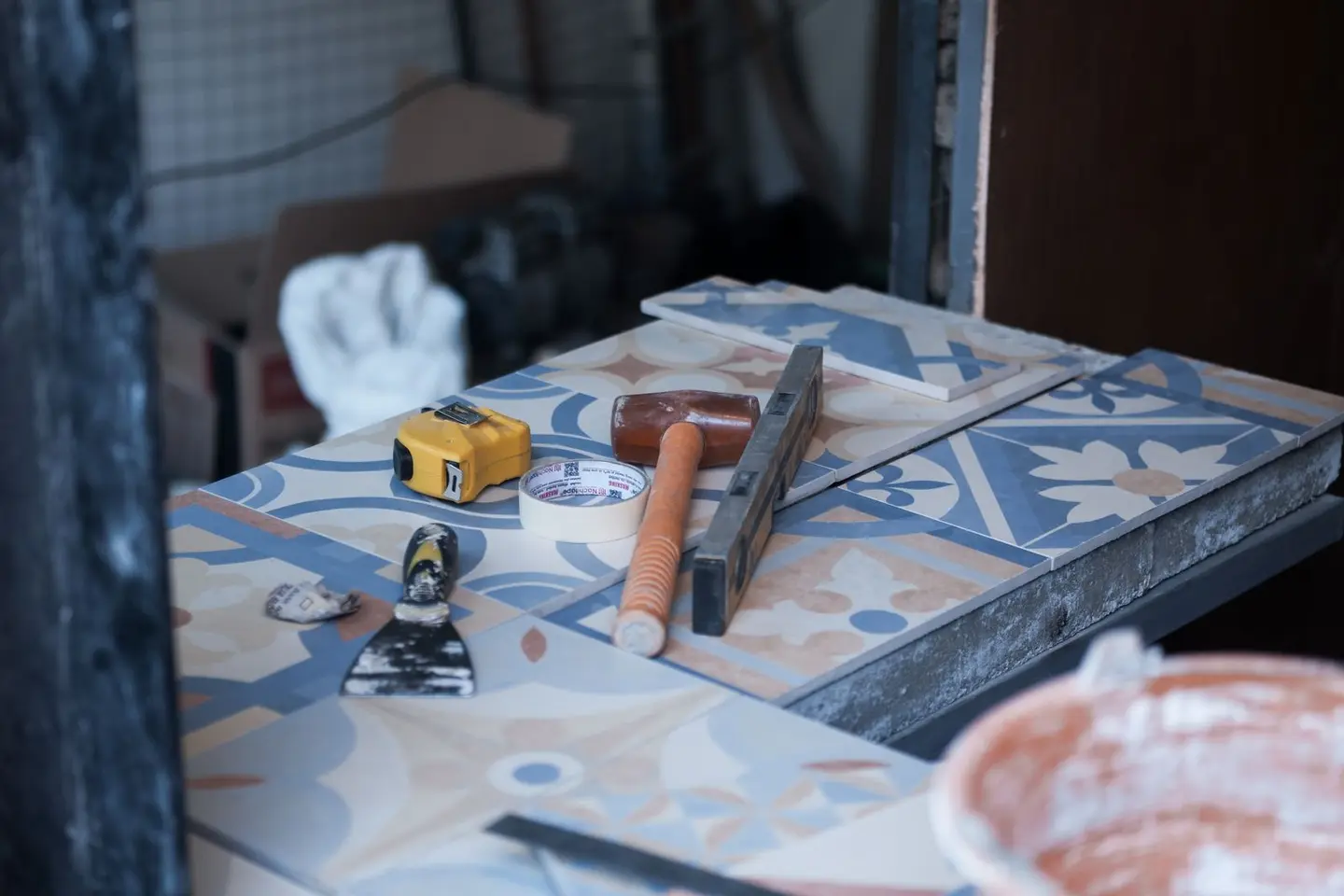
Walk into any builders’ merchant and you’ll find an entire aisle of tile adhesives and grouts. Standard, flexible, rapid-set, S1, S2, unsanded, epoxy, the terminology can be baffling, and the consequences of choosing the wrong product range from cracked grout lines to tiles delaminating off a wet room wall. This guide explains what the classifications mean, how to match product to application, and what you should expect to pay.
Tile Adhesive: The Basics
Tile adhesive (also called tile cement or fixing adhesive) bonds tiles to a substrate, typically plaster, plasterboard, cement board, screed, or existing tiles. Most tile adhesives are cement-based powders that are mixed with water; ready-mixed (dispersion) versions are available for light wall tiling, and reaction-resin (epoxy or polyurethane) adhesives for specialist use.
The European standard BS EN 12004-1 classifies tile adhesives by type (cementitious, dispersion or reaction resin) and by performance.1
- Class C, cementitious (powder mixed with water)
- Class D, dispersion (ready-mixed, acrylic)
- Class R, reactive (epoxy or polyurethane, specialist use)
Within Class C, you’ll see numbers and letters indicating performance:2
- C1, standard adhesive
- C2, improved adhesive (higher bond strength than C1)
- T, slip-resistant (thixotropic, won’t slump on vertical surfaces)
- F, fast-set
- E, extended open time (useful for large-format tiles)
- S1 or S2, deformable, often sold as flexible (S1: a transverse deformation of 2.5–5 mm; S2: more than 5 mm)2
So a product labelled C2 T F S1 is an improved, reduced-slip, fast-setting, deformable adhesive, suitable for wall and floor tiles in most domestic situations, including heated floors and wet rooms.
Which Adhesive for Which Application?
| Application | Minimum adhesive class | Notes |
|---|---|---|
| Internal wall tiles (dry, plaster) | C1 T | Standard adhesive; ready-mix acceptable for small areas |
| Internal floor tiles (rigid substrate) | C2 T | Improved bond needed under foot traffic |
| Bathroom / shower walls | C2 T S1 | Flexible grade advisable on plasterboard and boards; tank the shower area first |
| Wet room floor and walls | C2 T S1 or C2 T S2 | Full S2 flexibility in high-movement or heated substrates |
| Underfloor heating (UFH) | C2 T F S1 or S2 | Rapid set + flexibility essential for thermal cycling |
| Large format tiles (>600 mm) | C2 T E S1 | Extended open time prevents tiles snagging before bedded |
| Tiling over existing tiles | C2 T S1 | Must check structural load and adhesion of existing tiles first |
| External tiling / paving | C2 T F S2 | Frost-resistant, fully flexible grade |
As a rule of thumb: use at least an S1 adhesive wherever the background can move or heat up, such as plasterboard, timber, wet rooms and underfloor heating, and follow the adhesive maker’s data sheet for the substrate. The small cost premium over standard adhesive is insignificant against the cost of re-tiling a failed installation.
Costs
| Product type | Pack size | Coverage (m²) | Typical price |
|---|---|---|---|
| Standard C1 wall adhesive | 20 kg | 5–10 m² | £10–£18 |
| Improved C2 T floor adhesive | 20 kg | 3.5–5 m² | £10–£15 |
| Flexible S1 adhesive | 20 kg | 3.5–4.5 m² | £18–£26 |
| Rapid-set flexible (S1 F) | 20 kg | 3–4 m² | £15–£22 |
| Large-format / S2 adhesive | 20 kg | 3–4 m² | £18–£25 |
| Ready-mixed acrylic (light wall tiles) | 5 kg | 3–4 m² | £10–£18 |
Selco lists Dunlop’s CX-24, the standard-setting C1T adhesive whose data sheet is quoted below, at £17.10 a 20 kg bag including VAT.3 Dunlop’s CF-24 flexible adhesive is from £25.06 a 20 kg bag at the same merchant.4 Toolstation sells Mapei’s Keraquick Easy S1, a rapid-setting flexible adhesive, at £17.99 a 20 kg bag including VAT.5
Coverage varies with tile size and bed thickness. Dunlop’s data sheet for its standard-setting C1T adhesive gives 2 kg/m² on dry walls and 3.5 kg/m² on floors and wet areas at a 3 mm bed, so a 20 kg bag covers about 10 m² of wall or 5.7 m² of floor.6 Use a notched trowel sized to the tile (larger tiles need a deeper notch and a thicker bed) and follow the adhesive maker’s guidance on notch size.
For large-format tiles (above 600 × 600 mm), back-buttering, applying a thin skim of adhesive to the back of the tile in addition to the wall bed, is recommended to achieve full contact coverage. Adhesive coverage is not set by the Building Regulations but by the tiling code of practice, BS 5385, which since its 2018 revision calls for heavier wall tiles to be solidly bedded whatever their size.7 Poor coverage, where tiles are not solid-bed fixed, is a common cause of cracked grout, so aim for a solid bed in wet areas and on floors.8
Grout: Types and Selection
Grout fills the joints between tiles, prevents water ingress, and is the element that most affects the visual finish. The main types are:
Cementitious Grout (Powder Grout)
The standard for most domestic tiling. Available in:
- Unsanded (fine): for joints up to 3 mm, used for wall tiles with tight joints
- Sanded: for joints 3–15 mm, better for floor tiles and wider joints
- Polymer-modified (often sold as flexible grout): contains added polymer for better flexibility and lower water absorption, useful on floors and wherever the background can move
Epoxy Grout
Two-part resin system mixed on site. Extremely hard, virtually impervious to staining, chemical resistant, and long-lived. Preferred by professionals for kitchen floors, restaurant kitchens, and any area exposed to oils, fats, or acids. It’s significantly harder to work with than cementitious grout: Mapei gives its Kerapoxy epoxy grout a pot life of 45 minutes once mixed, and residue has to be cleaned off before it hardens.9 It also costs several times as much per square metre.
Epoxy grout is worth specifying in: kitchen floors where cooking oil or beetroot will land, swimming pool copings, commercial food-prep areas.
Grout Joint Width
Joint width affects both appearance and structural performance:
| Joint width | Typical use | Grout type needed |
|---|---|---|
| 2–3 mm | Wall tiles under 0.1 m², including rectified | Unsanded / fine powder |
| 3 mm (minimum) | Large-format wall tiles of 0.1–1 m² (e.g. 600 × 600 mm) | Fine powder |
| 3–6 mm | Most floor tiles | Sanded or polymer-modified |
| 6–15 mm | Stone, quarry, rustic tiles | Sanded, wide-joint grade |
| >15 mm | External paving, stone flags | Specialist pointing mortar |
Rectified tiles, whose edges are ground to a consistent size, look best with narrow joints, but for wall tiling BS 5385-1 still sets minimum widths: 2 mm for tiles under 0.1 m² with no side over 600 mm, and 3 mm for tiles of 0.1–1 m².7 Hairline joints under 2 mm fall below the code.
Grout Costs
| Product type | Pack size | Coverage (m²) | Typical price |
|---|---|---|---|
| Standard fine wall grout | 5 kg | 10–20 m² (2 mm joint) | £6–£10 |
| Sanded floor grout | 5 kg | 5–12 m² (4 mm joint) | £7–£12 |
| Anti-mould / premium grout | 5 kg | 10–18 m² | £10–£18 |
| Epoxy grout | 2 kg | 2–5 m² | £25–£50 |
Coverage depends heavily on tile size and joint width, larger tiles with wider joints consume much more grout per m².
Grout Colour
Grout colour is the most visible design decision in a tiled space. A contrasting grout (dark tiles, light grout or vice versa) emphasises the tile pattern but shows any inconsistency in joint width. A matching or near-matching grout creates a more monolithic, sophisticated look but can look dirty if it’s a light colour in a heavily used kitchen floor.
Whiter grouts stain more easily; darker grouts fade unevenly if bleach cleaning products are used regularly. Mid-tones (warm grey, beige, taupe) are the most forgiving in practice.
Tip: grout samples look different wet and dry, and dry they look different again on the wall versus in the bag. Always ask your tile merchant to show you a cured sample on the actual tile before committing.
Sealing Grout
Cementitious grout is porous and benefits from sealing after it has fully cured (typically 7 days). A penetrating grout sealer reduces staining and is especially worthwhile on floor grout in kitchens and bathrooms. Re-seal every 2–3 years depending on wear.
Epoxy grout does not need sealing.
Common Tiling Mistakes
- Tiling a shower without tanking, whatever the adhesive, the background must be protected from water; even standard adhesives rated for wet areas and power showers assume the background has been waterproofed first.6
- Grouting too early, wait until the adhesive has set (typically 24 hours for a standard-setting adhesive, longer in cold conditions, and a few hours for rapid-set products); grouting before the adhesive has cured is a common cause of grout problems.68
- Not mixing grout to the right consistency, too wet and it slumps from vertical joints; too stiff and it pulls away before it levels. Aim for a thick peanut butter consistency.
- Forgetting to leave movement joints, British Standards call for movement joints at perimeters, over structural joints and at changes of background, and for internal floors to be divided into bays of no more than 10 m in each direction (3 m outside), filled with flexible sealant rather than grout, to stop tiles cracking or lifting as the floor and substrate move.10
- Using powder grout at the tile-to-bath or tile-to-tray junction, this joint must be silicone sealant, not grout; it will crack within weeks if grouted.
References (10)
Figures in this note were checked against the sources below on 2 October 2026. Superscript numbers in the text point to them. Every source the site cites, by topic.
- 1technicalstrongBSI, a standard.RN-TL1I4RBS EN 12004-1:2017, published 28 February 2017, committee B/539, prepared by CEN/TC 67 Ceramic tiles, current; it supersedes BS EN 12004:2007+A1:2012. The scope covers three types of ceramic tile adhesive: cementitious for internal and external installations, and dispersion and reaction resin for internal installations only, on walls and floors. It gives the terminology for the products, working methods and application properties, specifies the performance requirements and the appurtenant test methods, the assessment and verification of constancy of performance, and the classification, designation and marking of tile adhesives, which is where the C, D and R type letters and class numbers on a bag of adhesive come from. It expressly does not provide criteria or recommendations for the design and installation of ceramic tiles, which is BS 5385. It notes tile adhesives may also be used for natural and agglomerated stones if they do not adversely affect the material. BS EN 12004-2:2017 gives the test methods.
- 2technicalsupplier figureBAL Adhesives, guidance.RN-93XKIBBAL's explanation of the BS EN 12004 codes (C, D, 1, 2, T, E, F) and the S1 and S2 deformability classes: S1 is 2.5 to 5 mm transverse deformation, S2 above 5 mm.
- 3costsupplier figureSelco Builders Warehouse.RN-5DSBMAA price, true at 2026-09. A national builders' merchant's product page for Dunlop CX-24 standard-setting tile adhesive in a 20 kg bag. It settles the price of £17.10 including VAT, the top of the standard adhesive row.
- 4costsupplier figureSelco Builders Warehouse.RN-JAKZEZA price, true at 2026-09. Selco product page for a 20 kg bag of Dunlop CF-24 flexible tile adhesive, priced from £15.00 excluding VAT, £18.00 including VAT.
- 5costsupplier figureToolstation.RN-JPISI2A price, true at 2026-09. A national merchant's product page for Mapei Keraquick Easy S1, a rapid-setting S1 flexible tile adhesive, 20 kg. It settles the price of £17.99 including VAT (£14.99 ex VAT).
- 6technicalsupplier figureDunlop (ARDEX), a data sheet.RN-HVB1D6Manufacturer technical data for a standard water resistant floor and wall tile adhesive, useful as the baseline against a flexible adhesive. At 3mm thickness a 20 kg bag covers approximately 2 kg/m2 on dry wall areas and 3.5 kg/m2 on floors, exterior and wet areas. Open time is 15 to 20 minutes, noticeably shorter than the 30 to 45 minutes of the S1 grade. Bed thickness is 3 to 6mm. Mix ratio is about 2.5 parts powder to 1 part water by volume, roughly 5.6 litres of cold water per 20 kg bag. Application is at about 20C and never below 5C. It exceeds BS EN 12004 for a C1T adhesive, and the manufacturer states it is not suitable for porcelain tiles or exterior areas unless a flexible additive is used. Maximum weight of tiling including adhesive is 20 kg/m2 onto plaster and 32 kg/m2 onto plasterboard, with plasterboard requiring fixing at 300mm centres or as the board manufacturer directs.
- 7technicalsupplier figureBAL Adhesives, guidance.RN-97W51DBAL's summary of BS 5385-1:2018: heavier tiles relative to the background's capacity must be solidly bedded regardless of size, and minimum grout joints are 2 mm for tiles under 0.1 m² and 3 mm for 0.1 to 1 m².
- 8technicalsupplier figureBAL Adhesives, guidance.RN-MWWTC3BAL's guide to grout faults lists poor adhesive coverage, meaning tiles not solid-bed fixed, among the common causes of cracked grout, and warns against grouting before the adhesive has cured.
- 9technicalsupplier figureMapei, guidance.RN-5FP5VEThe maker's UK product page for Kerapoxy two-part epoxy grout. Its technical data give a pot life of 45 minutes once mixed and an open time of 30 minutes.
- 10technicalsupplier figureBAL Adhesives, guidance.RN-OMSV8UBAL's guide to movement joints: British Standards divide interior floor tiling into fields of at most 10 m each way and exterior at 3 m, with joints at perimeters, structural joints and changes of base material.
-
BS EN 12004-1:2017 Adhesives for ceramic tiles. Requirements, assessment and verification of constancy of performance, classification and marking, BSI, accessed 30 September 2026. knowledge.bsigroup.com
-
Understanding tile adhesive classifications and what they mean, BAL Adhesives, accessed 30 September 2026. bal-adhesives.com
-
Dunlop CX-24 Essential Tile Adhesive Grey 20kg, Selco Builders Warehouse, accessed 2 October 2026. Priced at 2026-09 and left there. selcobw.com
-
Dunlop CF-24 Flexible Tile Adhesive 20kg, Selco Builders Warehouse, accessed 2 October 2026. Priced at 2026-09 and left there. selcobw.com
-
Mapei Keraquick Easy S1 Tile Adhesive Grey 20kg, Toolstation, accessed 2 October 2026. Priced at 2026-09 and left there. toolstation.com
-
Technical data: CX-24 Essential Tile Adhesive, Dunlop (Building Adhesives Ltd), accessed 30 September 2026. dunloptrade.com
-
Important changes to BS 5385-1 Wall and Floor Tiling, BAL Adhesives, accessed 30 September 2026. bal-adhesives.com
-
Understanding common grouting issues and how to prevent them, BAL Adhesives, accessed 30 September 2026. bal-adhesives.com
-
Kerapoxy, Acid-resistant Epoxy Grout & Adhesive, Mapei, accessed 2 October 2026. mapei.com
-
A guide to movement joints and sealants, BAL Adhesives, accessed 30 September 2026. bal-adhesives.com