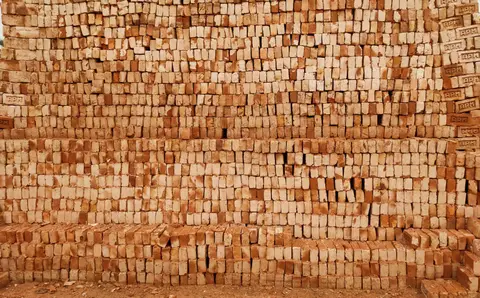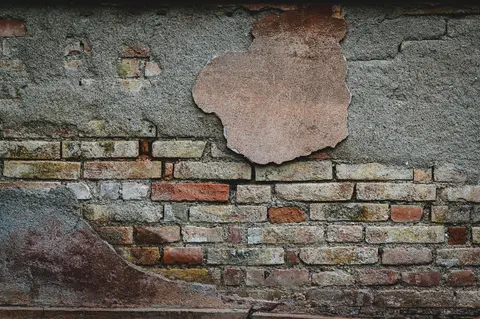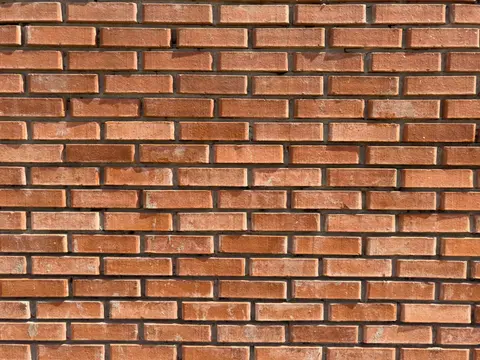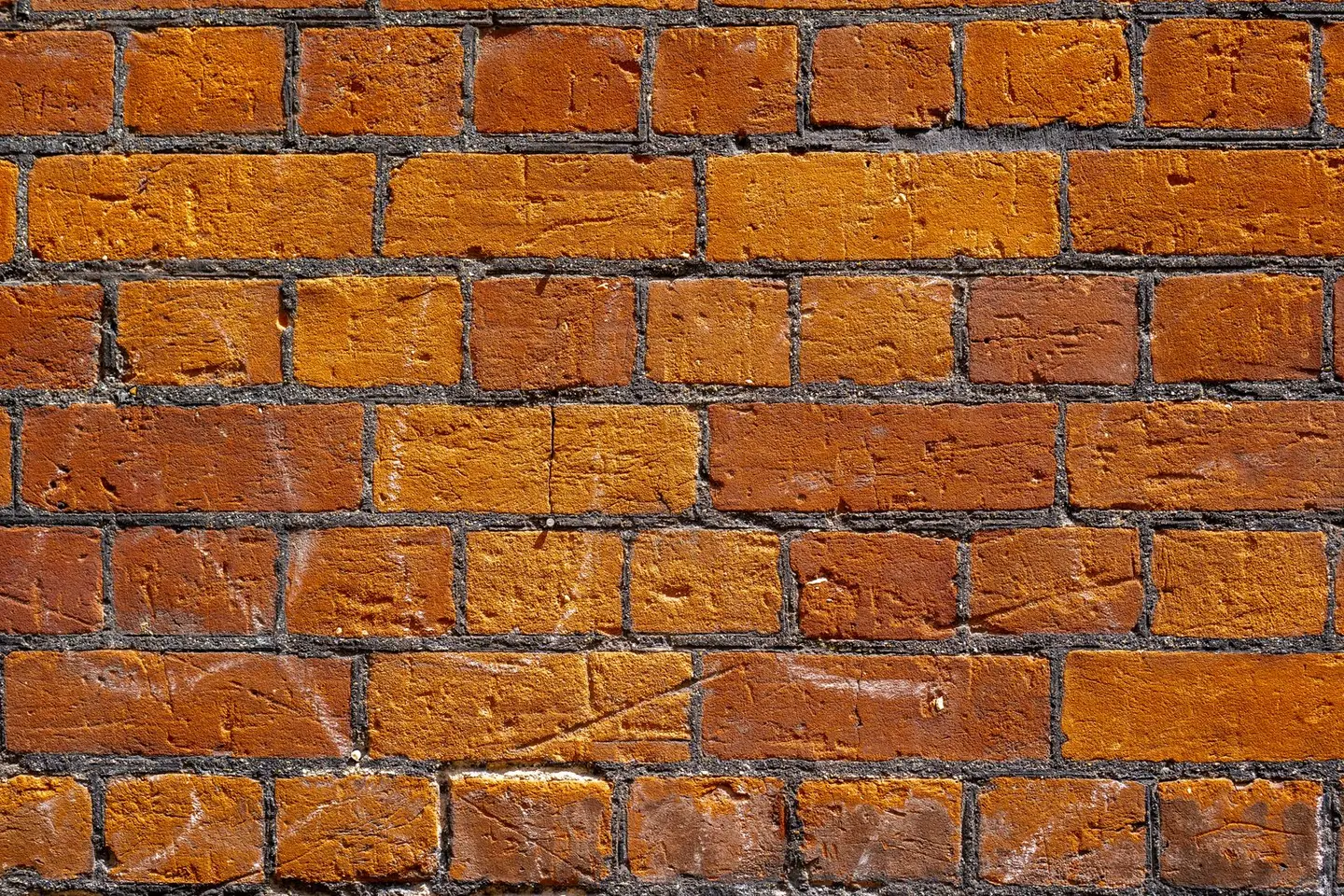
Brick choice matters more than most people realise. Use a soft common brick below DPC and it may spall within a decade; use a premium hand-made facing where common-stock bricks would do and you add cost for no benefit. There are three broad categories: facing, engineering and common.1 They differ in compressive strength, water absorption and frost resistance, and BS EN 771-1:2011+A1:2015 (specification for clay masonry units) sets out the characteristics and performance requirements that clay bricks must meet and declare.2
The standard UK metric brick is 215 × 102.5 × 65 mm (L × W × H). With a standard 10 mm mortar joint this gives a repeat module of 225 × 112.5 × 75 mm, meaning 60 bricks per m² in half-brick (102.5 mm) stretcher-bond walling.3
Facing Bricks
Facing bricks are manufactured for visual quality: consistent colour, texture and arrises (sharp edges). They are not necessarily stronger than commons, but they are selected and graded for appearance. Facing bricks must declare their compressive strength, water absorption and freeze-thaw durability class to BS EN 771-1.2
Freeze-thaw durability designations under BS EN 771-1:
- F2, Severe (fully frost-resistant): suitable for all UK exposures including capping, copings, below DPC, parapets4
- F1, Moderate (limited frost resistance): suitable for above-DPC walling in sheltered or moderate exposure
- F0, Passive (not frost resistant): only where protected from saturation and freezing, typically internal work
Many modern UK-made wirecut (extruded) facing bricks are rated F2. Handmade or ‘stock’ bricks vary: always verify the data sheet. For copings, parapets, below DPC and other severely exposed positions, specify F2.
Water absorption and soluble salts:
- Water absorption is declared as a percentage rather than as a class. Only engineering and DPC bricks have fixed upper limits (see below); ordinary facings and commons can absorb far more.
- Soluble salts are designated S0, S1 or S2; S2 means a low soluble salts content, the safer choice where brickwork will stay wet.4
Engineering bricks are dense and low-absorption; facing bricks vary widely.
Engineering Bricks: Class A and Class B
Engineering bricks are defined in the UK National Annex to BS EN 771-1 by their compressive strength and water absorption, not by visual quality.5 The Class A and Class B labels come from the withdrawn British Standard BS 3921 and are still widely used in specifications:
| Property | Class A (former BS 3921) | Class B (former BS 3921) |
|---|---|---|
| Compressive strength | ≥ 125 N/mm² | ≥ 75 N/mm² |
| Water absorption | ≤ 4.5 % | ≤ 7 % |
| Frost resistance | F2 | F2 |
| Typical colour | Blue-grey (Staffordshire blue) | Red or blue |
| Cost per 1,000 (2026) | £850–£1,100 | £600–£850 |
Class A engineering bricks have a compressive strength greater than 125 N/mm² and water absorption below 4.5%; Class B bricks exceed 75 N/mm² with water absorption below 7%.5
Engineering bricks are specified for:
- Below DPC and in ground, manholes, inspection chambers, retaining walls, sewer structures
- Parapets and copings, high-exposure locations where freeze-thaw and driving rain are severe
- DPC courses, but only DPC1 bricks (water absorption no more than 4.5%, which Class A engineering bricks meet) are suitable for a brick damp-proof course in buildings; DPC2 bricks (up to 7%, a limit Class B meets) are for external works such as garden and retaining walls only1
- Exposed piers and gate posts
For most domestic drainage and below-ground work, Class B engineering brick suffices. Class A is chosen where the highest strength and lowest water absorption are needed, including brick damp-proof courses in buildings.
Common (Stock) Bricks
Common or stock bricks are produced for structural use where appearance is secondary, they will be rendered, plastered, or hidden. In London and the South-East, ‘London stocks’ (yellowish, handmade appearance) have traditionally been used as common bricks and are also used decoratively in restoration work. Flettons, pressed commons made from the clay around Peterborough, were for much of the twentieth century the most widely used UK common brick. Forterra’s London Brick Commons, for example, are rated F1 with a compressive strength of 25 N/mm² and water absorption of 23%.6
Common bricks vary widely in quality. They should not be assumed to be F2, many are F1 or even F0. Never use unspecified common bricks below DPC or in exposed positions without confirming the durability class from the manufacturer’s data sheet.
Compressive strengths are often in the region of 15 to 50 N/mm², adequate for low-rise domestic loadbearing walls. Mortar designation should be matched to brick strength (weaker brick = softer mortar to allow differential movement).
Bricks Per m² and Buying Guide
| Bond | Brick thickness | Bricks/m² | Mortar/m² (approx.) |
|---|---|---|---|
| Stretcher (half brick) | 102.5 mm | 60 | 0.022 m³ |
| English bond (one brick) | 215 mm | 120 | 0.043 m³ |
| Flemish bond (one brick) | 215 mm | 120 | 0.043 m³ |
Add 5 % for cutting waste (10 % for complex patterns or curves). Bricks are sold per 1,000 or per pallet (typically 400–500 bricks depending on type).
2026 Cost Comparison
| Brick Type | Typical Cost/1,000 ex-VAT | Notes |
|---|---|---|
| Common / stock | £280–£450 | Flettons at lower end; London stocks higher |
| Wirecut facing, mid range | £350–£600 | Most common domestic choice |
| Handmade / tumbled facing | £650–£1,200+ | Conservation, match-to-existing |
| Engineering Class B | £600–£850 | Red or blue |
| Engineering Class A (blue) | £850–£1,100 | Staffordshire blue, heavier delivery |
| Reclaimed stock / London stock | £500–£1,000 | Variable quality, check frost rating |
Prices are trade ex-yard, London/South-East. Delivery typically adds £80–£180 per pallet. One pallet covers roughly 6–8 m² in stretcher bond.
Matching Existing Brickwork
Matching existing bricks for extensions or repairs is one of the hardest tasks on a renovation. Key variables are:
- Colour and texture, fire your architect or supplier a photo in daylight alongside a tape measure
- Dimensions, older imperial bricks vary in size and are often taller than the modern metric 215 × 102.5 × 65 mm brick (heights of roughly 68–76 mm are common). Mixing sizes requires adjusting joint widths or sourcing imperial-size bricks
- Frost class, reclaimed bricks are usually ungraded; do not assume they are frost resistant unless tested
- Mortar, matching the original mortar strength is as important as matching the brick colour
For listed buildings and conservation areas, your local authority’s conservation officer may specify approved brick suppliers.
Key Standards
- BS EN 771-1:2011+A1:2015, Specification for masonry units: clay masonry units (covers the physical and mechanical properties that manufacturers declare)2
- BS EN 772-1:2011+A1:2015, Methods of test: determination of compressive strength7
- BS EN 1996-1-1 (Eurocode 6), Design of masonry structures8
- BS 8000-3:2020, Workmanship on construction sites. Masonry. Code of practice. It replaced BS 8000-3:2001, which is withdrawn; the series was renamed from “building sites” to “construction sites” at the same revision9
- Building Regulations Approved Document A, Structural requirements for loadbearing masonry10
Reclaimed brick caution
Reclaimed bricks are popular for their character but carry real risks. Most reclaimed bricks were made before frost-resistance designations existed and carry no rating, and years of salvage yard storage do not improve frost resistance. Use reclaimed bricks above DPC in sheltered positions only, or obtain a test report (BS EN 772-22 freeze-thaw test) before specifying below DPC or in parapets.
The rules in this note are those that apply in England. Scotland, Wales and Northern Ireland have their own building standards and permitted development rights.
References (10)
Figures in this note were checked against the sources below on 30 September 2026. Superscript numbers in the text point to them. Every source the site cites, by topic.
- 1technicalsupplier figureWienerberger UK, guidance.RN-6UT6WTA brick maker's guide explaining that engineering bricks are rated Class A or Class B, with Class B the more common, and giving their strength and absorption limits.
- 2technicalstrongBSI (BSI Knowledge catalogue), a standard.RN-0Z2U0MDated 31 October 2011 with a 2015 amendment, this specifies the characteristics and performance requirements for clay masonry units intended for protected or unprotected masonry, covering facing and rendered masonry and loadbearing and non-loadbearing structures including internal linings and partitions. It defines performance for dimensional tolerances, strength and density against test methods in separate European standards, and it carries the F0, F1 and F2 frost resistance categories and the S0, S1 and S2 active soluble salts categories that a UK brick is declared against. Its scope note states the standard does not specify standard sizes for clay masonry units, which is why UK brick format remains a national convention rather than a European one.
- 3technicalgoodBrick Development Association, guidance.RN-B9M8JQThe Brick Development Association's technical guide to designing in brick dimensions, last updated April 2023. Gives the standard co-ordinating sizes, how brick and joint combine into a 225 mm horizontal and 75 mm vertical module, and how to set out openings, piers and courses so the brickwork works without cutting. The BDA represents almost all UK clay brick production, so this is the trade's own dimensional authority.
- 4technicalgoodBrick Development Association, guidance.RN-HPFDEFThe Brick Development Association's 2023 guide to severely exposed brickwork. Its details show engineering bricks laid in M12 mortar below ground and for at least two courses above, and give M12 as 1:¼:3.
- 5technicalsupplier figureWienerberger UK, guidance.RN-81XA5UManufacturer page for engineering bricks. It gives the Class A and Class B compressive strength and water absorption limits from the UK National Annex to BS EN 771-1.
- 6technicalsupplier figureForterra (London Brick), a data sheet.RN-RJ032ZLondon Brick Commons, 65 mm, made at Kings Dyke. Manufactured to EN 771-1. Dimensions 215 x 102.5 x 65 mm. Compressive strength 25 N/mm2, configuration frogged with 14-20% voids, dry weight 1.95 kg, active soluble salts S2, dimensional tolerance mean T2, manufacture type pressed. Thermal conductivity lambda 10,dry 0.45 W/mK and 0.75 W/mK exposed at 5% moisture. Forterra sell commons as utility bricks, not facing bricks, so colour, texture, chipping, hairline cracks and crazing may vary. London Brick is available in the standard 65 mm size with four bricks also in 73 mm, which is what makes it the usual match for an extension to a mid-century house.
- 7technicalstrongBSI (British Standards Institution), a standard.RN-6RE0OYSTATUS: CURRENT. BS EN 772-1:2011+A1:2015 (base edition published 31 May 2011, ISBN 978 0 580 84584 0, identical to EN 772-1:2011+A1:2015) supersedes BS EN 772-1:2000 and is part one of the BS EN 772 test series for masonry units. It specifies specimen preparation and conditioning and the compression test method used to determine the compressive strength of bricks and blocks, the figure quoted in N/mm2 that decides whether a unit is suitable for a given structural application. It is the test standard that sits behind the product specifications in the BS EN 771 series (BS EN 771-1 clay units, BS EN 771-3 aggregate concrete units, BS EN 771-4 autoclaved aerated concrete), and it replaced the strength testing formerly given inside the withdrawn British product standards such as BS 3921 for clay bricks. Other parts of the series cover dimensions (BS EN 772-16) and bending tensile strength. Catalogue page confirms number, title, date, status and scope; the method is paywalled.
- 8technicalstrongBSI (BSI Knowledge catalogue), a standard.RN-30GDL1Dated 30 December 2005 with a 2012 amendment, this is the masonry design Eurocode. Its overview states it is the first sub-part of Part 1 of the series and gives the basis for the design of buildings and civil engineering works in masonry, dealing with unreinforced masonry and with reinforced masonry where reinforcement is added to provide ductility, strength or improved serviceability. The principles of prestressed and confined masonry design are given but application rules are not provided, and the Part is expressly not valid for masonry with a plan area of less than 0.04 square metres. It is the standard a structural engineer designs a loadbearing brick or block wall to, and the reference behind the characteristic compressive strength of masonry built with a given unit and mortar strength.
- 9technicalstrongBSI, a standard.RN-5VWPRLBS 8000-3:2020, Workmanship on construction sites. Masonry. Code of practice, the British Standard code of practice, cited for the workmanship it specifies rather than for any price
- 10technicalvery strongMinistry of Housing, Communities and Local Government (GOV.UK).RN-Z6AXUWThe full Approved Document A PDF, which carries the deemed-to-satisfy tables a domestic project is checked against. Section 2E covers foundations of plain concrete: paragraph 2E3 gives the recommended minimum widths of strip foundations in Table 10, keyed to ground type and total load of loadbearing walling per linear metre. Table 10 sets, for rock (not inferior to sandstone, limestone or firm chalk, requiring at least a pneumatic or mechanically operated pick to excavate), a width equal to the width of the wall at every load. For medium dense gravel or sand (requires a pick to excavate, a 50mm square wooden peg hard to drive beyond 150mm) and for stiff clay or stiff sandy clay (can be indented slightly by the thumb), the minimum widths are 250mm at 20 kN per linear metre, 300mm at 30, 400mm at 40, 500mm at 50, 600mm at 60 and 650mm at 70. Firm clay and firm sandy clay (thumb makes an impression easily) start at 300mm. The document also covers minimum depth of strip foundations, wall thickness rules for residential buildings up to three storeys (paragraph 2C10 covers internal loadbearing walls in brickwork or blockwork), buttressing, lateral support by floors and at roof level, interruption of lateral support, wall cladding in Section 3, and Section 5 on reducing sensitivity to disproportionate collapse with the building consequence classes.
-
Different types of bricks explained, Wienerberger, accessed 30 September 2026. wienerberger.co.uk
-
BS EN 771-1:2011+A1:2015 Specification for masonry units. Clay masonry units, BSI, accessed 7 September 2026. knowledge.bsigroup.com
-
Designing to brickwork dimensions, Technical Guide, Brick Development Association, accessed 30 September 2026. brick.org.uk
-
Severely exposed brickwork, Technical Guide, Brick Development Association, accessed 30 September 2026. brick.org.uk
-
Engineering bricks, Wienerberger, accessed 30 September 2026. wienerberger.co.uk
-
London Brick Commons (65mm), Forterra, accessed 30 September 2026. forterra.co.uk
-
BS EN 772-1:2011+A1:2015, Methods of test for masonry units. Determination of compressive strength, BSI, accessed 14 September 2026. knowledge.bsigroup.com
-
BS EN 1996-1-1:2005+A1:2012, Eurocode 6: Design of masonry structures. General rules for reinforced and unreinforced masonry structures, BSI, accessed 14 September 2026. knowledge.bsigroup.com
-
BS 8000-3:2020, Workmanship on construction sites. Masonry. Code of practice, BSI, accessed 14 September 2026. knowledge.bsigroup.com
-
Approved Document A, Structure, 2004 edition incorporating 2004, 2010 and 2013 amendments, Ministry of Housing, Communities and Local Government, accessed 14 September 2026. assets.publishing.service.gov.uk