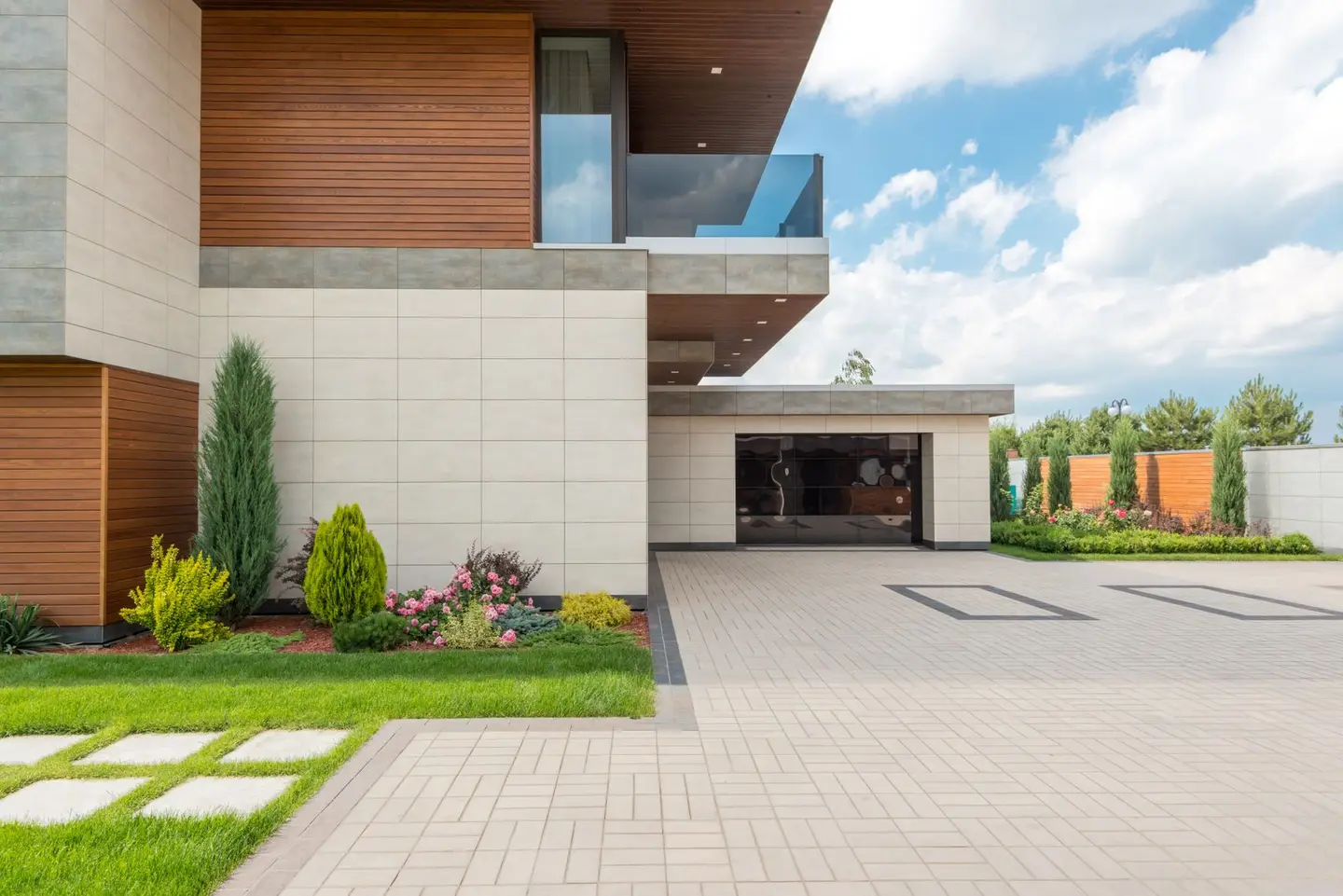
Resin bound driveways have become one of the most popular hard-standing choices for UK homeowners over the past decade, largely because they satisfy the planning requirement for permeable surfacing while looking considerably better than plain concrete. They are not the cheapest driveway option, block paving costs similarly, while tarmac is cheaper, but they offer a low-maintenance, long-lasting surface that works well on both modern and period properties.
Resin Bound vs Resin Bonded: What’s the Difference?
These two products sound almost identical but behave very differently:
Resin bound, aggregate and resin are mixed thoroughly before being trowelled onto the base. The resulting surface is fully permeable: water drains through the matrix rather than running off. This is the SuDS-compliant product most installers mean when they say “resin driveway.”
Resin bonded, a coat of resin is applied to the base and then aggregate is scattered on top. The result is a textured surface that is not permeable. Loose chippings can scatter over time. Far less common for driveways; mainly used decoratively on paths and garden areas.
For driveway use, almost always specify resin bound.
Planning Permission
In England, a hard surface in a front garden is permitted development, so it needs no planning application, provided that where it lies between the house and a road and covers more than 5 m², it is made of porous materials or drains to a lawn or border within the property.1 This condition applies from 1 October 2008, when the government changed the General Permitted Development Order, and it is a large part of why resin bound became so popular.2 A resin bound driveway laid on a permeable sub-base normally meets it.
If you are considering an impermeable surface (concrete, tarmac, or resin bonded) over more than five square metres of front garden, you need either planning permission or to direct the runoff to a lawn or border rather than the street.3
Conservation areas and Article 4 Directions may impose additional controls. Always check with your local planning authority if you are uncertain.
2026 UK Cost Breakdown
Costs assume an existing concrete or tarmac base in reasonable condition (no major cracking or subsidence). If a new base is required, a new concrete base typically adds £55–£85 per m² (excavation, 150 mm of hardcore and 100–250 mm of concrete).4 (2024 price, brought to 2026)
| Aggregate type | Cost per m² (installed, inc. VAT) |
|---|---|
| Standard 3–6 mm gravel (limestone/granite) | £40–£55 |
| Premium coloured quartz or marble chip | £55–£75 |
| Recycled glass aggregate | £60–£80 |
| Larger aggregate (6–10 mm) | £55–£70 |
| Job size | Total cost (standard aggregate) |
|---|---|
| Small driveway (30 m²) | £1,200–£1,650 |
| Average driveway (50 m²) | £2,000–£2,750 |
| Large driveway (80 m²) | £3,200–£4,400 |
| Driveway + path (100 m²) | £4,000–£5,500 |
Worked Example: 55 m² Driveway
- Existing tarmac base in good condition; minor crack repairs: £200
- 55 m² resin bound surface (premium quartz aggregate, 18 mm depth): £3,300
- Edging/border restraint (aluminium, 25 linear m): £350
- Total: approximately £3,850
What Drives the Price?
Base condition is the biggest variable. Resin bound relies on a structurally sound, rigid base, concrete or macadam (tarmac). A failing base will cause the resin layer to crack regardless of quality. If the existing base has potholes, significant cracking, or drainage problems, it must be repaired or replaced before the resin is laid. Poor-base work is the main cause of premature resin driveway failure.
Aggregate grade and colour: standard limestone or granite 3–6 mm chips are the cheapest. Coloured quartz, Venetian glass, or marble aggregates cost more and are chosen for colour and a more distinctive finish. UV-stable aliphatic polyurethane binders do not yellow in sunlight, while cheaper non-UV-stable resins can, which shows most on light aggregates.5
Depth: Makers typically specify about 18 mm for driveways, with the exact depth depending on the use and the size of the stone.6 Paths are often laid thinner, and thicker applications use more material and cost more but are more durable.
Edging: A robust restraint edge (aluminium angle or bespoke resin border strips) is essential to prevent edge spreading. This is sometimes included, sometimes priced separately, always check.
Access and shape: Awkward shapes (multiple curves, tight access, changes of level) add time and cost. A standard rectangular driveway is priced more competitively than a complex sweeping drive with radii and planters.
Pros and Cons
| Pros | Cons |
|---|---|
| SuDS-compliant, no planning permission for front drives | Higher upfront cost than tarmac |
| Smooth, weed-resistant surface | Requires a sound, rigid base to bond to |
| Very low maintenance | Cannot be repaired invisibly, patches show |
| Long lifespan (15–25 years) with good base | UV degradation possible with lower-quality resins |
| Wide colour and aggregate choice | Not DIY-friendly, requires professional mixing equipment |
| Barefoot-friendly (no loose stones) | Can feel hot underfoot in direct summer sun (dark aggregates) |
| Resistant to oil and fuel staining (UV-stable resins) | Price premium over block paving on large areas |
How to Choose an Installer
Resin bound driveways look simple but the quality of mixing and laying determines longevity. A poor installation that separates or cracks within three years is expensive to rectify because the whole surface needs to come up.
Key questions to ask any installer:
- What resin system do you use? (UV-stable aliphatic polyurethane is the quality choice; non-UV-stable resins can yellow outdoors)
- What depth will the aggregate be laid at? (around 18 mm is typical for driveways; ask why if a thinner layer is proposed)
- How do you assess the existing base? Will you carry out any necessary repairs before laying?
- What warranty do you offer on materials and workmanship? (5–10 years is typical from reputable installers)
- Are you a member of any trade body? (The British Association of Landscape Industries or equivalent)
- Can you provide references for jobs completed two or more years ago?
Get at least three quotes. Prices vary widely, not always for a good reason. The cheapest quote is frequently cheapest because the installer is cutting depth, using an inferior resin, or not repairing the base properly.
Maintenance
A well-installed resin bound driveway needs minimal maintenance:
- Leaf blowing or brushing to prevent leaf stain during autumn (tannins from wet leaves can discolour light aggregates)
- Occasional jet washing (low pressure, wide fan tip) to remove algae and moss, usually once or twice per year in a shaded driveway
- Weed treatment if any weeds appear around the edges, the surface itself should not support weed growth, but edges and cracks can
- De-icing, follow the installer’s or resin maker’s guidance; many advise sand or a calcium magnesium acetate (CMA) de-icer rather than heavy use of rock salt
Comparison with Alternatives
| Surface | Cost per m² installed | Lifespan | Permeability | Maintenance |
|---|---|---|---|---|
| Resin bound | £40–£807 | 15–25 yrs | Yes | Very low |
| Block paving (standard concrete) | £50–£858 | 20–30 yrs | Permeable (gaps) or not | Low–moderate (weeding) |
| Tarmac (macadam) | £20–£40 | 15–20 yrs | No (unless porous tarmac) | Low |
| Gravel | £10–£25 | 10–15 yrs | Yes | Moderate (raking, topping up) |
| Imprinted concrete | £50–£90 | 15–25 yrs | No | Low (resealing every 3–5 yrs) |
| Poured concrete | £55–£85 | 25–40 yrs | No | Very low |
Resin bound sits in the upper-middle band on cost but competes well on aesthetics, longevity, and compliance, which is a large part of why it has become so popular for front drives since the 2008 planning rule change.
References (8)
Figures in this note were checked against the sources below on 30 September 2026. Superscript numbers in the text point to them. Every source the site cites, by topic.
- 1technicalvery strongThe National Archives (legislation.gov.uk), legislation.RN-4C9X4BClass F permits the provision within the curtilage of a dwellinghouse of a hard surface for any purpose incidental to the enjoyment of the dwellinghouse, or its replacement in whole or in part. Condition F.2 applies where the hard surface would lie between a wall forming the principal elevation and a highway and its area would exceed 5 square metres: the surface must then be made of porous materials, or provision made to direct run-off water to a permeable or porous area or surface within the curtilage.
- 2technicalvery strongMinistry of Housing, Communities and Local Government, a government page.RN-V3VCFPThe Government's own explanatory guidance behind the front-garden paving rule, published 13 May 2009 as a 28-page PDF (710 KB). It explains the change to the General Permitted Development Order that took effect on 1 October 2008: the hard surfacing of more than 5 square metres of a domestic front garden is permitted development only where the surface is rendered permeable, or where the run-off is directed to a permeable or porous area within the curtilage. Traditional impermeable surfaces such as in-situ concrete or bitmac over an impermeable base need planning permission above that 5 square metre threshold. The guidance sets out the practical ways to comply: permeable block paving, porous asphalt and gravel; and the alternative of conventional paving laid to fall onto a lawn, border, soakaway or rain garden. It covers construction build-ups for driveways and paved areas and the principle of controlling and reducing rainfall run-off into drains. Read with Class F of Part 1 of Schedule 2 to the GPDO, which is the operative provision.
- 3technicalvery strongPlanning Portal, guidance.RN-VCANMUThe Planning Portal on paving a front garden: permission is not needed if the surface is permeable, or if run-off is directed to a permeable area within the curtilage, but it is needed for more than five square metres of impermeable surface draining to the road. The specific rule that makes a drive a planning matter, which surprises most people paving one.
- 4costvery strongValuation Office Agency, a government page.RN-RSLGJ5A price, true at 2024-04, brought forward on the Construction Output Price Index. The Valuation Office Agency's Rating Cost Guide 2026: estimated replacement costs per square metre for building types, used by the VOA for contractor's basis rating valuations. Each code gives a construction description, the unit of measurement and an ERC at a UK mean location factor of 1.00. It is official, free and unusually comprehensive, and it is a replacement cost for rating rather than a market tender price, which is why the guidance notes matter as much as the table.
- 5technicalsupplier figureSureSet UK Ltd, guidance.RN-CF6MD9A resin bound binder maker's product page. It explains that aliphatic polyurethane binders are UV stable and do not yellow, as other resin types can.
- 6technicalsupplier figureSureSet UK, guidance.RN-RU8A8DA major UK resin-bound surfacing maker's FAQ. It gives 18 mm as the typical laid depth and says depth varies with the application and the size of stone.
- 7costsupplier figureStoneSet Resin.RN-7L9XC4A price, true at 2026-09. a resin driveway installer's own customer-facing range for a resin bound driveway in 2026, £60 to £120 and above per square metre. It is the retail counterpart to the trade split published by Advanced Resin Solutions, and the two together are why this rate no longer rests on aggregated quote data alone
- 8costsupplier figureWickes Building Supplies Ltd.RN-PHHL94A price, true at 2026-09. the retail price Wickes Building Supplies Ltd publishes for Marshalls Driveline Priora Brindle Block Paving 200 x 100 x 60mm Pack of 404, which is the supply figure the cost book records for this item
-
The Town and Country Planning (General Permitted Development) (England) Order 2015, Schedule 2, Part 1, Class F: hard surfaces, The National Archives, accessed 30 September 2026. legislation.gov.uk
-
Permeable surfacing of front gardens: guidance, Department for Communities and Local Government, accessed 30 September 2026. gov.uk
-
Paving your front garden: planning permission, Planning Portal, accessed 30 September 2026. planningportal.co.uk
-
Rating Cost Guide 2026, Valuation Office Agency, accessed 30 September 2026. Priced at 2024-04; brought to 2026 on the Construction Output Price Index, housing repair and maintenance (Great Britain), published by Office for National Statistics, a factor of 1.0239. assets.publishing.service.gov.uk
-
ProResin UVR (7kg), SureSet UK Ltd, accessed 30 September 2026. sureset.co.uk
-
Frequently asked questions, SureSet UK Ltd, accessed 30 September 2026. sureset.co.uk
-
How Much Does a Resin Bound Driveway Cost in 2026?, StoneSet Resin, accessed 30 September 2026. Priced at 2026-09, so no calibration is needed. stonesetresin.co.uk
-
Marshalls Driveline Priora Brindle Block Paving 200 x 100 x 60mm Pack of 404, Wickes Building Supplies Ltd, accessed 30 September 2026. Priced at 2026-09, so no calibration is needed. wickes.co.uk