Plumbing and heating merchants are specialist trade counters that stock the full range of pipework, fittings, boilers, cylinders, valves, and controls that a domestic installer or heating engineer needs day-to-day. They operate differently from DIY sheds: pricing is tiered by account status, product ranges go deeper (especially on commercial and system components), and counter staff usually know the trade well. This guide explains how to navigate them, whether you’re a contractor opening an account or a homeowner trying to source materials at a sensible price.
What Plumbing and Heating Merchants Stock
A well-stocked plumbing merchant carries far more than pipe and fittings. Expect to find:
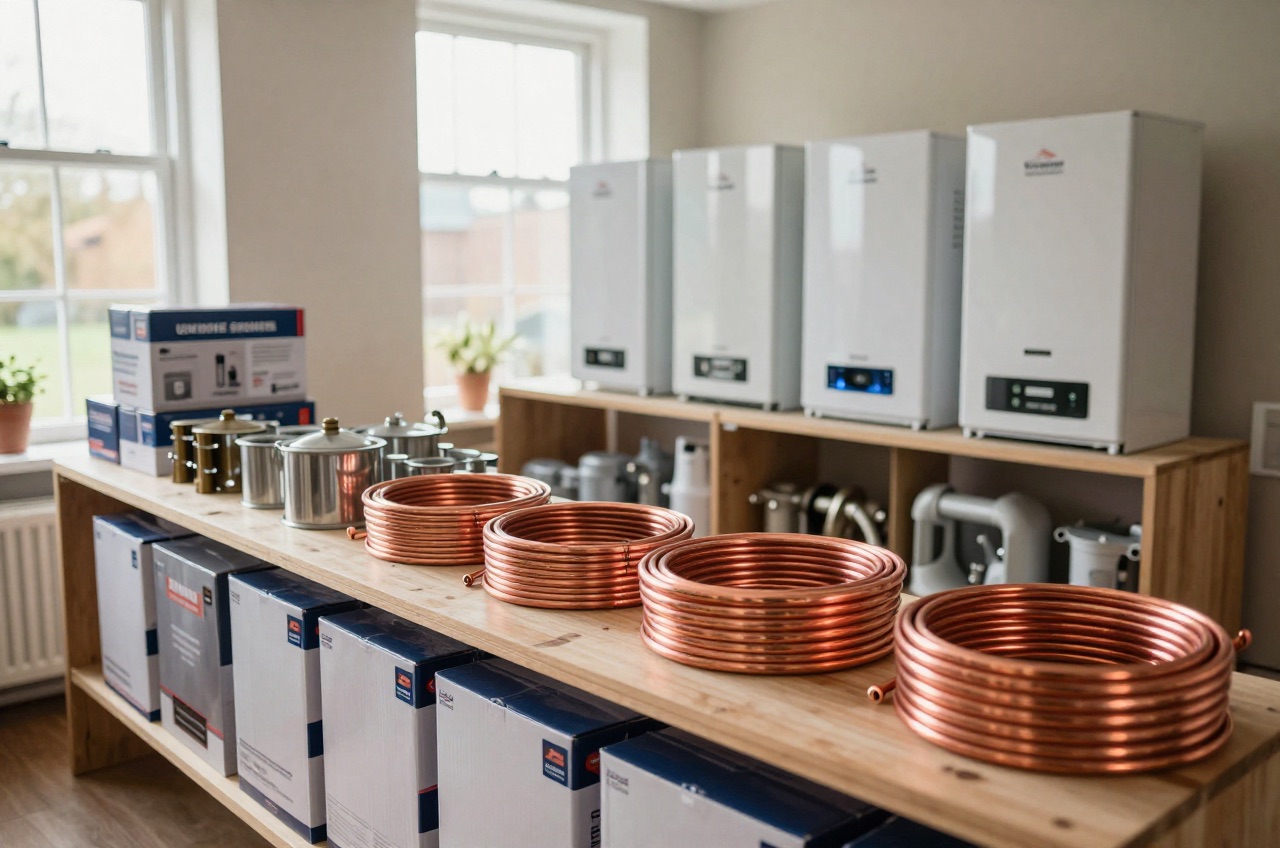
- Copper and plastic pipework, 15 mm, 22 mm, 28 mm copper; push-fit (e.g. Speedfit, Hep2O) and compression fittings in full ranges
- Boilers and controls, gas and oil boilers, heat pumps; cylinders; programmers, thermostats, and smart controls
- Radiators and UFH, panel radiators, towel rails, underfloor heating manifolds and pipe
- Bathroom and WC, basins, WCs, baths, shower enclosures, taps, and accessories
- Tools and consumables, flux, solder, PTFE, pipe cutters, pressure gauges
Larger branches (particularly those operated by Wolseley/Plumb Centre, City Plumbing, or BSS) also stock commercial heating plant, pressurisation units, plate heat exchangers, and heat interface units for larger-scale projects.
Trade vs Retail Pricing
Pricing at a plumbing merchant operates on several tiers. The difference between the highest and lowest available price for the same product can be substantial:
| Customer Type | Typical Access | Indicative Saving vs DIY Shed |
|---|---|---|
| No account (homeowner walk-in) | Counter price list | 10–20% |
| Trade account (low-medium spend) | Trade counter pricing | 20–35% |
| Trade account (high spend / national) | Negotiated rates | 30–45%+ |
| Online DIY retailer (e.g. Amazon) | Varies by product | 0–15% |
The figures above are indicative, actual savings depend heavily on product category. Boilers and cylinders tend to have tighter margins (often only a 10–20% trade saving) because they are big-ticket items whose retail price is widely known. Fittings, valves, and consumables often show much larger differences because the retail market for these is less transparent.
Boilers and Heating Equipment
Boilers are one area where buying through a plumbing merchant, rather than a DIY chain or online retailer, has real advantages beyond price. Merchants typically:
- Stock manufacturer-supported product ranges with full warranty documentation
- Can arrange delivery co-ordinated with your installer’s schedule
- Stock the flue kits, controls, and ancillaries alongside the boiler (avoiding the common problem of a boiler arriving without its flue pack)
- Have counter staff who can advise on sizing and compatibility
Warranty note: many boiler manufacturers require the unit to be installed by a Gas Safe registered engineer and registered with the manufacturer within a set period (often 30 days) to activate the extended warranty.1 This requirement is the same whether you bought via a merchant or a retail channel.
Homeowners can legally purchase a boiler themselves, there is no legal restriction on buying heating equipment. However, anyone employed to install a gas boiler in a home must be a Gas Safe registered engineer.2 If you’re supplying your own boiler, confirm with your installer in advance that they’re comfortable fitting a customer-supplied unit; some engineers add a surcharge for this or decline it for warranty reasons.
Opening a Trade Account
A trade account at a plumbing merchant unlocks trade-tier pricing and, typically, 30-day credit terms (commonly, everything bought in a month is paid for in one payment by the end of the following month).3 To open one, most merchants ask for:
- Business name and trading address (sole traders qualify)
- Two or three trade credit references from existing suppliers
- An indication of expected monthly spend
- ID for the account holder
Credit limits are set based on trading history and references, a new account might start with a £500–£1,000 credit limit that increases over time. Some merchants also offer a cash trade card (no credit, but trade pricing) for sole traders or homeowners who don’t want credit.
Processing times vary: a full credit account that needs references can take several working days, while some merchants now offer online accounts that let you start trading within the hour.4
Buying as a Homeowner
Homeowners are not excluded from plumbing merchants, most trade counters will sell to anyone at walk-in prices, which are still typically better than a DIY shed for many products. Some practical points:
- You don’t need an account to walk in and buy fittings, pipe, radiators, or bathroom products
- Bring measurements and specs, counter staff are experienced and will help you select correctly, but they need information (pipe diameter, radiator BTU requirement, cylinder capacity, etc.)
- Ask about project discounts, if you’re kitting out a full bathroom or a central heating system, ask the counter whether they can apply a discount to the whole basket
- VAT, trade counters quote ex-VAT. Homeowners pay 20% VAT on top.5 Check your quote carefully
- Returns, merchants generally take back unused goods in sealed, resaleable packaging with proof of purchase, but read the policy first: Wolseley, for example, allows 30 days, may pass on a supplier’s restocking charge for non-stock items, and will not take back special-order or made-to-measure items unless they are faulty6
Comparing Merchants
The main national networks in the UK include Wolseley (trading as Plumb Centre, Pipe Centre and Climate Centre), City Plumbing, BSS, and Screwfix/Toolstation (which now carry a growing range of plumbing materials at fixed retail-style pricing).4 Regional independents are also common and can be competitive on price, particularly for local contractors they know well.
| Merchant Type | Strengths | Limitations |
|---|---|---|
| National chain (City Plumbing, Wolseley) | Wide stock, consistent pricing, credit | Pricing less flexible for low-spend accounts |
| Regional independent | Often competitive on price, personal service | Stock depth may be lower |
| Screwfix / Toolstation | No account needed, fixed price, convenient | Narrower range, less technical support |
| Online trade (e.g. trade-specific websites) | Price comparison easy, good for non-urgent | No counter advice, delivery lead times |
The best approach for a significant project is to build a materials list, get a quote from your nearest large branch, and compare it against at least one other supplier. Counter staff at busy trade branches are often willing to price-match if you have a written quote from a competitor.
References (6)
Figures in this note were checked against the sources below on 2 October 2026. Superscript numbers in the text point to them. Every source the site cites, by topic.
- 1technicalsupplier figureWorcester Bosch, guidance.RN-3L8OEOA major boiler maker's guarantee terms; they make the guarantee conditional on installation by a certified installer and registration within 30 days, an example of the common condition.
- 2technicalvery strongHealth and Safety Executive, guidance.RN-HNP39HHSE's domestic gas safety FAQs; they state that anyone employed to work on gas appliances in a home must be on the Gas Safe Register.
- 3technicalsupplier figureWolseley UK, guidance.RN-818PK3Wolseley UK's terms of sale. For purchases on a trade account it requires invoices to be paid within 30 days of the end of the month in which they are dated, the usual merchant credit pattern.
- 4technicalsupplier figureWolseley UK, guidance.RN-W8NI9EThe home page of Wolseley, a national plumbing and heating merchant; it advertises trade accounts that let a customer start trading within 60 minutes, an example of fast online account opening.
- 5technicalvery strongHM Revenue & Customs (GOV.UK), guidance.RN-4W7T33Sets the three UK VAT rates: standard 20% on most goods and services, reduced 5% on some goods and services such as children's car seats and home energy, and zero 0% on zero-rated goods such as most food and children's clothes. The standard rate rose to 20% on 4 January 2011 from 17.5%. Some supplies are exempt rather than rated, including postage stamps and financial and property transactions. This is the reference for converting a merchant's ex-VAT trade quote into the figure a homeowner actually pays.
- 6technicalsupplier figureWolseley UK, guidance.RN-SJ1HD3Wolseley UK's trade returns policy: 30 days for unused items in sealed packaging with proof of purchase, a possible restocking fee on non-stock items, and no returns of special-order or made-to-measure items unless faulty.
-
Guarantee terms and conditions, Worcester Bosch, accessed 30 September 2026. worcester-bosch.co.uk
-
Gas safety in the home: frequently asked questions, Health and Safety Executive, accessed 30 September 2026. hse.gov.uk
-
Terms and conditions, Wolseley UK, accessed 2 October 2026. wolseley.co.uk
-
Wolseley: plumbing, heating and cooling specialist merchant, Wolseley UK, accessed 30 September 2026. wolseley.co.uk
-
VAT rates, GOV.UK (HM Revenue and Customs), accessed 30 September 2026. gov.uk
-
Returns policy, Wolseley UK, accessed 2 October 2026. wolseley.co.uk