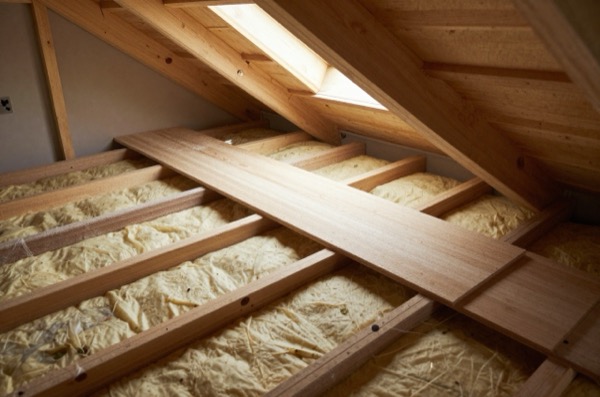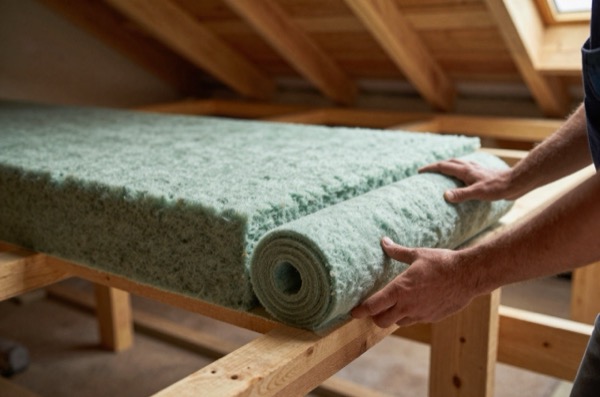
A boarded loft is one of the most cost-effective ways to add storage to a UK home. Even a modest semi-detached has 25–40 m² of loft area, equivalent to a large spare room, and much of it can be made genuinely usable with straightforward boarding and shelving. The challenge is doing it safely: the wrong approach compresses insulation, overloads joists or creates a fire hazard. Where the joists are already full of insulation, the Energy Saving Trust suggests raising the floor slightly so a second layer can run across the joists before the boards go down, leaving a small ventilation gap and not squashing mineral wool.1 This guide covers the practical ideas that work, what not to store, and when the loft’s days as a storage space should give way to a proper loft conversion.
Understanding Your Available Space
Before buying a single shelf bracket, map out what you are actually working with. Loft geometry is defined by two factors: the ridge height and the pitch of the roof.
A two-storey Victorian or Edwardian terraced house in the UK often has a roof pitch of 40–50° and a ridge height of around 2.2–2.6 m above the loft floor. At that pitch, headroom over 1.8 m is confined to a central strip, often only a quarter to a third of the floor area: on a 45° roof with a 2.4 m ridge height, the strip is about 1.2 m wide in a loft about 4.8 m across. The remaining space under the eaves is lower but still perfectly usable for shelving and stored boxes.
A semi-detached house built between 1950 and 1980 often has a lower pitch (30–35°) and a correspondingly smaller central standing zone. But the total floor area is similar.
Practical usable area: for a semi-detached house with a 35 m² loft floor, expect roughly 15–18 m² of kneeling-height space under the rafters and 10–12 m² of standing height in the centre.
Under-Eaves Storage
The under-eaves zone, the triangular space between the top of the external wall and the rafter, is the most overlooked storage area in a loft. In a typical house with a 45–50° pitch, you have a triangular zone approximately 600–900 mm deep at the eaves before the roof drops below kneeling height.
What Works Under the Eaves
- Open shelving: 300–400 mm-deep shelves fixed to the rafter feet or to timber uprights. Ideal for seasonal items, archive boxes and items accessed once or twice a year.
- Plastic storage bins: stackable containers with lids keep out dust and moisture. Label each bin clearly: the temptation to just ‘put it up there’ is strong, but unlabelled bins become unusable within months.
- Luggage storage: suitcases slide neatly under low rafters and stack well.
DIY Shelving Under the Eaves
Simple softwood shelving (18 mm planed-all-round timber or 18 mm MDF) supported on metal brackets fixed to the rafter feet costs very little to install. For a 3 m run of two shelves:
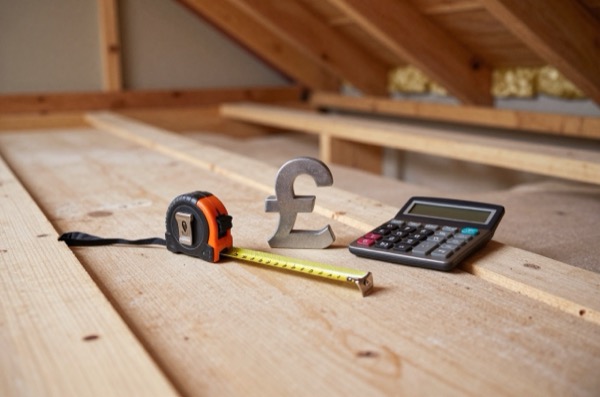
- Materials: £80–£150 (timber, brackets, screws)
- DIY time: 2–4 hours
- A carpenter would charge £300–£500 for the same job
Fix all brackets through the rafter feet or into noggings, not into plasterboard below. The loft floor already handles the vertical load; the shelving is primarily resisting items sliding off.
Central Shelving and Storage Systems
In the standing-height zone at the loft centre, standard freestanding shelving units (wire, steel or timber) work well if the floor is boarded and level. Freestanding units avoid any fixing into the roof structure.
| Shelving Type | Cost (Unit) | Load Capacity | Notes |
|---|---|---|---|
| Steel wire shelving (1.8 m × 900 mm) | £40–£90 | 50–100 kg per shelf | Ventilated; easy to reconfigure |
| Boltless metal shelving | £60–£120 | 100–200 kg per shelf | Very robust; suits heavy archive boxes |
| Timber cube shelving (IKEA-style) | £80–£200 | 25–50 kg per shelf | Lightweight; DIY assembly |
| Fitted timber shelving | £300–£800 installed | Variable | Custom to space; maximises corners |
Wire shelving is particularly practical in lofts because it allows air to circulate, reducing the chance of mould on stored items. Dense racking (closed shelves with no air gaps) can create pockets of still, humid air in an unheated loft.
What Is Safe to Store in a Loft?
Not everything belongs in a loft. The environment is unregulated: temperatures can swing from below freezing in winter to very hot in summer in a poorly ventilated space, and humidity fluctuates with the seasons.
Safe to store:
- Seasonal clothing and bedding (in sealed containers)
- Luggage and travel equipment
- Christmas decorations and seasonal items
- Sports equipment (bikes on floor, not hung from rafters)
- Archive paperwork (in sealed boxes on shelves, not directly on the floor)
- Tools and hardware (in cases or toolboxes)
Do not store:
- Electronics: temperature extremes degrade capacitors and solder joints. A loft is no place for an old laptop, cameras, or audio equipment you might want to use again.
- Photographs and films: heat and humidity accelerate deterioration significantly.
- Wine and spirits: repeated heating and cooling can spoil wine.
- Medicines: temperature instability compromises efficacy.
- Petrol, gas canisters, flammable materials: an unrated loft space is not a safe storage environment for flammables. This is a fire safety issue.
- Anything very heavy concentrated in a small area: 25 kg/m² is the approximate limit for standard ceiling joists (see below).
Weight Limits and Joist Safety
Standard UK ceiling joists are designed to carry the weight of the ceiling (plasterboard and insulation) plus a notional incidental load. They are often only about 47 × 100 mm, at 400–450 mm centres. As a general guide:
- Design load: about 25 kg/m² spread over the floor, plus a single concentrated load of about 90 kg (0.25 kN/m² and 0.9 kN), which is what the standard ceiling joist span tables assume2
- Span: a 45 × 95 mm joist at 400 mm centres spans only about 2 m, even in stronger C24 timber, so longer spans rely on deeper joists or a supporting wall below2
These figures assume joists in good condition with no rot, notching or previous damage. If your loft has any signs of moisture damage, sagging or infestation, have a structural engineer inspect it before loading.
Practical limit: for typical seasonal storage (boxes, suitcases, seasonal clothing), standard joists are adequate. For anything heavier, dense archive boxes over a large area, gym equipment, a workshop, get a structural engineer’s assessment (cost: £200–£350).
Access: Making the Loft Work Day to Day
Even the best-organised loft is unusable if access is awkward. The three improvements that make the biggest difference:
- A proper loft ladder: replacing a wobbly timber ladder with a good aluminium folding ladder (£150–£350 supplied and fitted) transforms the experience. An electric ladder (£500–£800 all-in) is worth considering if you access the loft weekly.
- Adequate lighting: a PIR-triggered LED batten light wired to the lighting circuit costs £80–£150 to supply and fit, and means you never have to hold a torch between your teeth while rummaging.
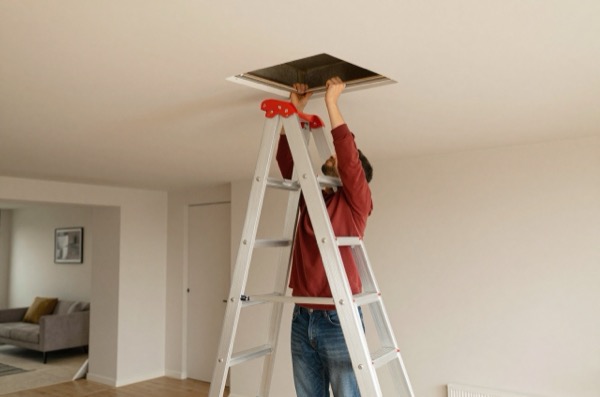
- A larger hatch: if your hatch is 550 × 550 mm (common pre-1980), enlarging it to 600 × 900 mm makes a significant difference to what you can carry up and down. Cost: £200–£450 including a new ladder and hatch unit.
When Storage Is Not Enough: Considering a Conversion
If your loft is being used as regular, year-round storage for items you access frequently, and if the head height in the centre is at least 2.2 m (the usual rule of thumb, measured from the top of the joists in the loft to the underside of the ridge), it may be worth considering a loft conversion rather than optimising the storage further.3
A storage loft costs £700–£1,500 to board and organise well. A basic Velux (rooflight) loft conversion, which adds a proper habitable room without altering the roof shape, costs £18,000–£28,000 but adds a bedroom, and is permitted development in most cases (no planning application required).4 Nationwide’s 2023 analysis found that a loft conversion or extension adding a large double bedroom and a bathroom could add as much as 25% to the value of a three-bedroom, one-bathroom house, though the gain varies by area.5
The break-even calculation depends heavily on your local property market and how much space you actually need. But if you are repeatedly accessing the loft and wishing there was a room up there, the comparison is worth making before spending another £1,000 on shelving.
The rules in this note are those that apply in England. Scotland, Wales and Northern Ireland have their own building standards and permitted development rights.
References (5)
Figures in this note were checked against the sources below on 2 October 2026. Superscript numbers in the text point to them. Every source the site cites, by topic.
- 1technicalfairEnergy Saving Trust, guidance.RN-I69XGOEnergy Saving Trust's consumer advice page on roof and loft insulation: recommended depths, the difference between insulating at joist level and at rafter level, and indicative costs and savings. EST is a consumer-facing body rather than the authority for the depth, so it is cited for the plain explanation and Approved Document L is cited for the requirement. The page blocks automated fetching, so it is described here from its title and publisher.
- 2technicalfairTimber Development UK, published by Taylor Maxwell, guidance.RN-SAYZCETimber Development UK's 2023 span tables for C24 solid timber members in dwellings, calculated to Eurocode 5: maximum clear spans of domestic floor joists, ceiling joists and flat roof joists by section, spacing and dead load.
- 3technicalfairFederation of Master Builders, guidance.RN-MK8GBNThe builders' trade body's homeowner guide to loft conversions; it gives 2.2 m as the working head-height figure and says how to measure it.
- 4technicalvery strongThe National Archives (legislation.gov.uk), legislation.RN-5QRXP7Class C permits any other alteration to the roof of a dwellinghouse, which is the right rooflight and Velux loft conversions rely on. Paragraph C.1(b) makes development not permitted if the alteration would protrude more than 0.15 metres beyond the plane of the roof slope, measured perpendicular to the original roof plane, and C.1(c) if the highest part of the alteration would be higher than the highest part of the original roof. C.1(d) excludes chimneys, flues, soil and vent pipes and solar equipment from the class, and condition C.2 requires any window in a roof slope forming a side elevation to be obscure-glazed and non-opening below 1.7 metres above the floor of the room.
- 5technicalfairNationwide Building Society, guidance.RN-J9EO63Nationwide's 2023 house price index research on home improvements; it estimates a loft conversion adding a double bedroom and bathroom can add up to 25% to a three-bed, one-bath house.
-
Roof and loft insulation, Energy Saving Trust, accessed 2 October 2026. energysavingtrust.org.uk
-
C24 Span Tables, Timber Development UK, published by Taylor Maxwell, accessed 29 September 2026. taylormaxwell.co.uk
-
Loft conversions: The ultimate guide, Federation of Master Builders, accessed 30 September 2026. fmb.org.uk
-
The Town and Country Planning (General Permitted Development) (England) Order 2015, Schedule 2, Part 1, Class C, legislation.gov.uk, accessed 30 September 2026. legislation.gov.uk
-
Bedrooms, bathrooms and extensions: what adds value to your home in 2023?, Nationwide Building Society, accessed 30 September 2026. nationwide.co.uk