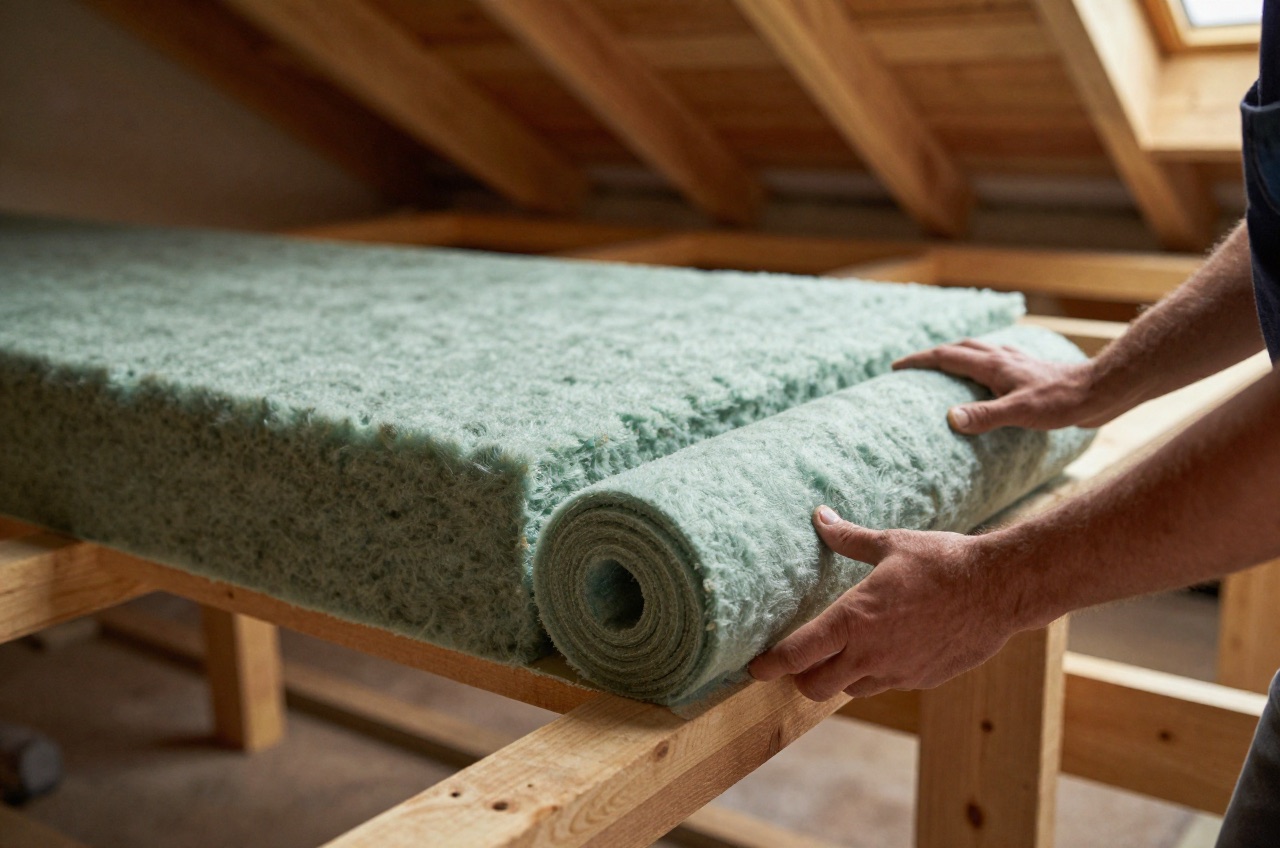
The best loft insulation for most UK homes is mineral wool, either glass wool or rock wool, laid to the recommended 270 mm depth. It is cheap, widely available, straightforward to install, and consistently performs well in independent tests. That said, there are good reasons to consider alternatives, and the right choice depends on your budget, whether you want to board the loft, and how much you care about environmental credentials.
This article breaks down the main loft insulation types with honest figures on cost, thermal performance, and practical trade-offs.
Why Depth Matters More Than Material
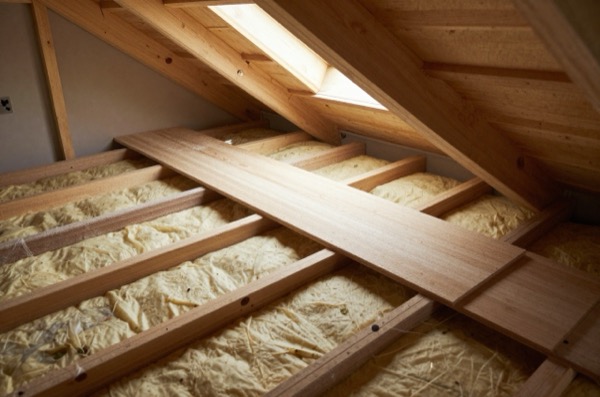
Before comparing products, it is worth stressing that adequate depth is the most important variable of all. A 270 mm installation of standard mineral wool will outperform a 50 mm installation of any premium product. The Centre for Sustainable Energy gives 270 mm as the recommended depth for mineral wool, usually laid in two layers:1
- 100 mm between the joists (first layer)
- 170 mm cross-rolled on top (second layer, at right angles)
This combination reaches a U-value of approximately 0.16 W/m²K, the improved value Approved Document L sets when an existing roof is upgraded.2 ECO4, which runs until 31 December 2026, can fund insulation for eligible households.3 The Great British Insulation Scheme closed on 31 March 2026.4
Mineral Wool (Glass Wool & Rock Wool)
Mineral wool is the dominant product in UK lofts for good reason. Both glass wool (spun from recycled glass) and rock wool (spun from volcanic basalt) are non-combustible, dimensionally stable, and effective.56
Glass wool (brands: Knauf Earthwool, Isover, Superglass) is lighter and compresses for transport, which makes the rolls easier to handle in a tight loft. It is the most common choice for DIY installation.
Rock wool (Rockwool, Knauf Rocksilk) is denser and is often chosen where sound absorption matters. Neither type performs well wet, so a dry loft should always be the starting point.
Both achieve broadly similar thermal performance at a given depth. The difference in real-world U-value at 270 mm is negligible.
Cost: £5–£9 per m² for materials at 270 mm total (two layers). A 50 m² loft floor area costs roughly £250–£450 in materials.
Sheep Wool Insulation
Sheep wool insulation (brands: Thermafleece, Black Mountain, YesColours Comfy) is a natural, breathable alternative that handles moisture differently from mineral wool. It can absorb and release small amounts of water vapour without losing significant thermal performance, a property known as hygroscopicity.7
This makes sheep wool well-suited to older, draughty houses where interstitial condensation is a concern, or to properties where the owners want to avoid synthetic materials. Wool is normally treated to resist insect attack, and Thermafleece itself notes that mineral fibre remains necessary where a non-combustible fire rating is required.7
The thermal conductivity of sheep wool (lambda value around 0.035–0.040 W/mK) is broadly comparable to mineral wool (around 0.033–0.044 W/mK depending on product), so the depth requirements are similar.89 Standard loft rolls sit at the top of the mineral wool range: Knauf’s Loft Roll 44 and Rockwool’s Thermal Insulation Roll are both rated at 0.044 W/mK.56 You will still need 270 mm.
Cost: about £40–£50 per m² at 270 mm depth, several times the material cost of mineral wool. A 7.22 m² pack of 100 mm Thermafleece CosyWool roll was listed at £116.80 including VAT in September 2026, about £16 per m² for each 100 mm.10 However, it is less irritating to handle, so some DIYers factor in the comfort benefit when comparing costs.
Multifoil Insulation
Multifoil products, layers of reflective foil separated by wadding, are heavily marketed and frequently misunderstood. They work by reflecting radiant heat rather than resisting conductive heat flow, which means their performance depends heavily on installation conditions (air gaps, surface emissivity, temperature differential).
Multifoil performance claims have long been disputed, and in real-world installations these products rarely achieve the thermal performance their marketing materials imply. A 40 mm multifoil is very unlikely to match 270 mm of mineral wool: even YBS describes its 40 mm SuperQuilt as matching up to 130 mm of mineral wool.11
That said, multifoil does have legitimate uses: as a membrane layer in cold-roof constructions, under metal roofing, or as a vapour control layer alongside other insulation. It is not a standalone replacement for mineral wool in a standard loft.
Cost: about £5–£9 per m² for the multifoil itself, but you will still need additional insulation underneath to meet U-value requirements. A 15 m² roll of YBS SuperQuilt was listed at £135.67 including VAT in September 2026, about £9 per m².11 A 15 m² roll of the lighter SuperQuilt Lite was listed at £76.70 including VAT, about £5 per m².12
Rigid Insulation Boards (PIR/EPS)
Rigid polyisocyanurate (PIR) boards (Kingspan, Celotex, Unilin) offer higher thermal performance per millimetre than any fibrous product, with lambda values as low as 0.022 W/mK against 0.033–0.044 W/mK for wool products.13 A 120–140 mm PIR board can match the performance of 270 mm mineral wool.
This makes rigid boards useful where headroom in the loft is limited, or where you want to install a raised boarding platform without the total thickness adding up to more than the joists can accept. They are also worth considering if you intend to board the loft directly on top, as they provide a firm, stable base.
The main downsides are cost and the environmental impact of the manufacturing process. PIR boards are a petroleum product with a high embodied carbon.
Cost: £18–£35 per m² at equivalent thermal performance. Installation is more fiddly than mineral wool rolls.
At-a-Glance Comparison
| Material | Typical Lambda (W/mK) | Depth for 0.16 U-value | Material Cost (per m²) | DIY-Friendly |
|---|---|---|---|---|
| Glass wool | 0.033–0.044 | 270 mm | £5–£9 | Yes |
| Rock wool | 0.033–0.044 | 270 mm | £6–£10 | Yes |
| Sheep wool | 0.035–0.040 | 270 mm | £40–£50 | Yes |
| Multifoil | n/a (radiant) | Not standalone | £5–£9 | Yes |
| PIR board | 0.022–0.025 | 120–140 mm | £18–£35 | Moderate |
Eco Options
If environmental impact is a priority, sheep wool and recycled glass wool are the most defensible choices. Some glass wool products now contain a high share of recycled glass: Superglass says its glass mineral wool is made from up to 84% recycled waste glass.14 Sheep wool is a renewable fibre, though long-distance shipping and chemical treatment add to its footprint.
Cellulose insulation, blown recycled newspaper, is common in the USA and Scandinavia but less common in UK lofts. It can be blown into difficult-to-reach areas and has good environmental credentials, but UK installers are fewer than for mineral wool.
Which to Choose
For most UK homeowners doing a standard loft insulation job: glass wool at 270 mm, either DIY or through ECO4 if your household qualifies. It performs well, costs little, and installation is well-documented.
If you are concerned about moisture management in a breathable old house, or want to avoid synthetic materials: sheep wool.
If you need to board over the insulation and space is tight, or you want the thinnest possible solution: PIR rigid board, accepting the higher cost.
Avoid: relying on multifoil as your only insulation. Use it as a supplement or membrane, not a replacement.
The rules in this note are those that apply in England. Scotland, Wales and Northern Ireland have their own building standards and permitted development rights.
References (14)
Figures in this note were checked against the sources below on 2 October 2026. Superscript numbers in the text point to them. Every source the site cites, by topic.
- 1technicalfairCentre for Sustainable Energy, guidance.RN-9MX1CZConsumer advice from the Centre for Sustainable Energy, an energy charity, drawing on Energy Saving Trust figures. It gives 270 mm as the recommended depth for mineral wool loft insulation.
- 2technicalvery strongMinistry of Housing, Communities and Local Government.RN-L0FCJXThe in-force U-value tables a DIY insulation or door note must quote, with the exact numbers. Table 4.2, limiting U-values for new fabric elements in existing dwellings, sets roof 0.15, wall 0.18, floor 0.18, swimming pool basin 0.25, window 1.4 or Window Energy Rating Band B minimum, rooflight 2.2, doors with more than 60 per cent of the internal face glazed 1.4 or Doorset Energy Rating Band C minimum, and other doors 1.4 or Doorset Energy Rating Band B minimum. Table 4.3, for existing elements, gives a roof threshold of 0.35 and an improved value of 0.16, which is the figure a loft insulation note needs: paragraph 4.12 says a retained element whose U-value is higher than the column (a) threshold, for example through a loft or garage conversion, should be upgraded to the column (b) value. Paragraph 4.13 allows a lesser upgrade only where the improved value is not technically or functionally feasible or would not achieve a simple payback of 15 years or less. Paragraph 4.8 requires a replacement element to be no worse than the one it replaces as well as meeting Table 4.2. Paragraph 4.10 gives the heritage exception: where character must be maintained, a centre pane U-value of no more than 1.2 or low-emissivity secondary glazing. Note 9 records that the timber window concession of 1.6 or Band C ended on 14 June 2023. The 2021 edition came into force on 15 June 2022; a 2026 edition exists at https://assets.publishing.service.gov.uk/media/69c122a6cfa346b9d4704a55/ADL1_2026.pdf.
- 3technicalvery strongOfgem.RN-FPPUSLECO4 is the fourth phase of the Energy Company Obligation across Great Britain. It applies to measures installed from 1 April 2022 and runs until 31 December 2026 following a nine-month extension; ECO3 closed on 31 March 2022 and ECO4 came into force in July 2022. The scheme places a Home Heating Cost Reduction Obligation on medium and large energy suppliers to promote measures that improve the ability of low-income, fuel-poor and vulnerable households to heat their homes, funding insulation and heating upgrades for both homeowners and tenants. Ofgem also lists the Great British Insulation Scheme as a separate obligation on this page.
- 4technicalvery strongOfgem.RN-RDOIJRThe scheme, formerly known as ECO+, ran from April 2023 to 31 March 2026 and is now closed. It obliged medium and large energy suppliers to deliver measures reducing energy use in the least energy-efficient homes in Great Britain. Eligibility was homes with an EPC rating of D to G in Council Tax bands A to D in England, or A to E in Scotland and Wales, plus low-income and vulnerable households. Unlike ECO4, which funds whole-house packages, GBIS mostly delivered a single insulation measure per home. This is the page to cite when a note has to say a grant route has closed rather than leave a reader chasing it.
- 5technicalsupplier figureROCKWOOL, guidance.RN-JX8BSRROCKWOOL's product page for its stone wool loft roll. It gives the thermal conductivity of 0.044 W/mK and the Euroclass A1 non-combustible fire rating.
- 6technicalsupplier figureKnauf Insulation, guidance.RN-EQOVZBKnauf Insulation's product page for Loft Roll 44 glass mineral wool. It gives the declared thermal conductivity of 0.044 W/mK and the Euroclass A1 non-combustible fire rating.
- 7technicalsupplier figureThermafleece, guidance.RN-R491K0Product site of Thermafleece, a UK sheep wool insulation maker. It describes the wool's moisture buffering and notes that mineral fibre is still needed where a non-combustible rating is required.
- 8technicalsupplier figureThermafleece, guidance.RN-D48430The maker's technical data sheet for Thermafleece CosyWool, its standard sheep's wool loft roll, declares a thermal conductivity of 0.039 W/mK, the upper end of the sheep wool range given.
- 9technicalsupplier figureThermafleece (Eden Renewable Innovations Ltd), a data sheet.RN-TOS2R5High density sheep wool rich insulation slab, 75% wool with recycled fibres, 20 to 25% recycled content. Density 31 kg/m3. Thermal conductivity 0.035 W/mK. Slabs 1200 mm long in 390 and 590 mm widths, thicknesses 50, 70 and 90 mm with a plus or minus 5 mm tolerance. Published thermal resistance (m2K/W): 50 mm 1.43, 70 mm 2.00, 100 mm 2.86, 140 mm 4.00, 190 mm 5.43, 240 mm 6.86. Fire Classification EuroClass E; flammability and smoulder resistance to BS 5803-4 pass. Vapour resistivity 9 MNs/gm. Specific heat capacity 1800 J/kgK. Water absorption at 100% RH 24% w/w. Sound reduction Rw 41 dB, NRC 1.10 at 90 mm. Dimensional stability to EN 1604 pass, EPD registration S-P-04468. Cradle to gate A1-A3 carbon 0.05 kg CO2e per functional unit. Thermafleece states UltraWool is not suitable for use as a cavity barrier.
- 10costsupplier figureInsulation UK.RN-N59WHDA price, true at 2026-09. An insulation merchant's product page for one pack of 100 mm Thermafleece CosyWool sheep wool roll. It shows the pack coverage of 7.22 m² and the price including VAT.
- 11technicalsupplier figureInsulation UK, guidance.RN-05RWCMAn insulation merchant's product page for one roll of YBS SuperQuilt multifoil. It repeats the maker's claim of performance equal to up to 130 mm of mineral wool at 40 mm thick, and shows the price including VAT.
- 12costsupplier figureDIY Building Supplies.RN-LTTJ9RA price, true at 2026-09. A building supplies retailer's product page for one 15 m² roll of YBS SuperQuilt Lite multifoil, showing the price including VAT and per square metre.
- 13technicalsupplier figureUnilin Insulation, guidance.RN-BU8LKQMaker's product page for Unilin Thin-R foil-faced PIR boards. It gives a certified thermal conductivity as low as 0.022 W/mK, the typical figure for PIR insulation board.
- 14technicalsupplier figureSuperglass, guidance.RN-W1UJPHHome page of Superglass, a UK glass mineral wool maker. It states recycled glass content of up to 84% and a Euroclass A1 non-combustible classification for its products.
-
Loft insulation, Centre for Sustainable Energy, accessed 30 September 2026. cse.org.uk
-
Approved Document L, Conservation of fuel and power, Volume 1: Dwellings, 2021 edition incorporating 2023 amendments, Ministry of Housing, Communities and Local Government, accessed 14 September 2026. assets.publishing.service.gov.uk
-
Energy Company Obligation (ECO), Ofgem, accessed 29 September 2026. ofgem.gov.uk
-
Great British Insulation Scheme, Ofgem, accessed 29 September 2026. ofgem.gov.uk
-
Thermal Insulation Roll, ROCKWOOL, accessed 2 October 2026. rockwool.com
-
Loft Roll 44, Knauf Insulation, accessed 2 October 2026. knaufinsulation.co.uk
-
Thermafleece sheep’s wool insulation, Thermafleece, accessed 30 September 2026. thermafleece.com
-
Thermafleece CosyWool technical data sheet, Thermafleece, accessed 30 September 2026. thermafleece.com
-
Thermafleece UltraWool factsheet (V6, October 2025), Thermafleece, accessed 30 September 2026. thermafleece.com
-
100mm x 370mm Thermafleece CosyWool Roll, 7.22m² pack, Insulation UK, accessed 2 October 2026. Priced at 2026-09 and left there. insulationuk.co.uk
-
YBS SuperQuilt Multi-Layer Foil Insulation 1.5m x 10m (15m2), Insulation UK, accessed 2 October 2026. insulationuk.co.uk
-
YBS Superquilt Lite Multifoil Thermal Insulation, 1.5m x 10m, DIY Building Supplies, accessed 2 October 2026. Priced at 2026-09 and left there. diybuildingsupplies.co.uk
-
Thin-R PIR insulation, Unilin Insulation, accessed 30 September 2026. unilininsulation.co.uk
-
Superglass glass mineral wool insulation, Superglass, accessed 30 September 2026. superglass.co.uk