Exposed soil pipes, supply pipes, and overflow pipes around a toilet are one of the most common bathroom eyesores. Fortunately, there are several practical ways to hide them, ranging from a simple boxed-in casing you can build in a day to a full wall-hung toilet installation that eliminates all visible pipework permanently. Which approach is right for you depends on your budget, bathroom layout, and how much disruption you are willing to take on.
Option 1: Boxing In With a Stud Frame
The most popular and affordable solution is to build a stud frame around the pipes and clad it in moisture-resistant board or pre-finished panels.
How It Works
A lightweight timber or metal stud frame is fixed to the floor and wall around the pipe run. The frame is then clad in 12.5 mm moisture-resistant (MR) plasterboard for tiling, or in pre-finished bathroom panels (PVC cladding or waterproof MDF) for a paint-ready finish.
What You’ll Need
- 47 mm x 47 mm C16 timber studs or 50 mm metal C-stud track
- 12.5 mm MR plasterboard (green board) or pre-finished PVC wall panel
- Screws, drywall screws, screw anchors for fixing to tile/brick
- Flexible sealant (sanitary silicone)
- Access panel (if the pipes need periodic inspection, e.g., if there is a solvent-weld joint behind the boxing)
Step-by-Step
- Mark out the boxing, identify the widest pipe run and allow 20–30 mm clearance around it. The boxing should be as shallow as possible to minimise the space it takes.
- Fix a sole plate to the floor and a head plate above (if running up to a shelf or ceiling). Use a spirit level to ensure they are plumb.
- Build side returns where the boxing meets the wall, fixing studs with appropriate wall fixings for your wall type (plastic plugs and screws for solid masonry, timber fixings into stud locations for studwork walls).
- Fix the cladding, for plasterboard, use drywall screws at 150 mm centres; for PVC panels, use the manufacturer’s adhesive or the panel’s own clip system.
- Seal all edges with sanitary silicone between the boxing and floor/wall.
- Install an access panel (a flush-fitting hatch, available for £15–£40 from plumbers’ merchants) if there are any joints, valves, or connections behind the boxing that may need future access.
Cost
| Item | DIY cost |
|---|---|
| Stud timber (2.4 m lengths x 4) | £12–£20 |
| MR plasterboard (one sheet) | £22–£27 |
| Pre-finished PVC panels (alternative to board) | £20–£60 |
| Fixings, screws, silicone | £10–£15 |
| Access panel | £15–£40 |
| Total DIY materials | £57–£135 |
| Tradesperson (carpenter or plumber) | £150–£300 |
The DIY total counts the plasterboard or the PVC panels, not both. At Selco, a 2400 × 1200 × 12.5 mm moisture-resistant board costs £23.86 inc. VAT.1
Option 2: Pre-Made Pipe Boxing (PVC Extrusion)
For a single pipe run against a wall rather than a full corner boxing, snap-on PVC pipe boxing is the quickest solution. These are pre-formed plastic channels in standard sizes (typically 100 mm x 50 mm, 130 mm x 80 mm) that clip over the pipe and fix to the wall.
- Cost: £5–£15 per metre
- Suitable for: Single supply pipes, 15 mm or 22 mm diameter
- Not suitable for: 110 mm soil pipes (too large for standard clip boxing)
- Finish: Available in white or chrome-effect; can be painted
PVC pipe boxing is not waterproof at the joints so is best used in dry areas, or sealed with silicone if near the toilet.
Option 3: Wall-Hung Toilet With Concealed Cistern
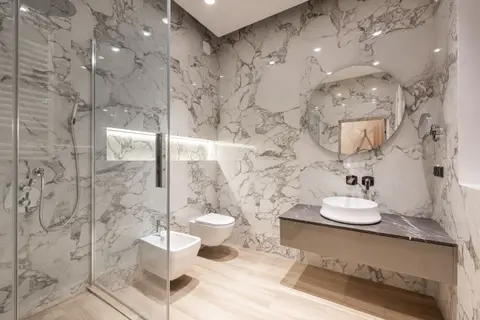
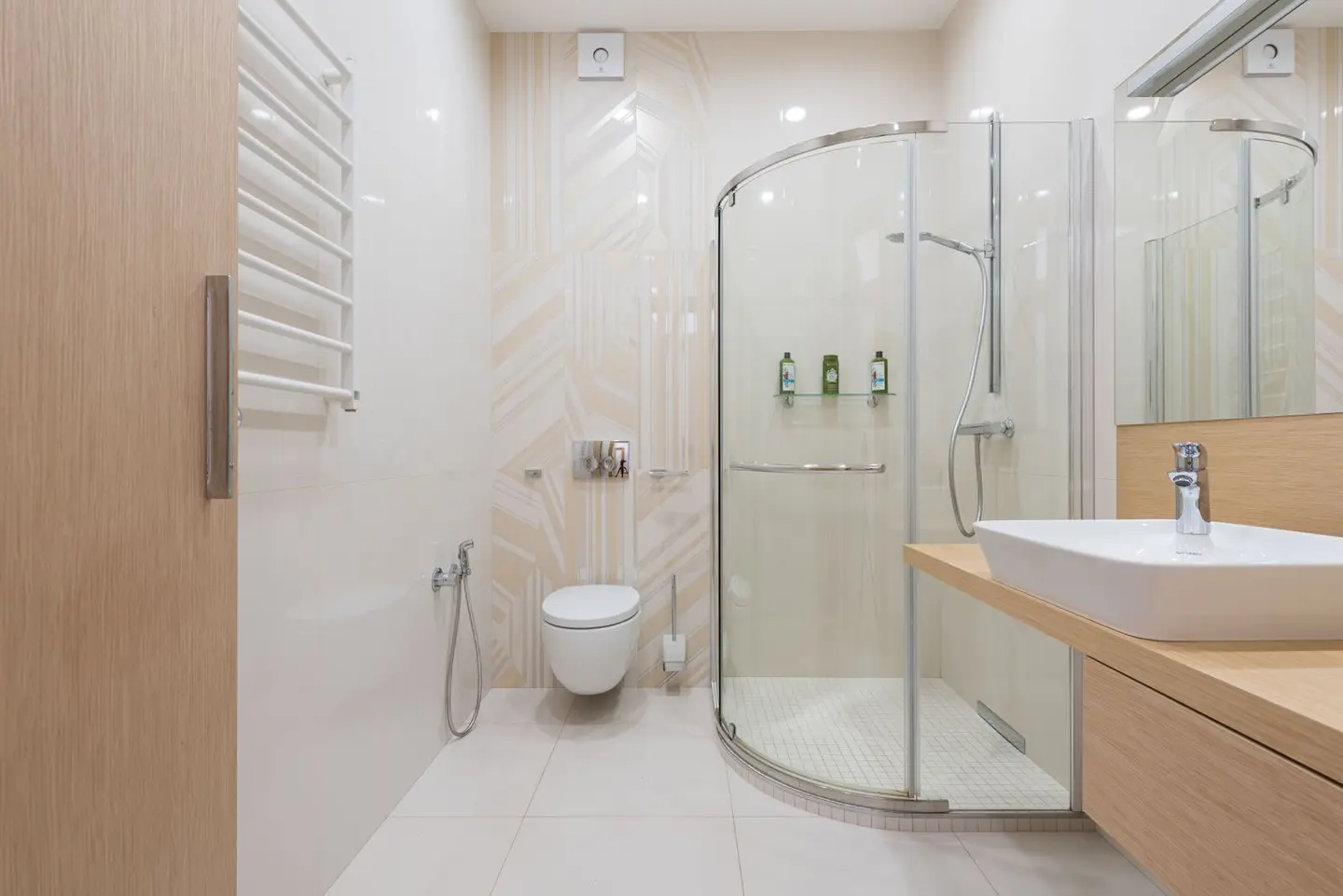
The cleanest solution, and the one increasingly standard in new UK bathrooms, is a wall-hung toilet with the cistern concealed in a purpose-built frame (called an in-wall carrier frame or concealed cistern unit) built into a false wall.
The carrier frame holds the cistern, flush mechanism, and waste pipe connection, all hidden behind a plasterboard face wall. The toilet bowl hangs from the frame at a comfortable height.
Benefits
- No exposed pipes at all, supply, waste, and overflow are all hidden
- Easier to clean underneath (floor-mounted toilet contact area eliminated)
- Height-adjustable during installation (useful for accessibility)
- Modern look compatible with all tile and panel finishes
Drawbacks
- Significant upfront cost (see below)
- Reduces bathroom depth by roughly 120–200 mm: Ideal Standard’s ProSys concealed cistern, for example, is 150 mm deep, and the plasterboard and tiles add to that.2
- Future access to the cistern is via the flush actuator panel, more complex if the cistern develops a fault
Cost
| Component | Cost |
|---|---|
| Concealed cistern carrier frame (e.g., Geberit Duofix) | £150–£350 |
| Wall-hung toilet pan | £100–£400 |
| Actuator plate (flush button) | £20–£80 |
| Plasterboard, studwork, tiling | £80–£200 in materials |
| Installation (plumber + tiler) | £300–£600 |
| Total installed | £650–£1,630 |
For reference, Toolstation lists Ideal Standard’s ProSys WC frame with a 150 mm in-wall cistern at £287.99 inc. VAT.2
Option 4: Furniture and Decorative Screening
For renters or those not wanting permanent works, a toilet storage unit, freestanding cabinet, or decorative wicker basket screen can visually reduce the prominence of exposed pipes without any construction. This is not watertight or permanent but costs as little as £30–£80 for a suitable bathroom storage unit.
Building Regulations Considerations
Boxing in pipes is not a notifiable building works activity in England and does not require Building Control sign-off. However:
- Access panels are required wherever there are joints or valves on the water supply pipes behind the boxing: the Water Supply (Water Fittings) Regulations 1999 do not allow a joint, or a fitting that has to be operated or maintained, to be concealed where it cannot be reached.3
- Soil and waste pipes must stay reachable: Part H of the Building Regulations asks for rodding points on any length of pipe that cannot be cleared another way, and for all pipes to be reasonably accessible for repair, so never seal a rodding eye or access fitting permanently behind the boxing.4
- Fire-stopping: if the pipes and boxing pass through a fire-separating floor (e.g., in a flat), the opening must be fire-stopped, typically with a tested proprietary seal such as an intumescent pipe collar.5
Which Option Is Right for You?
| Situation | Best option |
|---|---|
| Renting / temporary | Pre-made PVC boxing or decorative screen |
| Simple pipe run, tight budget | Stud-frame boxing with PVC panels |
| Full bathroom renovation | Concealed cistern wall-hung system |
| Single supply pipe only | PVC clip-on boxing |
| Accessibility or future-proofing | Wall-hung toilet (height adjustable) |
For most homeowners doing a partial bathroom refresh, stud-frame boxing in moisture-resistant board is the best balance of cost, durability, and flexibility. It is a realistic DIY project for a confident builder; if you are tiling the face, a tiler will often incorporate the boxing into their scope.
References (5)
Figures in this note were checked against the sources below on 30 September 2026. Superscript numbers in the text point to them. Every source the site cites, by topic.
- 1costsupplier figureSelco Builders Warehouse.RN-V2U6NGA price, true at 2026-09. A builders' merchant product page for a full sheet of 12.5 mm moisture-resistant plasterboard. It gives the current price including and excluding VAT.
- 2technicalsupplier figureToolstation, guidance.RN-NQMVH6A retailer product page for a WC support frame with a concealed in-wall cistern for a wall-hung pan. It gives the cistern depth and the current price.
- 3technicalvery strongThe National Archives, guidance.RN-MY6E6ESchedule 2 to the Water Supply (Water Fittings) Regulations 1999, which applies in England and Wales. It caps WC flush volumes and requires backflow prevention on every water system.
- 4technicalvery strongMinistry of Housing, Communities and Local Government.RN-SM6TRWThe statutory source for soakaway design and the discharge hierarchy every garden drainage note should state. Requirement H3(3) lists the order of priority for rainwater discharge: (a) an adequate soakaway or other adequate infiltration system, or where not reasonably practicable (b) a watercourse, or where not reasonably practicable (c) a sewer. Paragraph 3.25 bars infiltration devices within 5 metres of a building or road, in ground where the water table reaches the bottom of the device at any time of year, too close to other drainage fields or soakaways, or where contamination could pollute groundwater. Paragraph 3.26: soakaways serving less than 100 square metres are generally square or circular pits filled with rubble or lined with dry-jointed masonry or perforated ring units. Paragraph 3.27: design to a return period of once in ten years, and for small soakaways serving 25 square metres or less a design rainfall of 10mm in 5 minutes may be assumed as the worst case. Paragraph 3.28 requires percolation tests to derive the infiltration rate, and paragraph 3.30 sends larger soakaways to BS EN 752-4 or BRE Digest 365 Soakaway design. Paragraphs 2.10 to 2.12 cover pervious paving over a granular storage reservoir and warn against its use where sediment or oil spillage would block the pores. For foul drainage, paragraph 2.33 sets a minimum 75mm internal diameter, or 100mm for a WC, and Table 6 gives minimum gradients of 1 in 40 for 75mm and 100mm at peak flows under 1 litre per second.
- 5technicalvery strongMinistry of Housing, Communities and Local Government.RN-J0UZDBApproved Document B Volume 1, fire safety in dwellings, 2019 edition with the 2020, 2022 and 2025 amendments and the forthcoming 2026 and 2029 changes collated in. Covers means of warning and escape, internal fire spread through linings and structure, external fire spread and access for the fire service. This is the document behind escape window sizes, protected stairways, the 4.5 metre rule and the fire doors a loft conversion needs.
-
Siniat Moisture Board Tapered Edge 2400 x 1200 x 12.5mm, Selco Builders Warehouse, accessed 30 September 2026. Priced at 2026-09 and left there. selcobw.com
-
Ideal Standard ProSys WC Frame 150mm In Wall Cistern, Toolstation, accessed 30 September 2026. toolstation.com
-
The Water Supply (Water Fittings) Regulations 1999, Schedule 2, legislation.gov.uk, accessed 30 September 2026. legislation.gov.uk
-
Approved Document H, Drainage and waste disposal, 2002 edition incorporating 2010 and 2015 amendments, Ministry of Housing, Communities and Local Government, accessed 14 September 2026. assets.publishing.service.gov.uk
-
Approved Document B (fire safety) volume 1: Dwellings, 2019 edition incorporating 2020, 2022, 2025 and 2026 amendments, Ministry of Housing, Communities and Local Government, accessed 30 September 2026. assets.publishing.service.gov.uk