Getting your garden ready for spring in the UK means working with the climate rather than against it. The soil is often too wet and cold to do much useful work before mid-February, but from then until the end of April there is a clear sequence of jobs, clearing, pruning, lawn renovation, soil preparation, and pest prevention, that will set up the whole growing season. Do them in the right order and you avoid compacting waterlogged soil, killing emerging bulbs, or mowing a lawn that isn’t ready for it.
The key principle is simple: the ground needs to be workable (not frozen or saturated), and you should time each task to the average last frost in your region. The RHS puts the date of the last frost usually in late spring in the south of England, and later in the north and Scotland.1 It advises planting tender plants out only once the risk of frost has passed and nights are reliably above 7°C.2
Tools and Materials You Will Need
| Tool/Material | Typical cost (2026) | Notes |
|---|---|---|
| Secateurs (quality pair) | £25–£60 | Bypass secateurs for clean cuts; Felco or ARS are reliable |
| Loppers | £20–£50 | For stems up to 40mm diameter |
| Lawn scarifier (electric) | £60–£150 to buy / £30–£50 to hire per day | Hire is sensible if you only scarify once a year |
| Lawn aerator / garden fork | £15–£40 | A fork works fine on smaller lawns |
| Stiff-tined rake | £15–£30 | Essential for removing moss and dead thatch |
| Garden fork and spade | £25–£60 each | Stainless steel stays cleaner in heavy soil |
| Wheelbarrow | £50–£100 | For moving compost, mulch, and debris |
| Multipurpose compost (per 60L bag) | £6–£10 | For topping up raised beds and containers |
| Bark mulch (per 60L bag) | £5–£8 | Use on borders; 50–75mm layer |
| Grass seed (per 1kg) | £5–£15 | Match to your lawn type (shaded/wear-tolerant/general) |
| Slow-release granular fertiliser | £8–£20 per box | Apply once soil warms above 5°C |
| Pond net / pond vacuum | £15–£80 | For clearing debris and algae |
| Slug pellets / copper tape | £4–£10 | Ferric phosphate pellets are safer around wildlife |
Step-by-Step Spring Garden Preparation
1. Assess Winter Damage (Early February)
Walk the garden before you do anything else. Look for:
- Frost-heaved plants, perennials and shrubs pushed out of the ground by freeze-thaw cycles. Firm these back in gently and water lightly.
- Wind or snow damage on shrubs and trees. Snap cuts cleanly rather than leaving torn wood.
- Waterlogged areas in the lawn. Identify these now so you know where to aerate later.
- Any dead wood on climbers, roses, and shrubs. Dead wood is dry, brittle, and lacks any green beneath the bark when scratched.
Do not start digging or walking on the lawn if the soil is saturated, you will compact it and damage structure that takes months to recover.
2. Prune Shrubs and Roses (Mid-February to March)
Timing depends on the plant:
- Roses: Prune hybrid teas and floribundas from mid-February in the south, early March further north.3 Cut to an outward-facing bud to keep the centre of the bush open.3 Remove crossing, diseased, and dead stems entirely.
- Hardy shrubs that flower on new wood (buddleja, lavatera, late-flowering clematis): Cut hard back to a low framework in late February to early March.
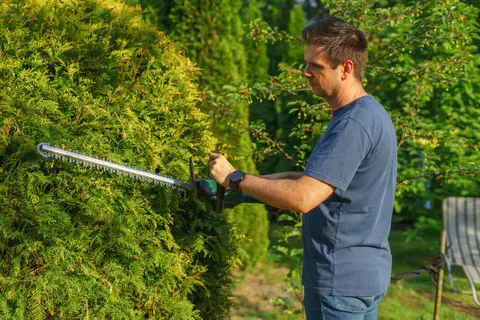
- Spring-flowering shrubs (forsythia, lilac, flowering currant): Do not prune these in spring, they flower on last year’s wood. Wait until flowering finishes.
- Evergreens: Leave until April when the worst cold is past.
Always clean secateurs between plants with a diluted bleach solution or surgical spirit to prevent spreading disease.
3. Clear Borders and Beds (February to March)
Remove all dead stems and leaves that you left standing over winter for wildlife shelter, by February, their value has diminished. Exceptions: leave hollow stems on plants like fennel and echinacea a little longer if you see insects emerging. Compost healthy material; bag up anything showing disease.
Once borders are cleared:
- Top up with compost at around 50mm depth, working around the crowns of emerging perennials. Do not bury crowns or emerging shoots.
- Apply bark mulch on top at 50–75mm to suppress weeds and retain moisture.4 Keep it a few centimetres away from plant stems.
- Pull or hoe annual weeds while they are small. Perennial weeds with tap roots (dock, dandelion) need to come out whole.
4. Tend to Tender Plants After Winter (February to March)
Tender plants that overwintered in pots or a frost-free greenhouse need careful handling:
- Geraniums (pelargoniums): Check for rot at the base. Remove dead leaves, cut leggy stems back by a third, water sparingly, and move to a bright spot.
- Dahlias in storage: Check tubers for rot. Discard any that are soft or mouldy. Start them off in pots of barely moist compost in a frost-free greenhouse or garage from late March.
- Cannas and gingers: Bring out of storage from late March. Pot up, water lightly, and keep under cover until the last frost has passed.
- Container citrus and bay trees: Keep indoors or in a frost-free greenhouse until mid-April in the south, later in the north. Harden them off over two to three weeks before leaving them out, bringing them in on cold nights.1
Do not rush tender plants outside. One late frost in April can undo months of overwintering care.
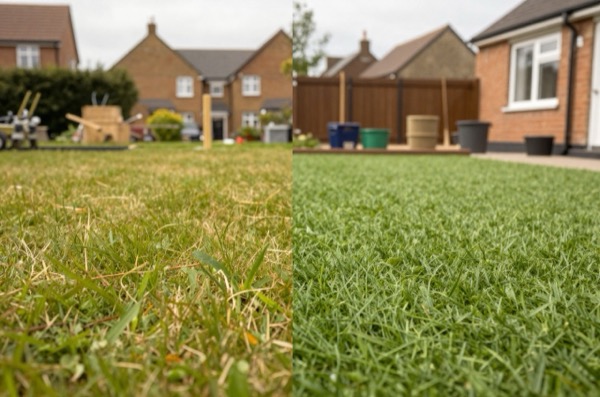
5. Renovate the Lawn (March to April)
The lawn is often the biggest job of spring. Work through these tasks in order, rushing this sequence is the most common mistake.
Wait until the lawn is growing before any renovation. The grass should be actively pushing up, not just surviving. This typically means soil temperature above 5°C, which in the UK usually occurs from mid-March in the south to early April in the north.
- First mow: Set the mower to its highest setting for the first cut of spring.5 Mowing too short too early stresses the grass and encourages moss. Do not remove more than a third of the blade length in one cut.5
- Scarify: Use a lawn scarifier or a stiff-tined rake to remove dead thatch and moss. Work in two directions (north-south, then east-west). The lawn will look terrible afterwards, that is normal.
- Aerate: If you have compacted soil or drainage problems, spike the lawn with a garden fork to a depth of 100–150mm, or hire a hollow-tine aerator. Work across the whole lawn at 100–150mm intervals.
- Overseed: Rake in grass seed at the rate recommended on the pack (typically 25–35g/m² for overseeding). Use a seed matched to your conditions, wear-tolerant for high-traffic areas, shade-tolerant under trees.
- Top-dress: For uneven lawns, brush a sandy top-dressing mixture into the surface after overseeding to fill hollows and improve drainage.
- Fertilise: Apply a slow-release spring lawn fertiliser once the grass is actively growing. Do not apply to dry soil.
Keep foot traffic off a freshly overseeded lawn for at least four to six weeks.
6. Prepare Soil in Borders and Vegetable Patches (March to April)
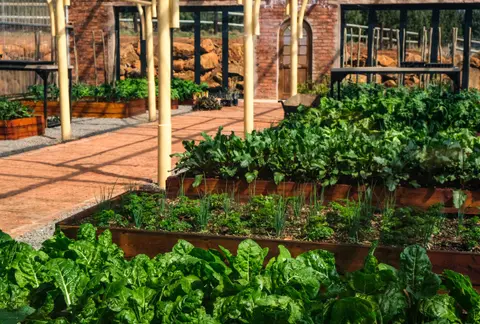
Once workable, dig over vegetable beds to a fork’s depth, incorporating well-rotted compost or manure. In no-dig beds, simply top up with 100–150mm of compost and leave the worms to incorporate it.
Test your soil pH if you have not done so recently. Most vegetables and ornamentals prefer pH 6.0–7.0. Lime (ground limestone) raises pH; sulphur chips lower it. Allow six to eight weeks for lime to take effect before planting.
7. Pond and Water Feature Care (March to April)
If you have a garden pond, spring is the time to act before pond life becomes too active:
- Remove blanket weed by hand or with a pond rake. Leave it on the pond edge for a day so trapped creatures can return to the water.
- Clear dead plant material from around pond margins.
- Check pump and filter: Clean out filters and check that the pump is working before the warmer weather encourages algae growth.
- Divide overgrown marginals: Divide congested pond plants (iris, marsh marigold) now, replanting sections in aquatic baskets with specialist pond compost.
- Do not do a full cleanout unless the pond is genuinely in crisis. Beneficial bacteria and overwintering wildlife are still present.
8. Pest and Disease Prevention (March onwards)
Spring is when slugs, snails, and aphids reappear. Getting ahead of them is far easier than dealing with a full infestation.
- Slugs and snails: If you use pellets, use ferric phosphate ones: the outdoor use of metaldehyde pellets has been banned in Great Britain since the end of March 2022 to protect wildlife.6 Copper tape around pot rims is effective for containers.
- Aphids: Check soft new growth weekly from April. Knock off small colonies with a strong jet of water or use insecticidal soap. Encourage natural predators by leaving some rough areas and growing pollinator-friendly plants.
- Vine weevil: Check overwintered containers for C-shaped grubs in the compost. Treat with nematodes when the compost is warm enough for them to work; the RHS finds late summer, August or early September, gives the best results.7
- Rose blackspot and mildew: Clear fallen leaves promptly; do not compost diseased material. Mulching helps prevent soil-borne spores splashing up onto leaves.
Spring Garden Task Checklist by Month
| Task | February | March | April |
|---|---|---|---|
| Assess winter damage and firm frost-heaved plants | Yes | - | - |
| Prune roses and late-flowering shrubs | South only | All regions | - |
| Clear dead stems and leaves from borders | Yes | Yes | - |
| Top up compost and apply bark mulch | Yes | Yes | - |
| Check and tidy tender plants in storage | Yes | Yes | - |
| First lawn mow (high cut) | - | Yes (south) | Yes (north) |
| Scarify and aerate lawn | - | Yes (south) | Yes (north) |
| Overseed bare patches | - | Yes | Yes |
| Apply spring lawn fertiliser | - | Yes (south) | Yes (north) |
| Pond weed removal and pump check | - | Yes | Yes |
| Start dahlias and cannas into growth | - | Late March | Yes |
| Harden off tender plants before planting out | - | - | Yes |
| Begin slug and aphid prevention | - | Yes | Yes |
| Sow hardy annuals direct | - | Late March | Yes |
Common Mistakes to Avoid
- Working soil when it’s too wet: Compaction is hard to reverse. If the soil sticks to your boots and doesn’t crumble, wait another week.
- Pruning spring-flowering shrubs before they bloom: Forsythia, chaenomeles, and flowering currant will not flower that year if you cut them before they have bloomed.
- Mowing too short too early: Scalping the lawn in March encourages moss and stress. Start high and lower gradually over the season.
- Rushing tender plants outside: Check the forecast for a two-week window free of frost before moving dahlias, pelargoniums, and citrus out permanently.
- Over-feeding in cold soil: Fertiliser applied before the soil warms above 5°C is wasted at best and damaging at worst. Wait until the grass or plants are visibly growing.
RHS Guidance on Frost Dates
The RHS notes that climate change has reduced frost days but late spring frosts still occur, so treat any average last frost date as a rough guide only, especially in northern England and Scotland. Always check a two-week local forecast before committing tender plants to outdoor positions.
Spring garden preparation is not a single weekend job, spread it across February, March, and April and each task becomes manageable. The reward is a garden that hits its stride in May rather than playing catch-up all summer.
References (7)
Figures in this note were checked against the sources below on 30 September 2026. Superscript numbers in the text point to them. Every source the site cites, by topic.
- 1technicalfairRoyal Horticultural Society, guidance.RN-0CYRBMRHS advice on hardening off tender plants. It says hardening off takes two to three weeks and that the last frost is usually late spring in southern England, later in the north and Scotland.
- 2technicalfairRoyal Horticultural Society, guidance.RN-BUFLXDRHS guidance on timing the planting out of tender and half-hardy plants. It sets a night-time minimum of 7°C and notes that late spring frosts still occur.
- 3technicalfairRoyal Horticultural Society, guidance.RN-KEW155The RHS general guide to pruning roses. It gives late winter, February or March, as the usual pruning time and the rule of cutting to an outward-facing bud.
- 4technicalfairRoyal Horticultural Society.RN-HFR7ATRHS guidance on mulching, the cheapest single intervention in a planted garden and the one most often done at the wrong depth. Apply a minimum of 5cm (2in) and ideally 7.5cm (3in): thinner and weeds come through, thicker over a wet soil and it can starve roots of air. Best timing is mid to late spring and autumn, when the soil is moist and warm, and at any time for new plantings. Keep the material off the stems: mulch in direct contact with the stems of trees or specimen shrubs can soften the stem and leave it vulnerable to disease, which is the failure behind the common 'mulch volcano' around a new tree. Biodegradable options that also feed the soil include garden compost, wood chippings, processed conifer bark, leaf mould, well-rotted manure, straw (traditionally for strawberries) and seaweed. Non-biodegradable options, used for surface and weed suppression rather than fertility, include slate, shingle, pebbles, gravel, stone chippings and decorative aggregates. Read with the RHS soil types page and BS 3882 where topsoil is being imported.
- 5technicalfairRoyal Horticultural Society, guidance.RN-DLC5SVThe Royal Horticultural Society on mowing. It settles the mistake this sentence warns about: cutting too low scalps the lawn and leaves bare patches, which happens most easily on soft ground, on fast turns, and where the surface is uneven. It also says the cutting height should be changed through the year rather than left alone. The page does not give a height in millimetres, so the 25 to 40 mm range here is ordinary summer practice rather than an RHS figure.
- 6technicalvery strongDepartment for Environment, Food & Rural Affairs, guidance.RN-DHZ7JBDefra and HSE press release announcing the ban on outdoor use of metaldehyde slug pellets. It settles that the ban covers Great Britain and took effect from the end of March 2022.
- 7technicalfairRoyal Horticultural Society, guidance.RN-78V9YRRHS pest profile for vine weevil. It covers biological control with nematodes, their working temperature ranges and the best time of year to apply them.
-
Hardening off tender plants, Royal Horticultural Society, accessed 30 September 2026. rhs.org.uk
-
When to plant out tender plants to avoid frosts, Royal Horticultural Society, accessed 30 September 2026. rhs.org.uk
-
Rose pruning guide, Royal Horticultural Society, accessed 30 September 2026. rhs.org.uk
-
Mulches and mulching, Royal Horticultural Society, accessed 30 September 2026. rhs.org.uk
-
Mowing lawns, Royal Horticultural Society, accessed 30 September 2026. rhs.org.uk
-
Outdoor use of metaldehyde to be banned to protect wildlife, Department for Environment, Food & Rural Affairs, accessed 30 September 2026. gov.uk
-
Vine weevil, Royal Horticultural Society, accessed 30 September 2026. rhs.org.uk