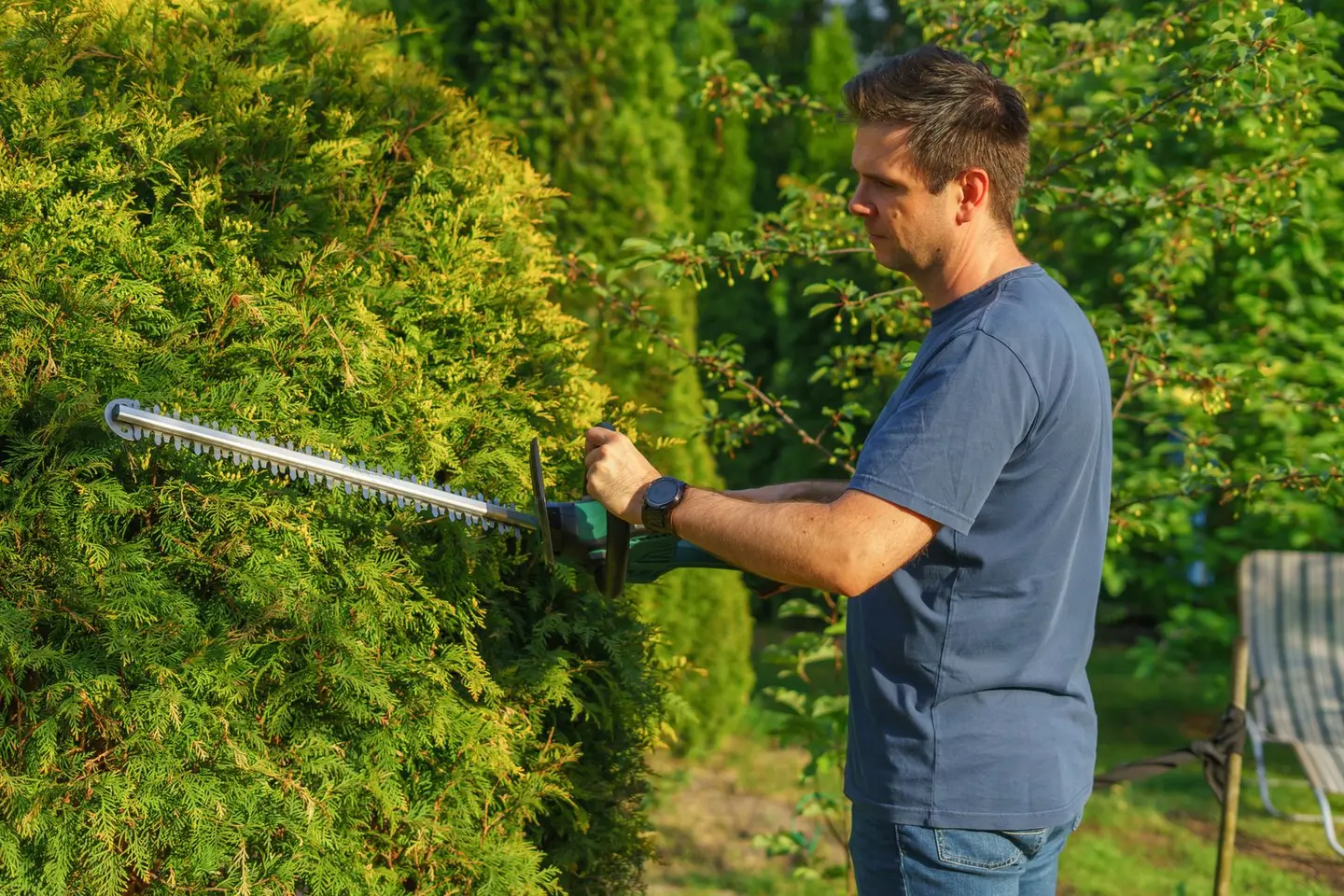
Hedge trimming is one of the most common garden maintenance jobs, but prices vary significantly depending on hedge type, height, length, and location. In 2026, a professional gardener typically charges £3–£12 per linear metre for routine trimming of a standard domestic hedge up to 2 m tall. A typical front garden hedge of 10–15 m runs to £60–£200 per visit; taller, thicker, or more complex hedges cost considerably more.
What Affects Hedge Trimming Costs?
Height
This is the single biggest driver. Hedges under 2 m can be trimmed by most gardeners from the ground with powered hedge trimmers. Above that height, scaffold or working platforms are needed, adding time, equipment, and health and safety consideration.
| Height | Typical cost per linear metre |
|---|---|
| Under 1.5 m | £3–£8 |
| 1.5–2 m | £5–£12 |
| 2–3 m | £10–£18 |
| 3–5 m | £15–£30 |
| Over 5 m (e.g., mature leylandii) | £25–£60+ |
Species
Fast-growing species like Leylandii (x Cuprocyparis leylandii) generate much more waste per metre than beech, yew, or laurel, and may need two or three annual cuts to stay manageable.1 Yew (Taxus baccata) is slow-growing but very dense, making trimming labour-intensive.
Length and Access
A long run of hedge on flat ground is quicker per metre than a short hedge in a tight space, or one that requires moving equipment around obstacles. Difficult access (narrow side passages, limited road parking for a van) adds to the price.
Waste Removal
Always confirm whether the quote includes removing clippings. Most gardeners include it in residential quotes, but for larger jobs (especially leylandii reduction) waste can fill one or more skips. Skip hire adds £180–£350 per 6-yard skip in 2026, or a grab lorry collection at £250–£450 for very large volumes.
London and South-East Premium
Labour rates in London and surrounding counties typically run about 25–40% higher than the Midlands or North. A job quoted at £200 outside London may cost £260–£280 in zone 3–6 London.
Typical Hedge Trimming Scenarios
| Scenario | Estimated cost |
|---|---|
| Front garden privet hedge, 10 m x 1.5 m, clippings removed | £70–£150 |
| Back garden beech hedge, 20 m x 1.8 m | £120–£220 |
| Leylandii hedge, 30 m x 3 m (routine trim) | £350–£600 |
| Leylandii reduction from 5 m to 3 m (major cut) | £500–£1,200+ |
| Formal box parterre (topiary), per hour | £40–£70 |
| Annual hedge trimming contract (2 visits/year) | 10–20% discount on per-visit price |
Gardener Day Rates in 2026
An experienced self-employed gardener typically charges £150–£250 per day in most English regions. London rates are typically £200–£350/day. Most gardeners work alone and price domestic hedge jobs either by the hour (£20–£40/hour) or by the job.
A typical suburban front-and-side hedge takes 1.5–3 hours; a large back-garden hedge might take a full day. Asking for an hourly rate is useful for small jobs; for larger hedges, request a fixed quote so you know the total before work starts.
Hedge Reduction vs Routine Trimming
Routine trimming maintains the hedge at its current size and keeps it tidy. This is done once or twice a year depending on species (once for slow-growing yew, twice or more for leylandii and privet).
Hedge reduction cuts the hedge back significantly, reducing height and/or width. This is more disruptive to the plant, generates more waste, and costs more per metre. It is often done when a hedge has been neglected or when it has grown too large.
Many species, including beech, box, hawthorn, holly, hornbeam and yew, can be reduced by as much as 50% in height and width in a single cut and recover well.2 Leylandii is the exception: new growth will not appear from bare, leafless wood, so never cut back below the green foliage.1 Brown wood removal on leylandii is a specialist job that often results in the hedge looking permanently patchy.
When Can You Trim Hedges?
In the UK, there are practical and legal restrictions on hedge-cutting timing:
- Wildlife and Countryside Act 1981: it is an offence to intentionally take, damage or destroy the nest of any wild bird while that nest is in use or being built.3 The Act names no dates, so the duty is to check for active nests before you start, whatever the month.
- Management of Hedgerows (England) Regulations 2024: since 23 May 2024 a hedgerow on or next to agricultural land must not be cut or trimmed between 1 March and 31 August. The rules exclude anything within the curtilage of a dwelling-house, so a garden hedge is outside them, but those dates are still the sensible guide for a garden hedge.4
- The Hedgerows Regulations 1997: these control the removal of hedgerows 20 m or longer on agricultural, forestry, common or protected land, and the 30-year age test belongs to the separate question of whether a hedgerow is “important”.5 They do not apply to any hedgerow within, or marking the boundary of, the curtilage of a dwelling-house.6
- The best times for most garden hedges: late February (before nesting season), and again in September–October after nesting.7
High Hedges and the Party Wall Situation
If a neighbour’s hedge is affecting your light or enjoyment of your garden, the Anti-social Behaviour Act 2003, Part 8 allows you to complain to your council in England and Wales about a high hedge, meaning a line of two or more mostly evergreen or semi-evergreen trees or shrubs, more than 2 m tall, that forms a barrier to light or access.8 The council can issue a remedial notice requiring the neighbour to reduce the hedge. Each council sets its own fee for handling a complaint and it is not normally refunded even if you win, and the process is formal, this is a last resort after reasonable neighbour discussion.9 Scotland works to the High Hedges (Scotland) Act 201310 and Northern Ireland to the High Hedges Act (Northern Ireland) 2011.11
Getting a Fair Quote
- Get two or three quotes from local gardeners, prices genuinely vary.
- Confirm what is included, does the price include waste removal, and if so, how is it taken away?
- Specify the frequency, if you are booking a one-off vs. a regular contract, make sure the quote reflects this.
- Check for insurance, any tradesperson working at height should have public liability insurance; ask for evidence. There is no 2 m threshold in the law: work at height means anywhere a person could fall far enough to be injured.12
- Ask about equipment, petrol hedge trimmers are standard for larger hedges; battery-powered tools are increasingly common and perfectly adequate up to about 2 m height.
For most standard domestic hedges, the job is not complex and almost any competent gardener can do it. For tall leylandii, steep banks, or work near power lines, use a specialist tree surgeon or arborist rather than a general gardener, these jobs carry genuine risks that require proper equipment and training.
References (12)
Figures in this note were checked against the sources below on 30 September 2026. Superscript numbers in the text point to them. Every source the site cites, by topic.
- 1technicalfairRoyal Horticultural Society, guidance.RN-4RCKRZRHS pruning guide for Leyland cypress hedges; it says an established leylandii hedge needs trimming up to three times in the growing season.
- 2technicalfairRoyal Horticultural Society, guidance.RN-JEHZQJRHS advice on renovating overgrown hedges; it names beech, box, hawthorn, holly, hornbeam, Lonicera nitida and yew as taking a cut of up to 50% in one go, and says most conifers other than yew do not re-shoot from old wood.
- 3technicalvery strongThe National Archives (legislation.gov.uk), UK Public General Act 1981 c.69, legislation.RN-U95SABThe law behind the advice not to cut hedges or strip ivy and soffits in the nesting season. Section 1(1) makes it an offence to intentionally (a) kill, injure or take any wild bird, (b) take, damage or destroy the nest of any wild bird while that nest is in use or being built, or (c) take or destroy an egg of any wild bird. Section 1(2) creates a possession offence for a live or dead wild bird, any part of or thing derived from one, or an egg or part of an egg. Section 1(5) adds a higher tier of protection for Schedule 1 species, making it an offence to intentionally or recklessly disturb such a bird while it is building a nest or is in, on or near a nest containing eggs or young, or to disturb its dependent young. The prohibition is tied to the nest being in use, not to a fixed calendar window, which is why guidance points at the main March to August season but does not treat it as a safe harbour.
- 4technicalvery strongRural Payments Agency and Defra (GOV.UK), guidance.RN-58KCPCStatutory cutting and trimming ban under the Management of Hedgerows (England) Regulations 2024, in force 23 May 2024: you must not cut or trim a covered hedgerow between 1 March and 31 August, and must not cause or permit another person to. Covered hedgerows are those more than 20 m long (gaps of 20 m or less ignored) or under 20 m but meeting another hedgerow at each end, growing on or next to agricultural land including horticulture, fruit growing, dairy, livestock breeding, grazing and meadow. Hedgerows within the curtilage of a dwelling house, or marking a garden boundary, are excluded, so domestic garden hedges are outside the rules. Exemptions cover overhanging or dangerous hedges on rights of way, hedge-laying and coppicing in March and April, plant or animal health risks, pest or weed infestation, statutory undertakers, oilseed rape or temporary grass sowing with RPA notification, and RPA derogations. Also sets the 2 m buffer strip rules.
- 5technicalvery strongThe National Archives (legislation.gov.uk), guidance.RN-KTNXDURegulation 4 of the Hedgerows Regulations 1997 as made; it sets the test for an important hedgerow, which must have existed for 30 years or more and meet a Schedule 1 criterion.
- 6technicalvery strongThe National Archives (legislation.gov.uk), legislation.RN-7I6791Regulation 3 sets which hedgerows the Regulations bite on: a hedgerow on or adjoining common land, protected land, or land used for agriculture, forestry or the breeding or keeping of horses, ponies or donkeys, where it has a continuous length of 20 metres or more, or is under 20 m and meets another hedgerow at each end. Any gap not exceeding 20 metres is treated as part of the hedgerow when measuring. The key exclusion for domestic readers: the Regulations do not apply to any hedgerow within the curtilage of, or marking a boundary of the curtilage of, a dwelling-house. The 30-year age test sits in regulation 4 and Schedule 1 as one limb of the separate 'important hedgerow' criteria, not in the application test.
- 7technicalfairRoyal Horticultural Society, guidance.RN-H8DR72RHS guide to trimming garden hedges; it gives the UK main nesting season as early March to early August, which is why late winter and autumn are the safe windows.
- 8technicalvery strongThe National Archives (legislation.gov.uk), UK Public General Act 2003 c.38, legislation.RN-L7IS6PThe statutory route for a neighbour dispute about a hedge. Section 66 defines a high hedge as a barrier to light or access formed wholly or predominantly by a line of two or more evergreens rising to a height of more than 2 metres above ground level, so a single tree and a deciduous hedge are both outside the Act. Section 65 lets an owner or occupier of domestic property complain to the local authority that a neighbouring high hedge adversely affects the reasonable enjoyment of their property. Section 68 lets the authority set a fee, subject to a maximum prescribed by the Secretary of State. Section 69 remedial notices require action but cannot require the hedge to be reduced below 2 metres or removed altogether. Section 71 gives complainant and hedge owner 28 days to appeal to the Secretary of State. Section 75 makes non-compliance with a remedial notice an offence carrying a fine not exceeding level 3 on the standard scale.
- 9technicalvery strongMinistry of Housing, Communities and Local Government (gov.uk), guidance.RN-CVE07HThe guidance that corrects the widespread belief that a hedge over 2 metres is illegal, which is the single most useful thing a hedge note can say. A hedge only comes within the Act if it is made up of a line of two or more trees or shrubs, mostly evergreen or semi-evergreen, more than 2 metres tall, and a barrier to light or access even if there are gaps, so a single tree, a deciduous hedge and a hedge that blocks a view but not light all fall outside it. The legislation does not set a specific height for a remedial notice, and the notice sets out what must be done to the hedge and by when, and may require the neighbour to keep it trimmed to a certain height. The council can reject a complaint if it thinks the complainant has not taken all reasonable steps to settle the dispute without involving them, and the guidance points to the companion publication Over the garden hedge for those steps. The council charges a fee, which varies, so its own website or complaint form must be checked. Both the complainant and the hedge owner can appeal to the independent Planning Inspectorate. Failing to comply with a remedial notice is an offence punishable with a fine of up to 1,000 pounds.
- 10technicalvery strongThe National Archives (legislation.gov.uk), legislation.RN-6NI2TZScotland's equivalent of Part 8 of the Anti-social Behaviour Act 2003, and the definition a complaint stands or falls on. A high hedge is a hedge that is formed wholly or mainly by a row of two or more trees or shrubs, rises to a height of more than 2 metres above ground level, and forms a barrier to light. A hedge is not to be regarded as forming a barrier to light if it has gaps which significantly reduce its overall effect as a barrier at heights of more than 2 metres. No account is to be taken of the roots of a high hedge, so root damage and encroachment are outside this regime and remain a common-law nuisance matter. Section 1 came into force on 1 April 2014. Note the difference from the English and Northern Irish tests: Scotland's definition is not restricted to evergreens or semi-evergreens, so a deciduous row can qualify. The application fee is set locally under section 4 and a high hedge notice is served under section 8.
- 11technicalvery strongThe National Archives (legislation.gov.uk), legislation.RN-6FHWFOThe Northern Irish high hedge test. A high hedge means so much of a barrier to light as is formed wholly or predominantly by a line of two or more evergreens and rises to a height of more than two metres above ground level. Evergreen means an evergreen tree or shrub or a semi-evergreen tree or shrub. A line of evergreens is not to be regarded as forming a barrier to light if the existence of gaps significantly affects its overall effect as such a barrier at heights of more than two metres. The Act does not apply to trees growing on land which is a forest or woodland of 0.2 hectares or more. Section 2 came into operation on 31 March 2012. Complaints go to the district council under section 3, with a fee under section 4, a remedial notice under section 5, an appeal under section 7, powers of entry under section 9, an offence for non-compliance under section 10 and council works in default under section 12.
- 12technicalvery strongThe National Archives (legislation.gov.uk), legislation.RN-M0RXVODefines 'work at height' as (a) work in any place, including a place at or below ground level, and (b) obtaining access to or egress from such a place while at work, except by a staircase in a permanent workplace, where, if measures required by these Regulations were not taken, a person could fall a distance liable to cause personal injury. No minimum height is stated anywhere in the definition, which is the authority for killing the common '2 metre rule' claim in trade and garden-maintenance copy. Also defines fragile surface, personal fall protection system, working platform and suitable and sufficient.
-
Leyland cypress: pruning, Royal Horticultural Society, accessed 30 September 2026. rhs.org.uk
-
Hedges: renovation techniques, Royal Horticultural Society, accessed 30 September 2026. rhs.org.uk
-
Wildlife and Countryside Act 1981, section 1: protection of wild birds, their nests and eggs, legislation.gov.uk, accessed 10 September 2026. legislation.gov.uk
-
Hedgerow management rules: cutting and trimming, Rural Payments Agency and Defra (GOV.UK), accessed 10 September 2026. gov.uk
-
The Hedgerows Regulations 1997, regulation 4: criteria for determining important hedgerows, legislation.gov.uk, accessed 30 September 2026. legislation.gov.uk
-
The Hedgerows Regulations 1997, regulation 3: application of Regulations, legislation.gov.uk, accessed 10 September 2026. legislation.gov.uk
-
How to trim a hedge, Royal Horticultural Society, accessed 30 September 2026. rhs.org.uk
-
Anti-social Behaviour Act 2003, Part 8: high hedges, legislation.gov.uk, accessed 10 September 2026. legislation.gov.uk
-
High hedges: complaining to the council, Ministry of Housing, Communities and Local Government (GOV.UK), accessed 10 September 2026. gov.uk
-
High Hedges (Scotland) Act 2013, section 1: meaning of high hedge, legislation.gov.uk, accessed 10 September 2026. legislation.gov.uk
-
High Hedges Act (Northern Ireland) 2011, section 2: meaning of high hedge, legislation.gov.uk, accessed 10 September 2026. legislation.gov.uk
-
The Work at Height Regulations 2005, regulation 2: interpretation, legislation.gov.uk, accessed 10 September 2026. legislation.gov.uk