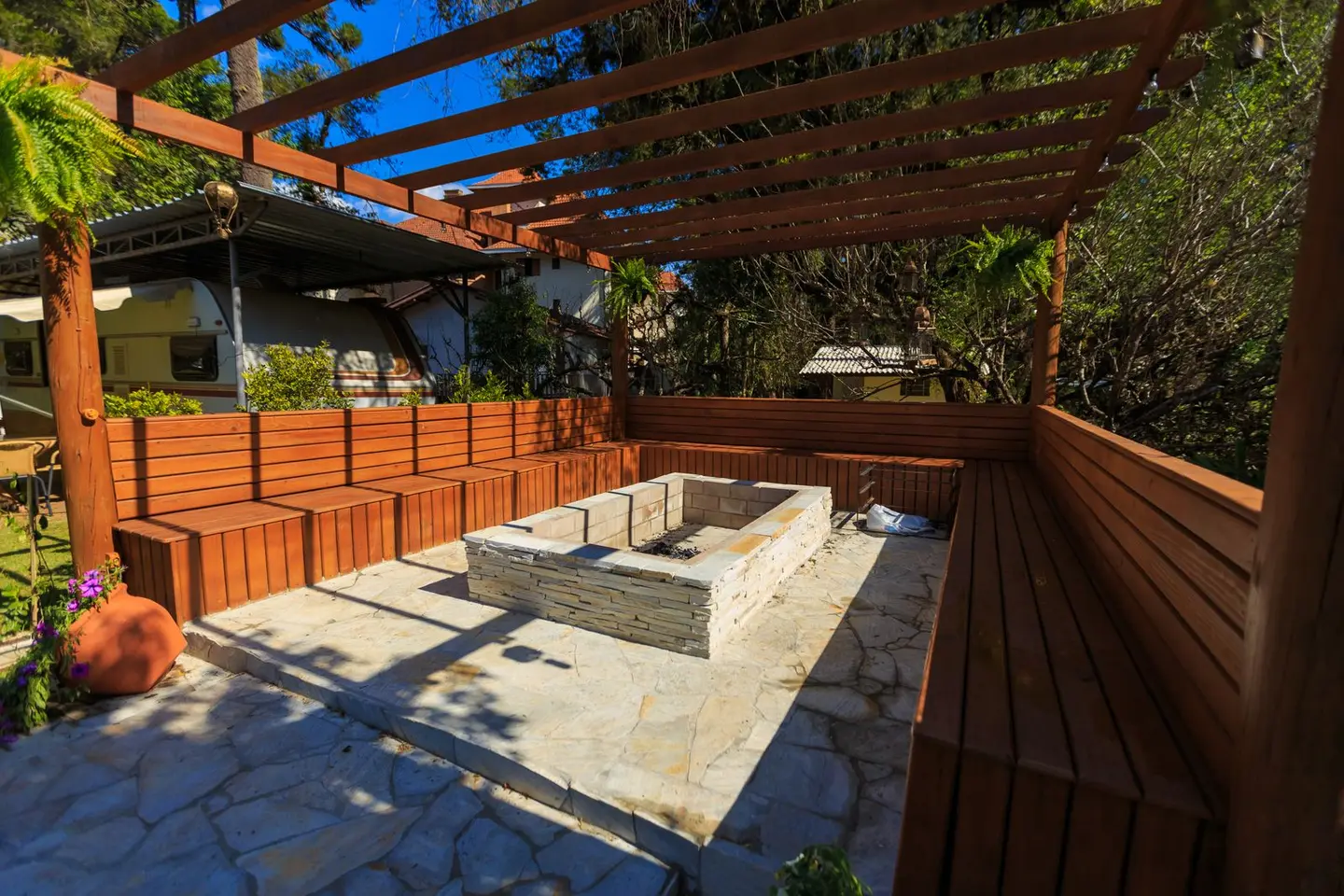
A fire pit transforms an outdoor space. Whether it is a simple steel bowl on the patio or a carefully designed sunken fire area surrounded by landscaping and seating, it creates a focal point and extends the time you can spend in the garden into autumn and beyond. Costs in the UK range from under £50 for an entry-level portable pit to £7,000 or more for a bespoke sunken installation, and the right choice depends on how you intend to use it and how permanent you want it to be.
Fire Pit Cost Summary
| Type | Typical cost | Durability |
|---|---|---|
| Portable steel bowl (basic) | £40–£100 | 3–7 years |
| Portable cast iron / corten steel | £80–£300 | 10–20 years |
| Raised fire pit on legs (large) | £200–£600 | 10–15 years |
| Built-in brick or stone fire pit | £800–£2,500 | 25+ years |
| Sunken fire pit (landscaped) | £1,500–£7,000 | Permanent |
| Gas fire pit table or feature | £600–£4,000 | 10–20 years |
Costs for built-in and sunken pits include labour, materials, and a hardstanding base where needed. Portable pit prices are retail prices; installation is not required.
Portable Fire Pits
The most popular option in the UK is still a portable fire pit, typically a steel or cast iron bowl on three or four legs, priced between £40 and £300 depending on size and quality.
What to look for:
- Corten (weathering) steel, develops an attractive rust patina, genuinely durable; a good 60 cm corten bowl costs £150–£300
- Powder-coated mild steel, cheaper but the coating will burn off around the firebox over time; budget option only
- Cast iron, very heavy, excellent heat retention, long life; classic choice at £80–£250
Look for a pit diameter of at least 50 cm for a useful fire size, keep the pit off timber decking and away from trees, sheds and fences, and use a spark guard near planting.
Built-In Fire Pits
A built-in fire pit is a permanent landscaping feature, typically constructed from engineering brick, natural stone, concrete block, or a combination. These are almost always bespoke to the garden layout and require professional construction or skilled DIY.
Standard construction sequence:
- Excavate and compact the base; lay a concrete foundation (typically 100–150 mm thick)
- Build the outer wall structure in brick, stone, or block
- Line the interior with refractory brick or concrete (ordinary brick can crack and spall under repeated heat)
- Lay a steel or refractory concrete base inside the pit
- Finish the capping with sandstone, granite, or brushed concrete
A built-in pit constructed by a landscaper using engineering brick and sandstone capping, roughly 1.0 m × 1.0 m, will cost £1,200–£2,500 installed, including groundworks and base. Adding a built-in seating wall or raised planters around it can push the total to £3,000–£6,000.
Sunken Fire Pit Ideas
A sunken fire pit, where the fire area is set below ground level, often surrounded by a raised seating area, is one of the most popular upscale garden ideas currently. The sunken element creates a natural windbreak and an amphitheatre effect for seating.
Construction is more involved than a surface-level pit:
- Deeper excavation (typically 400–600 mm below finished garden level)
- Retaining walls to hold back the surrounding ground
- Drainage provision to stop the pit filling with water
- Steps or access path into the seating area
Expect to pay £3,000–£7,000 for a well-designed sunken fire pit with integrated seating and proper drainage, designed and built by a landscaper. Budget designs without built-in seating can be delivered for £1,500–£3,000 by a confident landscaping team.
Gas Fire Pits
Gas fire pits, running on natural gas (if a mains supply is available) or LPG from a cylinder, are increasingly popular for gardens where clean, controllable flames are more appealing than wood smoke. They light instantly, produce no ash or embers, and can be turned off cleanly.
A gas fire pit table (a garden table with a gas burner in the centre) costs £600–£2,000 from garden retailers. A bespoke built-in gas feature designed by a landscaper, using a linear burner in a stone-clad trough, costs £1,500–£4,000 installed.
Fixed gas pipework to an outdoor feature, whether from the mains or from a bulk LPG tank, is a job for a Gas Safe registered engineer: anyone doing gas work as an employer or self-employed person must by law be a member of the class of persons approved by the Health and Safety Executive.1 A freestanding fire pit table that runs from a portable LPG cylinder is usually connected by the owner, using the regulator and hose supplied and following the maker’s instructions, but a check by a registered engineer is still sensible for any built-in feature.
Fire Pit Seating Ideas
The fire pit is only as good as the seating around it. Popular approaches:
- Timber benches, simple hardwood or treated softwood bench; from £200 per 1.8 m length supplied and fixed
- Built-in block and timber benches, a concrete block or brick base with a hardwood seat on top; durable and weather-resistant; around £300–£700 per 2 m run
- Curved stone seating wall, for a premium look; £400–£900 per metre run in sandstone or granite
- Moveable rattan or steel garden chairs, flexible but require storage in winter
If you are commissioning a landscaper for the whole feature, ask them to price seating as part of the same package, it is usually more efficient than two separate quotes.
Planning Permission and Legal Considerations
A garden fire pit does not normally require planning permission in England. A portable pit is not development at all, and a built-in or sunken pit in a back garden is generally treated as permitted development under Class E of the General Permitted Development Order, which covers an enclosure required for a purpose incidental to the enjoyment of the house.2 Class E does not cover anything forward of the principal elevation, so a built feature in a front garden may need consent.2
However:
- Smoke nuisance, you cannot get rid of household waste such as painted wood or plastics by burning it if that causes pollution or harms people’s health, and the council can serve an abatement notice if smoke from your fire becomes a statutory nuisance, so burn only dry, untreated natural wood.3
- Smoke Control Areas, smoke control rules do not stop you using an outdoor barbecue, chiminea or fireplace such as a fire pit, even in a smoke control area; they only restrict fuel where the appliance uses a chimney on the roof of a building such as a summerhouse, in which case you may burn only authorised fuel unless it is an exempt appliance.4
- Proximity to boundaries and structures, no legal setback distance exists for a fire pit in a garden, but fire and rescue services advise against placing one on decking or near trees, sheds or fences, and keeping it at least 3 m clear is a sensible working rule.5
For built-in features, check with your local authority before starting construction if your property is listed or in a conservation area: Class E does not apply within the curtilage of a listed building, and conservation areas may have extra controls.2
What to Buy vs What to Build
Most homeowners are best served by buying a quality portable corten steel or cast iron fire pit (£150–£300) initially and deciding later whether a built-in feature is worth investing in after using the space for a season or two. Garden use patterns are hard to predict, and a permanent fire pit in the wrong location is a significant landscaping correction.
If you are certain of the location and frequency of use, a built-in or sunken pit adds both enjoyment and lasting value to the garden, particularly when integrated with a seating area, lighting, and planting.
References (5)
Figures in this note were checked against the sources below on 30 September 2026. Superscript numbers in the text point to them. Every source the site cites, by topic.
- 1technicalvery strongThe National Archives (legislation.gov.uk), legislation.RN-UFY1XPRegulation 3(1) makes it unlawful for any person to carry out work in relation to a gas fitting or gas storage vessel unless he is competent to do so, and 3(2) places the duty to ensure that on the employer, on every other employer or self-employed person with any control over the work, and on anyone who required the work to be done at a place of work under their control. Regulation 3(3) goes further: no employer may let an employee, and no self-employed person may themselves, carry out work on a gas fitting or service pipework unless that employer or self-employed person is a member of a class of persons approved by the Health and Safety Executive, which in practice is registration with the Gas Safe Register. Regulation 3(4) exempts only replacing a hose or regulator on a portable or mobile space heater and replacing the hose connecting a re-fillable cylinder to installation pipework. Regulation 3(7) makes it an offence to falsely pretend to be a member of an approved class. This is the legal basis for saying a boiler must be fitted by a Gas Safe registered engineer.
- 2technicalvery strongThe National Archives (legislation.gov.uk), legislation.RN-J6L7TIThe primary legal text for garden rooms, sheds, summerhouses, pergolas, greenhouses and outdoor pools. Class E permits any building or enclosure, swimming or other pool within the curtilage required for a purpose incidental to the enjoyment of the dwellinghouse, plus a domestic heating oil container. Limitations: E.1(b) buildings, enclosures and containers other than the original dwellinghouse must not cover more than 50% of the curtilage; E.1(c) nothing forward of a wall forming the principal elevation of the original dwellinghouse; E.1(d) single storey only; E.1(e) maximum height 4 metres with a dual-pitched roof, 2.5 metres if any part is within 2 metres of a curtilage boundary, otherwise 3 metres; E.1(f) eaves no higher than 2.5 metres; E.1(g) not within the curtilage of a listed building; E.1(h) no verandah, balcony or raised platform; E.1(j) oil containers capped at 3,500 litres. E.4 defines incidental use as including keeping poultry, bees, pet animals, birds or other livestock for domestic needs or personal enjoyment, which is why a garden room used as a separate dwelling falls outside Class E.
- 3technicalvery strongGOV.UK, guidance.RN-KESS1BThe plain statement of what a homeowner may and may not burn in the garden, which a garden clearance or fire pit note can cite instead of asserting there is no law. It confirms there is no statutory ban on garden bonfires in England but you cannot dispose of household waste by burning it if that will cause pollution or harm health, and you could be fined if smoke drifts across a road and becomes a danger to traffic. Councils have a duty to investigate complaints of smoke and fumes amounting to a statutory nuisance and can serve an abatement notice, with a fine for breaching it. The page points homeowners to composting or council collection for garden waste instead.
- 4technicalvery strongGOV.UK, guidance.RN-55FX5RIn a smoke control area you must not release smoke from a chimney and must not burn unauthorised fuel unless it is in a Defra-approved exempt appliance. Authorised smokeless fuels include anthracite, semi-anthracite, gas and low volatile steam coal. Wood and other unauthorised fuels may only be burnt in a Defra exempt appliance, and only the fuel types the manufacturer specifies. Outdoor barbecues, chimineas, fireplaces and pizza ovens are outside the rules, as are garden bonfires that follow the bonfire rules. Penalties in England are up to £300 for smoke from a chimney and up to £1,000 for burning unauthorised fuel in a non-approved appliance. Whether an address sits in a smoke control area is confirmed by the local council's environmental services team.
- 5technicalstrong locallyMid and West Wales Fire and Rescue Service, guidance.RN-GV7WQGA fire and rescue service's safety advice for garden firepits; it tells users to keep firepits off decking and away from trees, sheds and fences. The 3 m figure is the note's own rule of thumb.
-
The Gas Safety (Installation and Use) Regulations 1998, regulation 3: Qualification and supervision, legislation.gov.uk, accessed 30 September 2026. legislation.gov.uk
-
The Town and Country Planning (General Permitted Development) (England) Order 2015, Schedule 2, Part 1, Class E: buildings etc incidental to the enjoyment of a dwellinghouse, legislation.gov.uk, accessed 30 September 2026. legislation.gov.uk
-
Garden bonfires: the rules, GOV.UK, accessed 30 September 2026. gov.uk
-
Smoke control areas: the rules, GOV.UK, accessed 30 September 2026. gov.uk
-
Firepit Safety Advice, Mid and West Wales Fire and Rescue Service, accessed 30 September 2026. mawwfire.gov.uk