A retractable patio awning is one of the most effective ways to make an outdoor space usable in UK summer conditions, providing shade, reducing glare, and allowing you to stay outside when light rain threatens. Costs range widely depending on size, mechanism type, and fabric quality. This guide sets out the main options, realistic 2026 prices, and what to check before buying.
Types of Patio Awning
Open-Roll (Bar) Awning
The most basic type. When retracted, the fabric rolls onto an exposed tube. There is no cover for the fabric when retracted, which means it is exposed to UV and bird droppings. Lifespan is typically 5–10 years. Cheaper to buy and install, but requires more frequent cleaning and re-treatment.
Semi-Cassette Awning
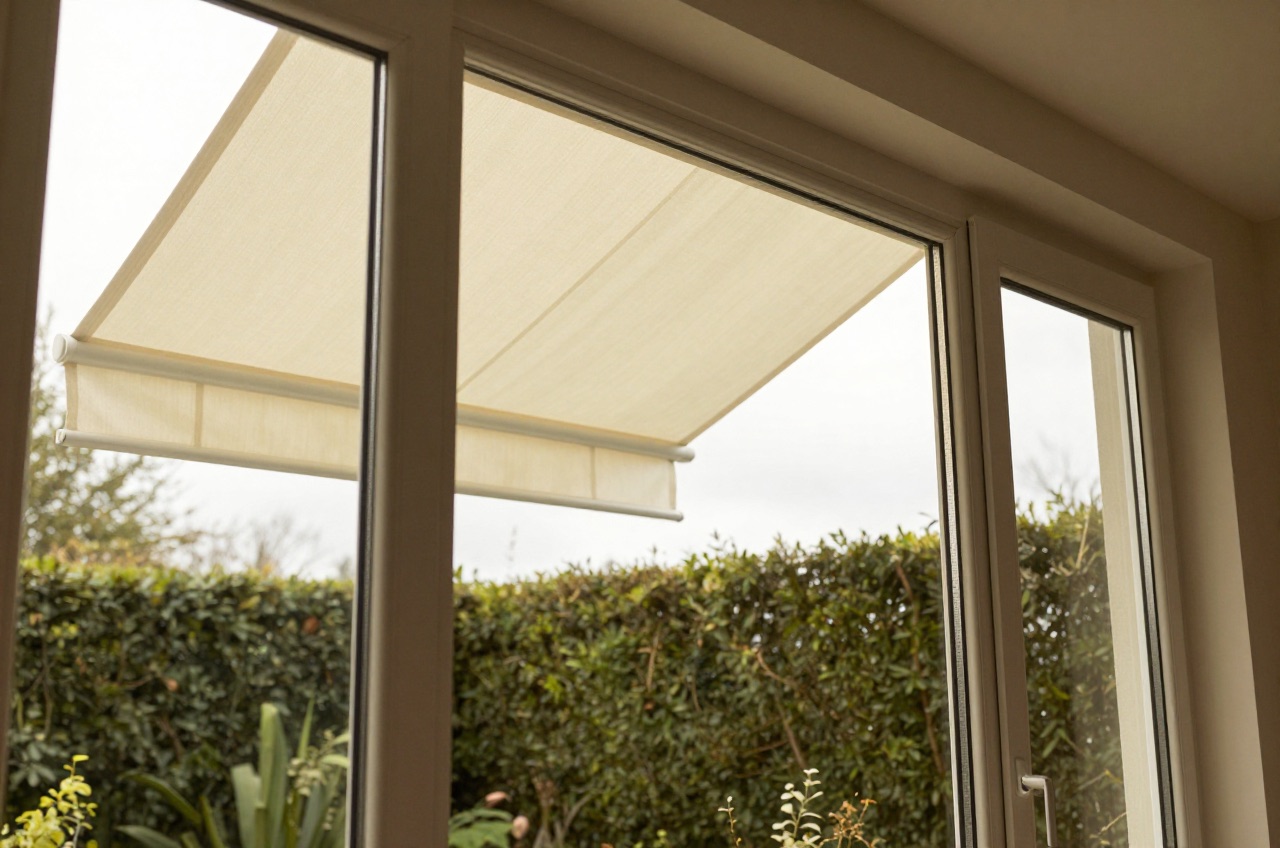
The roller mechanism is housed in a half-shell casing that covers the top of the roll when retracted. The arms (the hinged lateral extensions that support the awning when extended) are not housed. A reasonable mid-range choice, better fabric protection than open-roll, less expensive than a full cassette.
Full Cassette Awning
The entire awning, roller, fabric, and arms, retracts into a sealed aluminium cassette. This is the best protection for the fabric: it is shielded from UV, rain, and debris when not in use. Full cassette systems usually give the fabric and mechanism a longer life (15–25 years is often quoted for good-quality systems) and are the best choice if the awning will stay up all year.
Pergola-Style Fixed Awning
A fixed overhead structure, usually powder-coated aluminium or timber, with a retractable or louvred roof. Much more substantial than a wall-mounted awning and effectively an outdoor room covering. These are covered separately; even a basic aluminium louvred pergola usually costs several thousand pounds.
Cost Guide
Prices below are for supply and professional installation to a masonry or timber wall. Excludes electrical supply for motorised units.
| Awning Type | Width 3 m | Width 4 m | Width 5–6 m |
|---|---|---|---|
| Open-roll, manual | £700–£1,100 | £900–£1,400 | £1,100–£1,800 |
| Open-roll, electric | £1,100–£1,600 | £1,300–£2,000 | £1,500–£2,500 |
| Semi-cassette, manual | £900–£1,400 | £1,100–£1,800 | £1,300–£2,200 |
| Semi-cassette, electric | £1,300–£2,000 | £1,600–£2,500 | £1,900–£3,200 |
| Full cassette, electric | £1,600–£2,800 | £2,000–£3,500 | £2,500–£4,500 |
| Full cassette, electric + wind sensor | £1,900–£3,200 | £2,300–£4,000 | £2,800–£5,000 |
2026 UK prices, supply and installation by an awning specialist. Width refers to the awning’s face width when extended. Projection (the depth the awning reaches out from the wall) typically ranges from 2.0–3.5 m.
What Drives the Price
Width and projection: wider awnings and those with greater projection require heavier arms, larger roller tubes, and more fabric. Cost scales roughly linearly with width.
Cassette type: the cassette housing adds material cost and complexity. On the table above, an electric full cassette at 5–6 m width costs roughly £1,000–£2,000 more than an electric open-roll awning of the same width.
Fabric quality: standard polyester-acrylic fabric is fine for seasonal use. Premium Sunbrella or equivalent solution-dyed acrylic fabrics have dramatically better UV resistance, colour fastness, and water resistance, and cost more to specify. For a permanent installation, the premium is well worth paying.
Motorisation: electric operation is a significant convenience on larger awnings, operating a 5 m wide awning manually requires meaningful effort in wind. On the table above, choosing electric over manual operation adds roughly £400–£1,000 to the installed price, depending on width and cassette type. Wi-Fi or app control adds a further, usually modest, cost.
Sensors: wind sensors (retracting the awning automatically when wind speed exceeds a threshold) and sun sensors (extending at set light levels) are add-ons; the table above puts a wind sensor at roughly £300–£500 extra, installed. A wind sensor is strongly recommended for any electric awning, because leaving an awning extended in strong gusts risks damage to the arms and frame. External awnings are covered by BS EN 13561, External blinds and awnings: performance requirements including safety, so ask the installer which wind resistance class the awning has been tested to.1
Wall type: fixings into masonry (brick, block) are straightforward. Timber-framed walls, render systems, or lightweight cladding may need additional backing plates or structural support, adding labour cost.
Electrical Requirements
Motorised awnings need a 230 V mains supply run to the wall or soffit fixing point. If there is no existing external socket or switched spur nearby, an electrician will need to run a cable. This typically costs £150–£400 depending on the route. The supply should use cable and accessories rated for outdoor use, with a local isolator switch; a dedicated circuit is ideal but not always needed. A new circuit is notifiable electrical work under Part P, so use an electrician registered with a competent person scheme who can self-certify it.2
Planning Permission
In England, a retractable awning fixed to a house does not usually need planning permission, although the householder permitted development rules do not deal with awnings specifically, so ask your council if you are unsure. Exceptions:
- Listed buildings: works that alter a listed building in a way that affects its character need Listed Building Consent, and an awning fixed to the outside often will.3
- Conservation areas: awnings visible from the street may need consent in some conservation areas, particularly if they are to be permanently fixed.
- Flats and leasehold properties: check your lease terms and managing agent requirements before installation.
Commercial premises are outside this guide: shopfront awnings often need planning permission, and a branded awning may also need advertisement consent.
Choosing an Awning Specialist
Awnings are a specialist product, most general builders do not stock or install them. Look for:
- Membership of the British Blind and Shutter Association (BBSA), the trade body for blinds, awnings and shutters, or manufacturers’ training certifications (e.g., Markilux, Weinor, Somfy)4
- A physical showroom where you can see fabric samples and cassette mechanisms before ordering
- Written warranty on fabric (minimum 5 years; 10 years for premium acrylic) and mechanism (minimum 2 years parts)
- Experience installing to your specific wall type
Get two or three quotes with matching specifications, cassette type, projection, fabric weight, motor brand, before deciding. A notably cheaper quote is likely using lighter arms, thinner fabric, or a lower-quality motor.
Maintenance
Retractable awnings require minimal maintenance:
- Cleaning: brush off debris and clean fabric with a soft brush and soapy water two to three times per year. Do not use pressure washers, which damage the coating.
- Lubrication: annual light oiling of hinge points and arm pivots. Most cassette awning suppliers include this in a service visit.
- Winter storage: in the UK, a full cassette awning can remain in place year-round in a retracted position. Open-roll awnings in exposed positions should be retracted and ideally taken down over winter to prevent UV and frost damage.
A well-maintained full cassette awning from a reputable supplier can last 15–25 years with normal seasonal use.
References (4)
Figures in this note were checked against the sources below on 30 September 2026. Superscript numbers in the text point to them. Every source the site cites, by topic.
- 1technicalstrongBSI, guidance.RN-GZGAWTBSI's catalogue entry for BS EN 13561, the European standard setting performance and safety requirements for external blinds and awnings. It confirms the standard exists under that name and applies to awnings fitted to buildings.
- 2technicalvery strongMinistry of Housing, Communities and Local Government.RN-JYJ3I5The document that decides what electrical work a homeowner may legally do themselves, and the exact list of notifiable jobs. Regulation 12(6A), reproduced at paragraph 2.5, makes only three things notifiable: the installation of a new circuit, the replacement of a consumer unit, and any addition or alteration to existing circuits in a special location. Regulation 12(9) defines special location as, in a room containing a bath or shower, the zone extending vertically from finished floor level to 2.25 metres (or the shower head position if higher) and horizontally 600mm from the edge of the bath tub or shower tray. Paragraph 2.7 states that all other electrical installation work is not notifiable, namely additions and alterations to existing installations outside special locations, and replacements, repairs and maintenance anywhere. Paragraph 2.8 gives worked examples: a built-in cooker is not notifiable unless a new cooker circuit is needed, and connecting an electric gate or garage door to an existing isolator is not notifiable but running a new circuit from the consumer unit to that isolator is. Paragraph 2.2 confirms Part P reaches outdoor work including fixed garden lighting, pond pumps and outbuildings such as sheds, detached garages and domestic greenhouses. Notifiable work must be certified by self-certification by a registered competent person, third-party certification, or a building control body (paragraph 3.1), with the compliance certificate issued within 30 days (paragraph 3.4). Note that Approved Document P is a source of guidance rather than a ban: non-notifiable work still has to comply with BS 7671.
- 3technicalvery strongThe National Archives (legislation.gov.uk), legislation.RN-XN22L9The provision that decides when listed building consent is actually needed, and the answer to the common overstatement that any alteration to a listed building requires consent. Section 7(1): 'no person shall execute or cause to be executed any works for the demolition of a listed building or for its alteration or extension in any manner which would affect its character as a building of special architectural or historic interest, unless the works are authorised under section 8.' The trigger is therefore effect on character as a building of special architectural or historic interest, not alteration as such, so work with no effect on that character falls outside the restriction. Section 7(2) makes subsection (1) subject to section 33(1) of the Planning Act 2008, which excludes the requirement for other consents where development consent is required. Authorisation itself comes from section 8.
- 4technicalfairBritish Blind and Shutter Association, guidance.RN-HNBY4GThe home page of the British Blind and Shutter Association, the UK trade association for blinds, awnings and shutters, with a finder for accredited awning specialists. It confirms the BBSA is the relevant trade body.
-
BS EN 13561:2015 External blinds and awnings. Performance requirements including safety, BSI, accessed 30 September 2026. knowledge.bsigroup.com
-
Approved Document P: Electrical safety, dwellings (2013 edition), Department for Communities and Local Government, accessed 30 September 2026. assets.publishing.service.gov.uk
-
Planning (Listed Buildings and Conservation Areas) Act 1990, section 7, legislation.gov.uk, accessed 30 September 2026. legislation.gov.uk
-
British Blind and Shutter Association, British Blind and Shutter Association, accessed 30 September 2026. bbsa.org.uk