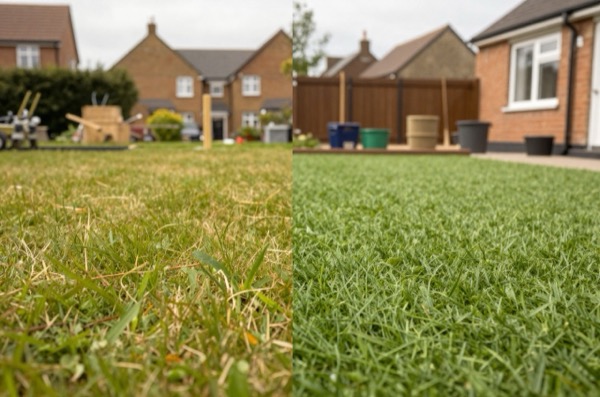
Scarification is one of the most dramatically effective things you can do for a tired, mossy, or spongy lawn, and one of the most alarming. A freshly scarified lawn looks devastated for a fortnight, prompting most first-timers to wonder what they have done. Within 3–4 weeks, provided timing is right and aftercare is followed, the result is a noticeably thicker, healthier, greener sward.
The process removes thatch, the compacted layer of dead grass stems, moss, and organic debris that builds up between the soil surface and the living grass blades. Heavy thatch prevents water, air, and nutrients reaching the roots, encourages moss colonisation, and makes lawns spongy and prone to waterlogging.1
When to Scarify a UK Lawn
Timing is the most important variable. Scarification stresses the grass significantly; it needs warm soil and active growth to recover. The wrong time of year causes lasting damage.
Best times in the UK:
- Late spring (late April to late May), grass is growing strongly, soil is warming, and there are months of growth ahead to recover. Preferred for light to moderate scarification.
- Early autumn (September to October), the other prime window. The RHS advises carrying out its autumn lawn tasks, scarifying included, in September or October.1 Soil is still warm from summer, autumn rains reduce drought stress, and there are several weeks of growth before winter dormancy. Preferred for heavy scarification and overseeding.
When not to scarify:
- During drought, stressed grass cannot recover
- In hot, dry summer conditions (late June–early August in a normal year), the combination of scarification stress and heat is damaging
- In winter or when frost is forecast, dormant grass will not regenerate
- When the lawn is waterlogged, muddy conditions smear the soil and damage root structure
What Equipment Do You Need?
| Tool | Best for | Cost to buy | Cost to hire (per day) |
|---|---|---|---|
| Spring-tine rake | Small lawns under 30 m²; light thatch | £15–£45 | - |
| Manual scarifier/dethatcher | Small-medium lawns; light–moderate thatch | £30–£80 | - |
| Electric scarifier | Medium lawns up to 150 m² | £80–£200 | £35–£60 |
| Petrol scarifier | Large lawns over 150 m²; heavy thatch and moss | £250–£600 | £50–£90 |
| Ride-on scarifier attachment | Very large lawns | £500–£2,000+ | £80–£150 |
For most domestic lawns, hiring a petrol scarifier for a day is the most cost-effective option. A petrol machine with adjustable blade height is significantly more effective than a light electric model on a heavily thatched lawn.
Preparation: Before You Scarify
-
Treat moss first, if your lawn has significant moss and you choose to use a moss killer, apply a proprietary lawn moss killer at the rate on its label 2–3 weeks before scarifying. The RHS advises that iron sulphate (ferrous sulphate) should not be used to control moss unless it is part of a proprietary, HSE-approved lawn mosskiller.2 Killing the moss first means it can be removed, rather than spreading viable moss fragments across the lawn. The dead moss turns black and then needs raking out.
-
Mow the lawn short, cut to approximately 25–30 mm two to three days before scarifying. If the grass is long, lower the blades over two or three mowings: the RHS advises never taking off more than one-third of the grass height at a time.3 This reduces the amount of live grass material the scarifier picks up and improves the machine’s access to the thatch layer.
-
Check soil moisture, the soil should be moist but not saturated. Bone-dry conditions make scarification less effective; waterlogged conditions risk compaction damage.
-
Mark obstacles, mark the positions of sprinkler heads, drainage inspection covers, tree roots close to the surface, and any buried irrigation or cable. Scarifier blades can damage all of these.
Step-by-Step Scarification
Step 1: Set the Blade Depth
Start with the blades set to barely touch the soil surface (or fractionally above on the first pass). For a lightly thatched lawn, this is often sufficient. You can always lower the blades on subsequent passes; over-aggressive depth on the first pass can damage grass crowns.
Signs that depth is correct: the machine is pulling up dead material and moss, but live grass is being disturbed, not ripped out wholesale.
Step 2: First Pass: In One Direction
Scarify the entire lawn in straight, overlapping parallel passes in one direction (north–south, for example). Keep a steady pace, don’t rush. The machine should be pulling up quantities of grey-brown thatch material as you go.
Step 3: Second Pass: Perpendicular
Rotate 90 degrees and make a second pass across the entire lawn.1 This cross-hatching is what gives professional results. For heavily thatched or mossy lawns, a third pass at 45 degrees can be added.
Step 4: Rake and Remove
The volume of material removed is typically surprising. Rake it all up and remove it from the lawn, do not leave it lying, as it will suppress the recovering grass.1 If the material is free of herbicides and weed seeds, it can go on the compost heap; otherwise bag it for green waste collection.
Step 5: Overseed Bare Patches
Immediately after scarification is one of the best moments to overseed. The soil has been opened up, there is good seed-to-soil contact, and the ground is warm. Use a seed mix appropriate to your lawn’s conditions, shade-tolerant mix for areas under trees; hard-wearing mix for high-traffic areas; fine ornamental mix for a decorative lawn.
Recommended overseeding rate: follow the seed packet; the RHS gives about 15–25 g/m² for re-seeding bare patches, and a lighter rate is enough when broadcasting across the whole lawn to thicken it.4
Step 6: Aerate (Optional but Recommended)
Following scarification with lawn aeration (spiking with a garden fork or hollow-tine aerator) further improves drainage, reduces compaction, and speeds recovery. Hollow-tine aeration removes cores of soil, improving air movement to roots significantly.
After-Care
| Week | Action |
|---|---|
| Week 1–2 | Water if dry (avoid waterlogging); lawn will look rough, this is normal |
| Week 2–3 | First signs of new grass growth; keep off as much as possible |
| Week 3–4 | Apply a spring/autumn lawn fertiliser (NPK balanced, high nitrogen for spring; high potassium for autumn) |
| Week 4–6 | Resume mowing when grass reaches 50 mm; cut back to 35–40 mm (not shorter, don’t stress recovering grass) |
| Ongoing | Top-dress with a sandy loam mix if the surface is uneven; this fills the scarification channels and levels the lawn |
The RHS suggests keeping an ordinary domestic lawn at up to 40 mm in spring and autumn.3 It also notes that autumn lawn feed encourages root growth through winter rather than leafy growth, so use a feed formulated for the season.1
How Often Should You Scarify?
For most UK lawns:
- Light scarification (spring-tine raking), annually in spring, every lawn benefits
- Full powered scarification, every 2–3 years for a well-maintained lawn; annually for a lawn with significant moss or thatch build-up
- After a heavy moss treatment, scarifying annually for 2–3 years is often necessary to remove successive treatments of killed moss
Overly frequent deep scarification weakens the lawn. The goal is to remove accumulated thatch, not to run an aggressive blade over healthy soil every year.
Why Does Moss Keep Coming Back?
Scarification removes moss but does not fix the underlying conditions that favour it. Moss thrives in lawns that are:
- Poorly drained, address with aeration and sand top-dressing
- Shaded, consider a shade-tolerant grass seed mix, or accept reduced lawn density under trees
- Acidic, many mosses prefer a low pH, so test the soil; most lawn grasses cope with mildly acid soil, so apply lime only if a test shows it is needed, at the rate on the pack5
- Underfed, hungry grass is thin and invaded easily; follow a feeding programme
- Heavily compacted, consider hollow-tine aeration followed by top-dressing, which the RHS suggests every three to four years1
Treating the cause is the only long-term solution. Scarification alone gives only temporary relief: the RHS notes that if growing conditions stay the same, moss is very likely to return.5
References (5)
Figures in this note were checked against the sources below on 30 September 2026. Superscript numbers in the text point to them. Every source the site cites, by topic.
- 1technicalfairRoyal Horticultural Society, guidance.RN-BF38VAThe authority for the autumn lawn renovation sequence and the quantities a scarification note needs. September and October are the window for scarifying, aerating, top dressing and feeding. Scarify with a spring-tined rake worked vigorously in two directions to lift thatch, or hire powered equipment for larger areas. Aerate by spiking with a garden fork as deep as possible, ideally the full depth of the tines, spacing each set of holes 10 to 15cm (4 to 6in) apart, and repeat every two to three years for a standard lawn; use hollow tines on clay or waterlogged soil every three to four years. Apply top dressing at 2 to 3kg per square metre (4 to 7lb per 10 square feet), mixed as 3 parts sandy loam, 6 parts sharp sand and 1 part well-rotted compost or soil improver. Use a fertiliser formulated for autumn to encourage root development, usually about a handful per square metre, applied before rainfall. Biological control of leatherjackets goes on in early autumn.
- 2technicalfairRoyal Horticultural Society, guidance.RN-3IGS1IRHS advice on moss in lawns; it says iron sulphate should not be used to control moss unless it is in an HSE-approved mosskiller, and that dead moss turns black and must be raked out.
- 3technicalfairRoyal Horticultural Society, guidance.RN-DLC5SVThe Royal Horticultural Society on mowing. It settles the mistake this sentence warns about: cutting too low scalps the lawn and leaves bare patches, which happens most easily on soft ground, on fast turns, and where the surface is uneven. It also says the cutting height should be changed through the year rather than left alone. The page does not give a height in millimetres, so the 25 to 40 mm range here is ordinary summer practice rather than an RHS figure.
- 4technicalfairRoyal Horticultural Society, guidance.RN-YDWVU9The source for the grass seed rate a turf versus seed note should quote. Spring and autumn are the ideal times to repair a lawn, when the weather is damp and cool. Grass seed is scattered at the rate advised on the packet, usually about 15 to 25g per square metre (half to three quarters of an ounce per square yard). When lifting damaged turf, slice underneath it to a depth of about 5cm (2in). Water gently with a watering can fitted with a fine rose so the seed is not dislodged, and keep newly sown grass and newly laid turf watered regularly until well rooted, because both are vulnerable to drying out.
- 5technicalfairRoyal Horticultural Society, guidance.RN-1CB0FIRHS guide to moss in lawns; it lists acidic soil among the common causes of excess moss.
-
Lawn Care in Autumn, Royal Horticultural Society, accessed 30 September 2026. rhs.org.uk
-
Moss in lawns, Royal Horticultural Society, accessed 30 September 2026. rhs.org.uk
-
How to mow a lawn, Royal Horticultural Society, accessed 30 September 2026. rhs.org.uk
-
Repairing lawns, Royal Horticultural Society, accessed 30 September 2026. rhs.org.uk
-
Moss in Lawns: Keep or Remove?, Royal Horticultural Society, accessed 30 September 2026. rhs.org.uk