A well-maintained lawn is one of those things that only looks effortless when it is done right. The UK climate, mild, damp winters and occasionally hot, dry summers, creates its own rhythm of lawn care, and understanding that rhythm is 80% of the job. The other 20% is having the right kit and not cutting corners in autumn when the grass looks dormant but is actually recovering.
Most problems with UK lawns, patchy growth, moss, thatch build-up, compaction, stem from doing the wrong thing at the wrong time of year rather than from neglect alone. This guide sets out what to do and when, with realistic costs for both DIY and professional approaches.
The UK Lawn Calendar
| Month | Key Tasks |
|---|---|
| Jan–Feb | Rest. Check drainage. Remove leaves and debris. |
| March | First cut (high setting). Rake out moss if needed. |
| April | Lower mowing height gradually. Apply spring/summer fertiliser (high N). Reseed bare patches. |
| May–June | Mow weekly. Water in drought. Treat weeds as needed. |
| July–Aug | Mow less in heat. Raise cut height. Reduce irrigation to encourage deep roots. |
| September | Scarify. Aerate. Apply autumn fertiliser (high K, low N). Overseed thin areas. |
| October | Last cuts. Tidy edges. Top-dress if needed. |
| November | Lay turf if required (soil still warm enough to root). Brush off worm casts. |
| Dec | Rest. Keep off frozen or waterlogged grass. |
Turf is best laid in mid-autumn, but it can go down at any time from mid-autumn to early spring while the soil is not too wet or frosty.1
Mowing
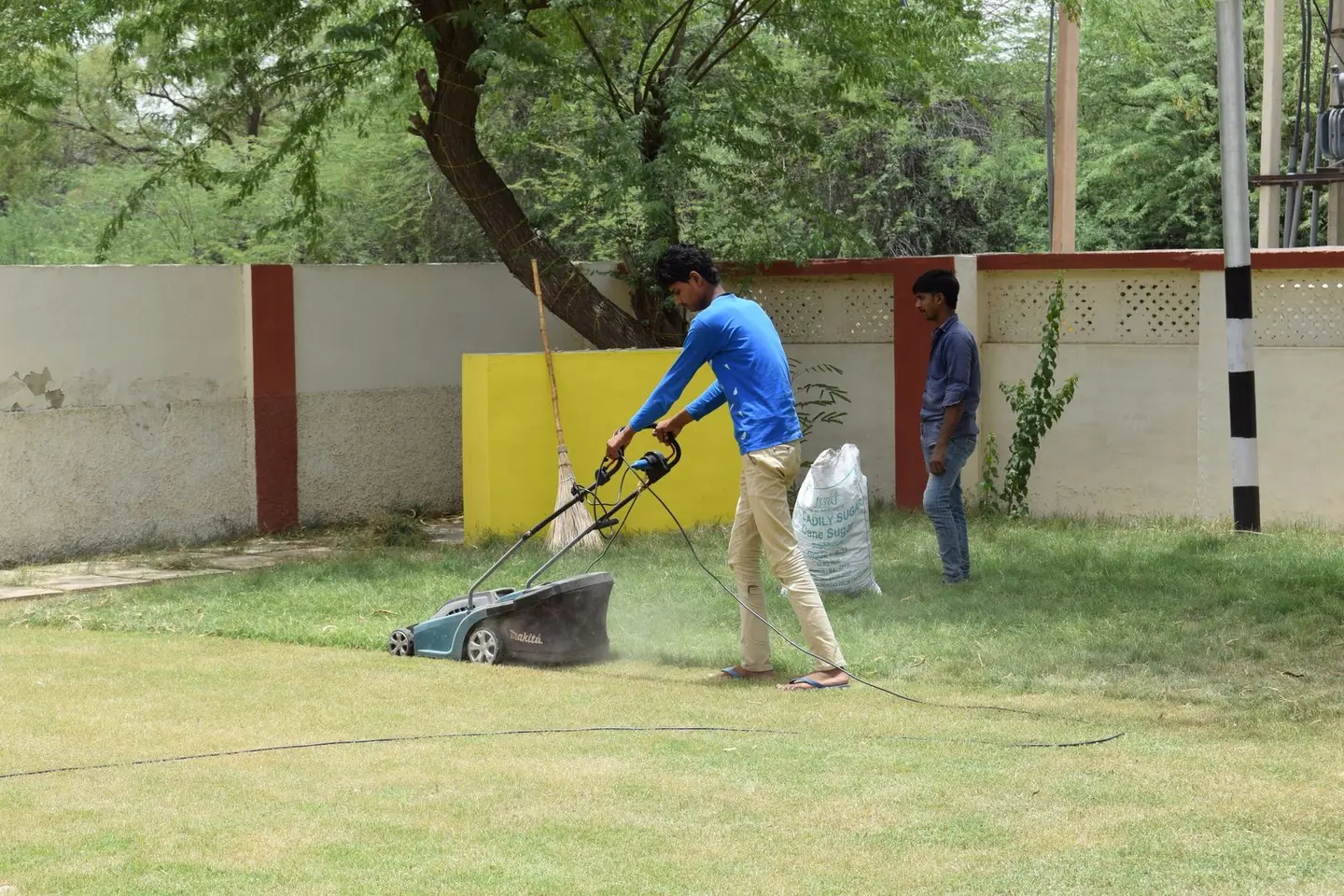
The single most important factor in lawn health is cutting height and frequency. Never remove more than one-third of the grass blade in a single cut.2 Cutting too short stresses the grass, opens it to moss and weed invasion, and causes yellowing in dry spells.
Target heights by season:
- Spring/autumn: 30–40 mm
- Summer: 40–50 mm (or higher in drought)
- First and last cuts of year: 50–60 mm
These heights sit at the longer end, which suits a hard-wearing family lawn; the RHS gives a general rule of 13–25 mm in summer and up to 40 mm in spring and autumn for an ordinary domestic lawn, and warns that very close mowing encourages shallow rooting, drought damage, weeds and moss.2
A rotary mower suits most UK family lawns.2 A cylinder mower gives a finer finish but requires a flat, well-prepared lawn. Robot mowers (£300–£2,500) work well on flat, clearly defined plots with no trees or garden beds creating complex navigation obstacles.
Feeding
Spring/summer fertiliser (high nitrogen, N:P:K around 20:10:10) goes on in mid-spring, usually late March to April, with a second dose a couple of months later only if the lawn still looks poor, and never after August.3 Nitrogen drives leaf growth and colour. Apply at the rate on the packet, which for a granular feed is usually about a handful per square metre.4 Do not apply in drought, as it can scorch grass if not watered in.
Autumn fertiliser (low nitrogen, high potassium, around 3:6:12) goes on in September. An autumn feed encourages root growth through winter rather than soft leafy growth.4 It is worth applying to a thin or tired lawn, though many lawns recover from summer wear without any feed.
Approximate feeding costs (for an average 50 m² lawn):
- Granular fertiliser (spring or autumn, 50 m²): £8–£15 per application
- Liquid lawn food: £6–£12 per application
Scarifying and Aerating
Scarifying removes the layer of thatch, dead grass, moss and organic debris, that builds up between the soil surface and the living grass. A thick thatch layer stops water getting down into the soil and reduces air circulation, which can lead to fungal problems; as a rule of thumb, if you cannot see the soil between the blades of grass, the lawn will benefit from scarifying.4 Scarify once in September using a spring-tine scarifier (manual: £30–£60, electric: £60–£150, hire: £30–£50/day). The lawn will look alarming immediately afterwards, bare and brown. This is normal; it will usually recover within a few weeks.
Aeration relieves compaction, a common cause of waterlogging and poor drainage. Drive a garden fork in as deep as the tines will go, with the holes 100–150 mm apart, or hire a hollow-tine aerator (£40–£60/day), which pulls plugs of soil to the surface and works better on clay or waterlogged ground.4 Do this in September after scarifying, then brush a top dressing of sandy loam, sharp sand and compost into the holes; for most lawns, aerating every two to three years is enough.4
Reseeding and Overseeding
Bare patches are best repaired in mid-spring or early autumn, when the soil is warm and moist.5 Steps:
- Scarify or scratch the bare area with a rake
- Apply a thin layer of top-dressing compost (10 mm)
- Broadcast seed at the rate on the packet, usually around 30–35 g/m² (use a mix appropriate to your lawn’s shade and use)
- Rake in lightly, water and keep moist for 14–21 days
- First cut when seedlings reach 50 mm, set the blade high
Grass seed costs £5–£15 per kg; a 1 kg bag covers roughly 30–33 m².6
Moss and Weeds
Moss is a symptom, not the problem. It grows where the grass is weak: compacted soil, poor drainage, shade, low pH or over-cutting. Apply iron sulphate (lawn sand or moss killer) to kill the moss, then address the underlying cause, otherwise it will return within a season.
Broadleaf weeds (dandelion, clover, plantain) can be spot-treated with selective lawn herbicide containing MCPA or mecoprop-P. Do not apply in drought or frost, and keep children and pets off the lawn for as long as the product label says. Weed-and-feed products combine fertiliser with herbicide and are convenient but tend to be less effective than separate applications.
Professional Lawn Care
Lawn care companies such as Greensleeves, GreenThumb and independent local operators offer treatment programmes that typically include four to six visits per year covering fertilisation, weed control, moss treatment and disease management.
| Service | Typical Cost (average UK garden, 50 m²) |
|---|---|
| Single treatment visit | £40–£80 |
| Annual programme (4–6 visits) | £180–£400 |
| Scarification (professional) | £80–£200 |
| Aeration (professional) | £60–£150 |
| Lawn renovation (scarify + aerate + seed) | £200–£450 |
| Full new lawn (turf, 50 m², supply & lay) | £600–£1,200 |
Professional programmes make most sense for larger gardens (over 100 m²), lawns where presentation really matters (front gardens of rental properties or commercial premises), or owners who genuinely do not have the time or inclination to follow the seasonal schedule themselves.
Common Mistakes
- Cutting too short. The most common cause of moss, weeds and a yellow lawn in summer.
- Ignoring autumn care. Skipping the September feed, scarify and aerate means the lawn enters winter weakened and takes longer to recover in spring.
- Watering lightly and frequently. Encourages shallow roots. Established lawns usually recover from summer browning once rain returns, so watering is optional; if you do water, water deeply and infrequently to push roots down.3
- Mowing wet grass. Damages the turf, compacts the soil and clogs the mower.2 Wait until the dew has lifted.
- Applying spring fertiliser in late summer. Forces soft leafy growth just before the first frost, which then dies back badly and can invite fungal disease.3
A good lawn is the product of consistent, seasonal attention over several years. The investment is modest, £50–£150/year in materials, and the results are cumulative.
References (6)
Figures in this note were checked against the sources below on 30 September 2026. Superscript numbers in the text point to them. Every source the site cites, by topic.
- 1technicalfairRoyal Horticultural Society.RN-QT0V7ZRHS method and timings for a turf lawn. Turf is best laid in mid-autumn and can go down any time from mid-autumn to early spring when the soil is neither waterlogged nor frozen; mid-spring to early autumn should be avoided because the turf struggles to root in heat and needs constant watering. Preparation is the whole job: dig or rotovate to 20 to 25cm depth, work in well-rotted organic matter, fork out perennial weed roots such as couch grass and bindweed, level, and let the ground settle for several weeks before laying. Turf should be laid within 24 hours of delivery; if laying is delayed more than a couple of days, unroll it flat so the grass gets light and water it if dry, or it will yellow and die. Lay with joints staggered like brickwork, butted tight with no gaps, working from boards so the new turf is not trodden. Brush a lawn dressing into the joints. In dry weather water every 5 to 10 days in mid to late summer and about every fortnight at other times, wetting right through the turf so roots grow down. First mow about three weeks after laying, blades set high, once a tug on the grass shows it has rooted; keep off it until then.
- 2technicalfairRoyal Horticultural Society, guidance.RN-DLC5SVThe Royal Horticultural Society on mowing. It settles the mistake this sentence warns about: cutting too low scalps the lawn and leaves bare patches, which happens most easily on soft ground, on fast turns, and where the surface is uneven. It also says the cutting height should be changed through the year rather than left alone. The page does not give a height in millimetres, so the 25 to 40 mm range here is ordinary summer practice rather than an RHS figure.
- 3technicalfairRoyal Horticultural Society, guidance.RN-U8E387RHS advice guide on spring and summer lawn care. It sets a high-nitrogen feed in mid-spring, usually late March to April, with a second application only if the lawn still looks poor and not beyond August.
- 4technicalfairRoyal Horticultural Society, guidance.RN-BF38VAThe authority for the autumn lawn renovation sequence and the quantities a scarification note needs. September and October are the window for scarifying, aerating, top dressing and feeding. Scarify with a spring-tined rake worked vigorously in two directions to lift thatch, or hire powered equipment for larger areas. Aerate by spiking with a garden fork as deep as possible, ideally the full depth of the tines, spacing each set of holes 10 to 15cm (4 to 6in) apart, and repeat every two to three years for a standard lawn; use hollow tines on clay or waterlogged soil every three to four years. Apply top dressing at 2 to 3kg per square metre (4 to 7lb per 10 square feet), mixed as 3 parts sandy loam, 6 parts sharp sand and 1 part well-rotted compost or soil improver. Use a fertiliser formulated for autumn to encourage root development, usually about a handful per square metre, applied before rainfall. Biological control of leatherjackets goes on in early autumn.
- 5technicalfairRoyal Horticultural Society.RN-MS68WPRHS method for a seeded lawn, the cheaper alternative to turf. Best sowing windows are early autumn and mid-spring; germination follows in seven to ten days. The sowing rate is on the packet and varies with the mixture, so it should be weighed out per square metre rather than scattered by eye. Three mixture types: general-purpose, a hard-wearing blend for heavy foot traffic; luxury or fine, dense and soft but slower growing and less tolerant of wear; and shady, formulated for light to medium shade. Soil preparation is the same discipline as for turf: dig or rotovate to about 20cm (8in) where the soil is compacted, clear perennial weeds, level and let it settle. After sowing, water every few days if needed, and protect with horticultural fleece weighted at the edges to keep birds off and hold moisture in. First cut when the seedlings are 5 to 7.5cm (2 to 3in) tall, taking off only about a third of the height. Keep heavy use off for roughly eight months - so from June onwards for an autumn sowing, or late autumn for a spring sowing.
- 6costsupplier figureWickes Building Supplies Ltd.RN-ACKNGYA price, true at 2026-09. Wickes Building Supplies Ltd, Miracle Gro Multi Purpose Grass Seed 33m2 1kg. Held in the cost register as a price source; the passage quoted against it reads: Miracle-Gro Multi-Purpose Grass Seed 33m2 - 1kg :: £14 | £11 ... Gro-Sure Fast Acting Lawn Seed 50m2 - 1.5kg :: £16.50 | £0.33 per m2 ... Gro-Sure Smart Seed La
-
How to lay a lawn from turf, Royal Horticultural Society, accessed 30 September 2026. rhs.org.uk
-
Mowing lawns, Royal Horticultural Society, accessed 30 September 2026. rhs.org.uk
-
Lawn care in spring and summer, Royal Horticultural Society, accessed 30 September 2026. rhs.org.uk
-
Autumn lawn care, Royal Horticultural Society, accessed 30 September 2026. rhs.org.uk
-
Starting a lawn from seed, Royal Horticultural Society, accessed 30 September 2026. rhs.org.uk
-
Miracle-Gro Multi-Purpose Grass Seed 33m2 - 1kg, Wickes, accessed 21 September 2026. Priced at 2026-09, so no calibration is needed. wickes.co.uk