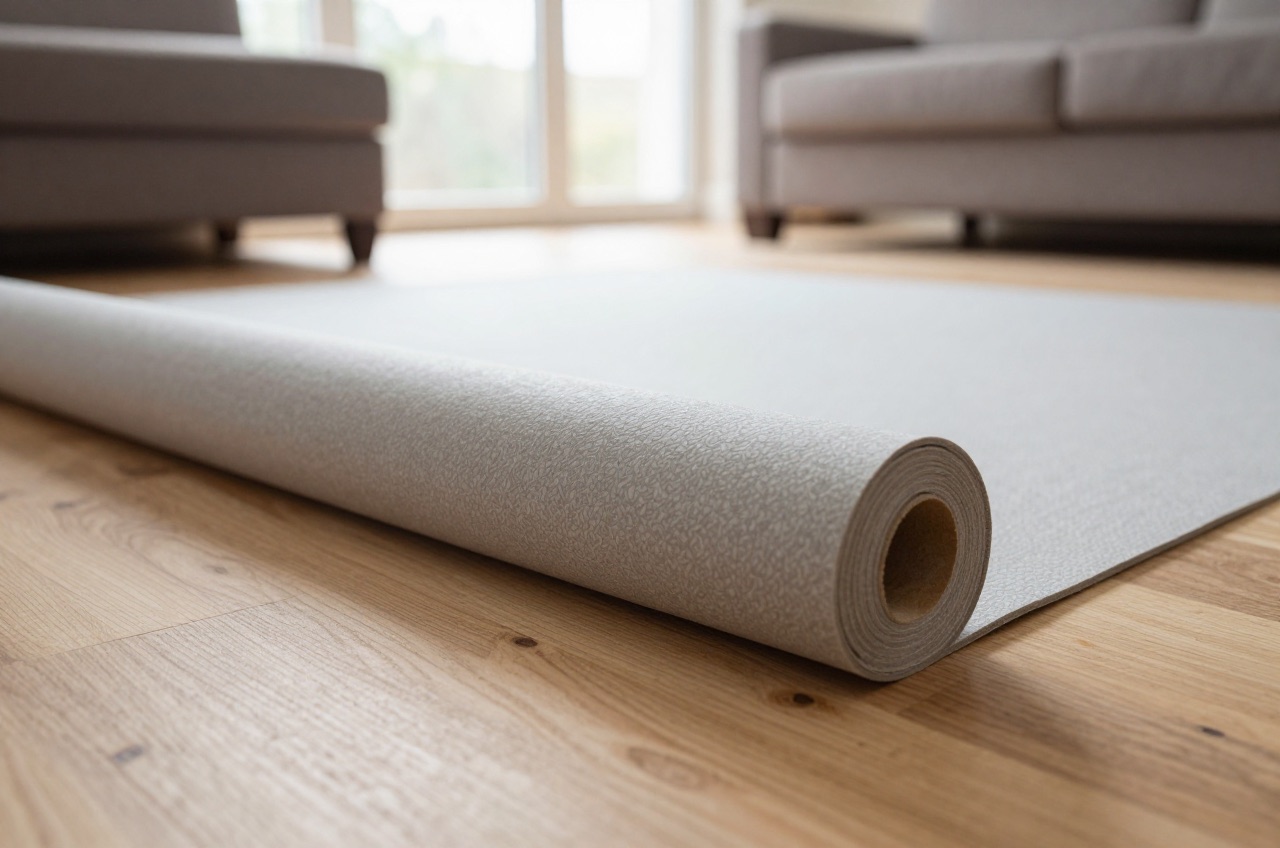
Noise travelling through floors, footsteps, dropped items, muffled voices from below, is one of the most common complaints in UK homes, particularly in flats and Victorian terraces with timber joists. The most practical and affordable first step is a quality acoustic underlay fitted beneath your chosen floor covering. Done correctly, it can make a measurable difference without lifting floorboards or pouring concrete.
Acoustic underlays work on two distinct sound paths: impact sound (vibrations travelling through the structure itself, like footsteps) and airborne sound (voices, music passing through air gaps). Most products target impact sound, which is where underlay has the greatest effect. For airborne noise you generally need a combination of mass and decoupling, underlay alone will not stop sound carrying between flats.
How Sound Reduction Is Measured
Impact sound improvement is expressed as ΔLw (delta Lw) in decibels, the higher the number, the better the product.1 A 10 dB reduction roughly halves the perceived loudness, so a ΔLw of 20 dB is a large improvement in footstep noise.2
Building Regulations Part E sets minimum sound insulation standards for separating floors and walls between homes, both in new-build houses and flats and in homes formed by a material change of use, such as a house converted into flats.1
The two figures come as a pair and the pair depends on how the flats were made:
- Purpose built separating floor: impact L’nT,w ≤ 62 dB, airborne sound insulation DnT,w + Ctr ≥ 45 dB1
- Formed by a material change of use, which is what a house split into flats is: impact L’nT,w ≤ 64 dB, airborne DnT,w + Ctr ≥ 43 dB1
Mixing 62 with 43 is the common slip, and it is the combination that appears in neither column.
If you are converting a house into flats in England, you must demonstrate compliance with Part E.1 An acoustic underlay alone is rarely sufficient, you will typically need a floating screed, resilient batten system, or specialist acoustic floor build-up tested to Part E. Speak to an acoustic consultant before starting conversion work.1
For owner-occupiers improving sound comfort within their own home (e.g., reducing noise between floors in a house), Building Regs do not apply, and a good underlay can deliver a satisfying improvement.
Types of Acoustic Underlay
| Type | Typical ΔLw | Thickness | Cost (£/m²) | Best For |
|---|---|---|---|---|
| Foam (polyurethane) | 12–18 dB | 3–5 mm | £2–£43 | Budget laminate, basic impact reduction |
| Crumb rubber | 18–25 dB | 5–10 mm | £4–£7 | Solid wood, laminate, engineered boards |
| Recycled felt | 20–28 dB | 6–10 mm | £5–£8 | Carpet, solid wood, engineered boards |
| Cork | 15–22 dB | 4–6 mm | £4–£7 | Laminate, LVT, engineered wood |
| Combination (rubber + foam) | 22–30 dB | 5–12 mm | £6–£12 | High-performance; flat conversions |
| Acoustic mat (dense mineral) | 28–35 dB | 5–8 mm | £8–£18 | Part E compliance systems |
As price checks in September 2026, Wickes listed a 3 mm laminate and wood flooring underlay with a built-in moisture barrier at £29 for 15 m², about £1.93 per m².4 A 5 mm acoustic floor mat for impact sound was listed at £84 for a 10 m² roll, or £8.40 per m².5 A 10 kg/m² mass-loaded vinyl acoustic mat was listed at £42.99 for a 2.4 m² sheet, about £18 per m².6
Foam underlays are the cheapest option but offer modest acoustic performance. They compress quickly under point loads, reducing effectiveness within a year or two.
Crumb rubber (often from recycled tyres) strikes a good balance of performance and cost. It is resilient, does not compress significantly under furniture, and works well under floating engineered boards.
Recycled felt (shoddy felt) is a popular choice under carpet and solid wood. It provides warmth underfoot and good mid-range acoustic performance but can absorb moisture in poorly ventilated spaces.
Cork is a natural option with reasonable impact reduction and thermal insulation. It works best under rigid boards and is worth considering in rooms where thermal performance matters.
Combination products laminate rubber with foam or felt to achieve the highest residential ΔLw figures. These are the go-to choice if you are trying to maximise impact sound reduction without structural intervention.
Acoustic mats (dense loaded vinyl or mineral-filled products) are primarily designed as part of a tested system for Building Regs compliance. They are thicker and heavier than standard underlays and require careful specification.
Acoustic Underlay for Different Floor Types
Laminate & Engineered Wood (Floating)
Look for an underlay with a combined thickness (underlay + floor) that does not exceed the floor manufacturer’s specification, typically underlay should be no thicker than 3–5 mm for most floating systems. Exceeding this can void the floor warranty. A crumb rubber or combination product at 5 mm is often the sweet spot.
Solid Wood (Glued or Secret-Nailed)
If gluing or nailing solid boards to a subfloor, a thin acoustic mat (2–3 mm) can be bonded beneath the boards. Thick compressible underlays are not suitable as they create movement under fixed floors.
LVT (Luxury Vinyl Tile / Plank)
Many LVT products have a pre-attached underlay. Adding a second layer can cause excessive flex and damage click joints. Check manufacturer guidance, some allow a 1–1.5 mm acoustic underlay; most rigid-core LVT does not.
Carpet
Carpet underlay is traditionally sold for comfort, but many products also carry useful acoustic ratings. A recycled felt or PU foam product at 8–10 mm will outperform a thin foam on impact noise. Combined carpet and underlay systems can achieve ΔLw of 25–32 dB.
What Affects the Cost?
The main cost driver is the ΔLw rating and material quality. At the budget end, a 3 mm polyurethane foam underlay for a 20 m² room will cost roughly £40–£80 in materials alone. A high-performance 10 mm combination product for the same area runs £120–£240.
For a typical 20 m² living room:
| Scenario | Underlay Cost | Installation (if hired) | Total Range |
|---|---|---|---|
| Budget foam, DIY | £40–£80 | - | £40–£80 |
| Mid-range crumb rubber, DIY | £80–£140 | - | £80–£140 |
| High-performance combination, DIY | £120–£240 | - | £120–£240 |
| Mid-range product, professional fit | £80–£140 | £60–£120 | £140–£260 |
Most acoustic underlays are straightforward to lay yourself, cut to size with scissors or a knife, butt-join without overlapping, and tape joins with the manufacturer’s recommended tape.
When Underlay Alone Is Not Enough
If you live in a flat and your neighbour’s footsteps are clearly audible, underlay will help but is unlikely to eliminate the problem. For significant improvement you typically need:
- Floating floor system, floor boards on resilient cradles or battens, decoupled from the structure
- Floating screed, a sand-cement screed of at least 65 mm, or a proprietary screed of at least 80 kg/m², laid on a resilient acoustic layer (adds significant mass)1
- Ceiling treatment below, an independent ceiling, or plasterboard on proprietary resilient bars with mineral wool in the void, to cut sound passing through the floor structure1
These systems cost £25–£80/m² installed and require structural assessment. An acoustic engineer (typical fee £500–£1,500 for a flat) can specify a compliant solution and may save you money by avoiding over-specification.
Key Things to Check Before Buying
- ΔLw rating, confirm the figure is independently tested, not just a manufacturer claim.
- Compatibility with your floor, check the floor manufacturer’s underlay thickness limit.
- Moisture barrier, if your subfloor is concrete, choose an underlay with a built-in DPM (damp-proof membrane) or use a separate polythene vapour barrier of the thickness the floor manufacturer specifies.
- Underfloor heating (UFH) compatibility, acoustic underlays with high tog values will impede heat transfer. Under laminate or wood on UFH, use a low-tog underlay made for it, typically 0.3 tog (0.03 m²K/W) or less.7 Under carpet, keep the carpet and underlay together at no more than 2.5 tog.8 Confirm UFH compatibility explicitly.
- Part E testing, if you need Building Regs compliance, expect the finished floor to be sound tested before completion, so only use products that form part of a tested system with published test data.1
A well-chosen acoustic underlay is one of the highest-value improvements you can make for floor noise, affordable, quick to install, and immediately noticeable underfoot.
References (8)
Figures in this note were checked against the sources below on 2 October 2026. Superscript numbers in the text point to them. Every source the site cites, by topic.
- 1technicalvery strongMinistry of Housing, Communities and Local Government.RN-35VE7WTable 0.1a sets separating element performance for dwellings: purpose built walls a minimum 45 dB DnT,w + Ctr, floors and stairs 45 dB airborne and a maximum 62 dB L'nT,w impact; where a dwelling is formed by material change of use the figures relax to 43 dB airborne and 64 dB impact. Table 0.2 sets the laboratory value for new internal walls and floors within a dwelling at a minimum 40 dB Rw. Requirement E2 covers internal walls between a bedroom or a room containing a WC and other rooms, and internal floors, but expressly does not apply to an internal wall containing a door, a wall separating an en suite toilet from its own bedroom, or existing walls and floors in a material change of use. Section 5 gives internal wall types A to D and internal floor types A to C, including timber or metal stud with plasterboard and mineral wool; paragraph 5.14 requires all gaps around internal walls to be filled.
- 2technicalfairUniversity of Salford Acoustics Research Centre (Sound science for schools and colleges), guidance.RN-NY0QQGA University of Salford acoustics teaching page explaining the decibel scale. It settles that a change of about 10 dB is heard as roughly a doubling or halving of loudness.
- 3costsupplier figureSelco Builders Warehouse.RN-WKYGB7A price, true at 2026-09. Selco's product page for a 2 mm, 15 m² roll of white foam flooring underlay, priced at £18.00 including VAT (£1.00 per m² ex VAT).
- 4costsupplier figureWickes.RN-R56GTAA price, true at 2026-09. Wickes product page for a 3 mm polyurethane foam laminate underlay covering 15 m2, giving its price and price per square metre.
- 5costsupplier figureSound Insulation Store.RN-ZKPSNKA price, true at 2026-09. Retailer product page for a 5 mm impact sound floor mat sold in 10 m2 rolls at £84 including VAT, or £8.40 per square metre.
- 6costsupplier figureAdvanced Acoustics.RN-NCUFP1A price, true at 2026-09. Manufacturer's product page for a 10 kg/m2 mass-loaded vinyl soundproofing mat, 1.2 m by 2 m (2.4 m2 per sheet), priced at £42.99.
- 7technicalsupplier figureWarmup, guidance.RN-UU8RG7An underfloor heating maker's technical guidance on floor finishes over UFH. It settles that low-tog underlays for laminate and wood over UFH are typically 0.3 tog or less.
- 8technicalsupplier figureUponor, guidance.RN-H8RZK4An underfloor heating maker's guide to floor coverings over UFH, with a CIBSE table of finish resistances. It settles the 2.5 tog combined limit for carpet and underlay.
-
Approved Document E, Resistance to the passage of sound, 2003 edition incorporating 2004, 2010, 2013 and 2015 amendments, Ministry of Housing, Communities and Local Government, accessed 14 September 2026. assets.publishing.service.gov.uk
-
Decibel scale, University of Salford Acoustics Research Centre (Sound science for schools and colleges), accessed 29 September 2026. salfordacoustics.co.uk
-
White Foam Flooring Underlay 15m2, Selco Builders Warehouse, accessed 2 October 2026. Priced at 2026-09, so no calibration is needed. selcobw.com
-
Barrier 3mm Laminate & Wood Flooring Underlay with Built-In Moisture Protection - 15m2, Wickes, accessed 30 September 2026. Priced at 2026-09 and left there. wickes.co.uk
-
dB Matting 5mm, Sound Insulation Store, accessed 30 September 2026. Priced at 2026-09 and left there. soundinsulationstore.co.uk
-
Premium Soundproofing Mat 10kg Mass Loaded Vinyl (MLV), Advanced Acoustics, accessed 30 September 2026. Priced at 2026-09 and left there. advancedacoustics-uk.com
-
Floor Finishes, Warmup, accessed 29 September 2026. pro.warmup.co.uk
-
Best Floor Coverings for Underfloor Heating, Uponor, accessed 29 September 2026. uponor.com