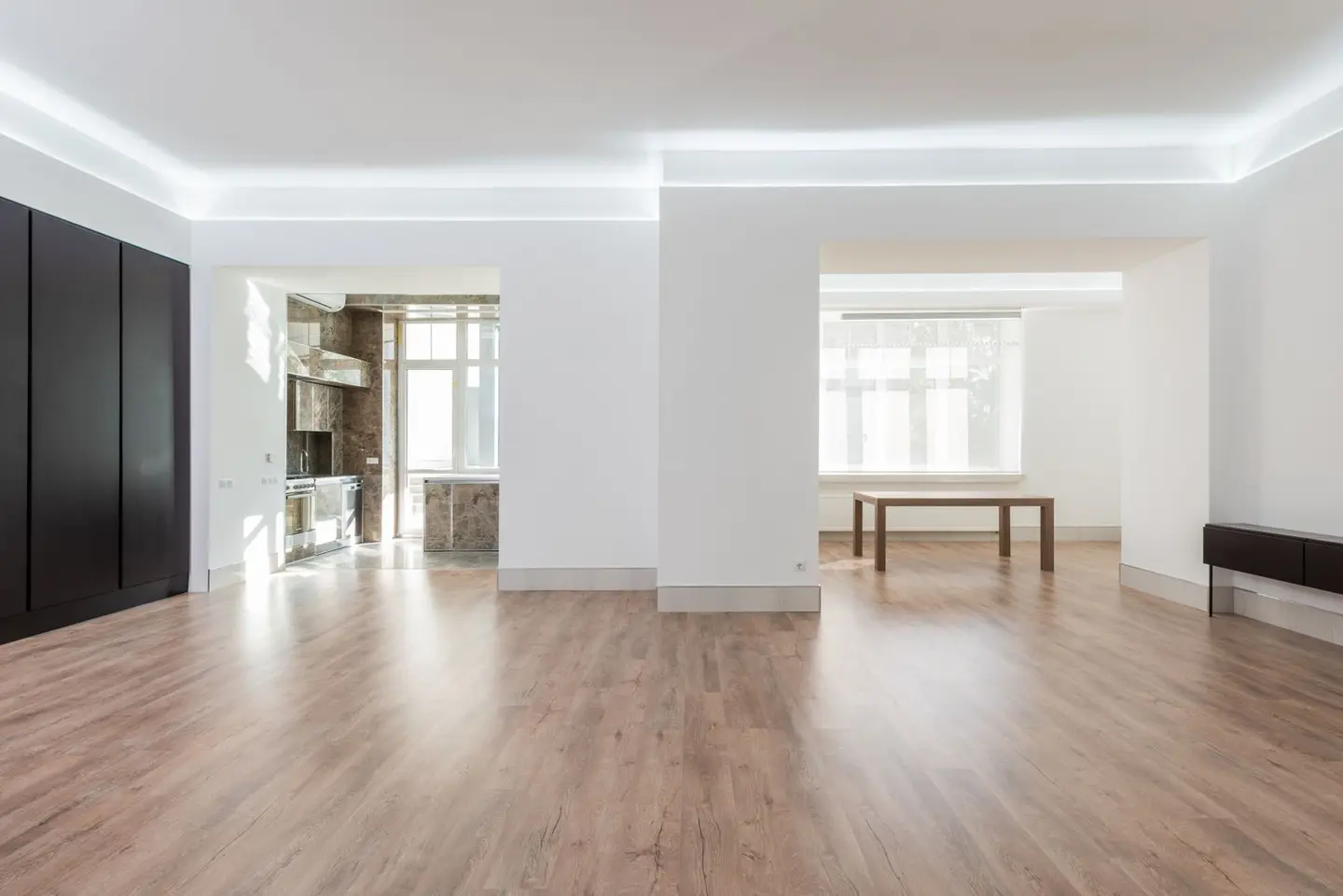
Resin flooring has moved beyond industrial warehouses into domestic kitchens, bathrooms, home offices and garages over the past decade. It’s seamless, hygienic, durable, and available in a huge range of finishes, but cost varies dramatically depending on the system chosen, substrate condition, and area size.
Across the UK in 2026, expect to pay £25–£150 per m² fully installed, with most domestic projects landing between £45 and £90/m².
Types of Resin Flooring and Their Costs
| System | Typical Cost (installed) | Best Use |
|---|---|---|
| Standard epoxy (solid colour) | £30–£60/m² | Garages, workshops, utility rooms |
| Self-levelling epoxy | £40–£70/m² | Kitchens, commercial kitchens, showrooms |
| Metallic/decorative epoxy | £70–£150/m² | Living rooms, kitchens, hotel lobbies |
| Polyurethane (PU) | £50–£100/m² | Areas needing flexibility and UV resistance |
| MMA (methyl methacrylate) | £60–£120/m² | Fast-cure; outdoor or cold-weather installs |
| Epoxy flake/chip (garage) | £25–£50/m² | Domestic garages, workshops |
| Microcement (cement-based resin) | £80–£150/m² | Walls and floors, bathrooms, bespoke finishes |
Prices include materials and labour but assume a sound, level concrete substrate. Poor substrates add £5–£25/m² for preparation.
What Drives the Price Up or Down
Substrate Condition
The concrete slab needs to be dry, structurally sound, and free of surface contamination (oil, dust, existing coatings). Testing for moisture is essential: resin applied over damp concrete can blister and delaminate. Sika, for example, requires a substrate moisture content below 4% by weight for its Sikafloor-264 epoxy coating.1 A damp-proof membrane (DPM) epoxy primer adds £8–£15/m².
Mechanical preparation, by grinding or shot-blasting, is needed to remove the weak surface layer (laitance) and create a key.1 Most contractors include this in their quote for a straightforward substrate; expect surcharges for:
- Existing paint removal: £3–£8/m²
- Crack repair: £15–£40 per crack
- Levelling compounds: £5–£15/m²
System Thickness
Thin-film epoxy (typically 0.25–0.5 mm) is the cheapest option and suits light domestic use. Self-levelling systems at 2–3 mm thickness are more durable and self-smooth, but use more material. Heavy-duty polyurethane screeds, typically 4 mm or thicker, are the most expensive but tolerate heavy plant and foot traffic.
Colour and Finish
Plain mid-grey epoxy is cheaper than custom colours, multiple broadcast layers, or decorative effects like marble veining, metallic swirls, or quartz aggregate finishes. Samples are worth ordering (typically free to £10 from contractors) before committing to a colour in situ, colours look different under workshop lighting versus home lighting.
Area Size
Resin flooring has significant mobilisation costs, mixing equipment, specialist primers, and setting up the space. Small areas (under 20 m²) attract a premium per m²; from about 30 m² the standard rate applies, and only much larger commercial floors usually earn a lower rate.
| Area | Typical Installed Cost (standard epoxy) |
|---|---|
| 10 m² (bathroom or utility) | £400–£800 |
| 30 m² (double garage) | £900–£1,800 |
| 50 m² (large open-plan kitchen) | £1,500–£3,000 |
| 100 m² (commercial space) | £3,000–£6,000 |
Garage Resin Flooring
The most common domestic resin job is a garage floor. A standard 30 m² double garage with epoxy flake or solid-colour epoxy typically costs £900–£1,800 installed, rising to about £2,100 for a 35 m² garage at the top of the £30–£60/m² range. The epoxy flake system (base coat + decorative coloured chips broadcast into the surface + clear topcoat) provides better slip resistance and hides minor imperfections compared to a plain solid coat.
Note: UK garage slabs often have poor moisture control and oil contamination from vehicles. A specialist contractor will test moisture levels and degrease before applying. Skip these steps and the floor is likely to lift or delaminate early.
Can You DIY Resin Flooring?
DIY epoxy kits cost £200–£600 for a double garage, making them substantially cheaper than a professional installation. However:
- Surface preparation is the hardest part and requires either hiring a floor grinder (£60–£100/day) or accepting lower adhesion.
- Working time is short: Sika gives its Sikafloor-264 epoxy a pot life of about 30 minutes at 20°C and about 15 minutes at 30°C.1
- Quality of finish depends heavily on mixing ratios and technique.
DIY suits garages and workshops where finish perfection isn’t critical. For kitchens, bathrooms, and living spaces, where the floor is the feature, professional installation is usually worth the cost.
Microcement: A Resin-Adjacent Option
Microcement is technically a cement-polymer composite rather than a pure resin, but it’s often quoted alongside resin floors. It’s popular for bathrooms because it’s applied 2–3 mm thin directly over existing tiles or substrates. Cost is £80–£150/m² installed, including sealant. It requires skill to apply without trowel marks, choose a contractor with a portfolio of microcement specifically.
Lead Times and Disruption
Resin flooring typically takes 1–3 days to install for a domestic project, but the full cure time before heavy use is:
- Foot traffic: 24–48 hours
- Vehicle traffic: 5–7 days
- Full cure: around 7 days at 20°C, longer in a cold garage
Sika’s data sheet for its Sikafloor-264 epoxy, for example, gives about 24 hours to foot traffic, 4 days to light traffic and 7 days to full cure at 20°C.1 Plan ahead: garages or rooms cannot be used during this period.
Building Regulations
Resin flooring in domestic settings is not subject to Building Regulations approval unless the project involves structural changes to the floor build-up. A workplace floor is a different matter. Regulation 12 of the Workplace (Health, Safety and Welfare) Regulations 1992 requires floors to be suitable, in good condition and free from obstructions, and HSE’s position is that where a floor is likely to be frequently contaminated, people should still be able to walk on it without the risk of slipping.2 That duty is legal; the numbers used to judge it are guidance. HSE’s slip potential classification puts a pendulum test value (PTV) of 0–24 at high slip potential, 25–35 at moderate, and 36 or above at low.3
Resin floors, though, are usually sold on an R rating, which comes from the German DIN 51130 shod ramp test and describes a slip angle rather than a pendulum value. HSE is blunt about this: the DIN classification schemes have “led to some confusion, sometimes resulting in the wrong floor surfaces being installed”, a floor rated R9 or in some instances R10 will be slippery in wet or greasy conditions, and R10 alone covers a coefficient of friction from 0.18 to 0.34, a very wide range of slip potential.3 An R10 on a datasheet is not a wet-area specification. Ask for a pendulum figure for any floor that will get wet.
Always get at least three quotes for any resin floor project and ask each contractor to specify the system (manufacturer, primer, number of coats, DFT) in writing.
References (3)
Figures in this note were checked against the sources below on 30 September 2026. Superscript numbers in the text point to them. Every source the site cites, by topic.
- 1technicalsupplier figureSika, guidance.RN-SKUI1ZThe maker's data sheet for a two-part epoxy floor coating. It sets a maximum substrate moisture content of 4% by weight, with a temporary moisture barrier required above that.
- 2technicalvery strongHealth and Safety Executive, guidance.RN-3UYBGNThe regulator's position on choosing a floor surface that will not become a slip hazard, page dated 23 June 2025. It cites regulation 12 of the Workplace (Health, Safety and Welfare) Regulations 1992, which requires floors to be suitable, in good condition and free from obstructions so people can move around safely, and states that where a floor is likely to be subject to frequent contamination people should still be able to walk on it without risk of slipping. It points to HSE guidance on assessing the slip resistance of flooring and the relevant British and European standards, to CIRIA C652 Safer surfaces to walk on, and to INDG225 Preventing slips and trips at work.
- 3technicalvery strongHealth and Safety Executive, guidance.RN-2IWEP7HSE's guidance note behind every slip-resistance figure a flooring or paving note quotes, and the source that separates the two tests people conflate. Table 1 classifies slip potential from pendulum test values (PTV): 0 to 24 high, 25 to 35 moderate, 36 and above low. Table 2 gives the parallel Rz microroughness classification. It describes the HSL/UKSRG ramp CoF test, then deals with the German ramp tests separately: DIN 51097 uses barefoot operators with a soap solution and DIN 51130 uses heavily cleated EN ISO 20345 safety boots with motor oil, and HSE states it has reservations about both because neither uses contaminants representative of real workplaces and the way results are reported is a cause for concern. Table 3 sets the DIN 51130 R scale by slip angle: R9 6 to 10 degrees, R10 10 to 19, R11 19 to 27, R12 27 to 35, R13 above 35. It warns that R9 and sometimes R10 surfaces will be slippery when wet and that a single class covers a wide CoF range, R10 alone spanning 0.18 to 0.34, so an R number is not a substitute for a PTV. Note that BS 7976-2, the pendulum method, was withdrawn in February 2022, which makes this HSE page the right citation for the thresholds.
-
Product Data Sheet: Sikafloor-264 SG, Sika, accessed 30 September 2026. gcc.sika.com
-
Flooring: slips and trips, Health and Safety Executive, accessed 10 September 2026. hse.gov.uk
-
Assessing the slip resistance of flooring (GEIS2), Health and Safety Executive, accessed 10 September 2026. hse.gov.uk