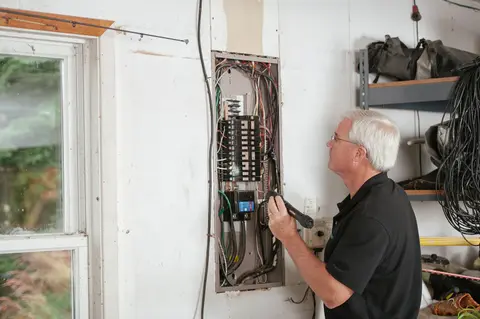
Contingency is money you plan to spend only if something goes wrong that you could not see when the price was agreed. On a renovation that usually means the building itself: rot under a floor, a lintel that is not there, wiring that has to come out, a drain that collapses when it is exposed. It is not a fund for upgrades, and it is not the same thing as the margin of error on an estimate.
This note covers how much to hold, why the answer depends on the age of the building and the stage you are at, and how contingency sits beside the other numbers in a budget. It belongs with our note on how cost estimates work and how far each level can miss.
What the Authorities Say
No official body publishes a single contingency percentage for home renovation. What they publish is the method, and it is consistent.
RICS NRM 1, the quantity surveyors’ rules for early estimates, recommends that risk allowances are not a standard percentage but a considered assessment of the risk.1 That assessment should take account of how complete the design is and how much site investigation has been done.1 NRM 1 splits the allowance into design development risks, construction risks, employer change risks and employer other risks.1 Construction risks, in NRM 1’s description, cover site conditions such as existing buildings, along with ground conditions and existing services.1 At RIBA Stages 0 and 1, NRM 1 says, the risk allowance can be a significant percentage of the total estimated cost.1
The RIBA Plan of Work expects the contingency in the cost plan to shrink as the design firms up, so that greater certainty can absorb cost increases.2 The Infrastructure and Projects Authority is blunt that contingency is for risks that materialise and should not be repurposed, even when the total stays within budget.3 It also expects the size of the contingency to be revised as the scope and risks become clearer.3
HM Treasury’s optimism bias guidance gives a sense of scale. It puts the upper adjustment for capital cost at 24% for standard buildings and 51% for non-standard ones, with lower bounds of 2% and 4%.4 Refurbishment projects fall in the non-standard group.4 The lower bounds are the level a project with effective risk management should reach by contract award.4 Those figures come from large public projects and are not a domestic rule, but they show two things clearly: the allowance falls steeply as risks are dealt with, and refurbishment needs about twice as much as new building at the same stage.
Why Old Buildings Need More
New work is drawn, then built. Work to an existing building is drawn from what can be seen, then built into what is actually there. The difference is investigation, and a house cannot be fully investigated without being partly taken apart.
That is why NRM 1 names existing buildings, ground and services among construction risks, and why the Treasury guidance puts refurbishment with the projects that overrun most. A surveyor writing in The Building Conservation Directory says a historic building scheme should carry a minimum allowance of 10%, with provisional sums where the building’s condition warrants them.5
The practical levers are the ones NRM 1 points to: more design and more investigation before the price is fixed. Opening up a sample of floor, lifting a few boards, a drainage camera survey or an asbestos survey before work starts converts unknowns into priced items, and every one priced is one less thing the contingency has to cover. Our notes on building surveys and asbestos surveys cover two of the most useful.
How Much to Hold
These are the site’s working figures, consistent with our budgeting guide. They are percentages of the construction cost.
| Stage you are at | Newer house (post-1980), little structural work | Older house (pre-war or Victorian), moderate alterations | Period house, significant structural work, unknown fabric or a first project |
|---|---|---|---|
| Ballpark only: a cost guide or per-m² figure | Budget from the top of the range, then add 10% | Top of the range, then add 15% | Top of the range, then add 20% |
| Fixed-price quote for a defined scope | 10% | 15% | 20% |
| Work under way, house opened up | Release what the opened-up work no longer needs | Release in step, keep enough for the finishing trades | Keep most of it until the structure and services are complete |
Two allowances appear in the first row because they protect against different things. The top of the range protects against the estimate being wrong about the work as described. The contingency protects against the work turning out to be different. Once a fixed price replaces the estimate, the first risk passes to the builder for the scope they priced, and only the contingency is left.
Move up a column if any of these apply: no measured survey, no structural engineer’s input on structural work, a building that has not been lived in for years, or a scope that is still changing. Move down only when the uncertain parts of the job have been investigated and priced.
Hold a time contingency as well. The same Treasury guidance gives upper adjustments to works duration of 4% for standard buildings and 39% for non-standard ones.4 On a domestic job that is the difference between a planned move-back date and the real one, and it costs rent, storage or a second mortgage month.
Contingency Is Not a Range, VAT or Fees
| Allowance | What it covers | When it goes away |
|---|---|---|
| Price range | The estimate itself being wrong about the described work | When a fixed price is agreed |
| Contingency | Work nobody priced because nobody could see it | When the risky work is finished |
| Provisional sum | A known item whose cost cannot yet be fixed, named in the quote | When the item is priced and done |
| VAT | Tax on the work, including any work paid for from contingency | Never, if the work is standard-rated |
| Professional fees | Design, engineering, surveys and approvals | Known in advance; not a risk allowance |
AACE’s accuracy ranges assume the estimate already contains an appropriate contingency, so a range is not a substitute for one.6
The RIBA Plan of Work expects provisional sums to be identified for uncertain work, for example where it has not been possible to fully analyse the structure or the building fabric.2 A provisional sum is better than a contingency where you can name the risk, because the builder has to account for it item by item. Our note on quotes and estimates explains how provisional and prime cost sums work in a quote.
NRM 1 recommends leaving VAT out of an order of cost estimate and assessing it separately, because VAT on buildings is complex.1 In NRM 1 the base cost estimate carries no allowance for risk or inflation; both are added separately.1 The standard rate of VAT is 20%, and extra work paid for out of contingency is charged VAT like the rest of the job.7 So work the contingency out on the same basis as the budget: if your budget includes VAT, so should the contingency. Our note on VAT on home renovations covers the reduced and zero rates.
The RIBA Plan of Work’s project budget carries professional fees, planning and Building Regulations costs and contingencies as separate items on top of the construction cost.2 Fees are a known cost to be budgeted, not a risk to be covered, and spending contingency on them is a sign the budget was short from the start.
Spending It Well
- Keep it separate. Money in the same account as the build budget gets spent on scheduled payments. Our budgeting guide suggests a separate account.
- Spend it only on risks that happen. An upgrade chosen halfway through is a budget increase. Agree it as a variation, price it, and fund it from somewhere else.
- Decide in writing. Every draw on contingency should be a written variation with a price agreed before the work, not an invoice after it.
- Release it as risks pass. Once the structure is up and the services are in, most of the risk has gone. What is left can cover the finishing trades and snagging, and anything unspent is a saving, not a target.
- Re-estimate if the scope changes. A contingency covers surprises inside the agreed scope. A bigger scope needs a new price, not a raid on the contingency.
References (7)
Figures in this note were checked against the sources below on 6 October 2026. Superscript numbers in the text point to them. Every source the site cites, by topic.
- 1technicalstrongRoyal Institution of Chartered Surveyors, guidance.RN-Y4KKG3The RICS rules for order of cost estimates and cost plans, 3rd edition (2021, reissued 2022). It states that its estimating and formal cost planning stages are aligned to the RIBA Plan of Work 2020 and the RIBA Digital Plan of Work.
- 2technicalstrongRoyal Institute of British Architects, guidance.RN-11CCPSThe RIBA's overview of its Plan of Work 2020. Its contents list the eight stages from Stage 0, Strategic Definition, to Stage 7, Use, and each stage chapter sets out the cost tasks.
- 3technicalvery strongInfrastructure and Projects Authority, guidance.RN-UVW6H5The UK Infrastructure and Projects Authority's cost estimating guidance for major projects. Its principles tie an estimate's class and confidence level to the evidenced maturity of the scope, not to reaching a gate.
- 4technicalvery strongHM Treasury, guidance.RN-TQUASWHM Treasury's supplementary guidance to the Green Book on optimism bias (2013), which tells appraisers to make explicit, evidence-based upward adjustments to estimates of cost and duration.
- 5technicalsecondaryThe Building Conservation Directory (Cathedral Communications), guidance.RN-HSJT86An article by Richard Woolley on estimating for historic buildings. It says a historic building scheme should carry a healthy contingency of at least 10%, with specific provisional sums where warranted.
- 6technicalstrongAACE International, guidance.RN-RZ7S8GAACE International's own published extract of its building estimate classification practice (revision of 7 August 2020), including Table 1. It defines the five estimate classes by maturity of project definition.
- 7technicalvery strongHM Revenue & Customs (GOV.UK), guidance.RN-4W7T33Sets the three UK VAT rates: standard 20% on most goods and services, reduced 5% on some goods and services such as children's car seats and home energy, and zero 0% on zero-rated goods such as most food and children's clothes. The standard rate rose to 20% on 4 January 2011 from 17.5%. Some supplies are exempt rather than rated, including postage stamps and financial and property transactions. This is the reference for converting a merchant's ex-VAT trade quote into the figure a homeowner actually pays.
-
NRM 1: Order of cost estimating and cost planning for capital building works, 3rd edition, Royal Institution of Chartered Surveyors, accessed 6 October 2026. rics.org
-
RIBA Plan of Work 2020 Overview, Royal Institute of British Architects, accessed 6 October 2026. architecture.com
-
Cost Estimating Guidance, Infrastructure and Projects Authority, accessed 6 October 2026. gov.uk
-
Supplementary Green Book Guidance: Optimism Bias, HM Treasury, accessed 6 October 2026. assets.publishing.service.gov.uk
-
Counting the Cost, The Building Conservation Directory (Cathedral Communications), accessed 6 October 2026. buildingconservation.com
-
Recommended Practice 56R-08: Cost Estimate Classification System, as applied in engineering, procurement and construction for the building and general construction industries (published extract), AACE International, accessed 6 October 2026. web.aacei.org
-
VAT rates, HM Revenue and Customs, accessed 6 October 2026. gov.uk