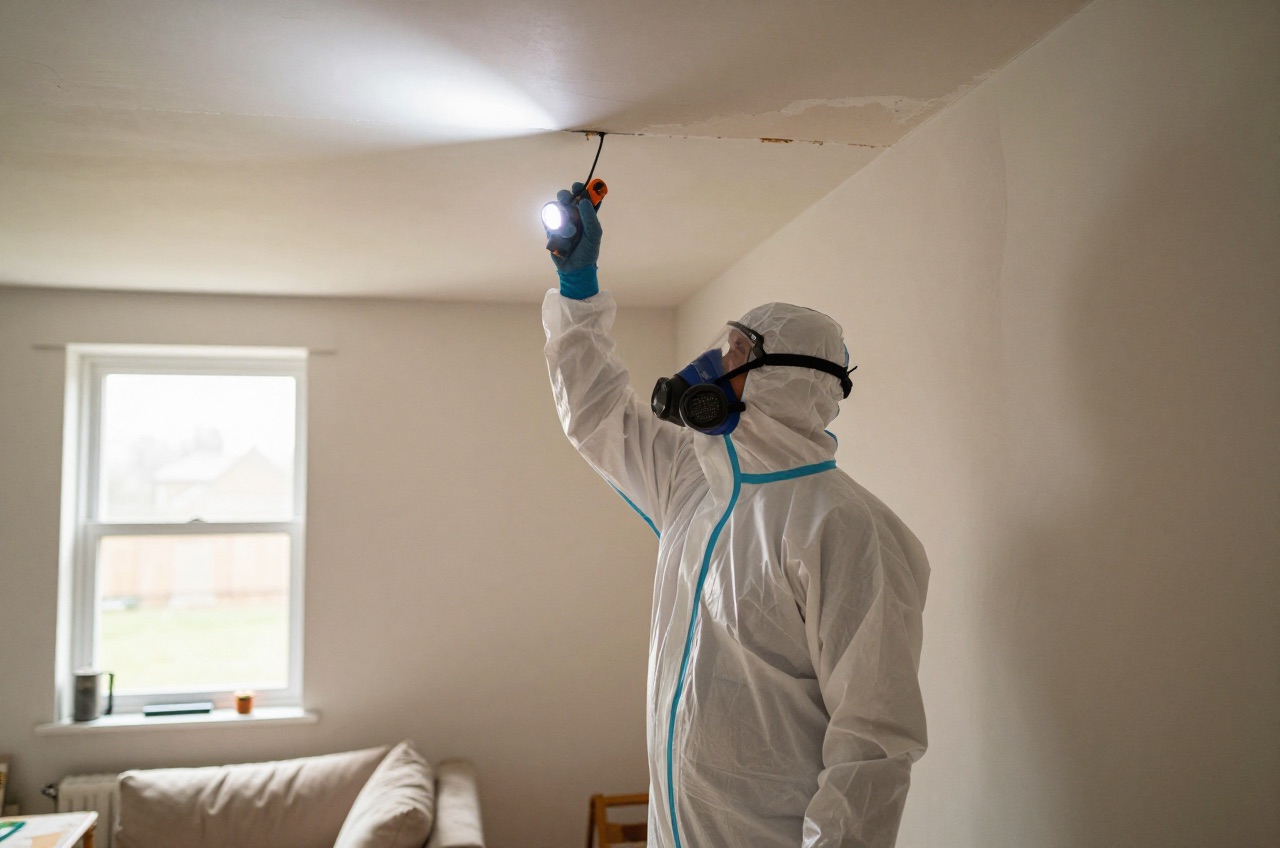
Asbestos can be present in any home built or refurbished before 2000.1 It was widely used in British homes until it was banned in 1999.2 It is not always a danger, undisturbed asbestos-containing materials (ACMs) that are in good condition generally pose little risk. The hazard arises when fibres are released into the air during drilling, cutting, or demolition. Before any renovation affecting pre-2000 fabric, knowing what you are dealing with is essential.1
Where Is Asbestos Found in Homes?
Asbestos appears in dozens of building products. Common locations in UK residential properties include:
- Roofing sheets and tiles, corrugated cement sheets on garages, sheds, and outhouse roofs (chrysotile asbestos)
- Artex and textured coatings, swirled ceiling finishes popular in the 1970s–1980s
- Floor tiles, vinyl floor tiles and the adhesive beneath them
- Pipe lagging and boiler insulation, especially in properties with older heating systems
- Soffit boards and rainwater goods, particularly on extensions built pre-1980
- Airing cupboard panels and boxing, often insulating board containing amosite (brown asbestos)
- Roof felt, underlays in some flat and pitched roof constructions
- Partition walls, AIB (asbestos insulating board) in some prefabricated or system-built homes
Not all of these materials are high-risk; the type and condition of asbestos matters enormously. Sprayed coatings and pipe lagging (amphibole types) are far more hazardous than chrysotile cement sheets.
Types of Asbestos Survey
HSE guidance describes two types of asbestos survey: a management survey and a refurbishment or demolition survey.3 A homeowner has no legal duty to commission one, because the duty to manage asbestos covers non-domestic premises and the common parts of blocks of flats, but any contractor working in the property needs to know where ACMs are before disturbing them.4
| Survey type | Purpose | Typical cost |
|---|---|---|
| Management survey | Identifies ACMs in normal occupation areas; materials are sampled but not removed | £200–£500 |
| Refurbishment & demolition survey | Full intrusive survey before renovation or demolition; all suspect materials sampled | £400–£800+ |
| Bulk sampling only | Lab analysis of specific samples you supply (not a full survey) | £25–£50 per sample |
Surveyors must be competent: HSE strongly recommends an accredited surveying organisation, and UKAS is the only recognised accreditation body for asbestos surveys in Great Britain.3 Employers who send material for asbestos analysis must use an analyst accredited to ISO 17025, so ask which UKAS-accredited laboratory the samples will go to.5 Avoid unqualified “asbestos testers” offering suspiciously cheap services; incorrect identification can be more dangerous than ignorance.
Asbestos Removal Costs
Removal cost depends on the type of ACM, its condition, volume, accessibility, and whether a licensed or non-licensed contractor is required.
Licensed vs Non-Licensed Work
Under the Control of Asbestos Regulations 2012, most higher-risk work, such as removing sprayed coatings or pipe lagging and most work on asbestos insulating board (AIB), must be carried out by an HSE-licensed contractor.6 Lower-risk work, such as carefully removing asbestos cement sheets without breaking them up, is non-licensed work, though it must still follow HSE’s controls; some work on damaged or more friable materials is notifiable non-licensed work, which must be reported to the enforcing authority.7
Licensed contractors must notify the enforcing authority on form ASB5 at least 14 days before starting work; for work in a home that is HSE.6 They will encapsulate the work area, use full respiratory protective equipment, and dispose of waste at a licensed facility.
Cost Breakdown by Material Type
| Material | Scale | Typical cost range |
|---|---|---|
| Garage/shed roof (cement sheets) | Single garage | £500–£1,500 |
| Garage/shed roof (cement sheets) | Double garage | £900–£2,500 |
| Artex testing + ceiling removal | One room | £800–£2,500 |
| Vinyl floor tiles | Single room | £600–£1,800 |
| Pipe lagging (licensed work) | Per linear metre | £150–£400 |
| AIB partition panels (licensed) | Per room | £2,500–£6,000 |
| Whole-house removal | Larger pre-1980s property | £10,000–£20,000+ |
Prices include disposal to a licensed landfill site. Asbestos waste must be double-wrapped, labelled and taken to a site licensed to accept it in containers that stop fibres escaping; it cannot go into a skip or general waste.2
The Asbestos Removal Process
Step 1, Survey and identification. Commission a refurbishment survey before any renovation work. The surveyor produces a report identifying every ACM, its condition, risk rating, and recommended action.
Step 2, Contractor selection. For licensed work, check the firm against the current list of HSE licence holders, which HSE links to from its guidance on licensed work. For non-licensed work, confirm the company follows current CAR 2012 requirements and carries adequate liability insurance.
Step 3, Notifications. Licensed contractors notify HSE on form ASB5, as above. Notifiable non-licensed work, such as large-scale steam or gel removal of textured coatings, must also be notified to the enforcing authority.8
Step 4, Enclosure and removal. The area is sealed with polythene sheeting, negative-pressure air units are used for high-risk work, and operatives wear appropriate RPE (typically FFP3 or air-fed respirators for licensed work).
Step 5, Air testing and clearance. After licensed work, an analyst inspects the area and tests the air before issuing a site clearance certificate for reoccupation, and only then is the enclosure taken down. Whoever makes that assessment must be accredited to ISO 17020 and ISO 17025.9 An independent analyst is worth using after any removal.
Step 6, Disposal. Waste is taken to a permitted site that accepts asbestos. Asbestos waste is hazardous waste, which must travel with a consignment note, so ask for a copy confirming disposal.10
What About Artex Ceilings?
This is one of the most common concerns for UK homeowners. Artex and similar textured coatings applied before 2000 may contain chrysotile (white) asbestos, and HSE counts textured decorative coatings among the lower-risk asbestos materials.2 A ceiling in good condition, left alone, poses negligible risk. The danger arises if you sand it, drill through it, or strip it.
Options:
- Leave it, if in good condition, this is often the safest choice.
- Overboard it, plasterboard fixed over the existing ceiling, encapsulating the artex. Cost: £200–£400 per room (materials and labour), no asbestos removal required.
- Test and remove, have a sample tested (£25–£50), and if positive, use a trained asbestos removal contractor: removing textured coatings does not need an HSE licence, but large-scale removal by steaming or gelling is notifiable non-licensed work.8
Many removal companies recommend overboarding as cost-effective and low-risk.
Finding a Licensed Contractor
Only an HSE-licensed contractor may remove the higher-risk materials, and the HSE sets out which work needs a licence. HSE links to a current list of licence holders, but a licence is only the starting point, so vet each firm yourself.6 Always:
- Get at least three written quotes with scope of work clearly defined.
- Check that the quote includes air testing, waste disposal, and a clearance certificate.
- Confirm the company carries public liability insurance of at least £5 million.
- Ask for a copy of their HSE licence before work starts.
Avoid cash-in-hand offers for asbestos work. Carrying out licensable asbestos work without an HSE licence is an offence.6 As a householder you also have a legal duty to take reasonable steps to make sure your waste goes only to someone authorised to take it, so a cheap job that ends in fly-tipping can come back to you.11
Disturbing asbestos without testing
Drilling, sanding, or breaking ACMs releases fibres that can cause mesothelioma and lung cancer decades later. Always test before you cut, drill, or sand any pre-2000 surface you are unsure about.1
Do I Have to Declare Asbestos When Selling?
There is no legal duty to survey for asbestos before selling a home in England and Wales, but the Misrepresentation Act 1967 means knowingly concealing a known hazard can expose sellers to claims. In practice, most solicitors advise disclosing any known ACMs in the property information form (TA6). A management survey carried out before listing, at £200–£500, can actually be a selling advantage, it shows buyers exactly what is present and in what condition, removing uncertainty that might otherwise kill a sale.
References (11)
Figures in this note were checked against the sources below on 30 September 2026. Superscript numbers in the text point to them. Every source the site cites, by topic.
- 1technicalvery strongHealth and Safety Executive, guidance.RN-A47PNLHSE's introduction to why asbestos is dangerous and where it is found: it can be present in any building built or refurbished before 2000, in artex, insulation board, cement sheet, floor tiles, pipe lagging and more. The list of locations is what makes it useful, because it is how somebody stripping out a room knows what they are looking at.
- 2technicalvery strongHealth and Safety Executive, guidance.RN-5PLWW8HSE's asbestos frequently asked questions: the health risks, which work is licensed and which is not, what a householder may and may not do themselves, and where the free HSE publications are. The quickest authoritative answer to whether a particular job needs a licensed contractor.
- 3technicalvery strongHealth and Safety Executive, guidance.RN-W6ISC0HSE's definition of the two asbestos survey types, which is the correction for notes that invent a third or call it an R&D survey as though that were the formal name. A survey aims to give accurate information on the location, amount and condition of asbestos-containing materials, assess damage or deterioration and whether remedial action is needed, provide the information to produce an asbestos register and an asbestos management plan, and identify hidden ACMs to be removed before refurbishment work or demolition. There are two types: a management survey, whose main aim is to let the dutyholder produce the register and management plan and manage ACMs during normal occupation and use, and a refurbishment or demolition survey, which is the one needed before invasive works. Both types are likely to require sampling.
- 4technicalvery strongHealth and Safety Executive, guidance.RN-L1K7IVHSE's overview of the duty to manage asbestos. It applies to non-domestic premises and the common parts of multi-occupancy domestic premises, not to a private house.
- 5technicalvery strongThe National Archives, guidance.RN-2J581CRegulation 21 of the Control of Asbestos Regulations 2012. An employer who has a sample analysed for asbestos must use a person accredited to ISO 17025.
- 6technicalvery strongHealth and Safety Executive, guidance.RN-T5ZCO5HSE's definition of which asbestos work must be done by an HSE-licensed contractor. Under the Control of Asbestos Regulations, work is licensable where exposure is not sporadic and of low intensity, where the risk assessment cannot clearly show the control limit will not be exceeded, where the work is on asbestos coating, or where it is on asbestos insulating board or asbestos insulation and the risk assessment does not show short duration work, defined as taking no more than 2 hours in any 7-day period with no person working more than 1 hour within that 2-hour period. Listed examples of licensable work include removing sprayed limpet coatings, any work that may disturb pipe lagging, any work involving loose fill insulation, work on asbestos millboard, cleaning significant quantities of loose or fine ACM debris, and non-short-duration work on AIB. A licence is needed to work as an asbestos contractor on someone else's premises or within your own premises using your own employees. This is the boundary that decides whether an asbestos quote is a licensed job or a much cheaper non-licensed one.
- 7technicalvery strongHealth and Safety Executive, guidance.RN-KU7LZ2Sets the conditions under which work with asbestos does not need a licence. The exposure must be sporadic and of low intensity, with the air concentration not exceeding 0.6 fibres per cubic centimetre measured over 10 minutes, and must not exceed the legal control limit of 0.1 asbestos fibres per cubic centimetre of air averaged over a four hour period. Materials listed as non-licensed include asbestos-containing thermoplastic and vinyl floor tiles worked on without substantial breakage, drilling textured decorative coatings to fit fixtures and fittings, painting or repainting asbestos insulating board in good condition, and maintenance of asbestos cement products such as roof sheeting, tiles and rainwater goods provided they are not substantially damaged. Notifiable non-licensed work includes large-scale removal of textured decorative coatings by steaming or gelling, and removal of asbestos cement where the material will be substantially damaged or broken up. This is the reference for anyone lifting old vinyl floor tiles or stripping Artex in a pre-2000 home.
- 8technicalvery strongHealth and Safety Executive, guidance.RN-Q6KO1FHSE's page on notifiable non-licensed work (NNLW). It requires notification to the enforcing authority and gives large-scale steam or gel removal of textured coatings as an example.
- 9technicalvery strongThe National Archives, guidance.RN-5FLQGLRegulation 20 of the Control of Asbestos Regulations 2012. Whoever assesses premises for a site clearance certificate for reoccupation must be accredited to ISO 17020 and ISO 17025.
- 10technicalvery strongEnvironment Agency, guidance.RN-6IVIWHGOV.UK guidance on hazardous waste in England. A consignment note must accompany hazardous waste, which includes asbestos, until it reaches its destination.
- 11technicalvery strongThe National Archives (legislation.gov.uk), legislation.RN-D47WL4Section 34(1) imposes a duty on any person who imports, produces, carries, keeps, treats or disposes of controlled waste, or who controls it as a dealer or broker, to take all reasonable measures to prevent a section 33 offence or a breach of regulation 12 of the Environmental Permitting Regulations, to prevent waste escaping, and on transfer to pass it only to an authorised person or for authorised transport purposes together with a written description of the waste. Section 34(2) exempts an occupier of domestic property in respect of household waste produced on the property, but section 34(2A) still requires that occupier in England or Wales to take reasonable measures to ensure any transfer of that household waste is only to an authorised person. Section 34(3) lists authorised persons, including waste collection authorities, waste management licence holders and carriers registered under the Control of Pollution (Amendment) Act 1989. This is why a homeowner must check a waste carrier licence before paying for a clearance or grab lorry.
-
Introduction to asbestos safety: Why asbestos is dangerous and where it can be found, Health and Safety Executive, accessed 7 September 2026. hse.gov.uk
-
Asbestos: frequently asked questions, Health and Safety Executive, accessed 7 September 2026. hse.gov.uk
-
Arrange an asbestos survey, Health and Safety Executive, accessed 30 September 2026. hse.gov.uk
-
The duty to manage asbestos in buildings: Overview, Health and Safety Executive, accessed 30 September 2026. hse.gov.uk
-
The Control of Asbestos Regulations 2012, regulation 21: Standards for analysis, The National Archives, accessed 30 September 2026. legislation.gov.uk
-
Work with asbestos that needs a licensed contractor, Health and Safety Executive, accessed 30 September 2026. hse.gov.uk
-
Non-licensed work with asbestos, Health and Safety Executive, accessed 30 September 2026. hse.gov.uk
-
Notifiable non-licensed work with asbestos, Health and Safety Executive, accessed 30 September 2026. hse.gov.uk
-
The Control of Asbestos Regulations 2012, regulation 20: Standards for air testing and site clearance certification, The National Archives, accessed 30 September 2026. legislation.gov.uk
-
Hazardous waste: Consignment notes, Environment Agency, accessed 30 September 2026. gov.uk
-
Environmental Protection Act 1990, section 34: Duty of care etc. as respects waste, The National Archives, accessed 30 September 2026. legislation.gov.uk