Choosing a kitchen worktop is one of the most consequential decisions in any renovation: it affects how the kitchen looks every day, how much maintenance you sign up for, and how much resale value you add. Quartz and granite are the two premium stone options; laminate sits at the affordable end but has come a long way in recent years. Here is what you actually need to know to choose between them.
Cost Comparison at a Glance
| Material | Supply cost per linear metre | Installed cost per linear metre | Typical 5 m run (fitted) |
|---|---|---|---|
| Laminate | £50–£150 | £80–£250 | £400–£1,250 |
| Quartz | £200–£500 | £300–£800 | £1,500–£4,000 |
| Granite | £200–£550 | £350–£900 | £1,750–£4,500 |
Prices assume standard 600 mm depth and 20–30 mm thickness. Complex layouts with islands, curved edges, or upstands add 15–30 % to the total. The stone figures include templating, CNC fabrication, delivery, and fitting by a stonemason, which is the normal trade package for stone.
Quartz Worktops
Quartz (engineered stone) is mostly crushed quartz bound with polymer resins and pigment, and can contain up to 95 % crystalline silica.1 It is manufactured under controlled conditions, so slabs are consistent in colour and pattern, there are no surprises when two slabs are placed side by side.
Pros:
- Non-porous: no annual sealing required, highly stain-resistant.
- Consistent appearance; wide colour range including whites, greys, and concrete looks that granite cannot replicate.
- Very hard (quartz itself rates 7 on the Mohs scale): highly scratch-resistant in everyday use.
- Suitable for kitchens with children or heavy cooking: bleach-free cleaners are enough.
Cons:
- Susceptible to UV fading over years, not ideal for very sunny kitchens with large south-facing glazing.
- The resins can scorch or discolour under sustained heat from hot pans; always use a trivet.
- Engineered stone is high in crystalline silica, so cutting it must comply with the Control of Substances Hazardous to Health Regulations 2002: HSE says dry cutting is unacceptable and expects water suppression and respiratory protection, so ask your fabricator to confirm how they work.1
- Runs longer than about 3 m usually need a seam, because a standard slab is only a little over 3 m long.
Thickness: standard 20 mm; premium 30 mm gives a more substantial look. Some manufacturers offer 12 mm with a mitred front edge to replicate 30 mm.
Expected lifespan: 20–30 + years with normal use.
Granite Worktops
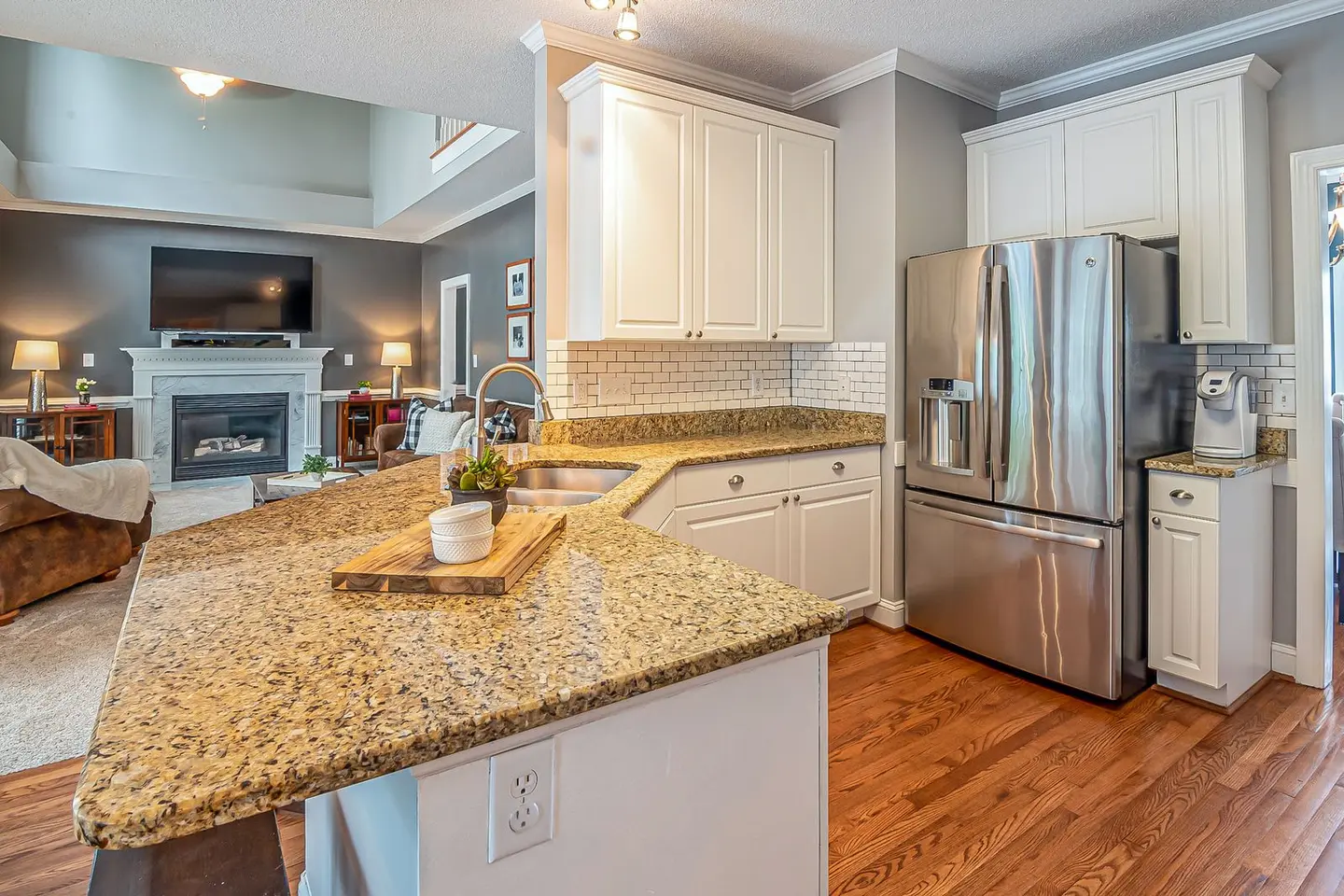
Granite is 100 % natural igneous rock, quarried globally and sliced into slabs. No two slabs are identical, which is part of the appeal.
Pros:
- Genuinely unique patterning; prestige appearance.
- Heat-resistant (place pots directly on it without risk of damage).
- Extremely hard (Mohs 6–7 depending on variety).
- Can be re-polished if scratched, unlike quartz.
Cons:
- Porous: must be sealed once or twice a year with an impregnating granite sealer (£20–£40 per 500 ml, 20–30 minutes to apply). Neglecting sealing leads to staining from red wine, cooking oils, and acidic foods.
- Colour matching between slabs can be tricky; inspect slabs together before fabrication.
- Slightly more expensive to cut and install because of natural variation.
- Radon: some granites emit trace radon gas, but the US Environmental Protection Agency says existing data do not show that the granite worktops commonly used significantly increase indoor radon, and the ground under a home is the main source.2
Expected lifespan: 30–50 + years; considered permanent when well-maintained.
Laminate Worktops
Modern laminate worktops (a chipboard core faced with high-pressure laminate, HPL) are a far cry from those of the 1990s. Top manufacturers now offer realistic stone, wood, and concrete print finishes, textured surfaces, and post-formed 180° front edges that eliminate the exposed chipboard strip.
Pros:
- By far the cheapest option; good for rentals, starter homes, or tight budgets.
- No sealing, no specialist cleaning products required.
- DIY-friendly: can be cut with a jigsaw and joined with worktop connectors, though a competent joiner produces cleaner results.
- Lightweight; suitable for cabinets without extra reinforcement.
Cons:
- Visible seams at joints and corners (though Minerva and similar solid-surface materials can be joined invisibly).
- Chipboard core is vulnerable to water ingress at cut edges and the sink cutout, always apply silicone to all cut edges.
- Scratches are difficult to repair and show on high-gloss finishes.
- Cannot withstand direct heat from pans; always use trivets.
- Does not add the same perceived value as stone at resale.
Key standard: Look for a surface laminate made to BS EN 438, the standard for high-pressure decorative laminates. Post-formed options avoid the exposed MDF/chipboard edge strip.
Expected lifespan: 10–20 years, depending on care.
Side-by-Side Verdict
| Criterion | Quartz | Granite | Laminate |
|---|---|---|---|
| Maintenance | Very low | Moderate (annual seal) | Very low |
| Heat resistance | Moderate (trivet needed) | Excellent | Poor (trivet essential) |
| Scratch resistance | Excellent | Very good | Fair |
| Stain resistance | Excellent | Good (if sealed) | Good |
| Visual variety | Wide range | Unique per slab | Wide range |
| DIY-friendly | No | No | Yes |
| Resale impact | High | High | Low–moderate |
| Best for | Family kitchens, modern aesthetics | Character kitchens, bakers | Budgets, rentals, quick refurbs |
Choosing the Right Worktop
Choose quartz if you want the lowest long-term maintenance with a premium look, particularly in a contemporary kitchen or where white and light grey tones are needed.
Choose granite if you want genuine natural character, plan to keep the kitchen long-term, do not mind annual sealing, and value the fact that heat cannot damage the surface.
Choose laminate if the budget is tight, you are renovating a rental, or the kitchen is likely to be replaced within ten years anyway. Quality HPL products can look convincing in person.
Whichever material you choose, keep any unsupported overhang within the worktop maker’s limit and add support brackets or legs beyond it. For stone worktops, your fabricator should provide a specific fixing and support schedule; do not rely on adhesive alone for runs longer than 1 m.
Finally, stone worktops are heavy, granite at 30 mm weighs roughly 75–85 kg per square metre. Confirm your base cabinets are solid enough before committing. Most standard flat-pack carcasses are adequate, but older cabinets or those on uneven floors may need checking.
References (2)
Figures in this note were checked against the sources below on 30 September 2026. Superscript numbers in the text point to them. Every source the site cites, by topic.
- 1technicalvery strongHealth and Safety Executive, guidance.RN-EOTIF1HSE's May 2026 press release on engineered stone: it states that engineered stone used in kitchen worktops can contain up to 95% crystalline silica.
- 2technicalfairUS Environmental Protection Agency, guidance.RN-AMKA0JThe US EPA's statement on granite countertops: data do not show they significantly raise indoor radon, and soil is the principal source of radon in homes. No equivalent UKHSA page could be fetched.
-
HSE says no dry cutting of engineered stone ahead of inspection crackdown, Health and Safety Executive, accessed 30 September 2026. press.hse.gov.uk
-
What about radon and radioactivity in granite countertops?, US Environmental Protection Agency, accessed 30 September 2026. epa.gov