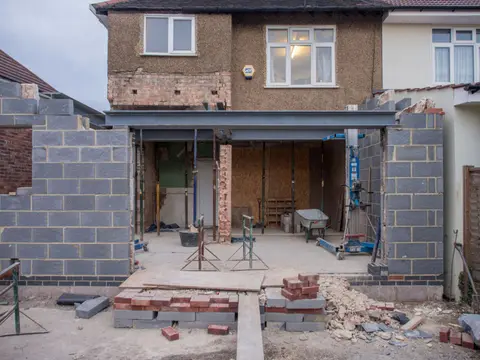
Millions of homes in England and Wales sit within areas at some risk of flooding, from rivers, the sea, surface water, or groundwater. If you are renovating or extending a property in one of these areas, flood risk touches virtually every stage of the project: planning, design, building regs, insurance, and long-term property value. This guide explains what to check, what it means for your plans, and what you can build in to make the property more resilient.
Understanding the Flood Zones
The Environment Agency (EA) in England and Natural Resources Wales (NRW) in Wales publish free online flood maps that show properties classified into zones:
| Zone | Description | Probability of flooding |
|---|---|---|
| Zone 1 | Low probability | Less than 0.1% annual (1-in-1,000 year) |
| Zone 2 | Medium probability | 0.1–1% annual from rivers (1-in-100 to 1-in-1,000 year) |
| Zone 3a | High probability | 1% or greater annual from rivers (1-in-100 year or more frequent) |
| Zone 3b | Functional floodplain | Floods regularly, land needed to store/convey floodwater |
Zone designations are based on river and sea flooding only.1 For the sea the thresholds are lower: Zone 2 is land with between a 0.5% and 0.1% annual probability of sea flooding, and Zone 3a is land at 0.5% or greater.1 Surface water (pluvial) and groundwater flooding are assessed separately through local strategic flood risk assessments (SFRAs), which your local planning authority holds.
Checking Your Property’s Flood Risk
Start with the EA’s Flood Map for Planning, a free, postcode-based tool that shows zone designations and the indicative flood outlines. This is the same map your LPA will use when assessing planning applications.
Also request a copy of your LPA’s SFRA. These documents, available on most council websites, show surface water and groundwater risk in more detail than the EA zone maps. For properties near ordinary watercourses (smaller rivers and streams not maintained by the EA), contact the Lead Local Flood Authority (LLFA), usually the county or unitary authority.
Planning Permission and Flood Risk
When Is a Flood Risk Assessment Required?
Under the National Planning Policy Framework (NPPF), a site-specific Flood Risk Assessment (FRA) is required with any planning application if:
- The site is in Flood Zone 2 or 3, regardless of the size of the extension.2
- The site is in Flood Zone 1 and is more than 1 ha (not typically relevant for residential extensions).
- The site is in Flood Zone 1 but in an area the Environment Agency has notified to the council as having critical drainage problems, or the council’s SFRA shows it at increased flood risk in future.1
For a minor extension, meaning a householder extension of up to 250 m², the Environment Agency’s standing advice sets out what the FRA needs to cover, which keeps it short.2 A consultant-prepared FRA for a householder extension commonly costs from several hundred pounds to a couple of thousand. It must demonstrate that the development will not increase flood risk elsewhere and that the building will be safe for its lifetime.
The Sequential and Exception Tests
National policy steers new development away from higher flood zones where suitable sites exist in lower ones: this is the sequential test. Householder development such as a residential extension, conservatory or loft conversion is exempt from it, but your LPA may still want evidence that the extension is designed to be flood-resilient.2
For minor residential extensions in high-risk zones, most LPAs will grant permission with conditions requiring specific resilience measures to be incorporated. Outright refusal of a modest extension to an existing dwelling purely on flood grounds is unusual, but it does occur in Zone 3b (functional floodplain).
Designing for Flood Resilience
If your property has flooded or is at risk, there are two broad strategies, and they work best in combination:
Flood resistance, keeping water out entirely. This is effective for shallow, slow-onset flooding but cannot withstand significant depths or fast-moving water. Measures include:
- Flood barriers and door guards (property-level protection, or PLP)
- Hydrostatic non-return valves on drainage outlets2
- Waterproofed brickwork and tanked floor slabs
- Raised threshold levels, even a 150 mm step up from external ground level provides useful protection
Flood resilience, accepting that water may enter but ensuring the property recovers quickly. This is the realistic approach for properties that have already flooded or face significant risk. Measures include:
- Lime render and masonry paints that dry out without damage, rather than gypsum plaster and emulsion2
- Tiled or concrete floors in ground-floor rooms rather than timber joists and floor decking
- Electrical sockets, wiring and consumer units raised well above floor level: the Environment Agency’s standing advice asks for sensitive electrical equipment, wiring and sockets at least 600 mm above the estimated flood level2
- Kitchens designed with wall-mounted units rather than base units resting on the floor
- Stud walls built on treated timber or steel rather than softwood sole plates
Cost of Resilience Measures
| Measure | Typical cost |
|---|---|
| Door guards and flood barriers (per property) | £1,000–£5,000 |
| Hydrostatic non-return valve on drains | £300–£800 per outlet |
| Ground-floor rewire to raise sockets above flood level | £1,500–£4,000 |
| Lime plaster / quick-drying render throughout | £3,000–£10,000 |
| Replace timber ground floor with concrete | £4,000–£12,000 |
| Full property-level protection package | £8,000–£30,000+ |
The cost can be significant, but property flood resilience is designed to reduce flood damage and speed recovery and reoccupation after a flood, and the extra cost is smallest when the work is done as part of a renovation.1
Building Regulations in Flood-Risk Areas
Approved Document C, which supports Part C of the Building Regulations (resistance to contaminants and moisture), states that flood resistance is not currently a requirement of the Building Regulations, though it describes ways to build in flood-prone areas.3 In practice, building inspectors will assess proposals against the guidance in:
- BS 85500:2015, Flood resistant and resilient construction: guide to improving the flood performance of buildings (withdrawn by BSI in March 2025, though the Environment Agency’s standing advice still refers to it)4
- CIRIA C790, the Code of Practice for property flood resilience, which the government’s planning guidance points to for both new-build and retrofit work1
- DEFRA/EA guidance on property-level protection
If your planning consent contains a condition requiring flood resilience measures to a specific standard, the building regs submission must demonstrate compliance.
Insurance Implications
Flood risk is a significant factor in home insurance pricing. Properties that have flooded will find premiums substantially higher, and some insurers will exclude flood cover entirely. Before renovation, consider:
- Flood Re, a joint initiative between the government and insurers that makes the flood cover in household insurance more affordable for homes at high flood risk.5 It only covers homes that were built and had a Council Tax band before 2009, and it does not cover business premises or homes let to anyone outside your immediate family.6 Check eligibility at floodre.co.uk.
- Insurer requirements, if your insurer has paid a flood claim, they may attach conditions to subsequent cover requiring you to install specific protection measures. Any renovation is an opportunity to do this at lower marginal cost.
- Disclosure on sale, flood risk must be declared on the property information form (TA6) in England and Wales. Failure to disclose a known risk can lead to claims under the Misrepresentation Act 1967.
Grants and Funding
Limited public funding exists for property-level flood protection:
- DEFRA property flood resilience grants, available in areas that have experienced significant flooding events, typically administered through the relevant LLFA. Check with your local council after a flood event.
- Environment Agency FRM funding, community-scale flood defence schemes may include PLP measures for individual properties in the scheme area.
- Some local authorities run their own loan or grant schemes for resilience measures.
Funding is patchy and demand consistently exceeds availability. Do not wait for a grant before carrying out essential works, use the renovation as the opportunity to build resilience in.
Check before you design
Some homeowners discover their property is in Zone 3b (functional floodplain) only after spending money on architectural drawings. A 10-minute check on the EA flood map and a call to your LPA planning department is worth doing before any design work begins.
What to Ask Before Buying in a Flood-Risk Area
If you are buying a property you intend to renovate, ask specifically:
- Has the property been flooded before, river, surface water, or sewage backup?
- Is the property in Zone 2, 3a, or 3b?
- Does the local SFRA show surface water risk even if the EA zone is Zone 1?
- Has any property-level protection been installed, and is it maintained?
- What is the current insurance position and has flood cover ever been declined or excluded?
The answers will shape your renovation budget significantly, and may affect whether the project is viable at all.
References (6)
Figures in this note were checked against the sources below on 30 September 2026. Superscript numbers in the text point to them. Every source the site cites, by topic.
- 1technicalvery strongMinistry of Housing, Communities and Local Government (GOV.UK), guidance.RN-HPIA1LDefines the flood zones used in English planning at paragraph 001: Flood Zone 1 is land with less than a 1 in 1,000 annual probability of river or sea flooding, Flood Zone 2 is between 1 in 100 and 1 in 1,000 for rivers or between 1 in 200 and 1 in 1,000 for the sea, Flood Zone 3a is 1 in 100 or greater for rivers and 1 in 200 or greater for tidal, and Flood Zone 3b is the functional floodplain where water has to flow or be stored in times of flood. Sets out the sequential test at paragraphs 023 to 029, steering development to the lowest risk areas and defining reasonably available sites at 028, and the exception test at 031 to 037, which requires wider sustainability benefits that outweigh the flood risk and that the development be safe for its lifetime without increasing flood risk elsewhere. Paragraphs 020 to 022 set out when a site-specific flood risk assessment must accompany an application and that its scope should be proportionate.
- 2technicalvery strongEnvironment Agency, a government page.RN-AQYZUUThe Environment Agency's standing advice for flood risk assessments, last updated 28 May 2026. It sets the design flood standards to assess against: 1 in 100 annual probability plus a climate change allowance for river flooding, 1 in 200 annual probability plus climate change for tidal flooding, and 1 in 100 annual probability plus climate change for surface water. Assessments are required for development in Flood Zones 2 and 3; the standing advice route (rather than a direct EA consultation) covers 'more vulnerable', 'less vulnerable' and 'water compatible' uses, excluding certain waste and water facilities. A minor extension is defined as a householder or non-domestic extension with a floor space of no more than 250 square metres, which follows a streamlined route. The surface water section requires a sustainable drainage strategy complying with the national standards for sustainable drainage systems and points designers to the CIRIA SuDS Manual. This is the page that decides whether a patio, driveway or garden building raises a flood-risk objection.
- 3technicalvery strongMinistry of Housing, Communities and Local Government.RN-NPO8FJThe statutory figures behind a damp diagnosis, and the numbers to quote when a note explains why ground levels or a bridged damp proof course cause rising damp. Paragraph 5.2 requires that in an external wall the damp-proof course should be at least 150mm above the level of the adjoining ground (Diagram 8) unless part of the building protects the wall, and that in an external cavity wall the cavity should be taken down at least 225mm below the level of the lowest damp-proof course, or a damp-proof tray provided (Diagram 9a). For suspended timber ground floors it requires a ventilated air space of at least 75mm from the ground covering to the underside of any wall-plates and at least 150mm to the underside of the suspended timber floor or insulation, with ventilation openings on two opposing external walls of not less than 1,500mm2 per metre run of external wall or 500mm2 per square metre of floor area, whichever is greater; for suspended concrete floors the clear ventilated space is at least 150mm with the same opening sizes. Section 2.39 onwards covers radon, referring to BRE Report BR 211 for protective measures. The 2013 edition was published on 3 September 2013 with changes in effect from 1 October 2013.
- 4technicalstrongBSI, guidance.RN-5QK2PDThe BSI catalogue entry for BS 85500:2015, giving its full title and showing it as withdrawn on 27 March 2025.
- 5technicalfairFlood Re, guidance.RN-F56GEQFlood Re's home page, describing the scheme as a joint government and insurer initiative to make the flood element of household insurance more affordable.
- 6technicalfairFlood Re, guidance.RN-SCSH1PFlood Re's eligibility checker: homes built and banded for Council Tax before 2009, not business premises or homes let outside the immediate family.
-
Flood risk and coastal change, Planning Practice Guidance, HM Government (GOV.UK), accessed 30 September 2026. gov.uk
-
Flood risk assessments: standing advice, Environment Agency (GOV.UK), accessed 30 September 2026. gov.uk
-
Approved Document C, Site preparation and resistance to contaminants and moisture, 2004 edition incorporating 2010 and 2013 amendments, Ministry of Housing, Communities and Local Government, accessed 30 September 2026. assets.publishing.service.gov.uk
-
BS 85500:2015 Flood resistant and resilient construction. Guide to improving the flood performance of buildings, BSI, accessed 30 September 2026. knowledge.bsigroup.com
-
Flood Re, Flood Re, accessed 30 September 2026. floodre.co.uk
-
Can Flood Re help me?, Flood Re, accessed 30 September 2026. floodre.co.uk