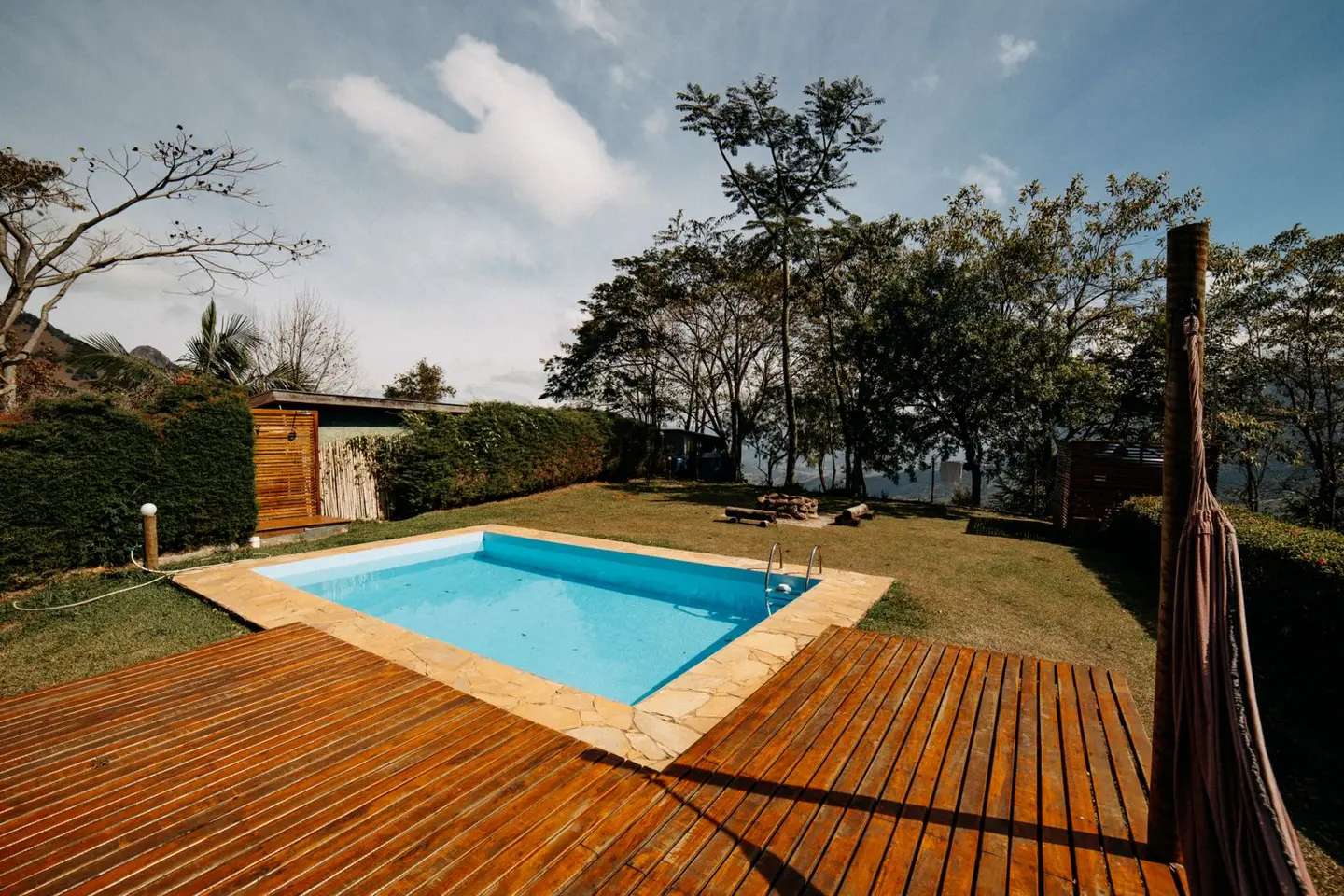
Decking is one of the most popular garden additions in the UK, but the choice between timber and composite divides opinion, and budgets. Timber costs less upfront; composite costs more initially but demands almost no ongoing maintenance. The right answer depends on how much you value your weekends.
What Does Decking Cost?
The boards are the part of the price that differs most between timber and composite. These are supply-only prices as UK merchants list them. The price per m² divides the board price by its face area and ignores the gaps between boards, so allow a little extra for gaps and offcuts.
Pressure-treated softwood (pine/spruce). Wickes sells its Standard treated deck board, 25 × 120 mm and 3.6 m long, for £11, or £3.06 a metre, which is about £25 per m².1 Its thicker Pro deck board, 27 × 144 mm and 3.6 m long, is £18, or £5 a metre, about £35 per m².2
Hardwood (balau, ipe, cumaru). Yellow balau boards, 21 × 145 mm, are £9.33 a metre before VAT from a specialist importer, about £64 per m² before VAT.3
Entry-level composite. NeoTimber’s Classic hollow board, 145 mm wide and 3.6 m long, is £24 including VAT, about £46 per m².4
Mid-range composite (capped). Trex Enhance Basics is £36 for a 3.66 m board at Wickes, about £70 per m².5 Trex Enhance Naturals is £59 for a 4.88 m board, about £86 per m².6
Premium composite. Trex Transcend is £117.53 including VAT for a 4.88 m board at Howarth Timber, about £172 per m².7 Millboard’s own retail price guide, dated January 2025 and including VAT, puts its decking boards at £145.99 to £187.46 per m².8
What It Costs Installed
Few installers publish an all-in price. UltraDecking, a composite decking supplier, published a case study in January 2026 for a 10 m² composite deck on a timber subframe, with labour at an average UK fitter’s day rate of £200.9 Depending on the board, the materials came to £708.32 to £1,014.86 and the finished deck to £1,208.32 to £1,514.86, or £120.84 to £151.49 per m².9 Labour was £500, for two to two and a half days’ work.9 The subframe materials in that guide are about £17.15 per m² for timber joists and £7 per m² for posts.9
A softwood deck sits on the same kind of timber subframe and takes much the same labour, so there is no saving on the structure whichever board you choose: the difference installed is mostly the difference in board price above. London and the South East are typically dearer. The joists and posts under either should be treated to Use Class 4, which covers exterior ground-contact use and exterior structural supports.10
Timber Decking
Pressure-Treated Softwood
Treated pine and spruce are the most widely installed decking boards in the UK. They are widely available, easy to cut and fix, and significantly cheaper than composite. The main catch is maintenance: softwood must be cleaned and re-treated (oil or stain) every one to two years to prevent it greying, splitting, and becoming slippery with algae. Without treatment, softwood decking typically degrades visibly within three to five years.
Lifespan with proper maintenance: typically 15–20 years, and the Timber Decking and Cladding Association treats 15 years as the minimum service life for a quality installation.11
Hardwood
Tropical hardwoods such as balau, ipe (pronounced ee-pay), and cumaru are significantly denser and more naturally durable than softwood. They do still need oiling, typically every one to three years depending on exposure, but they are harder, less prone to splintering, and last longer. Sustainably sourced hardwood (FSC-certified) is available; verify certification before purchasing, as the hardwood supply chain has a history of mislabelling.
Lifespan: 25–30+ years with maintenance.
Slip Resistance
Timber becomes extremely slippery when wet and covered with algae, a real safety hazard in shaded UK gardens. Regular cleaning (pressure washing plus a decking cleaner) and treatment help. Grooved decking boards provide marginally better grip than smooth-faced boards. Anti-slip strips can be added retroactively.
Composite Decking
Composite decking is made from a blend of wood fibre and recycled plastic. Early products (pre-2015) had a poor reputation, they were prone to fading, mould and surface checking. Modern capped and fully-encapsulated composites are significantly better and come with manufacturer warranties of 15–25 years.
Composite Types
Uncapped composite: wood-fibre and plastic blend with no outer skin. Cheaper but still susceptible to moisture absorption and surface mould over time. Not recommended for UK’s wet climate.
Capped composite (single-sided or four-sided): an outer plastic shell bonded to the core protects from moisture, staining and UV fade. Requires minimal maintenance, a brush-down and occasional wash.
Fully encapsulated composite: the highest grade, with a thick co-extruded shell on all four sides. Extremely resistant to moisture, fading and staining. Warranties typically 25 years.
Composite Maintenance Reality
The appeal of composite is that it genuinely needs very little upkeep:
- Brush off debris regularly to prevent organic matter building up
- Wash down once or twice a year with soapy water or a composite-safe cleaner
- No oiling, staining or sealing required
Slip resistance is generally better than timber in wet conditions, most quality composite boards have a textured or grooved surface that maintains grip when wet.
Composite Limitations
- Cannot be reclaimed or recycled at end of life as easily as pure timber
- Higher upfront cost
- Looks “plasticky” to some eyes, particularly cheaper products
- Cannot be sanded back if the surface is damaged
Total Cost of Ownership
This is where the comparison really matters. Composite costs more to buy; timber costs more to keep, because it needs cleaning and a fresh coat of oil or stain every one to two years.
| Scenario | Softwood timber | Mid composite |
|---|---|---|
| Re-treatment | Every 1–2 years | None |
| Time spent on maintenance | ~6–8 hours/year | ~1–2 hours/year |
The treatment products are not the large cost. Wickes’s own decking stain is £20 for 2.5 litres, or £8 a litre.12 Ronseal Ultimate Protection Decking Stain is £40 for 2.5 litres and covers 6.4 m² per litre.13 A composite deck needs only a wash, and Barrettine Super Concentrated Deck Cleaner, which Wickes lists for wood, composite and plastic decking, is £17 for 500 ml.14
So over 20 years the real difference is the time and effort a timber deck takes, or what you would pay somebody else to do it. Whether composite’s higher board price pays for itself depends on which of those you value more.
Planning Permission
Decking is normally permitted development in England provided:
- The deck is no more than 300 mm (0.3 m) above ground level15
- Together with any outbuildings and other structures, it does not cover more than 50% of the land around the original house16
- It is not forward of the wall forming the principal elevation of the original house, which usually means the front garden16
- It is not within the curtilage of a listed building16
Raised decks over 300 mm typically require planning permission.15 Always check with your local planning authority if in doubt, especially in conservation areas.
Building Regulations
Domestic garden decking at ground level does not normally require Building Regulations approval. However:
- A raised deck or balcony attached to the house may need approval, so ask building control before building anything well above the ground, and expect to need structural calculations and a designed balustrade
- Where a deck forms part of a building, Approved Document K expects guarding capable of preventing people from being injured by falling from a height of more than 600 mm17
- That guarding should resist at least the loads given in BS EN 1991-1-1 and its UK National Annex, so a balustrade on a high deck should be designed, not improvised17
Choosing Between Timber and Composite
| Choose timber if… | Choose composite if… |
|---|---|
| Budget is the primary driver | You want near-zero ongoing maintenance |
| You are comfortable with annual treatment | You value your weekend time |
| You prefer a completely natural aesthetic | You want consistent colour for 20+ years |
| You may want to change the deck within 10 years | You want better wet-weather slip resistance |
Both are valid choices. The key mistake to avoid is buying cheap uncapped composite (it performs poorly in the UK climate) or softwood timber and then neglecting the maintenance schedule.
References (17)
Figures in this note were checked against the sources below on 30 September 2026. Superscript numbers in the text point to them. Every source the site cites, by topic.
- 1costsupplier figureWickes.RN-1YXVWBA price, true at 2026-10. Wickes product page for its standard pressure-treated softwood deck board, 25 x 120 x 3600 mm, giving the shelf price, the price per metre and that one board covers 0.43 m². It settles the merchant price of a basic treated softwood deck board, supply only.
- 2costsupplier figureWickes.RN-7NN44LA price, true at 2026-10. Wickes's product page for its thicker Pro treated softwood deck board, 27 x 144 mm and 3.6 m long, with the shelf price per board and per metre. It settles the upper end of what a treated softwood deck board costs at a national merchant.
- 3costsupplier figureCo2 Balau (balau.co.uk).RN-WVHUO0A price, true at 2026-10. A specialist hardwood importer's price page for reversible yellow balau decking, 21 x 145 mm in random lengths, priced per linear metre before VAT and delivery. It settles what a common tropical hardwood deck board costs in the UK.
- 4costsupplier figureNeoTimber.RN-LKJ2TWA price, true at 2026-10. NeoTimber product page for its Classic hollow composite deck board, 145 x 24 x 3600 mm, priced per board including and excluding VAT. It settles what an entry-level hollow composite board costs from the maker, supply only.
- 5costsupplier figureWickes.RN-HYOK3EA price, true at 2026-10. Wickes product page for a Trex Enhance Basics capped composite deck board, 25 x 140 x 3660 mm, giving its shelf price and that one board covers 0.51 m². It settles the merchant price of a mid-range capped composite board, supply only.
- 6costsupplier figureWickes.RN-0O2907A price, true at 2026-10. Wickes product page for a Trex Enhance Naturals capped composite deck board, 25 x 140 x 4880 mm, giving its shelf price and that one board covers 0.68 m². It settles the merchant price of a mid-range capped composite board, supply only.
- 7costsupplier figureHowarth Timber.RN-QXLXI4A price, true at 2026-10. Howarth Timber's product page for a Trex Transcend grooved composite deck board, 25 x 140 mm and 4.88 m long, priced per board including and excluding VAT. It settles what Trex's premium Transcend range costs from a UK builders' merchant.
- 8costsupplier figureMillboard.RN-BSL1THA price, true at 2025-01. Millboard's own UK retail price guide (January 2025), listing the recommended retail price of each decking, cladding and edging board with its price per m². It settles what Millboard's moulded composite boards cost at list price, supply only.
- 9costsupplier figureUltra Decking.RN-2KC2FMA price, true at 2026-01. A UK composite decking supplier's January 2026 price guide: board prices per m2, the cost per m2 of clips, timber joists and posts, an average fitter's day rate drawn from 50 UK installers, and a worked 10 m2 deck priced with and without labour. It settles typical subframe, fixing, labour and installed costs for a small composite deck.
- 10technicalgoodTimber Development UK, guidance.RN-8SVBT1Timber Development UK, reporting TDCA guidance under BS 8417, says Use Class 3 applies to above-ground exterior uses such as deck boards while deck substructure components (joists, beams, posts) belong in Use Class 4.
- 11technicalfairTimber Decking and Cladding Association, guidance.RN-HN9JQAThe Timber Decking and Cladding Association's specification page sets out its recommended standards for a 15-year deck, including 150 mm of gravel at the bottom of post holes for drainage.
- 12costsupplier figureWickes.RN-9DFMR6A price, true at 2026-10. Wickes product page for its own water-based decking stain in a 2.5 litre tin, giving the shelf price, the price per litre and the coverage of 12 m² per litre.
- 13costsupplier figureWickes, guidance.RN-UOPFM5A price, true at 2026-10. Retailer product page carrying the maker's specification for Ronseal's decking stain. It gives coverage of 6.4 m2 per litre and 4 hours between coats.
- 14costsupplier figureWickes.RN-RWIM60A price, true at 2026-10. Wickes product page for a 500 ml concentrated deck cleaner for wood, composite and plastic decking, giving its shelf price and that it treats up to 40 m² once diluted.
- 15technicalvery strongMinistry of Housing, Communities and Local Government (GOV.UK).RN-2NL7UIMHCLG's technical guidance on householder permitted development rights. The government's own reading of the GPDO, with the diagrams, and what a planning officer works from when deciding whether a rear extension is permitted.
- 16technicalvery strongThe National Archives (legislation.gov.uk), legislation.RN-J6L7TIThe primary legal text for garden rooms, sheds, summerhouses, pergolas, greenhouses and outdoor pools. Class E permits any building or enclosure, swimming or other pool within the curtilage required for a purpose incidental to the enjoyment of the dwellinghouse, plus a domestic heating oil container. Limitations: E.1(b) buildings, enclosures and containers other than the original dwellinghouse must not cover more than 50% of the curtilage; E.1(c) nothing forward of a wall forming the principal elevation of the original dwellinghouse; E.1(d) single storey only; E.1(e) maximum height 4 metres with a dual-pitched roof, 2.5 metres if any part is within 2 metres of a curtilage boundary, otherwise 3 metres; E.1(f) eaves no higher than 2.5 metres; E.1(g) not within the curtilage of a listed building; E.1(h) no verandah, balcony or raised platform; E.1(j) oil containers capped at 3,500 litres. E.4 defines incidental use as including keeping poultry, bees, pet animals, birds or other livestock for domestic needs or personal enjoyment, which is why a garden room used as a separate dwelling falls outside Class E.
- 17technicalvery strongMinistry of Housing, Communities and Local Government.RN-XH6E39The standard that decides whether a loft ladder is legal and when a raised deck needs a balustrade. Published 3 January 2013, it covers protection from falling, collision and impact including stairs, ladders, ramps, guarding and vehicle barriers. Paragraph 1.31 states that retractable ladders must not be used as a means of escape. Paragraph 1.32 permits a fixed ladder, with fixed handrails on both sides, only for access in a loft conversion containing one habitable room, and only where there is not enough space without altering the existing space for a compliant stair, which is the rule that catches most loft ladder installations. Paragraph 1.29 restricts alternating tread stairs to loft conversions. For a private stair the maximum pitch is 42 degrees (Table 1.1 note 1), the normal relationship between rise and going is twice the rise plus the going between 550mm and 700mm, and for dwellings external tapered steps forming part of the building need a going of at least 280mm. Paragraph 3.1 requires guarding wherever it is reasonably necessary for safety at the edge of a floor, gallery, balcony, roof, light well, basement or similar sunken area. Paragraph 3.2 requires guarding to be at least the height in Diagram 3.1, allows any wall, parapet or balustrade to serve as guarding, and requires it to resist the loads in BS EN 1991-1-1 with its UK National Annex and PD 6688-1-1, with BS 6180 for barrier and infill panel design. Handrails should be positioned 900mm to 1000mm from the pitch line or floor.
-
Wickes Standard Treated Timber Deck Board - 25 x 120 x 3600mm, Wickes, accessed 17 October 2026. Priced at 2026-10 and left there. wickes.co.uk
-
Wickes Pro Timber Deck Board - 27 x 144 x 3600mm, Wickes, accessed 17 October 2026. Priced at 2026-10 and left there. wickes.co.uk
-
Balau Decking - Hardwood Decking 21mm X 145mm, Co2 Balau (balau.co.uk), accessed 17 October 2026. Priced at 2026-10 and left there. balau.co.uk
-
Classic Hollow Composite Deck Board, NeoTimber, accessed 17 October 2026. Priced at 2026-10 and left there. neotimber.com
-
Trex Enhance Basics Square Edge Clam Shell Deck Board 25 x 140 x 3660mm, Wickes, accessed 17 October 2026. Priced at 2026-10 and left there. wickes.co.uk
-
Trex Enhance Naturals Square Edged Deck Board Foggy Wharf - 25 x 140 x 4880mm, Wickes, accessed 17 October 2026. Priced at 2026-10 and left there. wickes.co.uk
-
Trex Composite Decking Transcend Grooved Island Mist 25 x 140 x 4880mm, Howarth Timber, accessed 17 October 2026. Priced at 2026-10 and left there. howarth-timber.co.uk
-
Millboard Retail Price Guide, Millboard, accessed 17 October 2026. Priced at 2025-01 and left there. millboard.com
-
Composite Decking Price Guide, Ultra Decking, accessed 17 October 2026. Priced at 2026-01 and left there. ultradecking.co.uk
-
Ensuring safe decking: The importance of Use Class 4, Timber Development UK, accessed 30 September 2026. timberdevelopment.uk
-
Specification for Timber Decking, Timber Decking and Cladding Association, accessed 30 September 2026. tdca.org.uk
-
Wickes Decking Stain - Natural Oak - 2.5L, Wickes, accessed 17 October 2026. Priced at 2026-10 and left there. wickes.co.uk
-
Ronseal Ultimate Protection Decking Stain - Medium Oak - 2.5L, Wickes, accessed 17 October 2026. Priced at 2026-10 and left there. wickes.co.uk
-
Barrettine Super Concentrated Deck Cleaner - 500ml, Wickes, accessed 17 October 2026. Priced at 2026-10 and left there. wickes.co.uk
-
Permitted development rights for householders: technical guidance, Ministry of Housing, Communities and Local Government (GOV.UK), accessed 30 September 2026. gov.uk
-
The Town and Country Planning (General Permitted Development) (England) Order 2015, Schedule 2, Part 1, Class E, legislation.gov.uk (The National Archives), accessed 30 September 2026. legislation.gov.uk
-
Approved Document K, Protection from falling, collision and impact, 2013 edition, Ministry of Housing, Communities and Local Government, accessed 14 September 2026. assets.publishing.service.gov.uk