Wall panelling has moved firmly into the mainstream of UK interior design, appearing in everything from period Victorian terraces to new-build semis. Done well, it adds texture, warmth and architectural interest; it can also hide uneven plaster, protect walls in high-traffic areas, and dramatically change how a room feels without a major renovation. This guide covers the main panel types, realistic 2026 costs, and practical advice for choosing and fitting them yourself or with a decorator.
Types of Wall Panelling
The term “wall panelling” covers a surprisingly wide range of products and styles. Understanding the differences will help you match the right system to your room and budget.
| Panel Type | Typical Material | Cost (Materials Only) | Best For |
|---|---|---|---|
| MDF shaker / flat-frame | MDF or moisture-resistant MDF | £8–£18/m² | Living rooms, bedrooms, hallways |
| Tongue & groove (T&G) | Softwood, MDF or PVC | £10–£22/m² | Bathrooms, kitchens, cottages |
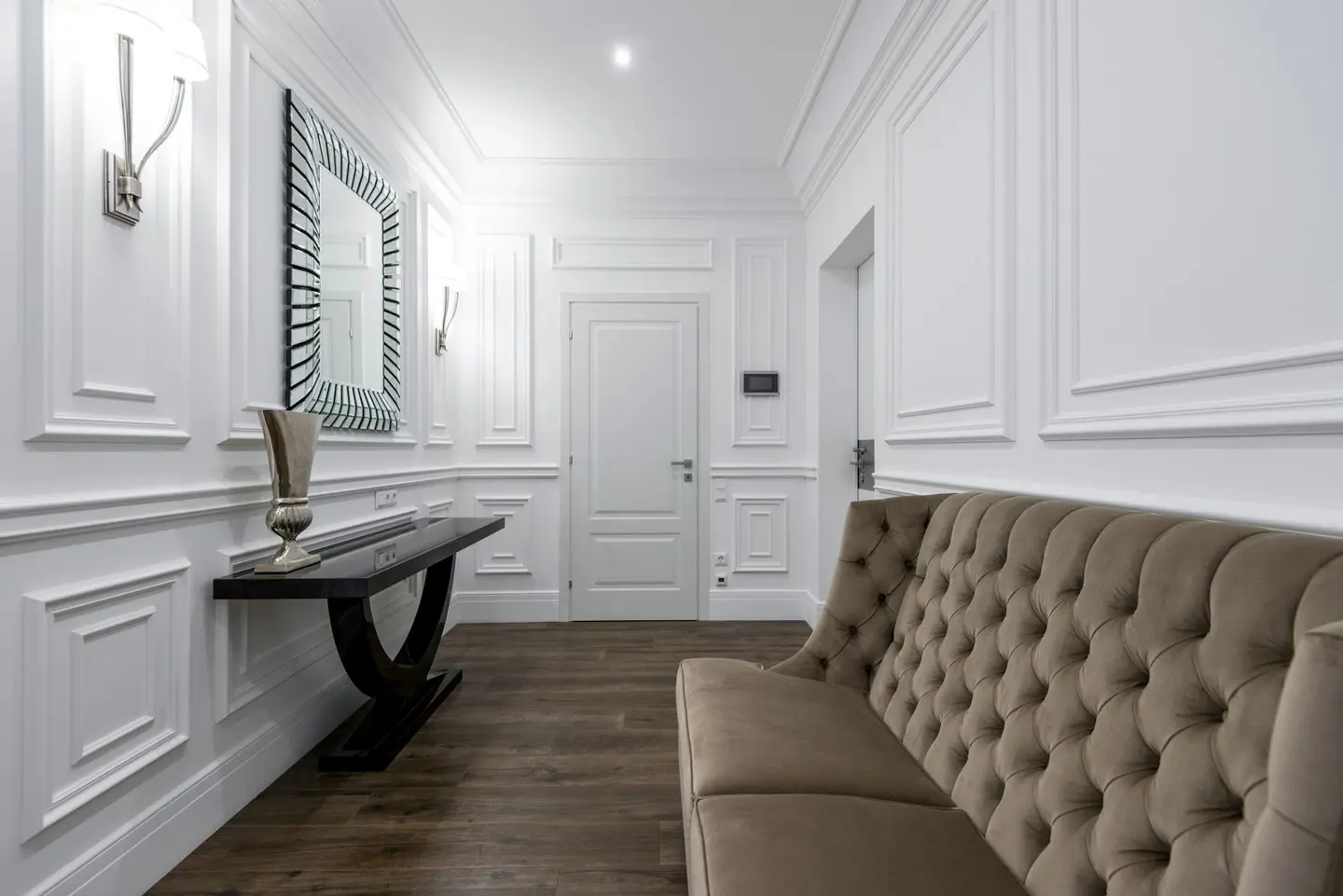
| Wainscoting / dado panels | MDF, hardwood | £15–£30/m² | Hallways, dining rooms |
| Fluted / reeded panels | MDF or plywood | £18–£40/m² | Feature walls, contemporary interiors |
| Solid oak / hardwood | Solid timber | £35–£60/m² | Traditional rooms, statement pieces |
| PVC / composite | PVC foam or composite | £12–£25/m² | Wet rooms, garages, utility rooms |
| 3D / textured panels | MDF, gypsum, plant fibre | £20–£50/m² | Feature walls, home offices |
MDF panelling is the workhorse of the UK interior market. It takes paint well, stays stable, and is available pre-primed from most timber merchants and builders’ merchants. Moisture-resistant (MR) MDF is made for humid rooms such as kitchens and bathrooms.1
Tongue-and-groove is traditional and versatile. Pine T&G is the budget option; it needs knotting primer and can shrink slightly in dry conditions. Modern MDF T&G avoids this and is widely available in lengths up to 2.4 m.
Fluted and reeded panels are currently very fashionable, often seen on chimney breasts or behind beds. They are generally routed from MDF sheets and can be bought ready-made or cut to order.
How Much Does Wall Panelling Cost?
Material costs only tell part of the story. You also need adhesive, filler, primer and paint, plus fixings if mechanically fastening to masonry.
Typical DIY budget for a 3 m × 2.4 m feature wall:
- MDF panels and mouldings: £60–£150
- Adhesive (grab adhesive, e.g., No More Nails): £8–£15
- Primer + 2 coats paint (1 litre each): £25–£40
- Filler, sandpaper, masking tape: £10–£20
- Total DIY: about £100–£225
If you hire a decorator or carpenter to do the full job, supply, fit and paint, expect £400–£900 for a standard feature wall and £800–£2,000+ for full-room wainscoting, depending on the complexity of the design and your location (London and South East rates are 20–30% higher than the Midlands or North).
Day rates for a skilled decorator in 2026 typically run £200–£300/day in London, £160–£250/day elsewhere. A feature wall is usually a one-day job for an experienced fitter; more complex room panelling may take two to three days.
Feature Wall Ideas by Room
Living rooms: A chimney breast panelled in fluted MDF, painted in a deep tone (Forest Green, Farrow & Ball Hague Blue, or similar), is currently one of the most popular renovator requests. Full-height shaker-style panels with a picture rail moulding at mid-height work well in Victorian and Edwardian homes.
Bedrooms: Headboard panels, running from skirting level to around 1.2 m, behind the bed create a hotel-style look without commitment. Fabric-wrapped acoustic panels are another option if noise is a concern.
Hallways and stairs: Traditional dado-height panelling (roughly 900 mm from floor) is highly practical, it protects plaster from bags, pushchairs and furniture scrapes. Beadboard or a simple flat-frame design both work well.
Kitchens: Tongue-and-groove below the worktop (instead of standard cupboard doors) is a popular country-kitchen look. All timber here should be sealed and painted with a kitchen-grade satin or eggshell.
Bathrooms: PVC tongue-and-groove is waterproof and needs very little maintenance, which makes it a practical choice for shower surrounds. If you want a more luxurious look, tiled panels or solid-surface products (such as Mermaid boards or similar) are available at £40–£80/m².
Installation: Key Steps
Most panel systems are designed for DIY installation. The broad approach is the same regardless of panel type:
- Prepare the wall. Fill any loose plaster, remove picture hooks and clean off grease. Walls do not need to be perfectly flat, most panel systems can bridge minor undulations.
- Mark out your design. Use a spirit level and pencil to mark the positions of rails, vertical battens and any dado lines. A laser level speeds this up considerably.
- Fix battens if needed. On masonry or very uneven walls, fix 25 × 38 mm softwood battens at 400–600 mm centres with frame-fixing screws. On plasterboard you can usually bond straight to the wall with adhesive.
- Apply grab adhesive and press panels into place. Use a pull-and-push technique: press, pull away for 60 seconds, then press back firmly. Use temporary pins or panel pins to hold in position while the adhesive grabs.
- Fill joints and nail holes. Use a fine surface filler; sand back when dry. On MDF edges, a thin coat of watered-down PVA before filling prevents absorbency issues.
- Prime and paint. MDF needs at least one coat of MDF primer before topcoats. Use two coats of eggshell or satinwood for durability. Avoid low-sheen emulsions on panelling, they scuff easily.
Building Regs and Party Walls
Decorative wall panelling on internal walls does not require planning permission, because works that affect only the interior of a building are not development.2 In a listed building, fixing panelling to historic walls may still need listed building consent.3 Panelling alone does not need Building Regulations approval, but adding insulation behind the panels on an external wall is different: Approved Document L counts dry-lining the inside of an external wall as renovating a thermal element.4 If more than half of that wall is renovated, the whole wall should be improved to at least 0.30 W/m²K where that is technically, functionally and economically feasible.4 If you do add insulation behind panels on a cold external wall, ensure a vapour control layer is fitted on the warm side to prevent interstitial condensation.
Choosing a Contractor
If you are not going the DIY route, a carpenter joiner is the right trade for bespoke panelling work; a decorator handles supply-and-fit of standard systems. Ask for:
- Fixed-price quote with materials itemised separately
- Photos of comparable previous jobs
- Confirmation they will prime and fill before finishing
Avoid anyone who quotes to paint over unprimed MDF or who skips the filling stage, the result will look amateur within weeks.
Wall panelling is one of the higher-impact, lower-cost changes you can make to a UK home interior. With realistic planning and a weekend’s work, a DIY feature wall is achievable for most confident homeowners.
The rules in this note are those that apply in England. Scotland, Wales and Northern Ireland have their own building standards and permitted development rights.
References (4)
Figures in this note were checked against the sources below on 30 September 2026. Superscript numbers in the text point to them. Every source the site cites, by topic.
- 1technicalsupplier figureMEDITE SMARTPLY, guidance.RN-ROZGRYThe maker's product page for a leading UK moisture-resistant MDF board, stating it is made for humid interiors such as kitchens and bathrooms.
- 2technicalvery strongThe National Archives (legislation.gov.uk), legislation.RN-M6VJS2Section 55(1) defines development as the carrying out of building, engineering, mining or other operations in, on, over or under land, or the making of any material change in the use of any buildings or other land. Section 55(2)(a) excludes works to a building which affect only the interior of the building or which do not materially affect the external appearance of the building, which is why internal renovation does not need planning permission.
- 3technicalvery strongThe National Archives (legislation.gov.uk), legislation.RN-XN22L9The provision that decides when listed building consent is actually needed, and the answer to the common overstatement that any alteration to a listed building requires consent. Section 7(1): 'no person shall execute or cause to be executed any works for the demolition of a listed building or for its alteration or extension in any manner which would affect its character as a building of special architectural or historic interest, unless the works are authorised under section 8.' The trigger is therefore effect on character as a building of special architectural or historic interest, not alteration as such, so work with no effect on that character falls outside the restriction. Section 7(2) makes subsection (1) subject to section 33(1) of the Planning Act 2008, which excludes the requirement for other consents where development consent is required. Authorisation itself comes from section 8.
- 4technicalvery strongMinistry of Housing, Communities and Local Government.RN-L0FCJXThe in-force U-value tables a DIY insulation or door note must quote, with the exact numbers. Table 4.2, limiting U-values for new fabric elements in existing dwellings, sets roof 0.15, wall 0.18, floor 0.18, swimming pool basin 0.25, window 1.4 or Window Energy Rating Band B minimum, rooflight 2.2, doors with more than 60 per cent of the internal face glazed 1.4 or Doorset Energy Rating Band C minimum, and other doors 1.4 or Doorset Energy Rating Band B minimum. Table 4.3, for existing elements, gives a roof threshold of 0.35 and an improved value of 0.16, which is the figure a loft insulation note needs: paragraph 4.12 says a retained element whose U-value is higher than the column (a) threshold, for example through a loft or garage conversion, should be upgraded to the column (b) value. Paragraph 4.13 allows a lesser upgrade only where the improved value is not technically or functionally feasible or would not achieve a simple payback of 15 years or less. Paragraph 4.8 requires a replacement element to be no worse than the one it replaces as well as meeting Table 4.2. Paragraph 4.10 gives the heritage exception: where character must be maintained, a centre pane U-value of no more than 1.2 or low-emissivity secondary glazing. Note 9 records that the timber window concession of 1.6 or Band C ended on 14 June 2023. The 2021 edition came into force on 15 June 2022; a 2026 edition exists at https://assets.publishing.service.gov.uk/media/69c122a6cfa346b9d4704a55/ADL1_2026.pdf.
-
MEDITE MR, MEDITE SMARTPLY, accessed 30 September 2026. mdfosb.com
-
Town and Country Planning Act 1990, section 55, The National Archives, accessed 30 September 2026. legislation.gov.uk
-
Planning (Listed Buildings and Conservation Areas) Act 1990, section 7, The National Archives, accessed 30 September 2026. legislation.gov.uk
-
Approved Document L, Conservation of fuel and power, Volume 1: Dwellings, 2021 edition incorporating 2023 amendments, Ministry of Housing, Communities and Local Government, accessed 14 September 2026. assets.publishing.service.gov.uk